
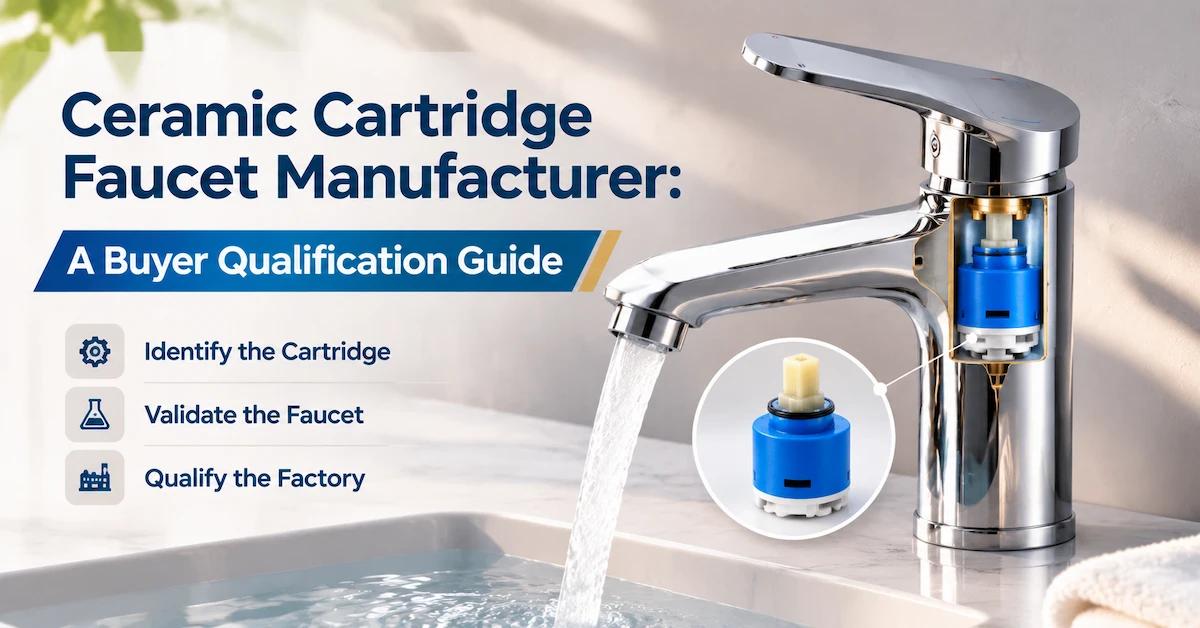
For a buyer approving a basin mixer, shower mixer, hospitality range, or project faucet, the phrase ceramic cartridge faucet manufacturer should mean more than a supplier that places a ceramic cartridge inside a catalog product. The manufacturer should be able to identify the cartridge, prove that it works in the finished faucet, control the body and sealing interfaces, provide model-level documents, and reproduce the approved configuration after the first order. That is the difference between buying a component description and approving a dependable faucet platform.
This distinction matters because a ceramic cartridge is a system component, not a complete performance claim. A loose cartridge may pass while the assembled faucet has excessive torque, poor shutoff, an incompatible retaining nut, or a distorted cavity. Qualify the supplier around the actual faucet, destination market, production controls, and evidence attached to the exact model revision.
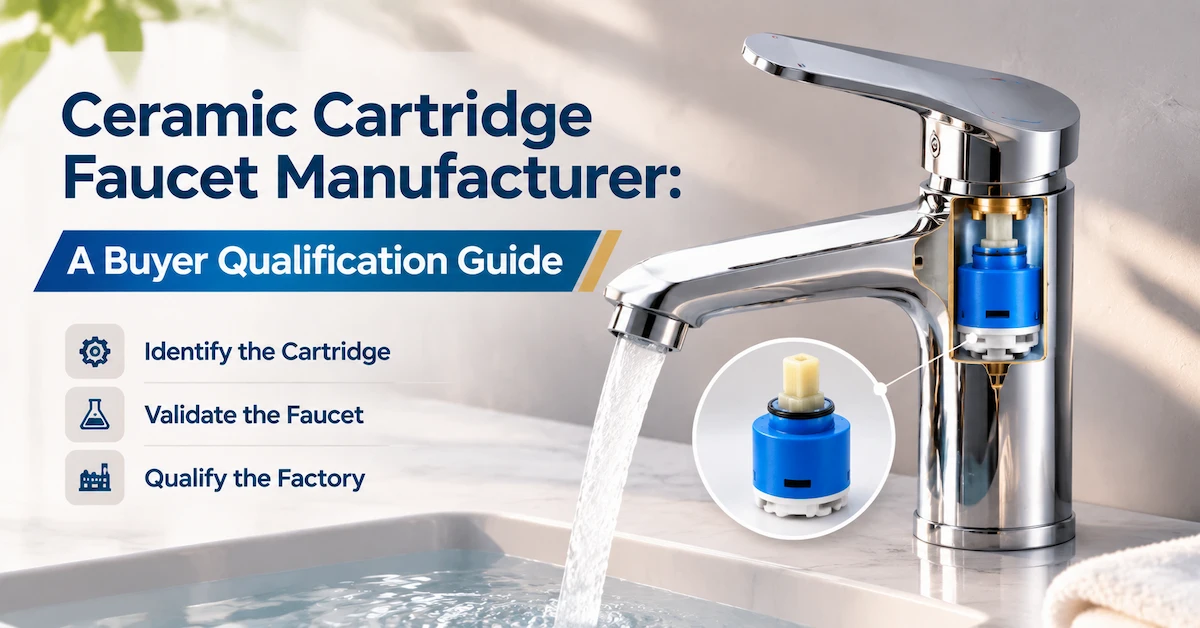
What a ceramic cartridge faucet manufacturer must prove
A credible manufacturer should answer five questions before a buyer approves a sample or places a production order. First, what exact cartridge is used, and can the supplier maintain that identity? Second, has the cartridge been validated in the completed faucet rather than only in a laboratory fixture? Third, are the body, seals, stem, retaining parts, and finish controlled as one bill of materials? Fourth, do certificates and test reports cover the specific model and destination market? Fifth, can the supplier support repeat production, replacement cartridges, and approved changes?
These questions turn a vague supplier conversation into a documented approval gate. A photograph and “ceramic cartridge, good quality” are not enough for a project purchase. A model drawing, cartridge identification, sample plan, test conditions, traceability method, and change-control commitment are checkable evidence.
Ceramic cartridge is a technology label, not a full specification
“Ceramic cartridge” normally describes the regulating element that controls water flow and temperature through two accurately finished discs. It does not, by itself, identify the cartridge dimensions, stem shape, locating features, seal materials, housing design, working pressure, temperature range, operating torque, cycle method, or certification scope. Two cartridges can both be described as ceramic and still be incompatible with the same faucet body or unsuitable for the same market.
Record the cartridge identity before comparing quotations
Ask the supplier to identify the cartridge manufacturer, model number, revision, overall height, body diameter, stem profile, base geometry, locating tabs, seal arrangement, retaining method, lubricant specification, and any approved alternate. If a brand name is confidential, the supplier should still provide enough dimensional and performance information to identify the approved component and to purchase service spares later.
The cartridge line should be tied to the faucet model and BOM revision. “Same size” is not enough. A stem can fit while port geometry changes flow, handle travel, temperature mix, or end-stop load. The retaining nut may also need a particular thread, shoulder, washer, or tightening condition.
| Information to request | Why the buyer needs it | Acceptable evidence |
|---|---|---|
| Cartridge brand, model, revision, and source | Prevents unapproved substitution and makes spare-part planning possible. | Controlled component list, supplier declaration, or purchase specification. |
| Dimensions, stem, locating and sealing interfaces | Confirms the cartridge is compatible with the actual body and handle. | Dimensioned drawing, inspection record, or approved sample comparison. |
| Pressure, temperature, flow, torque, and endurance conditions | Separates a useful test result from an unexplained cycle number. | Complete protocol and report tied to the model revision. |
| Water-contact materials and seal information | Supports destination-market compliance and root-cause analysis. | Material declaration and model-specific compliance documentation. |
| Approved alternates and change notification | Protects the buyer from silent changes during repeat supply. | Signed change-control clause and alternate approval record. |
Separate a cartridge supplier from a faucet manufacturer
A cartridge specialist can be an important partner, but the company that supplies the finished faucet owns additional risks. The faucet manufacturer controls the cavity, casting or forging, machining, seal seats, handle interface, retaining force, spout passage, aerator connection, assembly cleanliness, leakage inspection, packaging, and final identification. A component certificate cannot replace control of those interfaces.
When comparing a trading company with a factory, ask who owns the drawing, approves engineering changes, assembles the faucet, performs the final leakage test, and retains production records. A trading company may coordinate several factories effectively, but the buyer should know which legal entity owns model-level evidence and corrective action. AQBath publicly describes Ningbo Yinzhou Anqi Valve Co., Ltd. as a Ningbo manufacturer with design, machining, finishing, testing, and OEM capabilities. These are company-level capabilities, not automatic proof for every cartridge or certificate, so the purchase file still needs model-specific confirmation.
Validate the finished faucet, not only the loose cartridge
The most common qualification mistake is to accept a cartridge supplier’s test sheet as proof that the complete faucet is approved. The assembled product changes the load path and sealing conditions. Body cavity dimensions, flatness, machining marks, debris, seal compression, retaining-nut torque, handle leverage, hot and cold passage alignment, and the installation position can all change performance.
Use two linked test layers
Component qualification asks whether the cartridge design performs under defined conditions. Finished-faucet validation asks whether the cartridge performs inside the exact faucet body, with the exact handle and assembly method. The two layers should share a clear identity: faucet model, cartridge model, bill of materials revision, sample lot, test fixture, and acceptance criteria.
For the finished faucet, record shutoff and external leakage, torque, handle play, hot-cold mixing, flow, pressure, temperature, and visual damage. Define failure in advance. “Passed after testing” is difficult to audit without sample identity, sequence, interim checks, and post-test inspection.
| Validation layer | What it can answer | What it cannot prove alone |
|---|---|---|
| Loose cartridge test | Whether the component responds to a defined pressure, temperature, torque, or endurance method. | Whether the production faucet cavity, seals, handle, and retaining system are compatible. |
| Engineering faucet test | Whether a design configuration can operate and seal as assembled. | Whether mass production remains identical without lot and change controls. |
| Pilot-lot validation | Whether samples from the intended production route meet the agreed acceptance criteria. | Whether an unapproved supplier or component change will never occur later. |
| Routine production inspection | Whether the ordered lot continues to match the approved construction and basic performance. | Long-term service life under every installation and water condition. |
For a deeper explanation of test protocol, leakage locations, operating torque, and post-test inspection, buyers can read AQBath’s existing ceramic cartridge life testing guide. That article addresses how to evaluate a test. This page addresses how to decide whether the manufacturer behind the tested faucet is qualified to supply it repeatedly.
Check body materials, machining, seals, and assembly control
A ceramic cartridge does not compensate for weak control of the rest of the faucet. For a brass basin faucet, the buyer should identify the body material description, critical wall sections, machining operations, sealing surfaces, threaded connections, and any water-contact inserts. If a low-lead requirement applies, ask for the exact material declaration and test scope rather than relying on the phrase “brass body.” Material grade and regulatory acceptance are separate questions.
Look for process evidence that connects to the failure mode
- Incoming material: verify the material identity and lot records used for bodies, cartridges, seals, aerators, fasteners, and hoses.
- Casting, forging, or stamping: check how defects, porosity, deformation, and dimensional variation are screened before machining.
- Machining: define the cavity diameter, flatness, locating features, threads, and sealing surfaces that affect cartridge seating.
- Polishing and plating: control exposed surface quality, coating preparation, finish identification, and the sampling plan for corrosion or adhesion tests.
- Assembly: control cleanliness, seal placement, lubricant, cartridge orientation, retaining force, handle alignment, and test sequence.
- Final inspection: retain records for leakage, function, appearance, packaging identification, and any agreed sampling limits.
These controls matter because field failures are often combinations rather than single-component defects: debris can cross a sealing face, an over-tightened nut can raise torque, and a machining burr can damage a cartridge housing. A manufacturer that investigates these interactions is more useful than one that simply replaces a cartridge after a complaint.
Read certificates and test reports at model level
Certification is valuable only when the scope matches the product, configuration, market, and revision. A company may hold ISO management certificates, while a product certificate covers only listed models, finishes, water-contact materials, or sites. A cartridge approval may not cover the assembled faucet. A logo or certificate number without scope is not a complete compliance file.
Ask for the certificate, scope page, tested model list, production site, expiry or review status, and the relationship between the certified configuration and the quotation. Where a market requires a named standard, record its edition and product category in the RFQ. If the supplier mentions CE, NSF, CUPC, WaterMark, SNI, or another mark, ask which exact model and function are covered. The correct response may be “available for selected models” rather than “all products.” That precision is a sign of a more reliable supplier conversation.
Use a document matrix instead of a certificate folder
| Document | Buyer review question | Hold trigger |
|---|---|---|
| Product drawing and BOM | Does the document identify the faucet, cartridge, seals, finish, and revision being quoted? | Sample, quotation, and drawing use different model numbers or revisions. |
| Material declaration | Are body, water-contact, seal, and coating materials named clearly enough for the destination market? | “Premium brass” or “safe material” appears without a grade or test scope. |
| Mechanical test report | Are pressure, temperature, movement, sample, fixture, and acceptance limits stated? | Only a cycle number or “passed” statement is shown. |
| Certificate or listing | Does the scope cover the exact model, factory, finish, and current revision? | Brand logo is shown but the model is not in the scope. |
| Production control record | Can the supplier connect the ordered lot to incoming parts and final inspection? | No lot code, sample plan, or change history is retained. |
Evaluate traceability and engineering change control
Approval is the starting point for repeat-supply control. A buyer should identify the approved faucet by model, BOM revision, cartridge, finish, packaging, and destination. The supplier should identify the cartridge and body lots in a finished batch. This requires consistent records and a clear owner, not necessarily an elaborate digital system.
Change control should cover more than the cartridge. A supplier should notify the buyer before changing the ceramic discs, housing, seals, lubricant, handle, retaining nut, body material, machining route, plating process, packaging, or production site. The change notice should state why the change is proposed, which models are affected, what evidence was generated, and whether a new sample or certificate review is required.
Ask how the factory handles an alternate when the original cartridge is unavailable. The correct process is not “use a similar part and keep shipping.” It is dimensional comparison, functional validation in the finished faucet, document review, buyer approval, and an updated controlled BOM. A lower purchase price is not a benefit if the field service team cannot identify the replacement or if the handle feel changes across batches.
Score the manufacturer before issuing approval
A scorecard is useful when it contains rejection triggers, not only positive points. A supplier can have an attractive catalog and still fail a project if it cannot identify the cartridge, cannot show a model-level document, or refuses a written change-control commitment. Weight the items according to the risk of your application. Public-use, hospitality, and high-volume project faucets usually need more evidence than a small one-time sample order.
| Qualification area | Pass condition | Place the supplier on hold when |
|---|---|---|
| Product definition | Drawing, BOM, cartridge, finish, installation, and packaging are aligned. | The sample is approved by appearance while the internal component remains unidentified. |
| Finished-faucet performance | Leakage, torque, flow, mixing, pressure, and endurance criteria are written and tested. | The supplier submits loose-cartridge data only for a finished-faucet order. |
| Manufacturing control | Incoming inspection, machining, assembly, final test, and lot records have named owners. | Quality is described only as “100% checked” without records or acceptance limits. |
| Compliance | Documents match the destination, model, configuration, and current revision. | A certificate is presented without scope, model list, or production-site connection. |
| Continuity | Spare-part identification, alternate approval, and change notification are defined. | Substitutions may be made without buyer notice. |
| Commercial execution | Quotation confirms sample path, packaging, inspection point, shipping marks, and staged supply assumptions. | MOQ, lead time, and split-shipment commitments are promised but not written in the quotation. |
For a supplier that passes the first review, a pilot order should still have an acceptance plan. Keep the approved sample, signed drawing, cartridge record, test report, packaging artwork, and inspection checklist together. The goal is not to eliminate every possible failure. The goal is to make a failure diagnosable, containable, and traceable to the correct party.
Build a better RFQ for a ceramic cartridge faucet
A weak RFQ asks for a price on a photograph. A useful RFQ gives the manufacturer enough information to price the correct product and return comparable evidence. Include the faucet type, installation method, water connections, handle configuration, target market, finish, quantity by phase, packaging requirements, delivery location, spare-part expectation, and approval deadline. Attach drawings or dimensional references where possible.
RFQ fields that prevent later disputes
- Application: basin, shower, kitchen, hospitality, commercial restroom, apartment, or other project use.
- Construction: body material, cartridge arrangement, spout, aerator, hose, fasteners, mounting kit, and water-contact parts.
- Performance: flow target, pressure range, hot-water condition, temperature control, operating feel, leakage acceptance, and test method.
- Compliance: destination market, required standards, certificate scope, material declarations, labeling, and documentation language.
- Supply: sample quantity, pilot quantity, planned annual demand, batch releases, packaging, shipping marks, and spare-part quantities.
- Change control: approval required for cartridge, seal, finish, material, process, factory, packaging, or certificate changes.
- Evidence: drawing, BOM, component identification, test protocol, report format, inspection plan, and corrective-action process.
Ask every shortlisted supplier to respond in the same table. A supplier may still be capable when a field is open, but the gap must be visible before the decision. Keep “to be confirmed” separate from “included” so informal messages cannot be mistaken for a test, spare, certificate, or packaging commitment.
Suggested supplier response table
| RFQ field | Supplier response to require | Buyer approval point |
|---|---|---|
| Cartridge | Exact model, dimensions, source, alternates, and service-part code. | Engineering confirms fit, feel, and replacement plan. |
| Test evidence | Method, fixture, conditions, sample identity, result, and report availability. | Quality confirms the report covers the ordered configuration. |
| Materials | Body, seals, water-contact parts, finish, and packaging material declarations. | Compliance confirms destination requirements. |
| Production | Process route, inspection points, traceability, pilot plan, and corrective action. | Buyer agrees the acceptance gate and records to retain. |
| Commercial | Price basis, MOQ, sample terms, lead-time assumptions, packing, and shipment stages. | Purchasing records the assumptions in the order. |
Plan spare parts and long-term serviceability
A project faucet is not finished when the first shipment arrives. Ask whether replacement cartridges, seals, aerators, handles, hoses, and mounting parts have stable codes and remain compatible with the approved revision. Record the cartridge height, stem, base, seals, retaining arrangement, and reference sample in the project file. “The cartridge is standard” is not a service plan; a supplier should identify approved replacements and notify the buyer when a component is discontinued.
Use AQBath evidence correctly during supplier qualification
AQBath’s public information can start a technical conversation. The About Us page describes the Ningbo manufacturing base and public capabilities; the faucet sourcing category, product range, and project faucet category help narrow the product family.
Use those pages as context, then request the model package for the SKU you want to buy. Confirm whether the cartridge is customer-nominated or factory-selected, which tests and certificates apply, and what remains subject to project confirmation. Include the product link or drawing, market, demand, sample deadline, finish, delivery stages, and documents when contacting AQBath through the Contact Us page.
Frequently asked questions
What should a ceramic cartridge faucet manufacturer provide first?
Start with the exact faucet model, drawing, bill of materials, cartridge identity, material description, intended market, and sample plan. Then request the finished-faucet test protocol, model-level compliance documents, production-control summary, and change-control terms. A catalog page is useful for selection, but it is not an approval package.
Is a ceramic cartridge automatically more durable than another cartridge?
No. Ceramic discs can provide precise regulation and strong wear resistance, but performance also depends on disc finish, housing, seals, water quality, debris control, assembly, operating load, and the faucet body. The word ceramic is a component description, not a universal service-life guarantee.
Can a cartridge certificate approve the whole faucet?
Not automatically. The certificate may apply to the cartridge component, while the finished faucet introduces body, seal, handle, retaining, flow, and installation variables. Confirm the scope and request validation of the actual faucet configuration and revision being purchased.
What is the most important model-level document?
There is rarely one document that answers every question. A controlled drawing and BOM provide identity; a test report provides performance evidence; a certificate or listing provides the applicable compliance scope; and a production-control record shows whether the approved design can be repeated. These documents should agree with one another.
How should a buyer compare two ceramic cartridge faucet suppliers?
Compare evidence quality and commercial assumptions, not only unit price. Check whether each supplier identifies the cartridge, validates the assembled faucet, states test conditions, provides model-level documents, controls substitutions, supports spares, and writes sample, MOQ, lead-time, packaging, and shipment assumptions into the quotation. A supplier with fewer unsupported claims may be the lower-risk choice.
What should be written into the purchase order?
Reference the approved drawing, BOM revision, cartridge model, finish, packaging, inspection plan, required documents, acceptance criteria, change-notification requirement, and delivery assumptions. Add the project market and any standard or certificate scope that applies. Do not rely on a web page or an informal chat message as the only definition of the ordered faucet.
Does AQBath publicly prove a specific cartridge brand for every faucet?
No public company capability statement should be treated that way. A buyer should ask AQBath to confirm the cartridge brand or specification, model, test evidence, certificates, and production controls for the selected SKU. The answer should be tied to the quotation and current BOM, especially when the faucet is customized for an OEM or project.
When should a supplier be placed on hold?
Place approval on hold when the supplier cannot identify the cartridge, cannot connect test results to the ordered model, presents certificates without a matching scope, refuses change notification, or gives commercial promises without written assumptions. A hold is not a rejection; it is a request for the evidence needed to make the decision responsibly.
Conclusion
Choosing a ceramic cartridge faucet manufacturer is a qualification exercise, not a catalog search. The supplier should prove the identity of the cartridge, validate it in the finished faucet, control the body and sealing interfaces, connect certificates to the right model, preserve traceability, and support spares and approved changes. A strong RFQ makes those expectations visible before price comparison begins.
For an OEM, hospitality, commercial, or project program, keep the approved sample, drawing, BOM, test evidence, certificate scope, packaging definition, inspection plan, and change-control commitment together. Use AQBath’s public manufacturing information as a starting point, then request model-specific evidence for the configuration you intend to buy. That process gives procurement, engineering, quality, and after-sales teams the same product definition and makes a repeat order far less dependent on assumptions.