
Ceramic Cartridge Life Test: What Faucet Buyers Should Check
A faucet can look flawless under showroom lights and still become an expensive warranty problem. The cost arrives later: a slow drip, a stiff handle, a hotel room taken out of service or an installer returning to replace a part worth only a few dollars.
That is why buyers request a ceramic cartridge life test. The problem is that the resulting report sometimes contains little more than a cartridge model, a large cycle number and the word “PASS.”
That is not enough.
Without the water pressure, temperature, operating path, test speed, inspection intervals and acceptance criteria, the number has very little purchasing value. A meaningful test should explain not only how long the cartridge moved, but also how its sealing and operating characteristics changed along the way.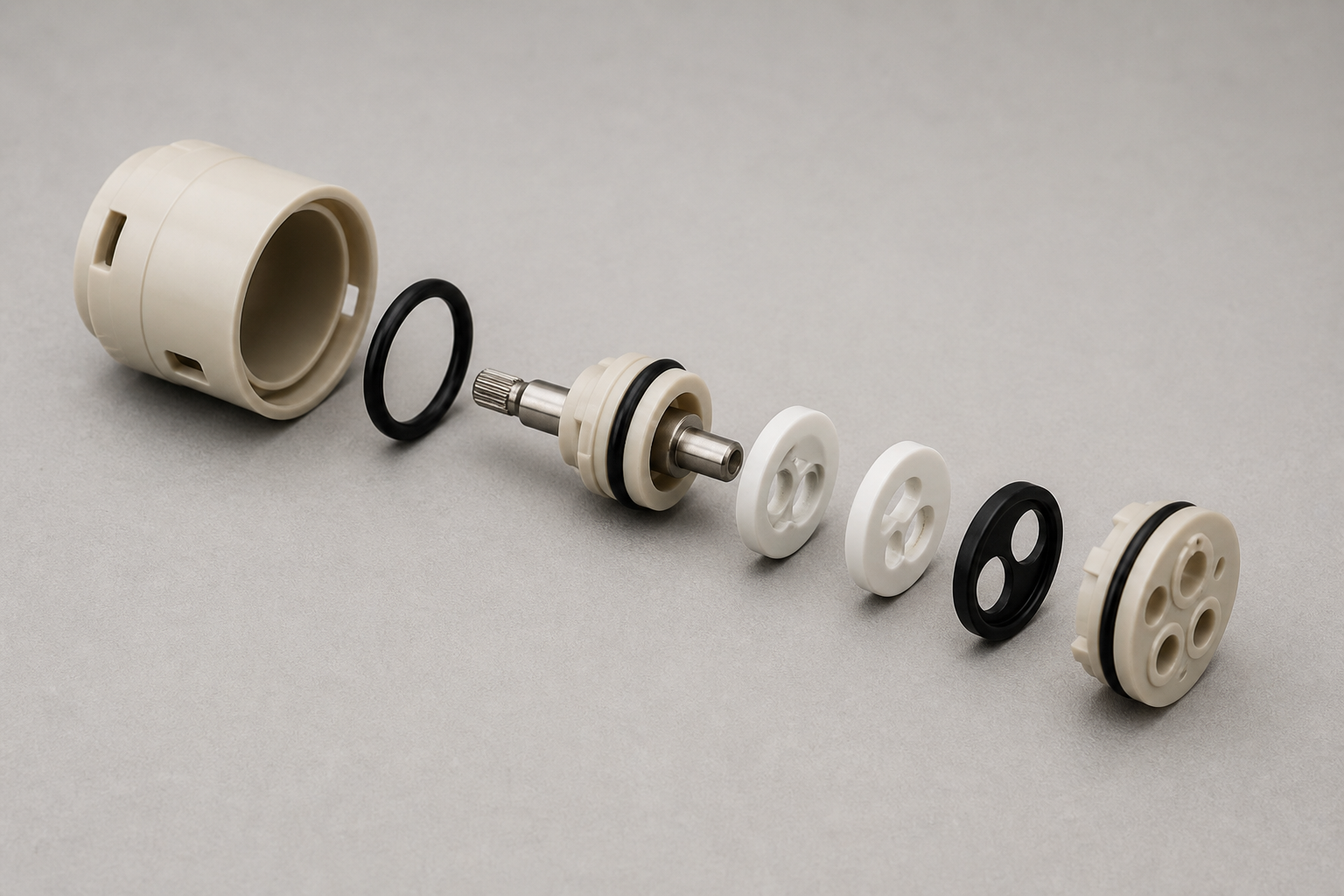
The Short Answer
A ceramic cartridge life test should evaluate the complete operating system under controlled conditions. At minimum, the buyer needs to know:
-
Which faucet and cartridge were tested
-
How the handle moved during each cycle
-
The hot- and cold-water conditions
-
When leakage and torque were checked
-
What counted as a failure
-
Whether the tested sample represents production
-
What happened during post-test disassembly
A high cycle count is useful only when those details are attached to it.
What Is Inside a Ceramic Faucet Cartridge?
A single-lever cartridge is more than two ceramic discs. It normally includes a housing, stem, moving disc, fixed disc, seals, base and other supporting components. Sedal’s manufacturing overview describes the stem, ceramic discs and housing as the principal parts that translate handle movement into water-flow and temperature control.
One disc remains fixed while the other moves. Their port geometry changes the quantity and mixture of hot and cold water.
The ceramic surfaces receive most of the attention because they combine high hardness with precise sliding and sealing behavior. CeramTec’s sanitary-fitting guidance explains how accurately manufactured ceramic sealing and regulating discs are used to maintain flow control and tightness.
Still, a faucet can drip even when the ceramic material itself is not visibly worn. A distorted housing, damaged gasket, unsuitable lubricant, debris on a sealing surface or incorrect cartridge compression can produce the same customer complaint.
Why the Cycle Number Can Be Misleading
Consider two reports.
The first says the cartridge completed a specified number of movements. The fixture ran continuously, no interim torque readings were recorded and the report does not describe the water temperature. The tested part was supplied separately rather than installed in the production faucet.
The second report uses a smaller but traceable sample from the pilot-production lot. It records the cartridge model, faucet drawing revision, pressure conditions, movement path, inspection intervals and leakage results. The operator also measures handle torque before and after testing and opens the cartridge to document any damage.
The second report tells the buyer much more, even before the cycle totals are compared.
A laboratory cycle is not a calendar year. Users apply uneven force, pause between operations and expose faucets to different temperatures, minerals and debris. An accelerated test is a controlled comparison tool—not a precise prediction of how many years every faucet will remain in service.
Use the Destination Standard, Not a Universal Number
The required test method depends on the product type and destination market.
For North American plumbing supply fittings, ASME A112.18.1/CSA B125.1 covers fittings and accessories between the supply stop and terminal fitting. Its scope includes multiple categories of faucets and related supply fittings.
EPA WaterSense documentation also references the ASME/CSA plumbing-supply-fitting standard as part of the performance basis for applicable lavatory faucet products. Buyers should consult the current EPA faucet specification information, especially while specification revisions are being considered.
The practical purchasing rule is simple: put the applicable standard, edition, product type and any project-specific additions directly into the RFQ. Do not write only “industry-standard lifecycle test.”
Requirements for a basin mixer, kitchen pull-down faucet, shower diverter and public-use faucet may not be identical.
What a Ceramic Cartridge Life Test Must Define
A useful ceramic cartridge life test begins with a written protocol. The following items should appear before testing starts.
| Test item | What the protocol should define | Why it matters |
|---|---|---|
| Test sample | Faucet model, cartridge model, BOM revision and production lot | Connects the result to the ordered product |
| Sample selection | Quantity, selection method and replacement rules | Prevents use of a specially prepared sample |
| Inlet conditions | Pressure, temperature and hot/cold arrangement | Reproduces the intended operating load |
| Handle path | Open-close and hot-cold movement sequence | Determines which cartridge surfaces are exercised |
| Test rate | Cycle speed, pause time and operating schedule | Excessive speed may create an unrealistic load |
| Mounting | Faucet fixture, cartridge nut torque and hose arrangement | Assembly conditions affect sealing and movement |
| Checkpoints | Leakage, torque and visual checks at agreed intervals | Reveals gradual deterioration |
| Acceptance criteria | Permitted leakage, damage, looseness and torque change | Makes the result auditable |
| Final inspection | Performance retest and controlled disassembly | Helps identify the failure mechanism |
The protocol should also state what constitutes one complete cycle. Otherwise, one laboratory may count a single handle movement while another counts a complete open-close or hot-cold sequence.
Five Results Worth Checking
1. Shutoff leakage
After the handle returns to the closed position, the inspector should check the outlet according to the specified stabilization period and test method.
An occasional drop immediately after closing may be water retained in the spout. Continuing drops can indicate a sealing problem. The protocol must distinguish the two.
2. External leakage
Water around the cartridge nut, stem, base or faucet body points to a different failure from dripping at the outlet. Record the leak location rather than writing only “faucet leaked.”
3. Operating torque
A cartridge may remain watertight while becoming unpleasantly stiff. It may also become too loose, causing poor control or a handle that will not stay where the user leaves it.
Measure torque using the same fixture, direction and handle geometry before and after testing. “Feels smooth” is not a measurement.
4. Handle play and end-stop condition
Inspect vertical movement, rotational free play and damage at the mechanical stops. Excessive force from the actuator can damage the handle interface even when the ceramic discs remain intact.
5. Flow and mixing control
For a mixer cartridge, confirm that movement still produces predictable flow and temperature adjustment. A pass on shutoff leakage alone does not prove acceptable control through the full handle range.
Why Faucets Begin to Drip
Faucet dripping rarely has just one possible cause.
Debris between the discs
Sand, scale, rust or installation debris can enter the cartridge and interfere with sealing. A hard ceramic surface may resist wear, but a particle can still prevent the two faces from closing correctly.
This is why site flushing and inlet protection should be considered separately from laboratory endurance.
Damaged sealing surfaces
A chipped edge or surface scratch can create a leakage path. During failure analysis, clean and inspect the discs before deciding whether the mark existed before testing or occurred during disassembly.
Seal deformation
Elastomer seals may take a compression set, swell, shift or become damaged during assembly. Their material compatibility and dimensions matter just as much as the ceramic pair.
Incorrect cartridge retention
If the retaining nut is too loose, the cartridge may move or leak. If it is excessively tight, the housing can deform and operating torque can rise. The assembly specification should therefore include a controlled tightening requirement.
Housing or stem wear
Wear or deformation in polymer and metal components can change alignment, handle play or disc loading even when the ceramic surfaces remain serviceable.
Lubricant change
The type and amount of lubricant influence operating feel. Temperature, water exposure and repeated movement may change that feel over time. Unapproved lubricant substitution is a legitimate production-control risk.
Test the Faucet Assembly, Not Only the Loose Cartridge
A cartridge supplier’s data is valuable, but the complete faucet introduces additional variables:
-
Cartridge-cavity dimensions
-
Flatness and cleanliness of the seating surface
-
Retaining-nut design
-
Tightening force
-
Handle leverage
-
Body distortion
-
Hot- and cold-water passage alignment
-
Seals supplied by other vendors
For that reason, buyers should request both component evidence and finished-faucet test results. A loose cartridge passing its own endurance test does not automatically prove that every faucet body using it will perform identically.
The same principle applies to health-effects compliance. NSF/ANSI/CAN 61 addresses substances that may be imparted to drinking water by materials and components. It does not replace mechanical performance testing, and a compliant cartridge material does not by itself certify an entire faucet model.
A Better Production-Control Plan
Product development testing answers, “Can this design pass?”
Production control asks a different question: “Are we still building the same design?”
A practical control plan can include:
-
Incoming identification: Confirm cartridge supplier, model, dimensions and lot information.
-
Critical dimensions: Check base geometry, locating features, stem interface and seal dimensions.
-
Assembly control: Define cartridge seating, cleanliness and retaining-nut conditions.
-
In-process leakage test: Test every faucet or apply the agreed inspection plan.
-
Periodic endurance verification: Select production samples at a defined frequency.
-
Change approval: Require written approval before changing the cartridge, seals, lubricant or assembly method.
-
Lot traceability: Link finished faucets to cartridge and assembly records.
-
Failure retention: Keep failed samples until the cause and corrective action are documented.
These controls are less exciting than a large cycle number. They are also what prevents an approved sample from drifting into a different production product.
How to Read a Test Report
Before accepting a report, ask four questions.
Does it identify the actual order?
The report should connect the tested faucet, cartridge and BOM revision to the product being purchased.
Can another laboratory repeat the method?
Pressure, temperature, movement, fixture, timing and acceptance criteria should be clear enough to reproduce.
Does it show the result over time?
Interim observations can reveal increasing torque or early leakage that disappears after adjustment.
Does it record abnormal events?
A stopped machine, replaced hose, adjusted actuator or restarted counter belongs in the report. Quietly restarting the test destroys traceability.
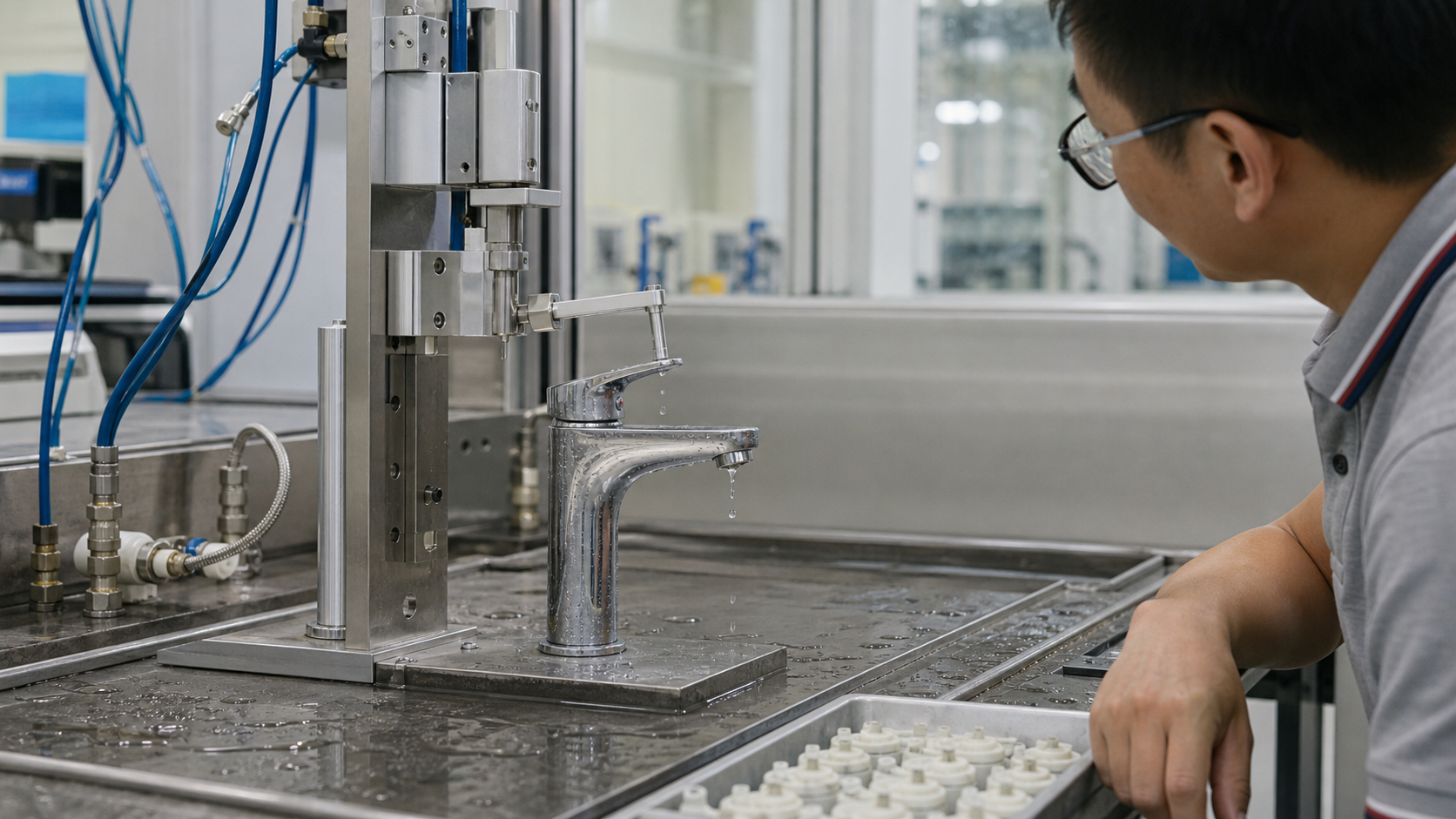
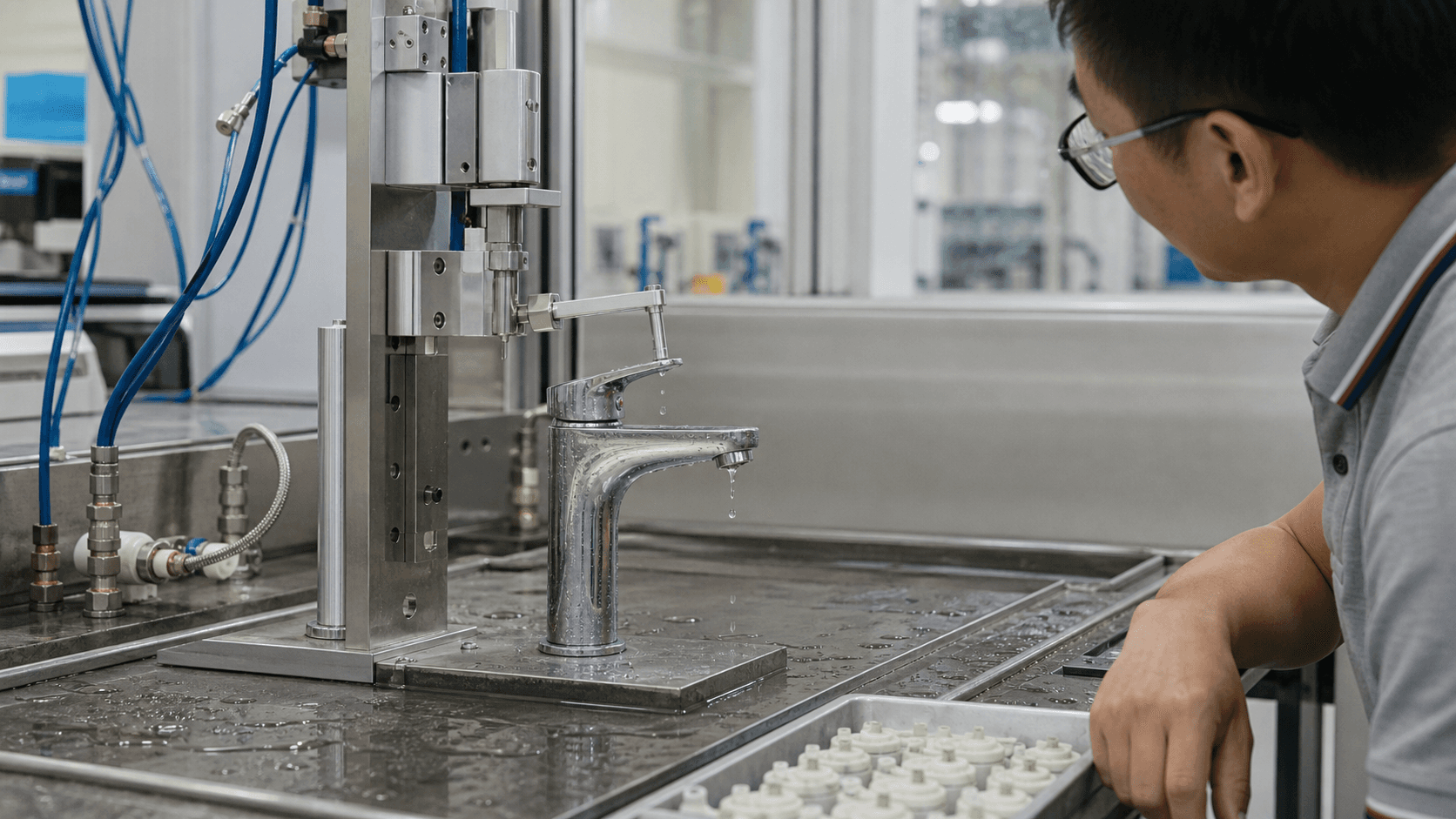
A photograph of the equipment helps, but photographs are supporting evidence. They do not replace test conditions or results.
What Post-Test Inspection Should Look For
When the endurance run ends, first repeat the agreed leakage, torque and functional checks. Do not immediately open the cartridge.
After recording the assembled result, disassemble the sample in a controlled sequence and inspect:
-
Ceramic surfaces and port edges
-
Sealing rings and their seating positions
-
Housing cracks or distortion
-
Stem wear and free play
-
Lubricant condition
-
Debris or deposits
-
Cartridge-cavity contact marks
-
Retaining components
Keep the parts from each sample separated and identified. Mixing components from several samples makes root-cause analysis almost impossible.
Applying This Checklist to a Faucet Supplier
AQ Bath’s public manufacturing and quality overview describes lifecycle, leakage and other inspection capabilities as part of its production system. Buyers can use the company’s product range to identify the faucet family they want to evaluate.
Those pages are a starting point, not the final approval package.
For a new OEM project, request a model-specific testing proposal containing the cartridge brand or specification, faucet BOM revision, test method, sample plan, acceptance criteria and report format. If the model uses a customer-nominated cartridge, define who is responsible for component qualification and completed-faucet validation.
Project details can be submitted through the AQ Bath contact page.
RFQ Language Buyers Can Adapt
Use wording such as:
The supplier shall submit a ceramic cartridge life test protocol for buyer approval before testing. The protocol shall identify the faucet model, cartridge model, BOM revision, applicable standard and edition, sample quantity, selection method, water conditions, operating sequence, test rate, inspection intervals, acceptance criteria and post-test examination. Unapproved replacement or adjustment of test samples is not permitted.
Add the market-specific performance values after checking the applicable standard and product category.
Frequently Asked Questions
1. Does a ceramic cartridge prevent every dripping problem?
No. The ceramic discs are only part of the sealing system. Debris, damaged seals, incorrect tightening and body tolerances can also cause dripping.
2. How many cycles should a faucet cartridge pass?
There is no single answer for every faucet and market. Use the applicable product standard, edition and project requirement. The test conditions are as important as the number.
3. Can the supplier test a loose cartridge instead of a faucet?
A loose-cartridge test is useful for component qualification, but buyers should also test the cartridge installed in the production faucet.
4. Does more operating torque mean better sealing?
No. Excessive torque can indicate compression, distortion, unsuitable lubrication or wear. Sealing and operating force should be evaluated separately.
5. Why does a new faucet drip after installation?
Installation debris, unflushed pipes, damaged seals, pressure conditions or incorrect assembly may be involved. Inspect the failure before automatically blaming the ceramic material.
6. Should hot and cold water both be used in testing?
Follow the applicable standard and intended application. Temperature conditions should be written into the protocol rather than left to the laboratory’s discretion.
7. Is a cartridge brand name enough for approval?
No. Record the exact model, version, dimensions, materials and production source. One manufacturer may offer several cartridges with different specifications.
8. What is the difference between leakage and lifecycle testing?
Leakage testing checks sealing under defined conditions at a particular time. Lifecycle testing repeatedly operates the product and checks whether performance changes.
9. Can a ceramic cartridge life test predict service years?
Not precisely. It provides controlled comparative evidence. Real service life also depends on usage, water quality, installation and maintenance.
10. What should buyers retain after approval?
Keep the signed specification, test protocol, complete report, approved sample, cartridge records, BOM revision and change-control agreement.
Conclusion
A ceramic cartridge life test is valuable when it exposes how a faucet changes—not merely when it produces a large number.
Define the sample, operating path, water conditions and acceptance limits before the machine starts. Measure leakage, torque and function during the test. Then inspect the finished assembly and its internal parts without losing traceability.
That work takes more effort than accepting a one-page certificate. It also gives the buyer something far more useful: evidence that the approved faucet can be reproduced in production.