
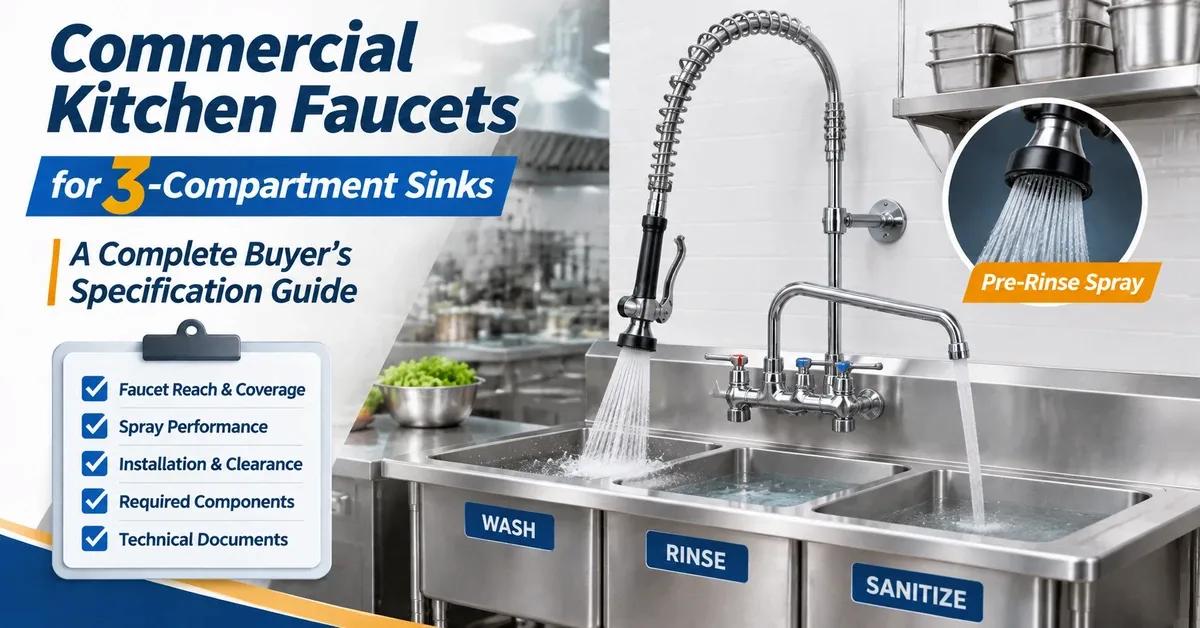
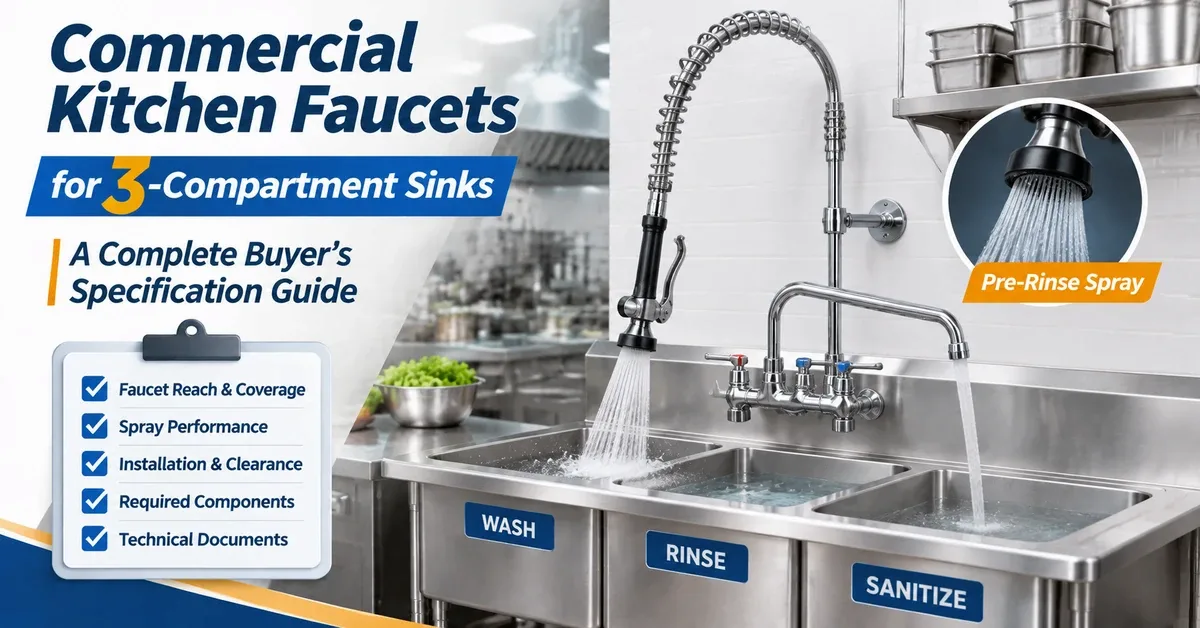
For a three-compartment commercial sink, the right faucet is selected from the sink drawing and warewashing routine, not from a product photograph. A kitchen faucet for 3 compartment sink applications must reach the working area, clear the backsplash and shelves, support the pre-rinse task, and leave enough control for filling or rinsing individual bowls. The buying decision should therefore combine faucet geometry, pre-rinse performance, installation structure, water conditions, service parts, and the supplier's technical documents.
This guide is written for restaurant equipment distributors, commercial kitchen equipment suppliers, foodservice contractors, restaurant chain procurement teams, and hotel kitchen buyers. It focuses on the questions that create costly rework: whether the faucet reaches all three bowls, whether the spray valve is actually suitable for food residue removal, whether the wall bracket has a sound fixing point, whether the quoted kit includes the required components, and whether a commercial kitchen faucet supplier can provide evidence for the exact configuration being ordered.
What a three-compartment sink faucet must do
A three-compartment sink normally supports an ordered sequence such as scrape or pre-rinse, wash, rinse, and sanitize. The exact procedure depends on the facility and local health requirements, but the physical implication is consistent: the faucet must serve more than one bowl without forcing the operator to stretch the hose, twist the riser, or place the spray valve where it interferes with the next task.
The faucet may perform several different jobs during one shift:
- Directed pre-rinsing of plates, trays, pans, utensils, and food-service containers.
- Filling or topping up one sink compartment through a swing spout.
- Rinsing the sink surface and surrounding work area.
- Moving between bowls while keeping the hose, spring, and spray valve within a predictable working envelope.
- Allowing maintenance staff to replace wear parts without removing the complete sink or damaging the mounting deck.
That is why a tall commercial assembly cannot be approved only because it is described as heavy duty. The buyer must confirm the relationship between the three bowls, the faucet centerline, the backsplash, the wall, the drainboards, and any shelves or equipment above the sink.
Start with the sink drawing, not the faucet catalog
The first document to send to a supplier is the sink drawing or a dimensioned installation sketch. A useful drawing shows the overall sink width and depth, bowl width and depth, backsplash height, drainboard position, faucet holes, hole spacing, deck thickness, wall distance, and the location of any shelf, dishwasher, rack, hood, or overhead obstruction.
Dimensions that control the recommendation
| Drawing field | Why it matters | What to confirm with the supplier |
|---|---|---|
| Faucet-hole count and spacing | Determines whether the faucet body, inlets, and mounting hardware can be installed without adapters. | Hole diameter, center spacing, deck thickness range, and required reinforcement. |
| Bowl length, width, and depth | Defines the spray valve reach and the area that must be covered without excessive hose tension. | Usable hose length, spray angle, riser position, and spout coverage. |
| Backsplash height and wall distance | Affects riser clearance, bracket reach, inlet routing, and access for tightening. | Deck- or wall-mount option, bracket adjustment, connection position, and service clearance. |
| Overhead clearance | Prevents the spring, hose, or spray valve from hitting shelves, ducts, or cabinets. | Overall height, return path, spring diameter, and maximum operating envelope. |
| Supply location and connection | Controls compatibility with hot and cold water lines and the available service route. | Inlet thread, hose connection, check-valve need, pressure, temperature, and shutoff access. |
Do not copy a faucet height or hose length from another sink unless the bowl layout and mounting position are the same. A configuration that works on a 47-inch sink with small bowls may not cover a longer three-bowl station with drainboards and a high backsplash. A commercial kitchen faucet supplier should be able to review the drawing and identify the dimensions still missing before issuing a final quotation.
How to choose faucet height and reach for three bowls
Faucet height is a clearance decision. Reach is a workflow decision. The correct assembly gives the operator enough vertical room to position cookware under the spray valve while keeping the riser stable and the hose return controlled. It also keeps the spray valve from colliding with the backsplash, shelves, or the next bowl.
Use a working-envelope check
- Mark the faucet centerline. Show whether the faucet is centered over the middle bowl or offset toward the pre-rinse bowl. Centering is not automatically best; the dirty-item flow may make an offset position more practical.
- Mark the spray valve rest point. The resting position should be reachable without crossing the operator's body or passing over clean items.
- Trace the hose path. Draw the hose at full reach and at rest. Look for sharp bends, contact with the spring, contact with the backsplash, and tension at the hose ends.
- Check every bowl. The operator should be able to direct the spray into the intended working areas of all three compartments or into the specific bowl assigned to pre-rinsing.
- Check service access. Leave room to remove the spray valve, hose, cartridge or valve parts, aerator, retaining hardware, and supply connections.
The goal is not maximum hose travel. Excess reach can encourage side loading and make the assembly harder to return to its bracket. The goal is sufficient reach with predictable movement and no interference with sanitation workflow. Ask the supplier for a dimensioned drawing, not only an overall height number.
Understand the three-compartment workflow
The faucet should support the way the station is actually used. Many kitchens treat one compartment as the wash basin, one as the rinse basin, and one as the sanitizing basin, with pre-rinsing performed at the dirty-side edge or before items enter the wash compartment. Other kitchens use a separate pre-rinse position and reserve the three bowls for washing and sanitizing. The supplier cannot make the correct recommendation without knowing which workflow applies.
Questions to answer before selecting the assembly
- Which bowl receives the heaviest soil and grease load?
- Is the spray valve used mainly for pre-rinsing, or also for filling pots and the sink compartments?
- Does the operator need a separate swing spout for controlled filling?
- Are clean dishes placed near the hose path or bracket?
- Are drainboards, pass-through openings, or dishwashing equipment next to the sink?
- Will the same faucet be installed across different sink widths in a chain rollout?
If the faucet must fill compartments, a separate swing spout may be more useful than asking the spray valve to perform every task. If the station is used only for targeted pre-rinsing, the buyer may prioritize spray-valve control, hose reach, return behavior, and service access. These are different specifications even when the visible faucet style looks similar.
Know the pre-rinse faucet parts in the quoted kit
“Pre-rinse faucet” describes an assembly, not one interchangeable part. The quotation should state whether the package includes the mixing body, riser, overhead spring, flexible hose, spray valve, wall bracket, swing spout, mounting hardware, supply connectors, check valves, seals, and installation instructions. This is especially important when comparing a factory quotation with a distributor quotation, because the two may define a complete set differently.
Pre-rinse faucet parts and their procurement risks
| Part | Function | Buyer should specify |
|---|---|---|
| Mixing body | Controls hot and cold supply and supports the riser or spout. | Inlet arrangement, mounting method, valve type, connection, material, and service parts. |
| Riser and overhead spring | Positions the spray valve and helps control its return path. | Height, diameter, material, finish, support method, and clearance. |
| Flexible hose | Provides working reach and connects the riser to the spray valve. | Usable length, braid, inner tube, bend behavior, end fittings, temperature, pressure, and spare code. |
| Spray valve | Provides the directed spray and release-to-close operation. | Trigger, grip, spray pattern, flow, force, guard, valve parts, and test conditions. |
| Wall bracket | Stabilizes the riser against repeated side movement. | Reach, adjustment, material, fasteners, fixing surface, and installation height. |
| Swing spout | Supports filling and lower-intensity rinsing tasks. | Length, rotation, outlet, clearance, seals, and whether it is included in the kit. |
Request an exploded drawing and controlled packing list. If a part is optional, show it as optional. If it is included only for a particular market or mounting method, state that limitation in the quotation. This prevents the common situation in which a buyer approves a photograph showing a swing spout and later discovers that the quoted set contains only the spray assembly.
Check water pressure, flow, and spray force together
Flow rate alone does not tell the buyer whether the station will work well. A spray valve needs suitable pressure, a useful spray pattern, and enough force for the intended residue. Excessive flow may increase water and hot-water consumption without improving the operator's result; insufficient pressure may produce a weak spray that encourages longer rinsing or repeated passes.
For U.S. commercial pre-rinse spray valves, current DOE requirements and test procedures distinguish flow and spray-force performance. Other markets may use different requirements or documentation routes. The RFQ should therefore state the destination, applicable rule or standard, test method, pressure, temperature, measured flow, spray force, product class if relevant, and model number represented by the report. Do not copy a rating from a similar-looking spray valve.
What the supplier should report
- Flow rate with units and test pressure.
- Spray force or the applicable performance class.
- Water temperature during testing.
- Test method and revision.
- Spray-valve model and complete faucet configuration.
- Whether the result is a component test or a finished-assembly test.
For a chain rollout, keep the same spray valve and performance basis where possible. If different sink widths require different hoses or brackets, record those as controlled variants rather than allowing each installer to substitute parts locally.
Evaluate mounting, wall support, and installation risk
A three-compartment sink creates repeated lateral movement because the operator pulls the spray valve across the work area. The deck, mounting hardware, riser, and wall bracket must share that load. A bracket fixed to a weak backsplash or an incorrectly sized fastener can create movement, leakage, noise, or premature hose and spring wear.
For deck mounting, confirm the hole diameter, center spacing, deck thickness, underside access, reinforcement, supply hose route, and tightening clearance. For wall mounting, confirm the wall type, anchor point, inlet height, bracket reach, and the distance from the wall to the bowl center. If the sink has an integrated backsplash, the faucet may need a different riser or connection arrangement than a wall-mounted workstation.
Installation instructions should identify the required tools, connection sequence, sealing method, flush procedure, pressure check, and final leakage inspection. The instructions should also show how to remove the spray valve and hose without disassembling the entire station. A commercial faucet that is easy to install but difficult to service may still create high lifetime cost.
Use an installation acceptance checklist
Before the sink is handed to the kitchen operator, the installer or project supervisor should record a short acceptance check. Confirm that the faucet is level, the hot and cold connections are correctly identified, the mounting hardware is tight without deforming the deck, and all joints remain dry under the specified pressure. Flush the supply lines before evaluating spray behavior; debris from new pipework can restrict a screen or damage a valve seal and create a misleading first complaint.
Operate the spray valve across its full intended reach. Check that the hose does not rub a sharp edge, the spring does not strike a shelf, the wall bracket holds the riser without excessive movement, and the spray valve returns to its rest position without pulling the body sideways. If a swing spout is included, rotate it over the intended bowl or container position and confirm that it does not collide with the spray hose. Photograph the final installation and retain the model number, batch information, and installer notes with the project file.
This acceptance record is useful when a distributor supplies many restaurants with similar sinks. It separates a product issue from a mounting, flushing, pressure, or clearance issue and gives the service team a practical starting point. The same record can be adapted for a hotel kitchen, central kitchen, school, hospital, or catering project.
Compare the total cost of the installed station
Unit price is only one line in the cost of a three-compartment sink faucet. A cheaper assembly may require a different bracket, an adapter, longer installation labor, extra spare parts, or a replacement spray valve that is difficult to source. A high-flow configuration may also increase water and hot-water consumption when operators use it for long periods. The correct comparison should include the complete delivered kit, installation effort, service access, expected replacement parts, local replenishment time, and the cost of kitchen downtime.
Ask suppliers to separate the base assembly from optional items and service items. Request the price and availability of the complete spray valve, hose, seals, swing-spout parts, mounting hardware, and any custom finish or packaging. For a chain, compare the cost of standardizing one controlled configuration against the cost of supporting several local substitutions. The lowest invoice price is not necessarily the lowest procurement risk; a clear specification can prevent repeated site modifications and emergency part purchases.
Compare suppliers using evidence, not only price
The right commercial kitchen faucet supplier should return a controlled specification package. A low price is not comparable if it excludes the wall bracket, swing spout, mounting kit, spare hose, packaging, test work, or required documents. Ask each shortlisted supplier to respond to the same fields and mark every assumption.
| Supplier evidence | Why it affects approval | Hold the quotation when |
|---|---|---|
| Dimensioned assembly drawing | Allows the buyer to check the three-bowl working envelope and installation interfaces. | Only a catalog photograph or an overall height is provided. |
| Exploded parts list and packing list | Shows what is included, optional, replaceable, and traceable. | The photograph shows parts that are absent from the quotation. |
| Flow and spray-force evidence | Connects the spray valve to the destination-market requirement and operating task. | The supplier gives a flow number without pressure, test method, or model identity. |
| Material and finish declaration | Supports foodservice suitability, corrosion review, incoming inspection, and finish consistency. | Materials are described only as “premium metal” or “commercial grade.” |
| Change-control and spare-parts plan | Protects repeat orders and reduces service downtime. | The supplier can substitute hose, spray valve, seals, or finish without written approval. |
AQBath publicly presents a Commercial Kitchen Faucet Series that includes C0001CP and other commercial models. The commercial kitchen faucet series is useful for comparing the available product family, while the C0001CP product page is the more specific starting point for a pre-rinse configuration. Buyers should still request current model drawings, exact dimensions, component materials, performance data, certificate scope, MOQ, lead time, packaging, and spare-part terms for the intended order.
Prepare an RFQ that produces comparable quotations
A useful RFQ does not ask, “How much is a commercial faucet?” It describes the station and asks the supplier to confirm the complete solution. Include the sink drawing, mounting type, faucet-hole spacing, bowl dimensions, backsplash and wall information, overhead clearance, supply connection, pressure and temperature, target market, finish, quantity by phase, packaging, spare parts, and required documents.
RFQ fields for a kitchen faucet for 3 compartment sink projects
- Application: restaurant, hotel, catering kitchen, institutional foodservice, central kitchen, or equipment distribution.
- Sink interface: deck or wall mount, hole count, spacing, deck thickness, bowl sizes, backsplash, drainboards, and wall distance.
- Working envelope: required height, usable hose reach, spray-valve rest position, bracket location, and overhead clearance.
- Performance: flow target, spray force, pressure range, water temperature, spray pattern, trigger operation, and leakage acceptance.
- Complete kit: mixing body, riser, spring, hose, spray valve, bracket, swing spout, mounting kit, connectors, seals, and instructions.
- Compliance: destination-market standards, foodservice material requirements, product certificates, test reports, labeling, and manual language.
- Supply: sample quantity, pilot quantity, forecast, MOQ, delivery stages, packing marks, spare-parts quantity, and change-control terms.
Ask the supplier to separate confirmed data from assumptions and project-dependent items. If dimensions or test results are not public, that is not automatically a problem; the important point is to identify the gap before approval. Do not publish an exact flow rate, certificate, material grade, lead time, or MOQ until it is confirmed for the selected model and destination.
Maintenance and spare-part planning
A busy three-compartment sink needs a service plan because the spray valve, hose, seals, aerator, spring, and mounting connections experience repeated movement and exposure to water, food residue, cleaning chemicals, and heat. The maintenance plan should include periodic leak checks, inspection of the hose and connections, removal of spray-nozzle restrictions, and replacement of damaged or loose parts. The operator should not have to improvise a substitute hose or spray valve that changes the approved performance.
Order or identify service parts by model and revision. A practical spare list may include a complete spray valve, flexible hose, seals, spray screen or flow-control parts where applicable, swing-spout seals, mounting hardware, and any model-specific repair kit. Quantities depend on installed units, operating intensity, local service response, and replenishment time. The supplier should state which parts are standard, which are custom, and how a future revision will be identified.
Frequently asked questions
What is the best kitchen faucet for 3 compartment sink?
There is no universal best model. The correct choice is the assembly whose height, hose reach, spray valve, spout, mounting, connections, and support match the sink drawing and workflow. Confirm the three-bowl working envelope and destination requirements before selecting by appearance.
Do all three-compartment sinks need a pre-rinse faucet?
No. The answer depends on the foodservice workflow and whether residue must be removed before washing. If pre-rinsing is required, a release-to-close spray valve may be suitable; if the station mainly fills and rinses bowls, a different commercial configuration may be more practical.
How long should the hose be?
The hose should reach the required working areas without constant tension, sharp bending, dragging, or contact with nearby equipment. Measure the sink and mounting position rather than copying a nominal length from another project.
What are the most important pre-rinse faucet parts to quote?
Quote the mixing body, riser, spring, flexible hose, spray valve, wall bracket, swing spout if required, mounting hardware, connectors, seals, instructions, and service parts. The supplier should clearly mark which items are included, optional, or market-dependent.
What should a commercial kitchen faucet supplier provide before approval?
Request a dimensioned drawing, exploded parts list, controlled packing list, material and finish information, flow and spray-force evidence, installation instructions, certificate matrix, inspection plan, spare-parts list, and change-control commitment. Tie every document to the quoted model and revision.
Can C0001CP be used on every three-compartment sink?
Do not assume that from the product name. C0001CP is a commercial pre-rinse product option, but the buyer must confirm the actual sink dimensions, mounting interface, height, reach, supply connections, clearance, performance, certificates, and included parts for the intended project.
How can distributors compare two commercial faucet quotations?
Compare the complete kit, dimensional fit, performance evidence, materials, certificates, spare parts, packaging, MOQ, lead time, and change-control terms on the same RFQ sheet. A lower unit price is not comparable when the quotation excludes a bracket, swing spout, hose, testing, or documentation.
Conclusion
A reliable three-compartment sink faucet is a configured workstation component, not a generic tall tap. Start with the sink drawing and workflow. Confirm height, reach, bowl coverage, backsplash, wall support, overhead clearance, supply conditions, spray-valve performance, and the complete list of pre-rinse faucet parts. Then compare suppliers by model-level evidence and written commercial assumptions.
For restaurant equipment distributors, foodservice contractors, chain procurement teams, and hotel kitchen buyers, the strongest purchasing file contains the approved drawing, complete packing list, performance requirements, certificate scope, inspection plan, spare-part codes, and change-control terms. AQBath's Commercial Kitchen Faucet Series and C0001CP product page can be used as starting points for a technical comparison. Send the actual sink dimensions and project requirements before requesting a final quotation.