
Short answer: The right project faucet supplier is qualified by the completeness and repeatability of its project package, not by a catalogue image or the lowest unit price. Before award, a contractor, developer, distributor or procurement team should verify the exact model, drawing revision, materials, water-contact components, finish, installation interface, inspection evidence, packaging, MOQ, lead time, delivery phases, spare parts and change-control process. The supplier should be able to connect the approved sample to the production lot and to the replacement unit ordered later.
This guide addresses a specific B2B question: how should a buyer compare and qualify a project faucet supplier before a multi-room, multi-building or phased construction order? It treats project faucet sourcing as a controlled approval process, not as a catalogue search. It is intended for plumbing contractors, property developers, hotel and apartment project buyers, bathroom wholesalers, importers, distributors, private-label brands and engineering procurement teams. It is not a general faucet buying guide and it does not present a single product as suitable for every project.
In project purchasing, the faucet is part of an installed system. The basin, vanity, countertop, wall, supply connection, installer access, finish schedule, maintenance plan and delivery sequence all affect whether the approved product works in the field. A supplier that can only quote a similar-looking item leaves the buyer to solve those interfaces later. A supplier that can return a controlled specification and evidence package helps the project team make an approval decision before those risks become site work.
Discuss a Project Faucet Package
What a project faucet supplier should deliver before award
A project supplier should give the buyer enough information to approve one controlled configuration. The information may be split across a quotation, drawing, specification sheet, sample record, installation guide and inspection plan, but the documents must refer to the same model, finish and revision. If the drawing says one thing and the quotation says another, the buyer should stop the approval and resolve the difference in writing.
A useful project package has six evidence blocks. First, it identifies the model and application. Second, it defines materials and water-contact components. Third, it explains installation and service interfaces. Fourth, it identifies the finish and appearance reference. Fifth, it states the inspection and document scope. Sixth, it defines commercial supply, packaging, spare parts and change control.
| Project approval block | Minimum information | Decision it supports |
|---|---|---|
| Product identity | Model code, application, drawing revision and finish | Whether the quoted item is the correct project product |
| Technical construction | Body, cartridge, seals, hoses, aerator, mounting parts and connections | Whether the product fits the waterway, basin and service plan |
| Quality evidence | Inspection plan, test scope, certificates and sample status | Whether claims apply to the exact model and market |
| Supply continuity | MOQ, lead time, packaging, phases, spares and change notice | Whether the product can be delivered and reordered reliably |
Define the project before comparing suppliers
A project faucet supplier cannot price and document a real requirement when the buyer sends only a product photograph and a total quantity. Start with the project schedule and divide the quantity by building, room type, application, finish and delivery phase. The first question is not which faucet looks attractive. It is which installed positions must be served and which requirements differ between those positions.
Separate room and application types
List guest rooms, apartments, public washrooms, offices, healthcare-adjacent areas, restaurant kitchens, staff facilities and other water-driven spaces separately. A basin faucet in a guest room may have different reach, appearance and service requirements from a high-traffic public washroom faucet. A commercial pre-rinse faucet for a kitchen should not be mixed into a bathroom package simply because both products are called commercial faucets.
For each position, record the basin or sink, mounting holes, deck thickness, wall or backsplash clearance, spout reach, outlet height, handle clearance, supply connection, service access and finish. If a product is wall-mounted or uses a concealed body, record the in-wall component and access panel separately. A project faucet supplier should be able to review this information and identify missing dimensions before issuing a final quotation.
Record the project schedule and delivery logic
State whether the project is new construction, renovation, replacement, phased refurbishment or a distributor stock program. Record the date for technical submittal, sample approval, mock-up, first installation, production release, inspection, dispatch and site delivery. A production lead time is not the same as an arrival date. The quotation should distinguish production, inspection, export documentation, transport, customs and site delivery responsibilities.
For a multi-building project, decide whether products will arrive by model, floor, room kit, building or installation phase. For bulk faucet orders, a partial shipment that lacks mounting parts, hoses or labels may create more work than a later complete shipment. Packaging and delivery sequence are part of the project specification, not administrative details to decide after production.
How to identify the supplier's actual role
Not every project faucet supplier is the factory that controls the model. A manufacturer, exporter, sourcing company, distributor or brand owner can each be a valid partner, but the buyer should know where technical decisions are made. The procurement file should identify the legal entity, manufacturing location, quotation owner, document owner, quality contact and after-sales contact.
Factory or manufacturer
A factory should be able to explain the relevant manufacturing route, inspection points, model drawing, bill of materials and change approval. Ask whether the quoted model is made at the named site, which processes are in-house, which are subcontracted and how incoming or subcontracted work is inspected. A factory profile is useful for screening, but the approval decision still requires model-specific evidence.
Exporter or sourcing supplier
An exporter may coordinate several factories and provide useful consolidation or logistics support. The buyer should ask who owns the drawing, who approves substitutions, who issues the inspection record and how the exporter keeps different suppliers from mixing components or finishes. If one purchase order contains several product families, a clear responsibility matrix becomes essential.
Distributor or local project partner
A distributor may provide local stock, technical service, language support and a shorter delivery route. The buyer should confirm whether the distributor can provide the manufacturer's current drawing and document scope, or whether the technical file must come from another party. Local availability does not automatically prove that the product is suitable for the project specification.
AQBath publicly identifies Ningbo Yinzhou Anqi Valve Co., Ltd., also presented as AG Valve, in Ningbo, Zhejiang, China, and states that it was established in 2006. Its public company information describes products for residential, hospitality, commercial, kitchen and bathroom applications, together with OEM/ODM discussions. These facts help a buyer understand the entity behind the website. They do not replace a project audit, model approval, certificate-scope review or written commercial quotation.
Review the product file at component level
A project buyer should not approve a faucet from the word “brass,” a product photograph or a series name alone. Request a component map or controlled bill of materials. Identify the main body, spout, cartridge or valve, seals, flexible hoses, aerator, check valves, mounting kit, fasteners and any decorative or structural inserts. Mark which parts contact water, carry pressure, carry load, remain visible or are replaceable.
Materials and water-contact parts
The material statement should be specific enough for the project engineer and responsible importer to review. “Brass faucet” may describe the main body while other parts use different materials. That is not automatically a defect, but the buyer must understand the complete water-contact chain and which documents support it. If a project requires a material limit, a drinking-water document or a market-specific conformity route, record the exact requirement and the model coverage.
Public AQBath information describes lead-free brass casting, zinc alloy die casting, forging, welding, pipe bending, cold stamping and precision machining. It also describes polishing, electroplating, material spectral analysis, coating testing, 3D image measurement, hardness testing, product lifespan testing, leakage testing and electroplating salt spray testing. These are useful factory-screening signals. Ask which process and test apply to the exact SKU, finish and production revision being quoted.
Cartridge, seals and service parts
Record the cartridge or valve reference, seal materials where relevant, aerator or spray insert, flexible hoses and mounting parts. Ask whether the component can be ordered separately and how the maintenance team will identify it after installation. If the supplier proposes a substitution, require a technical review and revised document before production. A visually similar part can differ in dimensions, operating feel, sealing behavior or service life.
Dimensions and interfaces
Request the current drawing rather than relying on a catalogue image. Check mounting-hole size, deck thickness, base footprint, reach, height, rotation, wall clearance, connection type, hose length, fixing method and access below the vanity or sink. Mark critical dimensions in the project schedule and confirm whether the drawing represents the same finish and component configuration as the sample.
Control finish, installation and acceptance evidence
Finish is part of the project specification because repeated products are often installed next to one another. A name such as chrome, brushed, black or gold does not define every visible characteristic. Approve a physical finish sample or limit sample, identify critical surfaces, define lighting and viewing conditions, and record how visible defects will be judged.
Finish and coating checks
Ask the project faucet supplier to identify the finish route and the inspection method relevant to the product. Depending on the configuration, evidence may involve appearance, coating thickness, adhesion, corrosion-related testing or chemical-cleaner compatibility. Do not convert one laboratory result into a guaranteed number of years in service. Test method, specimen, finish stack, cleaning environment and acceptance criteria all matter.
Installation trial
Install a representative sample on the actual or simulated basin, vanity, countertop, sink or wall. Use the intended installer where possible. Record unpacking, part identification, mounting access, tool requirements, connection steps, testing, cleanup and service access. Confirm that the installation guide matches the delivered kit. A product that requires an adapter or tool not named in the quotation should be treated as an open project item.
Functional and appearance acceptance
Define what the buyer will check before production release: leakage, handle operation, spout movement, outlet direction, spray or flow behavior, finish appearance, accessories, labels and packaging contents. The inspection plan should identify the sample or production lot, method, acceptance rule and record owner. “Passed QC” is not an acceptance criterion unless the parties agree what was checked.
Review Project Faucet Solutions
Build a project submittal and RFQ package
A buyer-owned RFQ makes supplier responses comparable. It is the practical starting point for project faucet sourcing and should state the project, product, quantity, market, schedule and evidence requirements. It should also tell suppliers what is included, optional, excluded or still pending. A clear RFQ reduces the chance that two suppliers quote different configurations under the same product name.
| RFQ field | Buyer provides | Supplier returns |
|---|---|---|
| Project scope | Building, application, quantity by phase and destination | Recommended model, assumptions and exclusions |
| Installation interface | Basin or sink drawing, holes, deck, connections and clearance | Current drawing, guide, mounting kit and deviations |
| Materials and finish | Required material evidence, finish code and limit sample | BOM, material declaration, finish route and sample status |
| Quality and documents | Applicable standards, certificates and inspection gates | Model scope, reports, inspection plan and open items |
| Commercial supply | Forecast, MOQ target, delivery phases, packaging and spares | MOQ, sample cost, lead time, price basis, packing and validity |
| Change control | Notice period, approval owner and prohibited substitutions | Change procedure, escalation path and responsible contact |
Use status labels such as confirmed, sample required, project-specific, supplier deviation, buyer decision and pending technical review. The labels make the submittal readable by procurement, engineering, quality and installation teams. They also prevent an empty field from becoming an accidental approval.
Compare project faucet suppliers by total installed risk
Unit price is only one part of project value. For bulk faucet orders, compare the same product scope, Incoterm, document package, packaging, inspection, warranty assumption and delivery responsibility. Then add the cost of missing components, installation rework, extra site labor, finish replacement, spare parts, warehouse handling and project delay.
MOQ and sample terms
MOQ can vary with the model, finish, packaging, customization and production route. Ask the supplier to quote the actual configuration and state whether the MOQ applies per model, finish, order, shipment or project. Sample terms should identify sample price, tooling or setup charge, delivery timing, sample ownership and whether the sample uses production-intent components.
Lead time and capacity
Request a milestone schedule rather than a single delivery promise. Separate drawing approval, sample, finish approval, production release, manufacturing, inspection, packing, dispatch, transport and site delivery. Ask what information the supplier needs before the clock starts. A lead-time estimate without a starting milestone is difficult to manage.
Packaging and phased delivery
Agree whether products arrive as individual cartons, room kits, floor kits, building kits or mixed pallets. Labels should identify the project, model, finish, quantity, batch and installation location where necessary. Conduct an unpacking trial and check for missing mounting parts, scratches, mixed finishes and unclear instructions. Packaging should protect the product without creating unnecessary site congestion or disposal cost.
Warranty and corrective action
Warranty language should define how a problem is reported, what evidence is needed, who identifies the affected lot, how replacement parts are issued and how corrective action is closed. A useful corrective-action response identifies containment, root-cause investigation, affected models or lots, corrective action and verification. It should not be limited to a promise to resend a product.
Use the product family that fits the project application
Project sourcing should begin with the installed application, then map to an available product family. A category page can show the supplier's range, but the final approval must refer to the exact model, drawing and component set.
Basin faucet and washroom projects
For apartment, hotel, office or commercial washroom projects, review basin geometry, splash, handle clearance, mounting access, finish consistency and replacement parts. The public A0053-01 single-handle basin faucet reference describes a brass body, single-handle operation, hospitality or commercial washroom use and an available drawing. It can be considered as a starting point for a project submittal, subject to confirmation of the current drawing, finish, cartridge, connections, documents and packaging.
Commercial kitchen projects
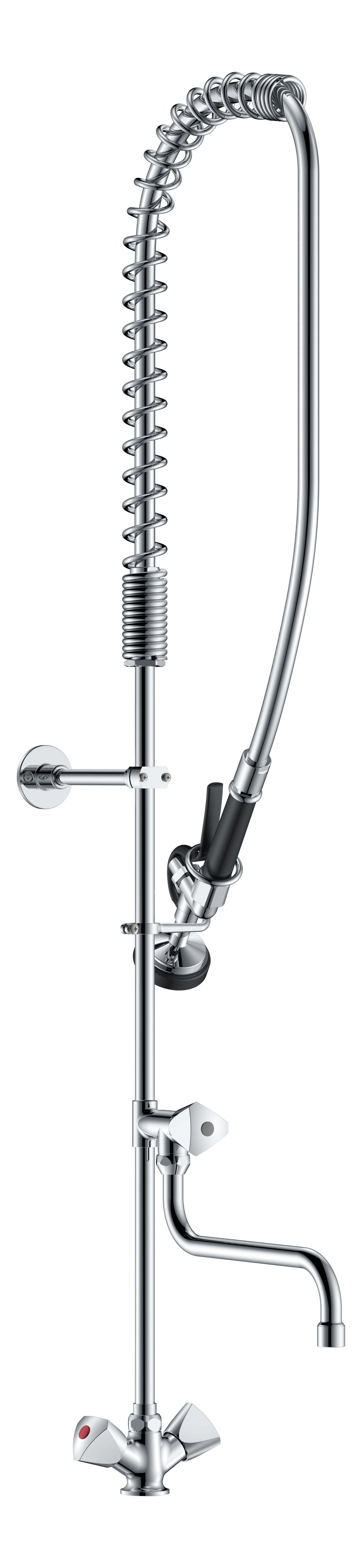
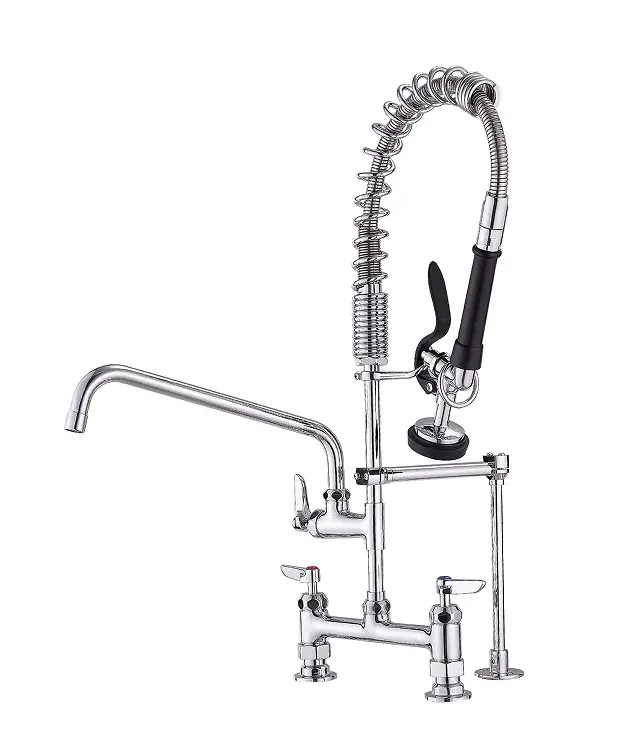
For restaurant, catering or hotel back-of-house projects, review reach, swing, spray control, hose routing, support, cleaning access and operator movement. AQBath publicly presents the C0001CP commercial pre-rinse kitchen faucet for professional kitchen applications with a spray head and swing spout. It may support a separate kitchen package, but it should not be inserted into a bathroom schedule without checking the application and installation requirements.
Fast-installation project platforms
Where installation labor and under-counter access are major risks, a buyer may also review the supplier's top-fixed or quick-installation product directions. The installation claim should be tested on the actual project substrate and by representative installers. Record tools, sequence, access, training and any remaining plumbing work before translating a demonstration into a schedule or cost assumption.
Set approval gates before mass production
A project should not move directly from a quotation to full production. Use controlled gates so an open technical issue cannot be hidden inside a commercial deadline.
Gate 1: document review
Check the model code, drawing revision, BOM, materials, water-contact parts, finish, installation guide, document scope, inspection plan and quotation. Record every deviation and unresolved item. Confirm that the model in the certificate or report is the same configuration being quoted.
Gate 2: sample and finish approval
Inspect the sample against the drawing and component list. Check dimensions, operation, finish, accessories, labels and packaging. Retain a signed or dated approval reference. If the sample uses provisional components, identify them and define the replacement review before production release.
Gate 3: installation or mock-up trial
Install the product under representative conditions. Check access, tools, connections, fit, sealing, serviceability, appearance and cleaning. Invite procurement, engineering, quality, installer and operator representatives where relevant. Record actions, owners and due dates.
Gate 4: pilot or first-lot inspection
Inspect the first production lot or an agreed pilot quantity using the approved criteria. Confirm that the production model, finish, components, packaging and labels match the approved sample. Do not use the development sample as proof that mass production is controlled.
Gate 5: release and repeat-order control
Release the final project file with model, revision, finish, BOM, documents, inspection plan, packaging, spares and change-control rules. Future purchase orders should reference the same controlled information. If the supplier changes a component, finish process, subcontractor, packaging or production site, the buyer should receive notice and decide whether another review is required.
Project faucet supplier scorecard
Use a scorecard to make supplier comparison visible across purchasing, engineering, quality and construction. Do not award points for claims that have no document, sample or responsible owner.
| Evaluation area | Evidence to score | Warning sign |
|---|---|---|
| Entity and role | Legal entity, factory location, technical owner and contacts | The quotation owner cannot identify the actual manufacturer |
| Product control | Drawing, BOM, component references and revision control | Only a photograph or generic series name is provided |
| Quality evidence | Inspection plan, model-level reports and sample records | “Strict QC” is stated without criteria or records |
| Project supply | MOQ, lead time, capacity, phases, labels and packaging | One arrival date is promised without milestones |
| After-sales control | Spare parts, warranty process and corrective action | The supplier cannot identify service parts or affected lots |
FAQ for project faucet sourcing
What is a project faucet supplier?
A project faucet supplier provides faucets and supporting information for a defined construction, renovation, hospitality, residential, commercial or institutional project. The role may be performed by a manufacturer, exporter, distributor or brand owner. A project supplier is qualified by its ability to control the exact product, documentation, delivery and service requirements for the project.
What should I send when requesting a project faucet quotation?
Send the project location, application, quantity by model and finish, basin or sink drawings, mounting and connection requirements, target delivery phases, packaging expectations, required documents, sample needs and spare-parts expectations. If the design is not final, mark the open items clearly so the supplier does not treat assumptions as confirmed requirements.
How do I compare two project faucet supplier quotations?
Normalize the exact model, material, components, finish, accessories, documents, sample scope, inspection, packaging, Incoterm, MOQ, lead time, delivery phases, warranty and spares. Then compare total installed risk rather than the unit price alone. For bulk faucet orders, ask each supplier to list exclusions and deviations separately.
Does a factory certificate prove that every project faucet is compliant?
No. A management-system certificate or company-level certificate does not automatically prove that every model, finish, component, production site or market configuration is covered. Request the document scope and compare it with the exact model and project requirement.
How should MOQ be handled in a project order?
Request MOQ for the actual model, finish, packaging and customization scope. Clarify whether the minimum applies per SKU, finish, order, shipment or project. A project forecast may help the supplier plan production, but it should not be treated as a confirmed order unless the commercial terms say so.
What is the difference between a sample and a pilot batch?
A sample demonstrates a product configuration. A pilot or first-lot inspection checks whether production can reproduce the approved configuration under normal manufacturing conditions. A sample should not be treated as proof that every later batch will match it without production controls and inspection evidence.
Can AQBath support a project faucet RFQ?
Start with the public AG Valve company profile and the relevant project product categories. AQBath publicly describes manufacturing processes, quality capabilities and OEM/ODM discussions. Send the application, drawings, quantities, finishes, target market and delivery plan through the AQBath contact page and request a model-based proposal. Confirm all model-level materials, documents, MOQ, lead time, packaging and testing items before approval.
Conclusion
A reliable project faucet supplier is a project-control partner, not only a source of products. The buyer should qualify the supplier's role, model file, component construction, installation interfaces, finish, inspection evidence, commercial terms, packaging, delivery phases, spare parts and change-control process. This approach gives procurement, engineering, quality and installation teams one controlled basis for the same decision.
AQBath's public information identifies AG Valve as a Ningbo-based manufacturer with published faucet manufacturing and quality capabilities. Those public facts are a useful starting point for supplier screening. The final project approval still depends on the exact model, drawing, BOM, finish, document scope, sample, production lot and commercial terms. Send the project schedule and RFQ requirements so the supplier can respond to a defined package instead of an image and a quantity.