
Why commercial faucets deserve more attention than they usually get
Commercial faucets are one of those fixtures people only notice when they slow down, leak, wobble, or make a kitchen harder to work in than it should be. For engineers, sourcing managers, and food-service buyers, that is exactly the wrong time to evaluate them. A faucet is not just a water outlet; in a busy kitchen it becomes part of the cleaning workflow, the fill station, the rinse station, and sometimes the difference between a line that keeps moving and one that backs up.
That matters because the right fixture can reduce operator fatigue, speed up washdown tasks, and handle repeated use without constant adjustment. The wrong one can create splash, waste water through poor control, or simply get in the way. If you are comparing commercial kitchen faucets for a restaurant buildout, replacement project, or equipment spec, the real decision is not “which faucet looks better?” It is “which assembly fits the work, the sink, and the pace of the operation?”
What this type of faucet is designed to do
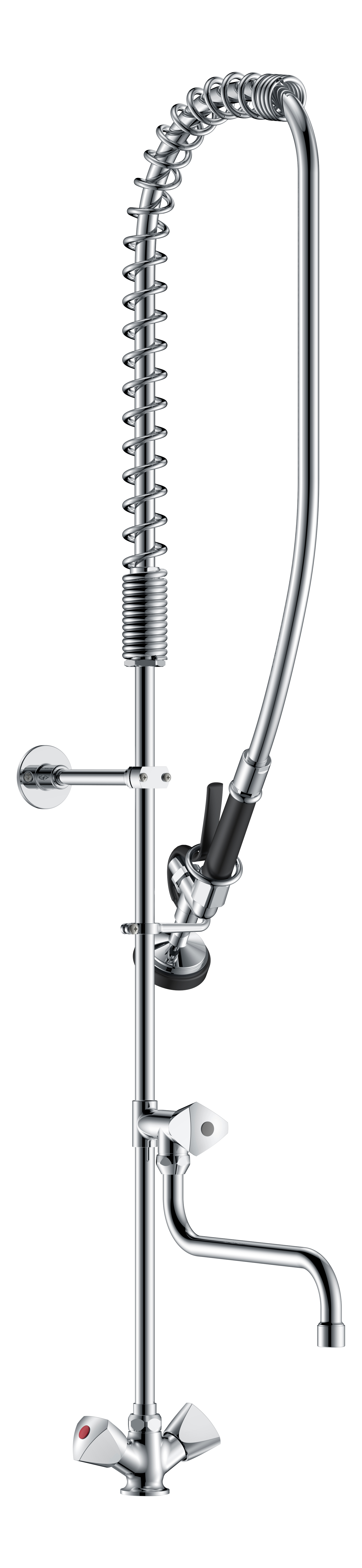
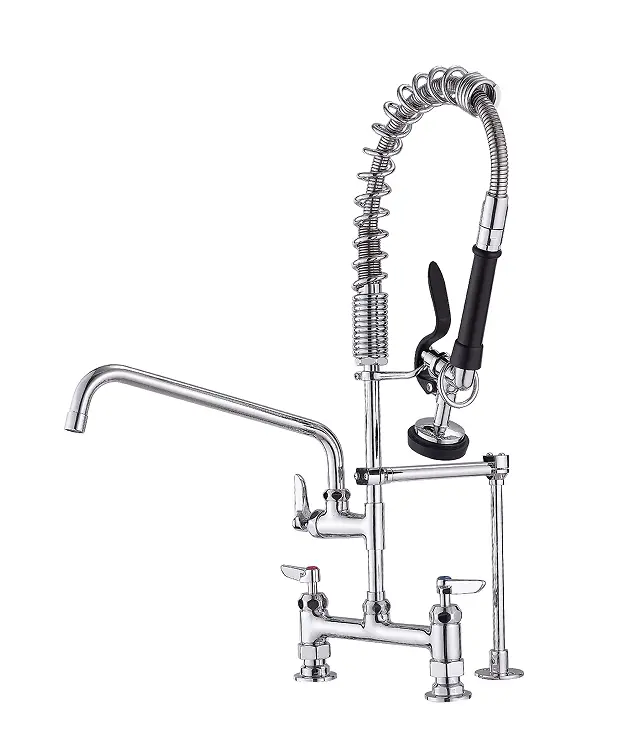
The commercial kitchen faucet assembly described here combines a high-arc gooseneck spout with a spring-supported pre-rinse sprayer and separate hot and cold handles. That combination tells you a lot about the intended use. It is built for kitchens that need two water delivery modes in one station: a fixed stream for filling and general sink work, and a flexible spray for blasting off food residue.
That dual-function setup is common in restaurant faucets because it matches the way staff actually work. A cook may need to fill a stock pot, then swing the spray head over to rinse a pan, then return to the spout without changing stations. In a tight back-of-house layout, that saves time and steps. It also helps reduce traffic around the sink area, which can be overlooked in layout planning until service starts.
Key features buyers should notice first
The visible structure of this faucet assembly is practical rather than decorative. The long-reach spout gives clearance over the sink basin, while the spring hose allows the spray head to be repositioned quickly. The support arm or bracket stabilizes the hose so it does not flop around under repeated use. That sounds minor on paper, but in a commercial kitchen it prevents a lot of small annoyances that become bigger ones over a long shift.
The separate hot and cold handles with red and blue indicators suggest individual control rather than a single mixing lever. For some operations, that is a benefit because it offers direct, familiar control and can be easier to service in parts. The caution is obvious: more exposed controls usually mean more wear points, so maintenance habits matter. A bargain fixture with weak handles tends to show its weakness fast.
The chrome-finished metal body and fittings also point to the usual priorities in this product class: corrosion resistance, cleanability, and a surface that wipes down easily. The spring coil is typically associated with stainless steel construction, while the spray grip may use plastic or coated material for handling comfort. Exact grades and finish specifications are not visible here, so buyers should verify those details before locking in a purchase.
Where commercial kitchen faucets earn their keep
These fixtures are most useful in food-service environments with frequent washdown and fast turnover. A restaurant dish station is the obvious example, but the same logic applies to prep areas, catering operations, institutional kitchens, and any workflow that combines rinsing, filling, and repetitive cleaning.
Typical tasks they support
Rinsing cookware and utensils after scraping
Filling sinks or vessels through the gooseneck spout
Washing produce at prep sinks, where a controlled spray helps remove debris
General clean-up between production cycles
In practice, the best commercial faucets are the ones that disappear into the workflow. Staff should not have to fight the fixture to get water where they need it. If they do, the equipment is wrong even if it looks heavy-duty in a product photo.
How to compare faucet assemblies before you buy
A useful way to evaluate commercial kitchen faucets is to look at the assembly as a system, not a single part. The spout, sprayer, hose support, valves, mounting style, and finish all affect performance together.
Start with the sink and the job. A deep wash sink with a lot of pot washing benefits from long reach and a stable spray hose. A prep sink may value easier control and a cleaner footprint. If the station is used continuously, spring-supported sprayers tend to make more sense than lightweight pull-down fixtures intended for light-duty use.
Then look at serviceability. Can the handles be replaced without removing the entire body? Is the sprayer hose accessible? Does the support arm keep the hose aligned, or does it create a snag point? These are small questions, but they matter when downtime is expensive.
Material and finish considerations
Because the exact material composition is not specified here, buyers should confirm the actual body material and finish before placing a volume order. Chrome-plated brass and stainless steel are both common in this category, but they are not interchangeable in price, weight, or service behavior. In a wet environment, finish quality influences how well the fixture resists staining and how easy it is to clean after repeated use.
If the faucet will face aggressive detergents or constant hot-cold cycling, ask about internal wear components as well. The visible metal can look solid while internal parts determine how long the unit keeps a tight seal. That is one of the more expensive lessons in commercial plumbing.
Common mistakes when sourcing restaurant faucets
One common mistake is treating every commercial faucet as if it were built for the same duty cycle. A light prep sink and a high-volume dish station are not equivalent environments. Another mistake is focusing on the sprayer alone and ignoring the spout reach, mounting stability, or handle layout. In a cramped kitchen, those details change how usable the fixture really is.
Buyers also sometimes assume that a heavier-looking assembly automatically means better performance. Not necessarily. Weight can indicate robust construction, but it can also hide awkward maintenance access or mounting issues. The smarter question is whether the unit matches the sink geometry and the way staff move around it.
A final caution: do not assume dimensions, flow behavior, pressure tolerance, or certification status from appearance alone. Those need to be verified from the supplier’s documentation, especially if the faucet will be installed in a regulated food-service environment.
What this design suggests about manufacturing
From a manufacturing standpoint, this kind of assembly is likely built from machined or cast metal parts that are plated or finished for corrosion resistance, then paired with a hose, spray head, spring coil, and handle hardware. That is a typical path for commercial plumbing fixture assemblies, though the exact process depends on the producer.
For buyers, this matters because assembly quality often shows up in the joints. A polished outer body is not enough. Thread quality, hose fit, handle feel, and the way the support arm carries the load all influence long-term reliability. If you are evaluating samples, look for clean alignment and consistent movement rather than just surface shine.
Practical buyer advice for spec’ing commercial faucets
If you are sourcing for a restaurant or institutional kitchen, begin by mapping the task, not the catalog. Decide whether the station needs more spray power, more fill capability, or a balanced mix of both. Then confirm the mounting arrangement, since the installation may be wall-mounted, deck-mounted, or convertible depending on the system. Do not assume one configuration from a product photo.
Ask for the finish specification, material breakdown, replacement parts availability, and installation guidance. If the faucet will be used all day, every day, service parts are not a minor detail. They are part of the total cost of ownership.
For multi-site operators, standardization also matters. Choosing a consistent faucet format across locations can simplify maintenance and reduce spare-part inventory. That is the sort of operational detail that rarely appears in a catalog description but often decides whether procurement feels easy six months later.
FAQ: quick answers buyers usually need
Is a spring-supported sprayer always better?
Not always. It is very useful in high-use kitchens, but it should match the sink size and workspace. Oversized hardware can become awkward in smaller prep areas.
Why keep separate hot and cold handles?
Separate controls can be straightforward to use and service. They are common in commercial settings where operators want direct control rather than a single mixing lever.
What should I verify before ordering?
Confirm mounting type, dimensions, finish, materials, replacement parts, and any required compliance documentation. Those details are more important than the product photo suggests.
What to do next
If you are comparing commercial faucets for a sink line, start by matching the fixture to the workflow instead of the other way around. The assembly described here is well suited to food-service tasks that need both a fixed spout and a flexible rinse option. That combination can be a strong fit for busy kitchens, but only if the installation, materials, and service requirements are confirmed in advance.
For procurement teams, the next step is usually simple: request the technical sheet, verify the mounting and material details, and compare the faucet against the actual station layout. That small amount of homework tends to save more time later than any glossy product brochure ever will.