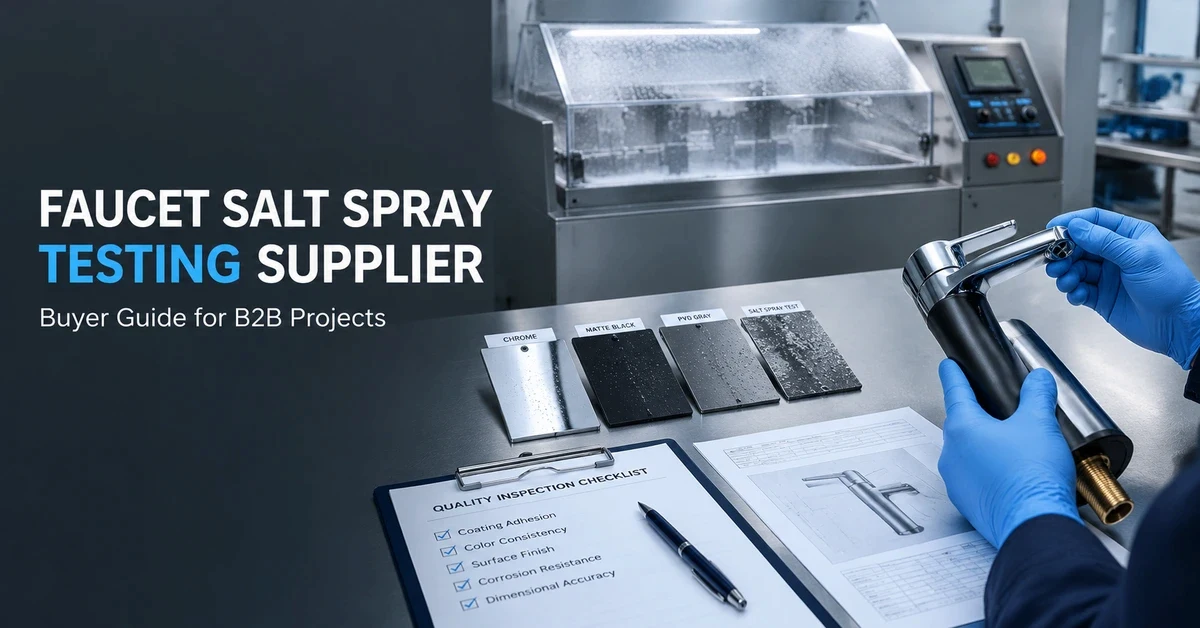

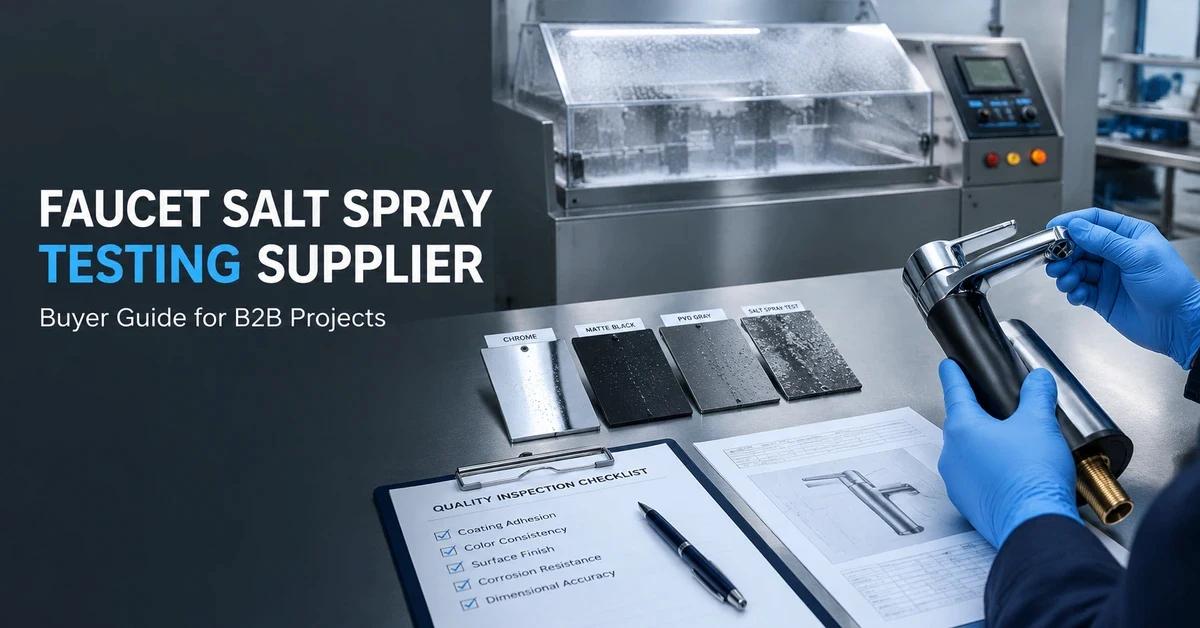
Short answer: A reliable faucet salt spray testing supplier should be able to connect the chamber result to the exact faucet model, substrate, finish process, production lot, test method, sample position, inspection criteria and corrective action record. A quoted number of hours is only one line in that evidence chain. For a hotel, restaurant, commercial washroom or OEM program, the supplier must show what was tested, how it was judged and how the result controls the product you will actually receive.
This buyer guide is for importers, bathroom brands, project contractors, hotel procurement teams and commercial-kitchen equipment companies that are comparing faucet manufacturers. It focuses on supplier qualification and RFQ control. It does not treat salt spray hours as a service-life promise, and it does not replace the destination market's applicable requirements.
Request a Faucet Finish Testing RFQ
What a faucet salt spray testing supplier must prove
When a supplier says that it can perform or arrange salt spray testing, the purchasing question is not simply whether a chamber exists. The question is whether the supplier can produce evidence that is relevant to your finished faucet and usable in a release decision. A qualified supplier should be able to explain the test method, identify the sample and lot, document the coating system, preserve the inspection photographs, state the acceptance criteria and investigate a failure without changing the story after the result is known.
This matters because a faucet is an assembly rather than a flat metal coupon. A basin faucet may combine a brass body, a cartridge, seals, a decorative finish and mounting hardware. A commercial pre-rinse assembly may add a spray head, hose, spring support and swing spout. Different substrates, edges, recesses and handling points can create different corrosion risks. A report that only says “chrome, 96 hours, pass” does not tell a project buyer whether the right part was tested or whether the visible surfaces were judged consistently.
| Buyer question | Evidence a supplier should provide | Why it changes the decision |
|---|---|---|
| Was the tested part the ordered product? | Model, finish, drawing revision, production lot and sample identity | Prevents a development coupon or unrelated SKU from supporting the quotation. |
| Was the test method appropriate? | Named method, edition, exposure conditions and deviations | NSS, AASS and CASS results are not interchangeable. |
| What counts as failure? | Significant surfaces, defect definitions, cleaning procedure and photographs | The same sample can receive different judgments under vague rules. |
| What happens after a failure? | Containment, root-cause review, retest plan and change record | A capable supplier turns a result into process control. |
Keep supplier qualification separate from test interpretation
Many buyers start with the test report because it is easy to compare. Supplier qualification starts earlier. You are checking whether the manufacturer has control over the surfaces, components and process that create the result. A good report is valuable, but it is only as strong as the supplier's identification and change-control discipline.
Capability is not the same as compliance
A factory may list coating testing and electroplating salt spray testing in its quality capabilities. That tells a buyer that the process is within the supplier's stated scope. It does not prove that every faucet, coating, substrate or destination-market requirement has already been approved. It also does not prove that the chamber is accredited for every standard or that a result from one lot applies to a later lot.
In an RFQ, ask the supplier to mark each statement as available capability, existing product evidence, project-specific test or not confirmed. This small distinction prevents a general factory profile from being mistaken for a certificate for the SKU you are buying.
Product approval is not the same as supplier approval
A supplier can have an acceptable manufacturing system while a proposed black finish, zinc-alloy handle or modified spray head remains unapproved. Conversely, one successful test does not guarantee that an undocumented component substitution will behave the same way. Keep three decisions visible: supplier capability, configuration approval and shipment release.
Seven checks for choosing a faucet salt spray testing supplier
1. Check whether the supplier controls the sample chain
The first check is simple: can the supplier prove where the sample came from? The report should identify the product model, finish code, base material, manufacturing date or lot reference, drawing revision and the person who released the sample. For a new OEM finish, the sample should be tied to the approved limit sample or pilot build rather than a loose part selected from a showroom.
Ask whether the tested sample was taken from normal production. If a supplier only tests a specially polished sample, the result may describe the best-looking part rather than the process that will fill your order. For a large project, define how many pieces are tested, how the pieces are selected and how replacements are recorded. A missing or damaged sample must not be silently replaced with a better-looking piece.
2. Check the finish and substrate map
“Chrome faucet” or “matte black faucet” is not a complete finish specification. A supplier should show the substrate and the finishing route for each significant component. The body may be brass, a decorative cover may be zinc alloy, and a handle may use a different material. Each surface can require different preparation, intermediate layers, adhesion controls and inspection points.
Request a component-level finish map that identifies the visible surfaces, water-contact surfaces, threads, sealing faces, edges and concealed areas. If several parts are supplied as a set, ask which parts share the same coating process and which parts are purchased or processed separately. A test on one body does not automatically qualify every accessory in the carton.
3. Check the chamber method and operating records
A supplier should name the salt spray method used and state any deviation. Buyers commonly see neutral salt spray, acetic acid salt spray and copper-accelerated acetic acid salt spray referenced under ISO 9227 or another agreed method. The method, solution, temperature, collection rate, exposure duration and sample orientation need to be visible in the test record.
You do not need to turn every procurement team into a laboratory. You do need a report that lets a competent reviewer reproduce the logic of the test. Ask for chamber identification, calibration or verification status, test start and end time, solution preparation record and the environmental conditions required by the method. If testing is outsourced, request the laboratory identity and the chain of responsibility between the laboratory and the faucet supplier.
4. Check how the supplier evaluates defects
A pass/fail statement without a defect definition is weak evidence. The specification should say whether it evaluates red rust, white corrosion products, blistering, peeling, pitting, discoloration, loss of gloss or edge attack. It should identify the significant surfaces and define whether a defect at a concealed thread is treated differently from a defect on the top of a spout.
Cleaning after exposure must also be controlled. Salt deposits can remain on the specimen, while aggressive cleaning can remove loose coating or corrosion products. The report should state the rinse, drying, conditioning and inspection procedure. Keep before-and-after photographs where practical, and use the same lighting and viewing distance for comparison. The purpose is not to make every finish look perfect; it is to make the decision repeatable.
5. Check whether the supplier can connect a failure to a process cause
Salt spray testing reveals a response under defined conditions. It does not by itself explain whether the cause was casting porosity, surface contamination, insufficient preparation, an intermediate-layer problem, low coating thickness, handling damage or a defect introduced during assembly. A capable supplier should have a method for moving from observation to containment and corrective action.
Ask for an example of the corrective-action structure without requesting another customer's confidential report. The record should identify the affected lot, the defect location, temporary containment, suspected cause, verification action and disposition of nonconforming product. If the supplier changes polishing, cleaning, plating parameters or packaging, the change should be recorded and linked to a retest or an agreed inspection decision.
6. Check the supplier's document discipline
A test report is useful only when it stays connected to the quotation, drawing and approved sample. Request a document register showing the model, revision, finish code, BOM or component map, test plan, report number, sample photographs and expiration or review date where applicable. Ask who is allowed to revise the document and how you will be notified of a material or coating change.
For repeat orders, put the document revision on the purchase order or quality agreement. If the supplier proposes a new cartridge, finish chemistry, base material, component source or packaging method, require written review before production. This is particularly important for private-label programs where a later change may be invisible until multiple sites are already installed.
7. Check whether the supplier can support your actual application
A faucet used in a hotel guest room, a public washroom, a restaurant dishwashing area and a coastal outdoor service zone does not face the same exposure. Cleaning chemicals, humidity, handling, salt contamination, ventilation and maintenance practices influence the risk. A suitable supplier should ask about the application rather than offer one universal hour target.
Include the destination market, project environment, finish, cleaning routine, expected quantity, installation phase and replacement strategy in the inquiry. A supplier who asks these questions is more useful than one who responds with a high number that is disconnected from the installed use.
Write the salt spray requirement into the RFQ
Do not copy a supplier's marketing phrase into your specification. Write a buyer-controlled requirement with enough detail for comparable quotations. The purpose is not to force every supplier into an identical laboratory setup when a different method is technically justified. The purpose is to make deviations visible.
| RFQ field | Buyer should specify | Supplier should return |
|---|---|---|
| Product identity | SKU, model, finish, application and drawing revision | Proposed model, deviations and sample identity |
| Substrate and coating | Component material, finish code and significant surfaces | Finish stack or process description and component map |
| Test method | Named method, edition and any project-specific conditions | Method used, exposure record and declared deviations |
| Sampling | Lot definition, number of pieces and selection rule | Lot traceability, sample photographs and replacement record |
| Acceptance | Defect definitions, evaluation area and cleaning procedure | Signed result, defect map, photos and disposition |
| Change control | Buyer approval required for substrate or finish changes | Notification route, requalification trigger and responsible owner |
Ask suppliers to label every line as complies, deviation, not applicable or not confirmed. A blank answer should not be interpreted as compliance. This format gives procurement, engineering and quality teams a shared record and makes price comparisons more honest.
Send Your Finish Specification for Review
Evaluate the manufacturer behind the report
For AQBath and AG Valve, the public company profile identifies a Ningbo, Zhejiang, China manufacturer founded in 2006. It describes markets including the United States, Japan, Australia, Europe and Southeast Asia. It also lists lead-free brass casting, zinc alloy die casting, forging, welding, pipe bending, cold stamping, precision machining, polishing and electroplating among its production capabilities.
The same page lists quality-management capabilities in material spectral analysis, coating testing, 3D image measurement, material hardness testing, product lifespan testing, product leakage testing and electroplating salt spray testing. For a buyer, this is useful first-stage supplier evidence because it shows that the factory publicly recognizes both material and surface-quality controls. The next step is to request the evidence that applies to your model and finish.
Do not turn the company profile into a laboratory certificate. It does not, by itself, establish a chamber accreditation, a specific test-hour result, a fixed coating thickness, a guaranteed service life, or compliance for every destination market. A careful quotation should state what is already documented and what will be verified during the project.
Ask for the right evidence package
- Controlled product drawing and revision number.
- Component or BOM map showing substrate and finish for each relevant part.
- Finish process description and approved physical or visual limit sample.
- Salt spray test plan with method, exposure, sample selection and acceptance rules.
- Model- and lot-linked report with photographs and defect evaluation.
- Coating thickness, adhesion or other supporting checks where the finish risk requires them.
- Corrective-action route for a failed sample or production-lot deviation.
- Packaging and handling controls that protect visible surfaces after testing.
Use actual faucet products when reviewing supplier fit
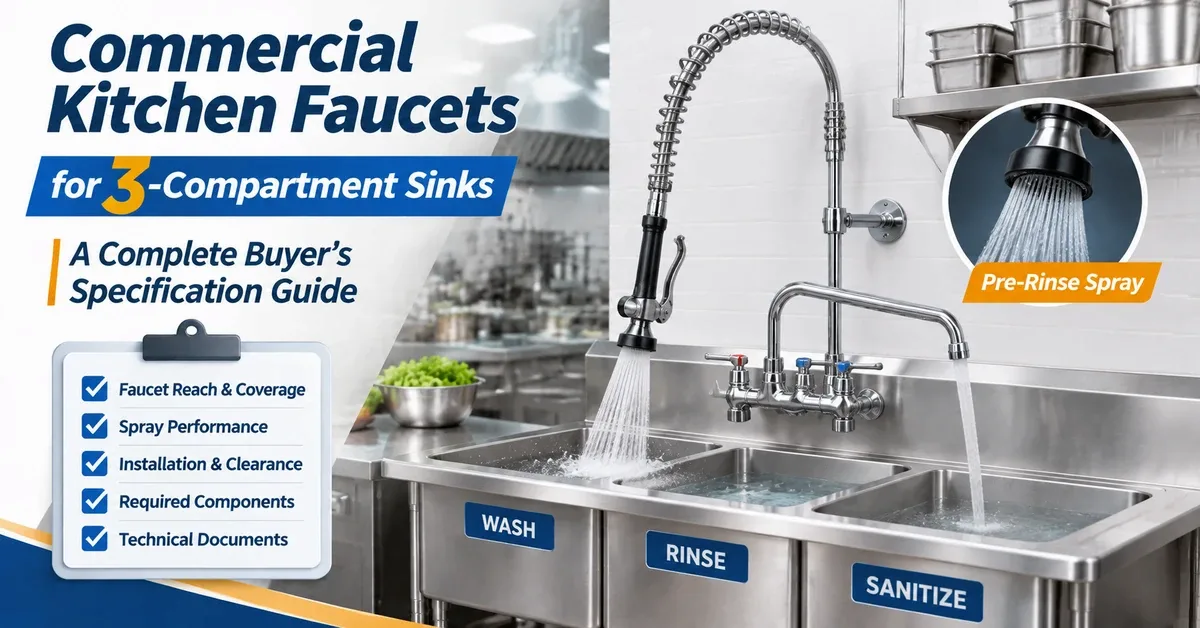
A supplier evaluation becomes more useful when it is tied to products that have a defined application. AQBath publishes the C0001CP commercial pre-rinse kitchen faucet for professional environments such as restaurants, hotels, catering facilities and dishwashing stations. The public page describes a spray head and swing spout and discusses OEM/ODM cooperation. It does not establish a universal finish test result for every order. A buyer should ask for the exact finish, substrate, lot and test evidence quoted for the project.
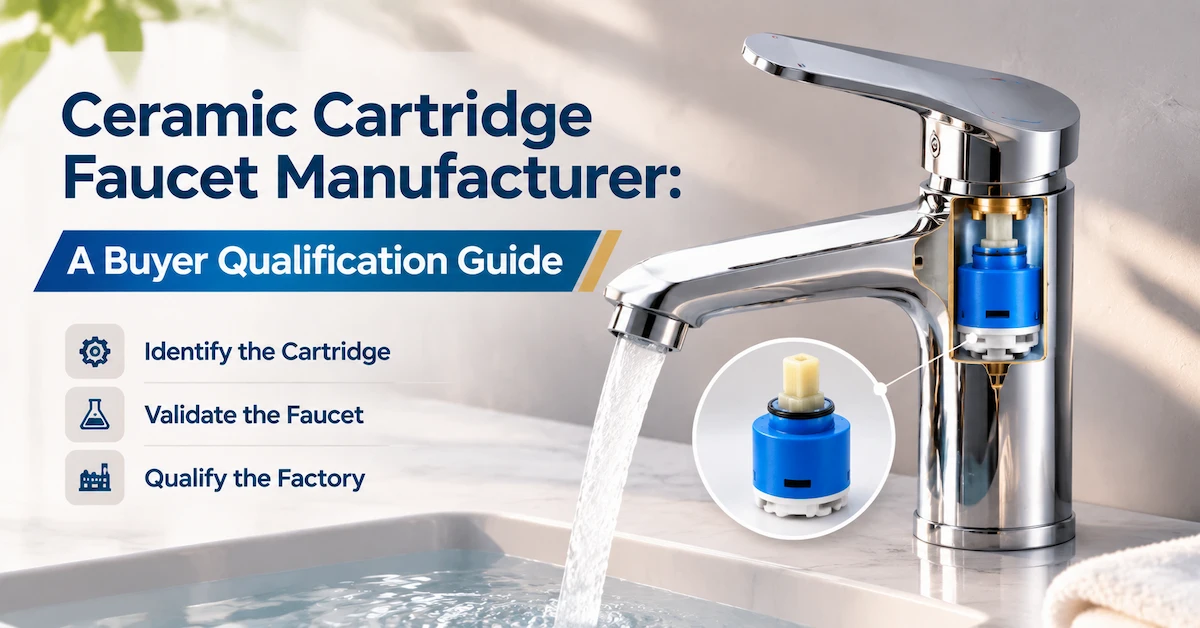
For a hospitality or commercial washroom program, the A0053-01 single-handle basin faucet page describes a brass body, single-handle operation and hospitality or commercial washroom applications. That is a useful starting point for a basin-faucet RFQ. It is not a substitute for the buyer's material declaration, finish specification, test plan or market documentation.
| Product discussion | Published starting point | Salt spray supplier questions |
|---|---|---|
| C0001CP pre-rinse assembly | Professional kitchen use; spray head and swing spout; OEM/ODM discussion | Which parts and finish are tested? Is the spring, hose support or spray head included? What lot does the report cover? |
| A0053-01 basin faucet | Brass body; single handle; hospitality and commercial washroom use; drawing available | Which finish stack and visible surfaces are covered? Does the sample match the approved drawing and production lot? |
| Custom or private-label variant | Project configuration must be agreed with the manufacturer | What change triggers requalification? Who approves a revised coating, component source or packaging method? |
Build a sample-to-shipment control plan
The supplier's test report should sit inside a wider approval process. A project buyer can reduce risk by setting four gates. Each gate answers a different question, so one positive result should not close all four.
Gate 1: document review
Review the drawing, finish map, substrate declaration, test method, report scope and applicable market documents. Resolve differences between the quotation, product page, sample label and technical file. Do not approve a finish merely because the color looks acceptable in a photograph.
Gate 2: physical sample
Install the sample on the intended basin or kitchen assembly where possible. Check the visible surfaces, transitions, threads, fixing areas and the way the operator handles the product. Record the model, finish code, sample date and approval signatures. The sample should become the visual reference for later batches, while the test report remains the technical evidence.
Gate 3: production-lot verification
Before shipment, confirm that the lot is built to the approved revision and that the sample-selection rule has been followed. A buyer may require supplier inspection records, photographs, independent inspection or a defined retest depending on risk and order size. The important point is to connect the release decision to the actual lot rather than the original development sample.
Gate 4: change control and after-sales feedback
Track finish complaints, discoloration, peeling, corrosion spots and handling scratches by model, lot and environment. A recurring complaint may require a new cleaning instruction, packaging change, surface-preparation review or finish requalification. A supplier that records feedback and updates the control plan is more valuable than one that only produces a single attractive report.
Compare suppliers on evidence quality, not quoted hours
When three suppliers quote different exposure durations, do not rank the largest number first. Normalize the comparison. Confirm that the method, substrate, finish, sample selection, defect criteria and inspection procedure are comparable. If they are not comparable, treat the result as a clarification item rather than a score.
| Evaluation area | Strong supplier response | Weak response |
|---|---|---|
| Method | Names the method, edition, conditions and deviations | Says only “salt spray tested” or quotes hours with no method |
| Traceability | Links model, finish, drawing revision and lot to the sample | Provides a generic certificate or an unlabelled photograph |
| Acceptance | Defines surfaces, defect limits, cleaning and inspection photos | Uses “no rust” without location, area or evaluation rules |
| Corrective action | Shows containment, root cause, retest and change control | Offers to retest a replacement sample with no explanation |
| Commercial clarity | Separates sample, test, inspection, packaging, MOQ and lead-time assumptions | Hides testing scope inside a low unit price |
Price still matters, but a low price that excludes model-specific testing, inspection photographs, packaging protection or a controlled retest is not a like-for-like offer. Ask every bidder to state what is included and what remains to be confirmed. This makes supplier evaluation useful for procurement and engineering at the same time.
Questions to ask before approving a supplier
Use the following questions in a structured call or RFQ response. They are designed to expose missing evidence without turning the conversation into a generic audit.
- Which exact SKU, finish and production lot does the presented report cover?
- Was the sample a finished faucet, a component, a coupon or a development piece?
- Which substrate and coating layers are present on the visible surfaces?
- Which salt spray method and edition were used, and were any conditions changed?
- How were pieces selected, labelled, positioned and photographed?
- Which surfaces and defects determine pass or fail?
- How were specimens cleaned and inspected after exposure?
- What other checks support the result, such as coating thickness, adhesion or visual inspection?
- What happens to the lot if one sample fails?
- What product, finish, component or packaging change triggers a new review?
- What MOQ and lead time apply to this exact model, finish, branding and packaging configuration?
- Which documents will be available before sample approval and which will be available before shipment?
Notice that the questions ask for conditions rather than promises. A supplier may not have every project-specific answer at the first contact, but it should identify the owner and timing for each missing item. Do not invent an MOQ, delivery date or test result in your own purchasing sheet when the supplier has not confirmed it.
FAQ for faucet salt spray testing supplier searches
What does a faucet salt spray testing supplier actually provide?
The supplier should provide a controlled test record and the product evidence needed to interpret it: model and lot identity, substrate and finish, method, exposure conditions, sample preparation, inspection criteria, photographs and result. Depending on the project, the package may also include coating thickness, adhesion, material, leakage or lifecycle records. The exact scope should be agreed before testing.
Are more salt spray hours always better?
No. Hours are meaningful only with a comparable method, sample, coating system and acceptance rule. A higher number under a different method or on a different specimen is not automatically a better result. Salt spray testing is also not a direct conversion to years of bathroom or kitchen service.
Can a factory capability page qualify my faucet?
No. A capability page helps with initial supplier screening. It does not replace the model-specific drawing, finish declaration, test plan, report and lot release evidence for the product being purchased. Public capability statements should be treated as a starting point for an RFQ.
Should the whole faucet be tested or only a coating coupon?
It depends on the risk and the agreed method. A coupon may be useful for process development or a defined coating comparison, while a finished faucet or representative component may be necessary when geometry, edges, recesses, assembly or handling affect the result. The supplier should explain why the chosen specimen represents the ordered product.
What should a hotel or restaurant buyer send with an inquiry?
Send the destination market, application, model or target configuration, finish, quantity, installation phase, cleaning environment, required documents and any project acceptance criteria. Add the drawing or fixture schedule when available. This lets the supplier propose a test scope that relates to the installed risk rather than quoting a generic number.
Does AQBath publish a fixed salt spray result for every faucet?
The public company profile lists electroplating salt spray testing as a quality capability, but the public material reviewed for this guide does not establish one universal test result for every model and finish. Request the applicable report and acceptance criteria for the configuration you plan to buy.
How can I request a product-specific review?
Use the AQBath inquiry page and include the model, finish, market, quantity and requested evidence. For a commercial kitchen discussion, the C0001CP page is a relevant starting point. For a hospitality or commercial basin discussion, the A0053-01 page provides a separate product reference. The supplier can then confirm which details require a project-specific quotation.
Conclusion
Choosing a faucet salt spray testing supplier is a supplier-evidence decision, not a contest for the largest hour number. The reliable path is to connect the exact model and finish to a controlled sample, a named method, a traceable production lot, defined defect limits, photographs, supporting checks and a corrective-action route. Then carry the approved evidence into the sample review, shipment release and repeat-order change process.