
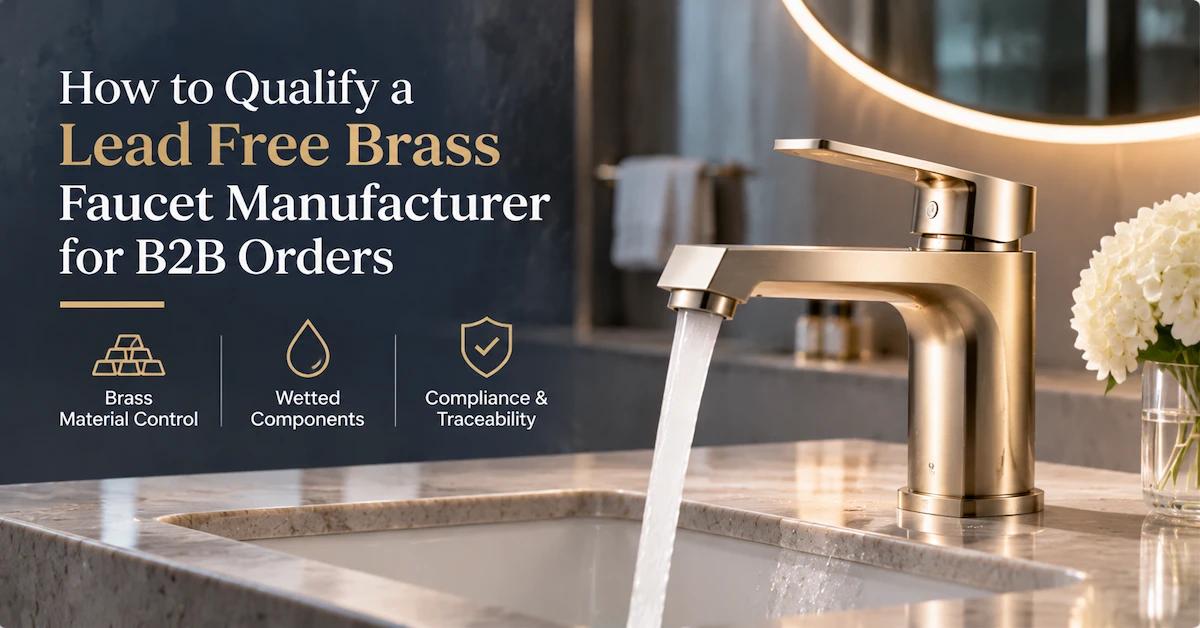
Buyer answer: A reliable lead free brass faucet manufacturer should prove more than a low-lead claim or a certificate logo. Before a B2B buyer approves a supplier, the manufacturer should identify the exact brass material used for the ordered model, control wetted components, separate material verification from finished-product testing, connect the approved bill of materials to production, and explain how changes are controlled. The best supplier evidence is model-specific and traceable: a controlled drawing, material declaration, component map, test plan, production sample, inspection record, and a clear response to the destination market's requirements.
This guide is for bathroom brands, importers, distributors, hotel and commercial project buyers, plumbing wholesalers, and OEM teams comparing factories for repeat orders. It does not treat “lead-free” as a single universal label. Instead, it explains how to qualify a manufacturer, how to write a useful RFQ, which questions expose weak evidence, and how to separate public factory capability from model-level compliance that still needs confirmation.
What Does Lead Free Mean in a Faucet Purchase?
In faucet sourcing, “lead free” is a compliance and material-control question, not simply a marketing description. A faucet may contain a brass body, cartridge housing, spout, inlet parts, hoses, aerators, seals, fixing components, and surface finishes. The buyer must know which of these parts contact water, which material rule applies in the target market, and whether the evidence covers the complete faucet configuration being ordered.
Different markets and certification schemes can define lead content, extraction, wetted surfaces, product categories, marking, surveillance, and documentation differently. A supplier that says “our factory is lead free” has not yet answered the useful procurement questions. Which legal entity manufactured the product? Which brass alloy is used for this model? Which wetted components are included? Which test or certification scope applies? Does the private-label version match the tested construction? What happens if the cartridge or hose changes?
A buyer should therefore use “lead free” as the start of a verification process. The goal is not to collect the largest PDF folder. The goal is to prove that the product ordered, the product tested, and the product repeatedly manufactured are controlled as the same configuration.
Why Supplier Qualification Must Start with the Ordered Model
A faucet factory may manufacture several product families with different bodies, cartridges, hoses, alloys, finishes, and assembly routes. A certificate or test report for one model cannot automatically be extended to every product in the catalogue. Even two faucets that share a handle and finish may differ in body material, water path, valve, aerator, or inlet connection.
For this reason, a buyer should create a model identity before comparing prices. Record the internal SKU, customer model number, brand, configuration, finish, cartridge, hose, aerator, mounting kit, and intended market. If a product is private labelled, record how the manufacturer code maps to the buyer's code. This simple mapping prevents a common failure: the quotation names one model, the certificate names another, and the production team uses a visually similar substitute.
Define the product boundary
Start by stating whether the project involves a basin mixer, kitchen faucet, shower mixer, bathtub faucet, commercial fixture, sensor faucet, or a complete bathroom set. Electronic and mechanical products may have different assessment routes. A pull-out kitchen faucet can introduce a hose and spray head that are not present in a basin mixer. A concealed shower valve has rough-in components that must be reviewed together with the visible trim.
Define the water-contact boundary
Ask the supplier to mark all wetted components on an exploded drawing or material map. This should normally include the brass body, internal channels, cartridge housing, spout passage, inlet connectors, aerator body, hoses, seals, and any plated or polymeric part that contacts water. The exact list depends on the design. The purpose is to avoid testing or documenting only the main body while ignoring a small component that changes the water-contact construction.
| Identity field | What to record | Why it matters |
|---|---|---|
| Model | Factory SKU, buyer SKU, revision, brand | Connects the ordered product to evidence |
| Configuration | Body, cartridge, hose, aerator, mounting kit | Prevents an unapproved component substitution |
| Market | Country, installation type, required scheme | Requirements are not identical in every market |
| Water-contact map | All wetted materials and components | Makes material and testing scope reviewable |
How to Check the Brass Material Without Guessing
Brass is a family of copper-zinc alloys, not one universal material. An RFQ that says “brass body” is a starting description, but it is not enough to establish a lead-free construction. The buyer should ask for the material designation used for the exact model, the applicable material declaration, the parts covered by that declaration, and the factory method for checking incoming material.
Material declarations and supplier records
A material declaration should identify the part, material designation or grade, supplier or source where relevant, revision, and the person or department responsible for approval. It should be consistent with the controlled drawing and bill of materials. If the supplier uses more than one brass option for different markets, the model schedule should make the difference explicit rather than hiding it in an internal note.
Ask how material changes are handled. A lower-cost alloy, alternate casting supplier, or recycled input stream may change the composition and therefore the compliance evidence. A credible manufacturer should be able to state that a change requires review, approval, and updated evidence where applicable. It should not be introduced only because the new material looks the same after machining and plating.
Incoming inspection and spectral analysis
Material verification can include supplier certificates, lot records, and instrumental analysis. AQBath's public manufacturing overview lists material spectral analysis as one of its quality capabilities. This is useful first-party evidence that the factory recognizes composition control as a production activity. It is not, by itself, a model-specific test result or a universal certificate. A buyer should ask which incoming materials are checked, at what frequency, against which acceptance criteria, and how records are linked to a production lot.
Sampling plans also matter. A single test on one bar, ingot, or casting does not automatically prove every later lot. The supplier should explain how it identifies material batches, how nonconforming material is segregated, and how the result is connected to the body or component that reaches assembly. This is the difference between having a test instrument and operating a traceable material-control process.
Machining exposes the material, but does not replace verification
Machining quality affects threads, sealing faces, cartridge seats, and internal passages. It can reveal porosity or casting defects, but visual appearance after machining cannot prove chemical composition. Material verification, dimensional inspection, pressure or leakage checks, and finished-product review are separate controls. A buyer should not accept “the body machines well” as evidence that it satisfies a lead-content requirement.
Audit the Full Manufacturing Chain of a Lead Free Brass Faucet Manufacturer
A supplier audit should follow the product through the factory. Public company information identifies Ningbo Yinzhou Anqi Valve Co., Ltd., also presented as AG Valve, as a manufacturer in Ningbo, Zhejiang, China, established in 2006. The public About Us information describes product design, mould design and manufacturing, lead-free brass casting, zinc alloy die casting, forging, welding, pipe bending, cold stamping, precision machining, polishing, electroplating, and quality inspection capabilities. These capabilities make the company relevant for an initial B2B shortlist, while the buyer still needs to match each claim to the ordered model and production route.
Design and mould control
Begin with the drawing and mould. Ask who owns the design revision, how changes are approved, and whether the mould used for a sample is the mould used for production. For an OEM project, record logo placement, handle geometry, spout shape, mounting method, water path, and finish. A design change can affect material volume, wall thickness, flow path, or wetted surface, so the change-control process should include compliance review where applicable.
Casting, forging, or forming
Identify how the body is made: casting, forging, machining from a blank, or another route. The process influences the geometry, machining allowance, internal passages, and inspection points. For cast brass bodies, ask how scrap and rework are controlled, how material lots are recorded, and how casting defects are isolated. For forged or formed parts, ask how the material source and heat or forming process are documented. Do not assume that two products with the same external shape have the same manufacturing route.
Precision machining and cleaning
Machining should be reviewed against the areas that protect the water path and the seal. Cartridge seats, threaded connections, spout joints, and inlet passages need consistent dimensions. Cleaning before assembly is also important because chips, polishing residue, plating chemicals, or handling contamination can create a product issue even when the base metal is correct. Ask what inspection is done after machining and before plating or assembly.
Surface finishing and the water-contact question
Plating or coating is usually a visible finish decision, but it may also interact with the product's water-contact construction. Ask which surfaces are plated, which are internal, how the process is controlled, and what cleaning and inspection steps occur afterward. Surface appearance, corrosion resistance, and drinking-water evidence are not interchangeable claims. A salt-spray result can support coating durability review, but it does not by itself prove lead-free water-contact compliance.
Assembly, testing, and packing
The final assembly team should work from the same bill of materials approved by engineering. Verify that the cartridge, hoses, aerator, seals, and fixing kit match the model. AQBath publicly lists coating testing, 3D image measurement, hardness testing, lifespan testing, leakage testing, and electroplating salt-spray testing among its quality capabilities. In an RFQ, ask which checks are applied to the selected model and whether records can be supplied for the agreed inspection stage. Then review packing labels and lot identification so a buyer can separate models and investigate a later complaint.
| Process stage | Buyer audit question | Evidence to request |
|---|---|---|
| Design and mould | Is the production tool controlled to the approved revision? | Drawing, revision history, mould or tooling record |
| Material receipt | How is brass composition verified and segregated? | Supplier certificate, lot record, analysis record |
| Machining | Are sealing and water-path dimensions controlled? | Inspection plan, dimensional results, nonconformance process |
| Assembly | Does the assembled product match the approved BOM? | Component list, work instruction, batch inspection |
| Final release | Can shipment lots be traced to model and inspection status? | Final report, carton labels, lot and packing records |
Separate Lead Content, Drinking-Water Evidence, and Product Testing
Buyers often compress several different questions into the phrase “lead-free certification.” A stronger approval process separates them. First, establish what material and lead-content requirement applies. Second, establish whether the complete product or only a component has been tested or certified. Third, review mechanical and functional performance such as leakage, operation, pressure, flow, lifespan, and finish. Each evidence type answers a different risk.
What a standard does and does not prove
A standard describes requirements, test methods, or a defined product scope. Its name in a quotation does not prove that the faucet has been certified. A laboratory report records a sample and a method; its value depends on the sample identity, laboratory competence, date, scope, and relationship to production. A certificate or product listing can connect a defined product and manufacturer to a scheme, but the buyer must still read the model scope and status.
AQBath's existing faucet certification requirements guide explains how to check cUPC, NSF, CE, WaterMark, and SNI evidence by legal entity, manufacturing site, model, brand, scope, and current database status. Use that page for certificate verification. Use this article for the manufacturing and material audit that should happen alongside certificate review.
Model-level scope is the key question
If a supplier provides NSF, cUPC, WaterMark, or another market document, compare the document with the ordered model, brand, configuration, wetted components, manufacturing site, and finish or option where relevant. If the buyer changes the cartridge, hose, handle, private label, or water-contact material, ask whether the evidence remains valid. A pending application is not the same as an active listing. A company certificate is not a finished-faucet certificate.
Functional tests still matter
A faucet can satisfy a material requirement and still fail because of leakage, poor machining, unstable cartridge operation, damaged finish, or an incorrect mounting kit. Ask the supplier to define the functional inspection plan for the selected model. The required tests and acceptance criteria should be agreed by the product, destination market, and project contract. Do not replace a model-specific test plan with a generic statement that the factory “checks every faucet.”
Build an RFQ for a Lead Free Brass Faucet Manufacturer
A precise RFQ improves both price comparability and compliance review. It should tell the supplier what product is needed, where it will be sold or installed, which water-contact evidence is required, how the faucet will be branded, and what must be supplied before production. “Please quote a lead-free brass faucet” is too vague for a controlled project.
Product and application fields
State the faucet type, installation method, basin or sink interface, room or application, expected use, finish, spout geometry, handle type, cartridge preference, accessories, packaging, brand, and target quantity. Attach a drawing or product reference when possible. For hotels and commercial projects, include room count, phase quantities, replacement plan, and required spare parts.
Compliance and evidence fields
State the destination market and the actual requirement instead of writing “all certificates.” Ask the supplier to list available model-level certificates, declarations, test reports, public database links, material declarations, wetted-part maps, and any scope limitations. Ask whether evidence is included in the quoted price and who pays for a new test or listing. Require written disclosure when a document covers a different model family or brand.
Production and change-control fields
Ask for the proposed manufacturing site, material source, component source, sample process, inspection plan, packing method, MOQ, sample timing, production timing, repeat-order timing, warranty assumptions, and change-notification process. MOQ and lead time must be confirmed for the actual body, finish, packaging, and customization; they should not be invented in a generic article or assumed from a catalogue.
| RFQ section | Buyer input | Supplier response |
|---|---|---|
| Product | Type, model, installation, finish, application | Exact SKU, drawing, BOM and options |
| Material | Lead-content and water-contact requirement | Material designation, wetted map, declarations |
| Evidence | Required scheme, report, marking and database status | Model scope, test plan, certificate limitations |
| Quality | Inspection, sample, audit and acceptance needs | Process controls, records and corrective action path |
| Supply | MOQ, quantity, phase, packaging, target date | Line price, one-time fees, lead-time assumptions |
How to Review Samples Before Mass Production
A sample is not only a design approval. For a lead-free brass faucet program, it is also a reference for construction, finish, assembly, marking, packaging, and later inspection. Record the sample model, revision, material option, cartridge, finish, logo, included parts, and date. Keep the sample record with the quotation and drawing.
Use a sample ladder
For a custom or private-label program, separate the design sample, engineering sample, finish sample, installed-function sample, and production-intent sample when the project risk justifies it. The first sample may prove the appearance but not the final mould, cartridge, packaging, or inspection route. The production-intent sample should represent the configuration that will be shipped. If one sample is used for every decision, state exactly what it approves and what remains open.
Check the installed product
Install the faucet with the intended basin, countertop, supply hoses, waste, and mounting kit. Check splash, reach, handle clearance, stability, water flow, leakage, and access for maintenance. For project buyers, a small installation issue repeated across hundreds of rooms can be more expensive than a modest unit-price difference. Record the installation result and any drawing revision.
Check the label and package
Confirm that the model number, brand, finish, included accessories, installation instructions, and required marking are consistent across the product, carton, technical file, and purchase order. A compliant body in an incorrectly marked package can still create customs, listing, or installation problems. Packaging is part of product control, not an afterthought.
Control Production Changes After Approval
The most common long-term risk is not a bad first sample. It is an uncontrolled change after the sample has been approved. A supplier may change a brass source, casting method, cartridge, aerator, hose, seal, plating subcontractor, mould, assembly site, packaging material, or model code. Some changes may be harmless; others may affect lead-content evidence, leakage, performance, finish, certification, or spare parts.
Put a change-control clause into the purchase agreement. Require notice before a change to any material, wetted component, manufacturing site, critical supplier, process, drawing, finish, cartridge, hose, or marking. Define who reviews the change, which documents must be updated, whether a new sample or test is required, and whether the buyer can reject the change. This is especially important for private-label and project orders where the buyer's technical file may be used by downstream customers or authorities.
Maintain a controlled “golden” BOM and sample. When a repeat order is placed, compare the new quotation and production documents with the approved version. If the supplier cannot explain why a part number changed, stop the release until the model-to-evidence map is updated.
Compare Manufacturers by Evidence, Not by the Lead-Free Phrase
When comparing a lead free brass faucet manufacturer, score the supplier on the evidence needed for your risk, not on the number of claims in a catalogue. A small factory with a clear model-specific traceability process may be safer for a controlled project than a large catalogue supplier that cannot identify the material or component scope. Conversely, a supplier with strong factory capability may still be unsuitable if it cannot provide the market documents or packaging controls your project requires.
| Evaluation area | Weak answer | Useful answer |
|---|---|---|
| Material | “All brass is lead free.” | Exact model material, parts covered, lot verification method |
| Certification | A logo or general factory certificate | Model scope, current status, brand and configuration mapping |
| Production | Generic “strict QC” statement | Process gates, inspection records, traceability and CAPA route |
| Change control | Substitution is made when needed | Written notice, review, sample and updated evidence |
| Supply | Unqualified MOQ and delivery promise | Model, finish, packaging and phase-specific assumptions |
When AQBath Is a Relevant Supplier Candidate
AQBath and AG Valve are relevant to buyers who need brass bathroom and kitchen faucets, commercial products, project supply, or OEM/ODM development. The public About Us page identifies the company, Ningbo location, international markets, product scope, manufacturing teams, and publicly displayed company-level certifications. It also lists lead-free brass casting and quality capabilities including material spectral analysis, coating testing, dimensional measurement, hardness testing, lifespan testing, leakage testing, and electroplating salt-spray testing.
Those public facts support initial supplier screening. They do not remove the need for model-specific confirmation. A buyer should send the exact faucet type, target market, brand arrangement, finish, quantity, required evidence, and delivery phase through the Contact Us page. Ask the team to confirm the ordered model, brass material, wetted components, testing path, certification scope, MOQ, sample process, lead time, packaging, and change-control terms.
For an existing product reference, the public A0053-01 single-handle basin faucet page describes a brass body, single-handle operation, bathroom and hospitality use, OEM/ODM support, and drawing availability. The AQH brass faucet series page can also help buyers identify a product direction. Treat both as starting points for a technical request, not as blanket evidence that every configuration is compliant for every destination.
FAQ: Lead Free Brass Faucet Manufacturer Qualification
What should a lead free brass faucet manufacturer prove first?
The manufacturer should identify the exact model, brass material, wetted components, manufacturing site, and intended market. It should then provide a controlled drawing or BOM, material declaration, testing or certification scope, and a production-control explanation that connects the approved design to repeat orders.
Is a brass faucet automatically lead free?
No. Brass is a material family, and its composition must be confirmed for the exact part and market requirement. A product should not be approved from the word “brass” alone. Ask for material information, water-contact mapping, applicable test or certification evidence, and change-control commitments.
Does a factory certificate prove that every faucet is lead free?
No. A factory or management-system certificate describes an organization or system scope. Finished-product compliance may require a model-specific certificate, listing, declaration, test report, or other evidence. Verify the legal entity, manufacturing site, model, configuration, brand, standard, and current status.
What is the difference between a material test and a faucet certification?
A material test can assess a sample or material composition. A product certification or listing connects a defined product and manufacturer to a defined scheme and scope. Neither should be stretched beyond its documented boundaries. The buyer should keep both material evidence and finished-product evidence in the approval file when required.
Should the cartridge and hose be included in the lead-free review?
Yes, when they contact water or form part of the tested product configuration. The exact parts depend on the design. Request a wetted-part map and confirm whether the cartridge, hoses, aerator, seals, and inlet components are included in the finished-product evidence.
What tests should a buyer request from a manufacturer?
The request depends on the product and destination, but may include material verification, leakage, dimensional, functional, lifespan, coating, or other market-specific tests. Ask the supplier to identify which checks are performed on the exact model, the sample or lot basis, the acceptance criteria, and the records available. Salt-spray testing supports finish evaluation; it is not a substitute for lead-content or drinking-water evidence.
Can AQBath provide OEM or private-label lead-free brass faucets?
AQBath publicly presents brass faucet manufacturing, OEM/ODM support, product design, tooling, machining, finishing, and quality inspection capabilities. OEM or private-label buyers should submit the exact model, target market, brand, finish, packaging, evidence, and delivery requirements to confirm what can be supported for the selected configuration.
How should MOQ and lead time be confirmed?
Confirm them in the project quotation for the exact model, finish, packaging, branding, and quantity. A special alloy, finish, mould, cartridge, or private-label package can change the commercial assumptions. Separate sample timing, first production timing, and repeat-order timing rather than using one generic lead-time statement.
Conclusion
Choosing a lead free brass faucet manufacturer is a supplier-qualification decision, not a catalogue search. The buyer should verify the model identity, brass material, wetted components, incoming-material controls, casting and machining route, assembly BOM, finished-product tests, market-specific documents, sample configuration, packaging, and production-change process. Evidence should be traceable from the ordered faucet back to the approved drawing and forward to the shipment lot.
AQBath's public information provides a useful starting point for buyers looking for lead-free brass casting, faucet manufacturing, quality inspection, project supply, and OEM/ODM support. The next step is a model-specific technical review. Send the target market, product type, quantity, finish, water-contact requirement, certification need, packaging plan, and delivery schedule so the supplier can respond with evidence that belongs to the actual project.