
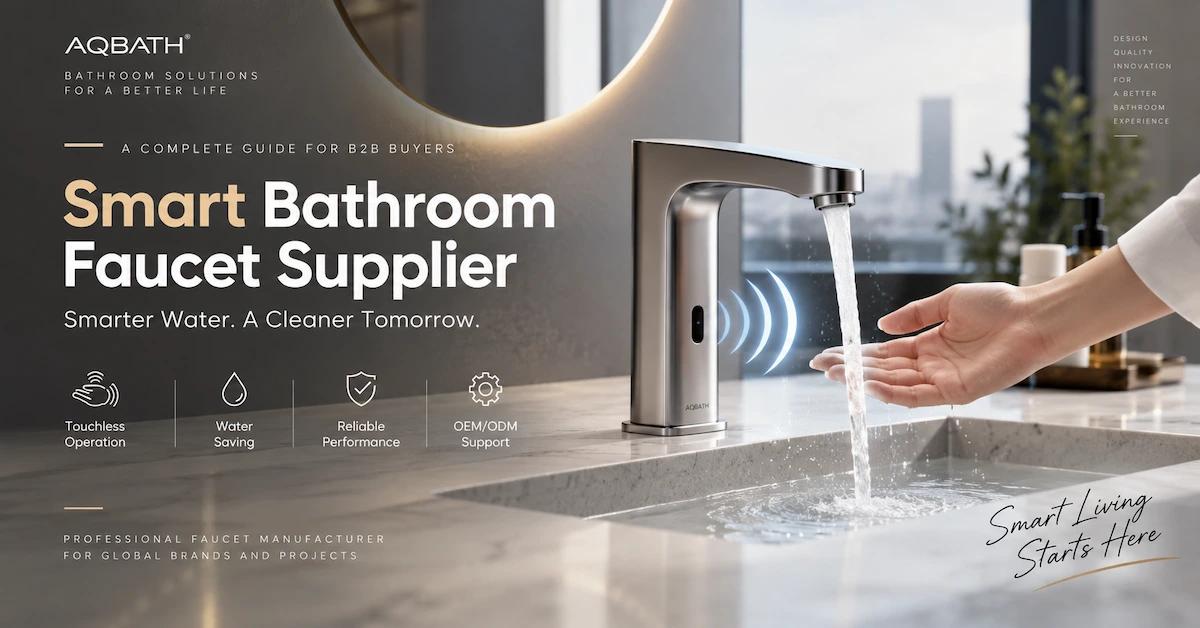
What Should a Smart Bathroom Faucet Supplier Actually Provide?
A smart bathroom faucet supplier should provide more than a faucet body with an electronic sensor added to it. For a B2B buyer, the real product is a controlled system that combines the mechanical faucet, waterway, sensing method, electronic control, power supply, installation hardware, finish, testing requirements, packaging, documentation, and long-term replacement strategy.
That distinction matters for bathroom brands, distributors, hotel projects, apartment developments, healthcare facilities, and commercial washrooms. A faucet may operate correctly during a short sample demonstration but still create problems later if the sensor range is unstable, the control box is difficult to access, the battery architecture is unsuitable for the project, or the mechanical platform is inconsistent between production batches.
Buyer takeaway: Do not approve a smart faucet from a product photo or a sensor demonstration alone. Approve a complete specification that can be repeated in samples, production, inspection, installation, and future replacement orders.
AQBATH’s current public catalog focuses on conventional and project-oriented faucet platforms, including basin faucets, kitchen faucets, shower faucets, commercial kitchen faucets, and top-fixed basin faucets. Buyers requiring sensor, touchless, or other electronic functions should confirm the exact OEM/ODM scope and technical feasibility for the intended model before treating a platform as a smart faucet solution.
Define “Smart” Before Asking for a Quotation
“Smart bathroom faucet” can describe several different product concepts. If the buyer and supplier use the same term for different functions, the RFQ may already be wrong before pricing begins.
For procurement purposes, separate the required function into clear categories.
| Smart Function | Typical Buyer Requirement | What Must Be Confirmed |
|---|---|---|
| Touchless activation | Automatic hand detection | Sensor type, range, response logic |
| Automatic shutoff | Reduce unnecessary running | Shutoff timing and control logic |
| Electronic water control | Controlled opening/closing | Valve module and power architecture |
| Temperature management | Safer or preset outlet temperature | Mixing method and temperature limits |
| Battery operation | Retrofit or no nearby mains power | Battery type, life target, access |
| AC/DC power | High-use commercial projects | Input requirement, adapter location |
| Connected features | Monitoring or system integration | Communication protocol, software scope |
The first RFQ question should therefore not be:
“Can you make a smart faucet?”
It should be closer to:
“We need a deck-mounted sensor basin faucet for a hotel/public washroom program, with defined detection range, power architecture, installation space, finish, target market, annual quantity, and compliance requirements.”
That gives the supplier an engineering problem that can actually be evaluated.
Start With the Application, Not the Sensor
The best sensor technology is still the wrong solution if the faucet does not fit the actual bathroom.
A smart bathroom faucet supplier should first understand where the product will be installed.
Hotels and Serviced Apartments
Hotel buyers usually care about:
-
visual consistency across rooms
-
basin-to-spout geometry
-
simple installation
-
accessible maintenance
-
spare parts
-
stable finish between batches
-
controlled replacement specifications
For hotel programs, a smart faucet should be checked in a mock-up bathroom before bulk approval. Sensor behavior, basin splash, control-box access, hose routing, cleaning access, and power replacement can all look different in the real vanity than they do on a sample table.
Commercial Washrooms
Offices, shopping centers, schools, transportation facilities, and other high-use washrooms place more emphasis on:
-
activation reliability
-
repeated operation
-
vandal resistance
-
maintenance access
-
shutoff behavior
-
water control
-
downtime
-
spare-part availability
A low unit price is less valuable if a maintenance team must repeatedly remove panels or disconnect plumbing to service the electronic module.
Healthcare and Senior-Care Facilities
Touchless operation may reduce the number of physical contact points, but that does not automatically make every sensor faucet suitable for healthcare applications.
Buyers should separately evaluate:
-
cleaning procedures
-
waterway materials
-
temperature control
-
accessibility
-
maintenance routines
-
applicable facility requirements
“Touchless” and “hygienic” should not be treated as interchangeable technical claims without evidence.
Residential and Private-Label Programs
A consumer-oriented smart faucet may place more weight on:
-
design
-
battery replacement
-
intuitive operation
-
finish
-
packaging
-
installation instructions
-
after-sales support
For private-label brands, the electronics and spare-parts strategy can be just as important as the faucet design because product reviews often reflect installation and long-term reliability, not only appearance.
The Mechanical Faucet Platform Still Determines Reliability
Smart functions do not remove the need for good faucet engineering.
Before evaluating sensors, buyers should still verify the mechanical platform.
Body and Waterway Materials
The quotation should identify which components are made from:
-
brass
-
lead-free brass where required
-
stainless steel
-
zinc alloy
-
engineering plastic
-
elastomers and seals
Do not accept a single description such as “brass faucet” without knowing which water-contact and structural components it refers to.
AQBATH publicly lists manufacturing capabilities including brass and lead-free brass casting, zinc-alloy die casting, forging, welding, pipe bending, stamping, precision machining, polishing, and electroplating. Buyers can review the manufacturer’s broader production background on the About AQBATH page.
Spout Geometry
For a basin faucet, check:
-
overall height
-
outlet height
-
spout reach
-
outlet angle
-
basin depth
-
basin drain position
A sensor faucet that activates perfectly can still perform poorly if water hits the wrong part of the basin and creates excessive splash.
Mounting Structure
Confirm:
-
mounting-hole diameter
-
allowable deck thickness
-
base dimensions
-
fastening method
-
hose routing
-
access below the basin
-
access to electronic components
AQBATH’s top-fixed basin faucet range illustrates why mounting architecture matters in projects where cabinet access is restricted. A top-fixed mechanical platform should not automatically be described as a smart faucet, but installation-oriented design thinking can still be relevant when developing an electronic bathroom faucet.
What Should Buyers Verify in the Sensor System?
The sensor module is one of the areas where an ordinary faucet specification becomes insufficient.
Ask the supplier to document the electronic architecture rather than simply stating “infrared sensor.”
Detection Range
The sensor should have a defined working range.
Buyers should ask:
-
Is the range fixed or adjustable?
-
What is the target detection distance?
-
Can reflective basins or mirrors affect detection?
-
How does the faucet respond to stationary objects?
-
What happens when hands leave the sensing area?
A showroom demonstration is not enough. Detection should be validated in the actual basin environment.
Response and Shutoff Logic
Specify:
-
activation response
-
shutoff delay
-
maximum continuous run time
-
anti-false-trigger logic
-
restart behavior
These settings influence user experience, water consumption, and failure behavior.
Solenoid or Electronic Valve Module
If the faucet uses an electronic valve, buyers should identify:
-
valve supplier or controlled specification
-
water-pressure range
-
serviceability
-
replacement method
-
expected validation method
A beautiful faucet body cannot compensate for an unstable valve module.
Control Box
For externally controlled designs, verify:
-
dimensions
-
mounting location
-
water protection
-
connector type
-
service access
-
cable routing
-
hose routing
This is especially important in hotel vanities and commercial washrooms where space under the basin may already contain traps, shutoff valves, shelves, or cabinetry.
Power Architecture Is a Procurement Decision
Battery, mains-powered, or hybrid operation changes the installation and maintenance model.
Battery-Powered Faucets
Potential benefits include easier retrofit installation where electrical infrastructure is unavailable.
But buyers should clarify:
-
battery type
-
number of batteries
-
expected service target under defined usage
-
low-power indication
-
battery compartment location
-
replacement access
Avoid unsupported statements such as “three-year battery life” unless the supplier defines usage frequency, battery specification, operating environment, and test basis.
AC or DC-Powered Systems
These may suit high-use projects with planned electrical infrastructure, but buyers should check:
-
voltage/input requirement
-
adapter specifications
-
cable length
-
installation location
-
electrical protection
-
local approval requirements
The correct power option depends on the building, not only the faucet.
Quality Control Must Cover Both Mechanical and Electronic Risks
A smart bathroom faucet supplier should be able to separate ordinary faucet QC from additional electronic validation.
AQBATH publicly lists mechanical and surface-quality capabilities such as material spectral analysis, coating testing, 3D measurement, hardness testing, lifespan testing, leakage testing, and electroplating salt-spray testing. Buyers evaluating its standard faucet manufacturing controls can also review the company’s bathroom faucet manufacturer quality audit.
For a sensor or electronic version, additional evidence should be discussed separately.
A useful smart-faucet QC plan may include:
-
sensor activation repeatability
-
detection-range verification
-
false-trigger testing
-
solenoid opening/closing cycles
-
power-loss behavior
-
low-battery behavior
-
connector reliability
-
water exposure around electronic components
-
combined faucet leakage testing
-
final functional testing after assembly
Do not assume that a factory’s normal mechanical faucet tests automatically cover sensor electronics.
Certifications Must Be Checked at Model Level
AQBATH’s company profile currently lists certifications and standards including ISO9001:2015, ISO14001:2015, cUPC, NSF, CE, WaterMark, and SNI.
That is useful when evaluating supplier capability, but it does not mean every smart faucet configuration automatically carries every listed certification.
Changing from a mechanical basin faucet to an electronically controlled faucet may change:
-
components
-
waterway
-
power architecture
-
electrical scope
-
applicable standards
-
certification file
-
test requirements
For this reason, the supplier should connect the requested destination market to the exact model and configuration.
A professional supplier response should say:
“This exact configuration is covered by this document.”
not:
“Our company has this certificate.”
OEM/ODM Development Should Freeze the Complete Smart-Faucet Specification
Smart faucet projects create more revision-control risk than standard faucets because both mechanical and electronic components can change.
AQBATH’s existing OEM faucet manufacturing guide emphasizes the value of converting a customized faucet into a controlled, repeatable specification. That principle becomes even more important for smart products.
Before mass production, buyers should freeze:
-
faucet model
-
dimensional drawing
-
body material
-
waterway materials
-
finish reference
-
aerator or outlet component
-
sensor module
-
detection parameters
-
electronic valve
-
control box
-
power supply
-
cable and connector specifications
-
hoses
-
mounting hardware
-
accessories
-
packaging
-
labeling
-
instructions
-
inspection criteria
If the smart function includes programmable logic or connected features, the approved version should also identify the relevant software or firmware configuration.
Golden Samples Matter More Than Catalog Samples
A catalog sample tells you what the supplier can send once.
A golden sample tells production and QC what must be reproduced.
For a smart bathroom faucet, the approved sample should validate:
-
appearance
-
dimensions
-
basin compatibility
-
sensor behavior
-
flow behavior
-
installation
-
power configuration
-
maintenance access
-
packaging
-
documentation
For hotel and project orders, testing the golden sample in the intended installation environment is preferable to approving it only on a conference-room table.
How to Compare Smart Bathroom Faucet Suppliers
Use a supplier scorecard that separates marketing claims from evidence.
| Evaluation Area | What to Ask For | Procurement Risk if Missing |
|---|---|---|
| Mechanical platform | Drawing, materials, mounting | Fit or leakage problems |
| Sensor system | Detection specification and sample | False activation |
| Electronic valve | Controlled part specification | Early functional failure |
| Power supply | Defined architecture | Maintenance problems |
| QC | Mechanical + electronic test plan | Unstable production |
| Compliance | Model-specific evidence | Market-entry risk |
| OEM control | BOM and golden sample | Repeat-order variation |
| Spare parts | Replacement plan | Long downtime |
| Packaging | Approved pack standard | Transit damage |
| Change control | Written revision process | Unapproved substitutions |
A supplier does not need the most complex technology to be the right partner. It needs a system that is suitable for the application and sufficiently controlled to remain consistent.
What Type of Buyer Is This Supplier Evaluation Best For?
The smart bathroom faucet supplier keyword is especially relevant to:
-
bathroom fixture brands developing a sensor faucet line
-
importers adding touchless washroom products
-
hotel procurement teams
-
commercial building contractors
-
washroom solution providers
-
healthcare project suppliers
-
private-label brands
-
distributors evaluating automatic faucet categories
-
OEM buyers developing market-specific bathroom products
It is less useful for buyers who have not yet defined the application, market, installation method, or desired smart function.
If the project is still at that stage, start with the complete faucet product range and determine which mechanical platform is closest to the desired bathroom application before adding electronic requirements.
Common Smart Faucet Sourcing Mistakes
Choosing by Sensor Feature Alone
“Touchless” does not tell you whether the faucet fits the basin, project, plumbing, or maintenance environment.
Ignoring Service Access
A control box or battery compartment that is difficult to reach can create recurring maintenance costs.
Treating Company Certificates as Product Certificates
Always verify the exact model and configuration.
Approving a Sample Without a Controlled BOM
Future production may not remain identical if critical components are not locked.
Asking for the Lowest Price Before Freezing the Specification
Two quotations can appear to describe the same smart faucet while using completely different sensors, valves, materials, power systems, and test requirements.
Forgetting Spare Parts
The project should define which components can be replaced independently and how long replacements are expected to remain available.
Smart Bathroom Faucet RFQ Checklist
Before requesting a final quotation, send the supplier:
-
destination country
-
buyer type
-
application
-
residential/private or commercial/public use
-
annual quantity
-
project quantity
-
target price range
-
faucet style
-
basin drawing if available
-
mounting-hole requirement
-
deck thickness
-
desired material
-
finish
-
desired smart function
-
sensor range requirement
-
shutoff logic
-
battery or mains power preference
-
water-pressure conditions
-
flow requirement
-
certification requirement
-
logo requirement
-
packaging requirement
-
spare-parts requirement
-
sample quantity
-
target production schedule
This information helps the supplier respond with an engineering-based quotation rather than a generic price.
How AQBATH Can Be Evaluated for a Smart Faucet Project
AQBATH’s public website shows an established mechanical faucet manufacturing base with product design, mold development, casting, machining, polishing, electroplating, and faucet quality-control capabilities. Its catalog includes basin, kitchen, shower, bathtub, commercial, brass, and top-fixed faucet platforms.
However, the current public product catalog does not show a dedicated sensor or touchless bathroom faucet category.
For a buyer searching for a smart bathroom faucet supplier, the correct next step is therefore not to assume that an existing AQBATH faucet already includes smart electronics. Instead, identify the closest mechanical platform and ask whether the required sensor, valve, power architecture, testing, and certification scope can be developed or supplied for that project.
Buyers can review the company manufacturing capabilities, compare the current faucet catalog, and then send AQBATH a project-specific RFQ.
A useful inquiry should include the smart function, target market, installation environment, expected quantity, certification requirements, and the mechanical faucet style you want to use as the starting platform.
FAQ
1. What is a smart bathroom faucet?
For sourcing purposes, it usually refers to a bathroom faucet with electronic functions such as touchless sensing, automatic water control, electronic shutoff, temperature-related control, or other digitally controlled features. The exact function should always be defined in the RFQ.
2. Is a sensor faucet the same as a smart faucet?
Not always. A sensor faucet is one type of smart faucet. Some smart products may include additional electronic controls, temperature functions, monitoring, or connectivity.
3. What should I ask a smart bathroom faucet supplier before ordering?
Ask for the exact mechanical drawing, materials, sensor specification, electronic valve, power system, installation requirements, QC plan, compliance documents, spare-parts strategy, and approved BOM.
4. Can an existing basin faucet be converted into a sensor faucet?
Sometimes an existing mechanical platform can provide a useful starting point, but sensor integration may require changes to the body, waterway, mounting, control box, hoses, power system, and certification scope. Feasibility should be reviewed model by model.
5. Which is better: battery or mains power?
Neither is universally better. Battery power can simplify some retrofit projects, while mains power may suit high-use buildings with planned electrical infrastructure. Maintenance access and local electrical requirements should influence the choice.
6. Do company-level faucet certificates automatically cover a smart faucet?
No. Certification should be confirmed for the exact model, configuration, target market, and current certificate scope.
7. What quality tests should be added for a sensor bathroom faucet?
In addition to ordinary faucet material, finish, leakage, dimensional, and lifecycle checks, buyers should discuss sensor repeatability, false activation, electronic valve cycles, power-loss behavior, connectors, and final functional testing.
8. What should be included in a golden sample?
The golden sample should represent the approved appearance, dimensions, materials, sensor behavior, valve, power system, mounting hardware, hoses, finish, packaging, labeling, and instructions.
9. Is a touchless faucet automatically more hygienic?
Touchless operation can reduce direct hand contact with the faucet control, but hygiene performance also depends on cleaning, waterway design, facility procedures, installation, and maintenance. Avoid treating “touchless” as a complete hygiene specification.
10. How should I request a smart bathroom faucet quotation from AQBATH?
Send the target market, faucet application, desired smart function, basin or installation information, quantity, finish, certification needs, OEM requirements, and target schedule through the AQBATH contact page. The electronic customization scope should be confirmed before final quotation and sample approval.
Conclusion
Choosing a smart bathroom faucet supplier is primarily a specification-control decision, not simply a sensor-feature comparison. Buyers should verify the faucet platform, sensor and valve architecture, power system, installation access, testing plan, compliance scope, OEM controls, spare-parts strategy, and repeat-order consistency before approving mass production.
If you are developing a sensor, touchless, hotel, commercial washroom, or private-label faucet project, review AQBATH’s current faucet platforms and then send your specifications for project evaluation and quotation. Providing your target market, application, quantity, smart-function requirements, installation conditions, and certification needs will make the technical evaluation and quotation more precise.