

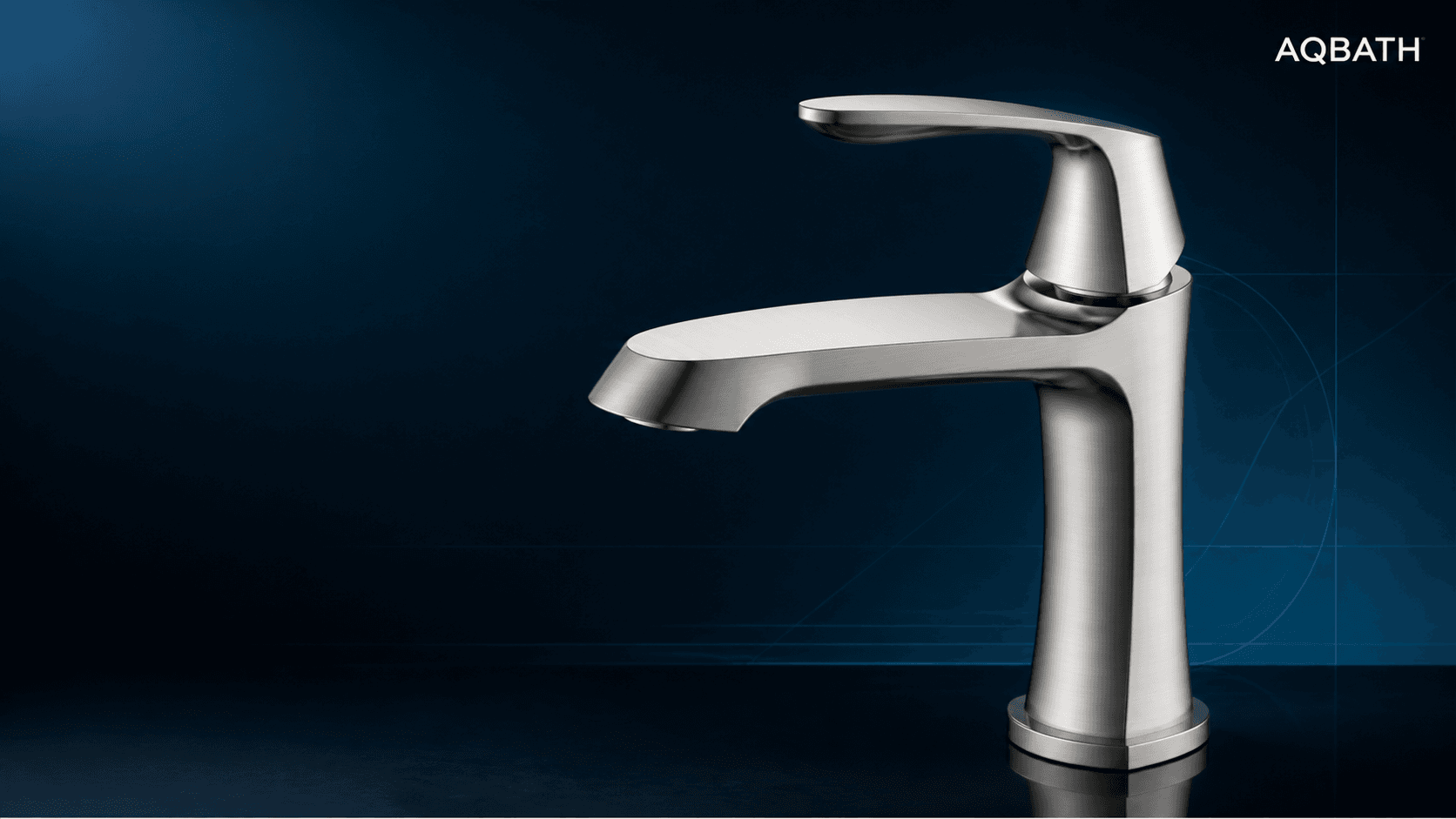
Bathroom Faucet Manufacturer Audit: How to Verify Brass, Cartridge, Finish and Factory Quality
Direct answer: Do not select a bathroom faucet manufacturer from a catalog, price list, or certificate collage alone. Approve a supplier only after the factory can connect one exact model number to a controlled bill of materials, destination-market compliance evidence, dimensional drawings, cartridge and waterway specifications, finish test conditions, functional test records, packaging validation, traceability, and a signed golden sample. A persuasive sales presentation tells you what the supplier would like to sell. A defensible model-specific evidence pack tells you what will actually arrive.
This guide is written for importers, distributors, hospitality procurement teams, private-label brands, developers, and plumbing-product buyers. It focuses on the decisions that determine field reliability and total landed risk: which material touches water, which cartridge controls flow, how the decorative surface is prepared, what a test report really covers, whether the production line can repeat the approved sample, and whether the supplier will still support the product after the first container ships.
Buyer takeaway: The best quotation is not necessarily the lowest unit price.It is the offer with the fewest unpriced assumptions. Ask every shortlisted factory to quote the same controlled specification and attach the evidence listed below. That makes price, risk and service comparable.
Why faucet sourcing fails even when the sample looks good
A showroom sample is a snapshot. A supply program is a repeated process. Problems usually appear in the gap between the two: the sample uses one cartridge and production uses another; the brass alloy changes with raw-material cost; the finish color drifts between plating lots; the flexible hoses or aerator are substituted; the installation kit does not match the drawing; the certification covers a family that does not include the quoted SKU; or the packaging that survived a courier shipment fails when pallets experience months of compression and vibration.
These failures are expensive because a faucet is an installed component. A visible cosmetic defect can lead to a hotel-room rejection. A leak can damage cabinetry and flooring. A stiff handle generates complaints that are difficult to reproduce at the factory. A missing fastener stops an installer. A noncompliant waterway can block market entry. For that reason, a competent audit considers product engineering, process control, regulatory scope, installation, logistics and after-sales support as one connected system.
Begin by defining the use case. A private hotel guest-room lavatory faucet, a public washroom fitting, a residential vanity mixer and a kitchen faucet do not share the same flow expectations or regulatory scope.EPA explains that its current WaterSense criteria apply to private lavatory faucets and accessories, not every faucet category. The official WaterSense page also notes that labeled products are independently certified for efficiency and performance. Therefore, never copy a flow or label claim from one product category to another.
The 20-point bathroom faucet manufacturer audit
1. Confirm the legal manufacturer, factory location and responsibility map
Ask which legal entity owns the factory, signs the purchase agreement, holds certificates, invoices the shipment and accepts warranty claims. These may be different entities, but the relationships must be documented. Record the manufacturing address, sales office, subcontracted processes and final inspection location. If casting, plating, hose assembly or cartridge production is outsourced, identify the approved subcontractor and define who controls changes. A trader can still be a capable supply partner, but a buyer should not confuse coordination with manufacturing.
Request a process map that starts with incoming metal and components and ends with packed goods. Mark every external process. During an audit, compare the map with material movement, work orders and inspection records. A polished assembly line does not prove control over a critical plating vendor. The objective is not to punish outsourcing; it is to see whether the supplier has specifications, incoming controls, change notification and corrective-action authority across the complete chain.
2. Lock the exact product identity before discussing claims
Every document should use one unambiguous model number.The quotation, drawing, bill of materials, test report, label, carton, instruction sheet and certificate scope should point to that identifier or to a documented product-family rule. Create a revision level and date. If the website title, internal SKU and customer SKU differ, add a cross-reference table. This prevents the common situation in which the buyer approves one image while production follows a similarly named but materially different platform.
Require front, side, top and installation drawings with tolerances, hole requirements, connector threads, spout reach, height, handle travel and minimum clearances. Add a photo standard showing permitted finish tone and visible-surface zones. A strong bathroom faucet manufacturer can explain what is controlled, how it is measured, and who may approve a deviation. If the supplier answers technical questions only with marketing adjectives, the specification is not ready for mass production.
3. Separate body material, waterway material and external appearance
“Brass faucet” can describe the main body while other wetted parts use different metals, polymers, elastomers or coatings. Ask for a wetted-parts diagram and BOM. For each component, record material designation, supplier, function, contact with drinking water, and required evidence. Do not accept color, weight or a handheld analyzer reading as the only proof of alloy identity. Use supplier certificates, incoming verification, batch traceability and independent laboratory analysis according to risk.
For products intended to dispense drinking water in North America, evaluate both extraction/leaching requirements and lead-content requirements. NSF explains that NSF/ANSI/CAN 61 addresses contaminants that products may introduce into drinking water. NSF/ANSI/CAN 372 provides a method for verifying lead content, including a 0.25% maximum weighted lead content for most components. The two standards answer different questions; a claim about one should not be presented as proof of the other.
4. Verify alloy consistency, not just one laboratory result
A one-time chemistry report can support product development, but production assurance needs a recurring control plan. Ask how incoming bars, forgings, castings and recycled material are identified. Review purchase specifications, supplier certificates, positive material identification frequency, acceptance limits, quarantine rules and records for nonconforming batches. If the factory melts or casts brass, review charge recipes, furnace controls, spectrometer calibration and the link between melt number and finished lot.
Sample multiple lots, including ordinary warehouse stock rather than only prepared audit samples. Compare chemistry with the BOM and applicable market requirements. Require written notification before material source or grade changes. The buyer should decide whether a change requires document review, re-testing, a new golden sample or regulatory approval. This change-control clause is often more valuable than a long generic warranty because it prevents silent degradation.
5.Audit casting, forging and machining for hidden defect risk
Porosity, thin walls, burrs, misaligned waterways and damaged sealing surfaces may not be visible after polishing and plating. Ask the manufacturer to identify critical-to-quality dimensions and leak paths. Review machining fixtures, tool-life control, gauge calibration and first-piece inspection. On cast bodies, study how the factory detects porosity and repairs defects. Any permitted repair method should be defined and validated rather than left to operator judgment.
Cut sections from development or periodic samples to examine wall thickness and internal passages when risk justifies it. Check threaded connections with appropriate gauges. Inspect sealing faces under magnification. Confirm that chips and polishing compound are removed before assembly. A credible supplier should be able to trace a finished faucet to a body batch, machining date, assembly line and final test record without building a special demonstration for the visit.
6. Identify the cartridge by manufacturer, model and performance envelope
“Ceramic cartridge” is not a complete specification. Record the cartridge manufacturer, model, diameter, operating torque, temperature and pressure limits, flow characteristic, sealing materials and cycle-test requirement. Determine whether the approved cartridge is standard, customized or interchangeable. If a substitute is allowed, define equal-or-better criteria and require buyer approval before use. Keep retained samples of the approved and production cartridges for comparison.
Review endurance reports with the exact test conditions: cycle count, pressure, temperature, water quality, actuation speed, failure definition and post-test leakage. A large cycle number without conditions is not decision-grade evidence. Also evaluate handle feel across the full operating range and after thermal exposure. For hotel or multifamily projects, consistency among units matters; guests notice when one handle is smooth and the next is stiff even if both technically pass a leakage test.
7. Check seals, hoses, aerators and connectors as safety-critical components
Small purchased parts create disproportionate field risk. Map every O-ring, gasket, hose, aerator, check valve, connector and fastener. Specify material, dimensions, supplier and inspection method. Review hose burst, pull-out, aging and corrosion evidence where applicable. Confirm thread standards and destination-market connection sizes. A visually perfect faucet with the wrong connector creates installation delays that a buyer may experience across hundreds of rooms.
Ask how the factory prevents mixed parts on the line. Look for barcode or traveler controls, dedicated bins, line clearance and approved-component samples. Inspect replacement-part availability and identification. Service teams need to order the correct cartridge or hose years later without guessing from a photograph. Add service part numbers to the technical pack before launch, not after complaints begin.
8. Define the finish system layer by layer
Finish names such as chrome, brushed nickel, matte black and brushed gold describe appearance, not process.Ask for the substrate preparation, polishing sequence, cleaning, underlayers, decorative layer, topcoat or PVD structure, target thickness range and color standard. Record which surfaces are cosmetic class A, B or hidden. Define acceptable variation under controlled light and viewing distance. Photographing samples under random office lighting is not a reliable color-control method.
Review bath chemistry or coating-process controls, rack placement, current density or deposition parameters, curing, adhesion checks and thickness measurement. For outsourced coating, examine supplier approval, incoming inspection and lot traceability. Require a master finish panel and signed golden sample. The acceptance standard should address scratches, pits, burn marks, color shift, fingerprints, edge coverage and mating-part consistency.
9. Interpret salt-spray evidence correctly
Salt-spray testing is useful but frequently misused. ISO 9227:2022 specifies neutral salt spray, acetic acid salt spray and copper-accelerated acetic acid salt spray methods. ISO also cautions that these methods are not intended to rank materials or predict long-term service life. Therefore, do not reduce finish quality to a single number of hours. Record the exact method, specimen preparation, exposure, evaluation zones, defect criteria and product specification that defines acceptance.
Ask whether the tested sample matches the production substrate, preparation and finish stack. Review cabinet calibration and corrosivity checks. Combine accelerated corrosion data with adhesion, thickness, color, abrasion, chemical-resistance and real-use evidence appropriate to the target market.For hospitality, include cleaning-agent compatibility because aggressive chemicals and housekeeping practices can damage finishes that performed well in a laboratory salt environment.
10. Test water pressure, leakage, flow and function on the exact configuration
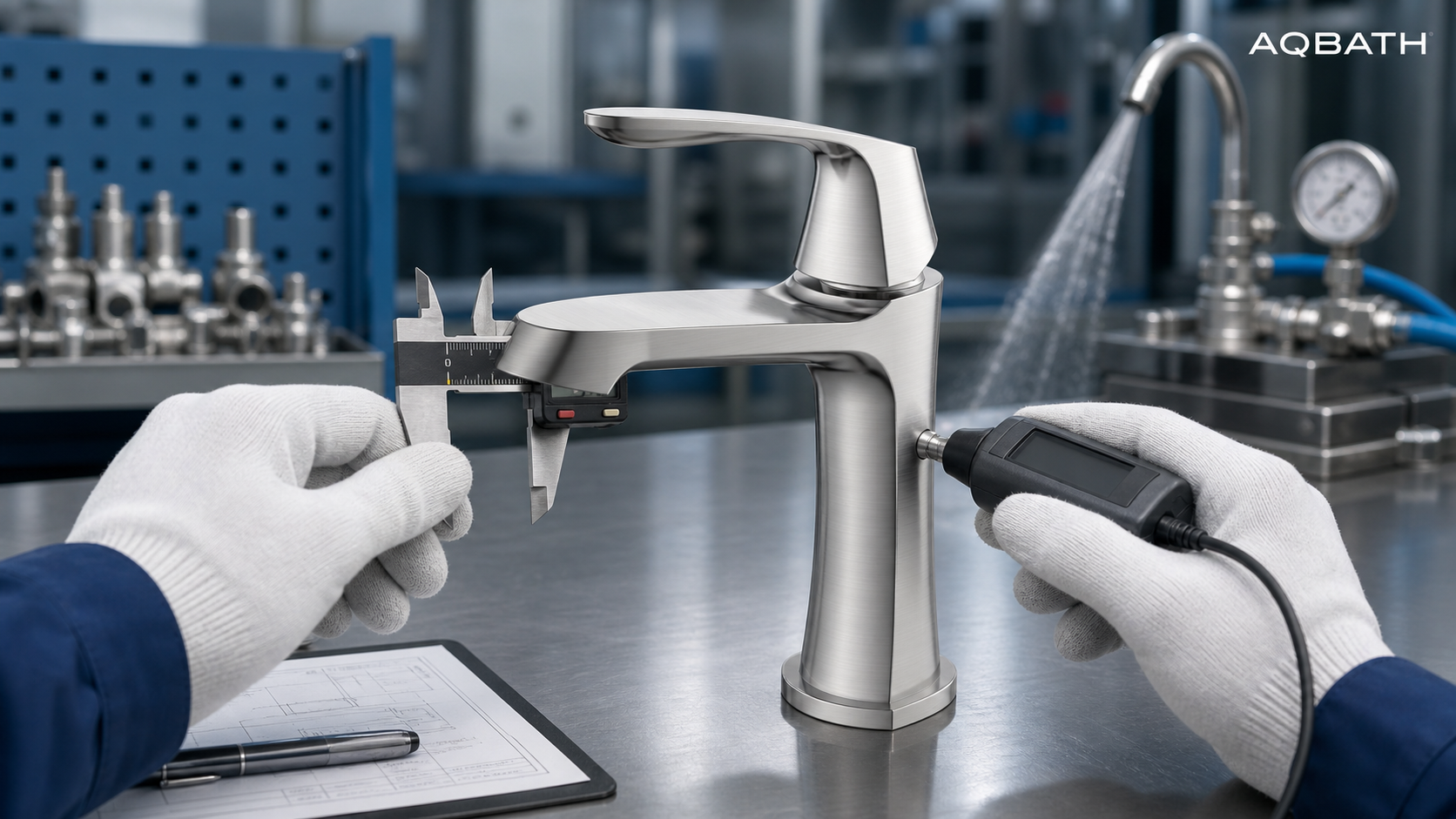
Build a test matrix that covers static pressure, dynamic pressure, leakage, flow rate, temperature control, diverter operation where present, spout rotation, hose behavior and low-pressure performance. State test pressures, duration, water temperature, stabilization time and acceptance criteria. Sampling plans should reflect process risk and order size. A factory may perform 100% leak testing while using statistical checks for dimensions and finish; the buyer should know which is which.
The applicable product standard depends on product type and market. ASME A112.18.1/CSA B125.1 covers a wide range of plumbing supply fittings, including lavatory and kitchen supply fittings, bath and shower fittings, showerheads and commercial pre-rinse spray valves. Ask the supplier to identify the adopted edition and certification scope for the destination jurisdiction. Do not write “meets ASME” on packaging until a qualified party has confirmed model coverage and marking rules.
11. Match flow efficiency to use case and jurisdiction
Flow is a design decision, a user-experience variable and sometimes a regulatory requirement.Specify the rated flow at defined pressure, tolerance, aerator model and destination. Measure multiple samples at relevant pressures. Confirm that the aerator does not loosen, whistle, splash or create an unpleasant stream. For private lavatory faucets, EPA states that current WaterSense-labeled models use a maximum of 1.5 gallons per minute and must pass independent certification; EPA has paused work on a draft Version 2.0 proposal. Buyers should use the current official page rather than assuming a draft requirement is final.
Public washrooms, kitchens and private hotel guest bathrooms can require different choices. Do not install a very low-flow public-lavatory configuration in a guest-room application without testing user satisfaction and cleaning needs. Conversely, do not assume a residential configuration satisfies a public project specification. Put the flow requirement in the RFQ and verify it on the golden sample.
12. Verify certification at model level
Request the certificate, listing, test report and public-directory record. Check certificate holder, manufacturing site, brand, model or family, standard edition, issue and expiry dates, conditions, and authorized markings. Compare them with the quotation and production BOM. A factory-level management certificate does not prove a product meets a plumbing performance or drinking-water standard. ISO describes ISO 9001 as a quality-management-system standard; it can support confidence in process consistency, but it is not a substitute for model-specific product compliance.
For Australia, the official WaterMark product database allows buyers to verify certified plumbing and drainage products, and Australia introduced lead-free requirements for relevant copper-alloy drinking-water products effective 1 May 2026. For other markets, use the official regulatory or certification database. Make destination market a mandatory RFQ field so the supplier cannot respond with a generic certificate bundle.
13. Inspect assembly controls and mistake-proofing
Observe an ordinary production order. Look for work instructions at the station, torque specifications, controlled seal lubrication, fixture condition, component verification, line clearance and defect segregation. Ask operators how they know which cartridge, aerator and hose belong to the order. Compare their answers with the traveler. Review first-piece approval after a changeover and the reaction plan when a test fails.
Torque deserves special attention. Under-tightening can leak; over-tightening can damage seals, threads or finishes. Calibrated tools, programmed drivers and error-proof fixtures reduce variation. If a manual process is necessary, define the method and audit it. The goal is not automation for its own sake. It is a repeatable process with clear limits, evidence and containment when the limits are exceeded.
14. Demand batch traceability that works under pressure
Select a packed faucet at random and ask the factory to trace it backward to incoming component lots, body material, finish lot, assembly date, test station and inspector. Then select a suspect component lot and trace forward to affected finished goods and shipments.Time the exercise. A traceability system that requires days of spreadsheet reconstruction will not support fast containment during a field issue.
Agree on traceability markings that survive installation yet remain discreet: carton label, product label, laser mark or encoded batch reference. Define record-retention time based on warranty and legal requirements. Protect customer confidentiality while keeping enough detail for a root-cause investigation. Include traceability checks in periodic supplier audits rather than waiting for a recall.
15. Validate installation, not just laboratory performance
Have an installer who did not design the product follow the supplied instructions. Record time, tools, access requirements and common mistakes. Check mounting stability, hose routing, connector access, handle clearance, drainage compatibility and maintenance access. For hotel and multifamily programs, repeat the test on representative vanity thicknesses and confined spaces. An installation claim should state the comparison method and conditions.
Require exploded diagrams, parts lists and troubleshooting guidance. Use clear illustrations and market-appropriate language. Include torque or sealant instructions where necessary. A manufacturer that reduces installer ambiguity can lower total project cost even when its unit price is slightly higher. Ask for a small installer trial before final product approval, and convert its feedback into controlled documents.
16. Stress-test packaging and labeling
Packaging must protect the finish, keep components separated, prevent movement and communicate product identity.Review inner bags, protective sleeves, molded supports, carton strength, moisture protection and pallet pattern. Confirm that accessories cannot scratch the faucet during vibration. Conduct appropriate drop, vibration, compression or transport simulation based on route and sales channel. Inspect after testing for cosmetic damage, loose parts and label readability.
Align carton labels, instruction sheets, regulatory marks, country-of-origin statements and customer barcodes with approved artwork. Prevent mixed finishes and models with scan checks where practical. For e-commerce or distribution, consider the additional handling cycles after import. A product that arrives intact at the importer but fails during parcel delivery still creates customer-service cost.
17. Review capacity, lead time and change control with evidence
Ask for demonstrated output by process, not a single optimistic monthly number. Identify bottlenecks in casting, machining, plating, assembly, testing and packaging. Compare order forecast with line capacity, changeover time, subcontractor capacity and peak-season demand. Review on-time delivery history with customer names removed. Define how the factory will communicate material shortages or capacity conflicts.
Establish a formal product-change notification process. Changes to material, cartridge, supplier, finish chemistry, tooling, factory location, inspection method, packaging or label may require buyer review. Set notice periods and approval evidence. An inexpensive unauthorized change can invalidate certification, alter field performance or make spare parts incompatible.
18.Test the corrective-action system
Ask for anonymized examples of recent defects and corrective actions. A useful report contains containment, verified root cause, corrective action, responsibility, due date and evidence that recurrence was prevented. Be cautious when every historical issue is blamed on an operator. Strong systems examine specification clarity, fixtures, maintenance, training, incoming variation and detection controls.
Include response times in the quality agreement: initial containment, traceability result, root-cause report and permanent corrective action. Define how replacements, sorting, rework, freight and field costs will be handled. The purpose is not to create an aggressive contract; it is to remove uncertainty before a problem tests the relationship.
19. Model total landed and lifecycle cost
Compare more than FOB price. Include tooling, samples, testing, certification, inspection, packaging, freight cube, duty, financing, damage, installation time, spare inventory, warranty labor and expected service life. Assign a risk allowance to assumptions that are not supported by evidence. A slightly higher unit price can be economical when packaging is denser, installation is faster, finishes are more consistent and replacements are available.
Run scenarios for finish mix, order volume, exchange rate, rejected lots and late delivery. Separate one-time development costs from recurring costs. Require quotation validity and a transparent mechanism for metal-price changes. This protects both buyer and supplier from disputes driven by hidden assumptions.
20.Use a pilot order and signed golden sample as the release gate
Do not move directly from an attractive prototype to a full rollout. Produce a pilot under intended production conditions with normal operators, tooling, components and packaging. Inspect dimensions, finish, function, installation and documentation. Place samples in realistic use where possible. Record all deviations and update drawings, BOM, work instructions and control plans before mass production.
Sign and seal representative golden samples for buyer and factory. Link them to the specification revision. Define what the golden sample controls and what remains governed by numerical tolerances or test methods. Appearance comparison should never replace measurable requirements, but it is valuable for shape, finish tone and assembly feel. Mass production begins only after documents and sample agree.
Bathroom faucet supplier audit scorecard
| Category | Weight | Minimum evidence | Stop-ship trigger |
|---|---|---|---|
| Product identity and BOM | 15% | Controlled model, drawing, wetted-parts BOM | Documents refer to different models |
| Material and drinking-water safety | 20% | Batch evidence and market-specific listings | Unverified wetted material or listing gap |
| Cartridge and functional reliability | 15% | Exact cartridge,endurance and leak tests | Unauthorized cartridge substitution |
| Finish system | 15% | Layer specification, master panel, tests | Color drift or undefined coating process |
| Manufacturing and traceability | 15% | Process controls and backward/forward trace | Affected lot cannot be identified |
| Installation and packaging | 10% | Installer trial and transport validation | Missing parts or repeat finish damage |
| Commercial resilience and service | 10% | Capacity, change notice, spares and CAPA | No change-control commitment |
Set a pass score,but keep critical gates independent of the total. A factory should not compensate for an unsupported drinking-water claim with excellent packaging. Likewise, a beautiful showroom should not outweigh failed traceability. Score evidence quality as well as the answer: verified public listing or controlled test record is stronger than a sales statement; a statement is stronger than no information, but it still creates a closure action.
How to run a fair RFQ
Send every supplier the same RFQ pack: application, destination market, annual volume, order profile, finish mix, drawing, performance criteria, certification requirement, packaging channel, warranty expectation and requested Incoterm. Ask suppliers to mark compliant, exception or proposed alternative line by line. Require a costed option when an alternative changes material, cartridge, finish or packaging.
Request a model-specific response package containing the quotation, drawing, BOM summary, certificate links, test plan, sample schedule, tooling ownership, MOQ, lead time, capacity, payment terms, spare-parts policy and change-notification commitment. Then hold a technical clarification call. The most valuable questions are often the ones a supplier asks you: destination pressure, countertop thickness, accessibility requirements, cleaning chemicals and installation sequence. They demonstrate that the team is engineering the application rather than merely matching a photograph.

How AQBATH should be evaluated
Based on the supplied product master, AQBATH currently presents basin faucets, shower faucets, shower sets, kitchen faucets and commercial pre-rinse products. The database identifies model-specific pages such as the B2601 brass faucet platform, the A0053-2 high-rise basin faucet and the S4001 shower faucet. It also records that several public claims still need controlled specifications, certificate-to-SKU mapping or test evidence. A serious buyer should request those items rather than assume every displayed certification covers every model.
That evidence-first position is useful to both sides. Buyers receive a quotation matched to destination market, finish, volume and installation conditions. The manufacturer avoids promising a configuration before confirming the applicable certificate, BOM and test standard. In your RFQ, include the target country, project type, model or drawing, finish, annual quantity, initial order, required flow, connection standard and requested compliance. Those fields allow a technical response instead of a generic price.
Related bathroom sourcing topics
The following pillar phrases are included for navigation without implying that every category is currently represented by a verified AQBATH product page. Where the supplied product master confirms a relevant product, the link points to it. Where it does not, the link points to the current catalog so the buyer can confirm scope before requesting a quote.
- shower door manufacturer — confirm project scope; no shower-door SKU appears in the supplied 24-product master.
- freestanding bathtub manufacturer — AQBATH’s supplied master confirms a bathtub faucet, not a freestanding tub; request scope confirmation.
- bathroom vanity manufacturer — confirm scope before specifying furniture.
- bathroom faucet manufacturer — review the current brass faucet platform.
- smart toilet manufacturer — confirm scope; no smart-toilet SKU appears in the supplied master.
- LED bathroom mirror manufacturer — confirm scope; no LED-mirror SKU appears in the supplied master.
- shower tray manufacturer — confirm scope; no shower-tray SKU appears in the supplied master.
- bathroom accessories manufacturer — review stated bathroom-hardware capabilities and request model-level evidence.
- hotel bathroom supplier — review a current shower-system example for hospitality use.
- bathroom products manufacturer China — review the current catalog and confirm the exact package required.
Frequently asked questions
What documents should I request before ordering bathroom faucets?
Request a model-specific quotation, controlled drawing, BOM or wetted-parts list, material evidence, applicable certificate and public listing, functional and finish test plan, packaging specification, installation instructions, spare-parts list, warranty terms and change-notification agreement. The model number and revision must agree across all documents. For private-label work, also define artwork ownership, tooling ownership, confidentiality and approval authority.
Does ISO 9001 prove faucet quality?
No. ISO 9001 certification can show that an organization operates a quality-management system within a defined scope. It does not by itself prove that a particular faucet model meets drinking-water, performance, flow, corrosion or destination-market requirements. Verify the management certificate and then separately verify product-level evidence.
How do I verify a lead-free faucet?
First define the destination jurisdiction and the exact meaning of lead-free there.For North American drinking-water products, review evidence for both material lead content and extraction/leaching requirements, including model coverage. NSF explains that NSF/ANSI/CAN 372 addresses lead content while NSF/ANSI/CAN 61 addresses health effects from substances introduced into drinking water. Use public certification directories and confirm the exact model, brand and manufacturing site.
How many salt-spray hours are enough?
There is no universal number that proves every finish is durable. Specify the relevant method, coating system, exposure, evaluation zone and acceptance criteria. ISO 9227 expressly warns that salt-spray testing is not a method for predicting long-term service life or ranking materials. Combine it with thickness, adhesion, color, abrasion, chemical-resistance and real-use evidence.
What is the best faucet cartridge?
There is no single best cartridge for every application. Choose from a defined performance envelope: pressure, temperature, torque, cycle life, flow characteristic, water quality, service availability and regulatory scope. Record the exact manufacturer and model, validate it in the finished faucet, and prohibit substitution without approval.
Should I audit the factory before receiving samples?
Usually begin with document screening and development samples, then audit before the pilot or full production order. This avoids spending audit resources on a supplier that cannot meet basic technical or market requirements. For high-risk programs, audit earlier to confirm that the proposed product can be manufactured under controlled conditions.
What should be included in a bathroom faucet RFQ?
Include destination market, application, model or drawing, annual and initial quantities, finish mix, pressure and temperature conditions, rated flow, material requirements, cartridge expectations, connector standard, installation constraints, certification, labeling, packaging channel, warranty, spare parts, Incoterm and schedule. Ask the supplier to list every exception.
How can I reduce faucet warranty claims in hotel projects?
Standardize a small number of platforms, validate installation on the actual vanity, control cleaning chemicals, keep cartridges and aerators serviceable, hold spare kits locally, train installers, trace batches and review early field data. The lowest claim rate usually comes from a system of product, installation and maintenance controls rather than one premium component.
Authoritative references
- ASME A112.18.1/CSA B125.1 — Plumbing Supply Fittings
- NSF — Faucets and Plumbing Products / NSF/ANSI/CAN 61
- NSF/ANSI/CAN 372 Technical Requirements
- U.S. EPA WaterSense — Bathroom Faucets
- ISO 9227:2022 — Salt Spray Tests
- ISO 9001:2015 — Quality Management Systems
- Australian WaterMark Product Search
Practical evidence-request template for your supplier
Use the following request after a supplier returns its first quotation. It converts general claims into a reviewable package and gives both parties a clear closure list. Ask the supplier to identify confidential items rather than omitting them silently; sensitive details can be reviewed under a non-disclosure agreement or summarized by an independent auditor.
A. Product definition file
Provide the customer model, factory model, current revision, dimensional drawing, installation envelope, exploded view and a controlled BOM summary. The BOM summary should identify the main body, wetted components, cartridge, aerator, hoses, seals, mounting hardware and finish system. For each purchased critical component, identify the approved manufacturer and exact part number. Mark which substitutions are prohibited and which require written customer approval. Include the target application, pressure and temperature range, rated flow, connection standard and intended destination market.
B. Material and compliance file
Provide material declarations and recent evidence for the quoted configuration, with traceable model or family coverage. Include drinking-water health-effects and lead-content evidence where applicable, plumbing performance certification, required market marks and any local registration. Attach the public directory link when one exists.Highlight exclusions, pending renewals and differences between the certified construction and the quoted construction. A certificate image without scope, holder, standard, model and validity information will be treated as an open action.
C. Reliability and performance file
Provide the test plan and representative reports for pressure integrity, leakage, flow, low-pressure performance, cartridge endurance, spout and handle operation, hose or connector strength, thermal exposure and any diverter function. Reports should state sample identity, sample size, equipment, calibration status, conditions, acceptance limits, raw observations, failures and disposition. If the factory relies on a component supplier’s test, explain how the finished-faucet design and assembly are verified so the component result remains applicable.
D. Finish-control file
Provide the approved finish name and code, substrate preparation, layer system, target thickness or controlled process range, master panel procedure, color measurement or visual standard, adhesion method, corrosion method, chemical-resistance method and acceptance criteria. Identify whether finishing is internal or subcontracted. Include batch identification and rework rules. State the cleaning products that are permitted and prohibited in the installation guide, especially for hotels that use concentrated disinfectants or abrasive pads.
E. Manufacturing control file
Provide the process flow, control plan, inspection points, sampling plan, gauge list, calibration program, work-instruction examples and nonconforming-product procedure.Identify which checks are 100% and which are sampled. Explain line clearance, component verification, tool or fixture maintenance and torque control. Include a recent backward-and-forward traceability demonstration with confidential customer information removed. State the record-retention period and the identifier visible on the product or packaging.
F. Packaging and installation file
Provide carton drawings, internal protection, included-parts checklist, label artwork, pallet pattern and validation method. Show how the faucet is protected from contact with hoses, fasteners and other hard parts. Attach installation instructions and service diagrams in the required language. State countertop or deck thickness range, hole size, required tools, connector details and access clearances. If fast-installation benefits are claimed, provide the comparison method, sample size, installer profile, starting and ending conditions and unedited demonstration evidence.
G. Commercial and continuity file
Provide MOQ by finish, sample and tooling charges, tooling ownership, lead time by order phase, demonstrated monthly capacity, peak-season constraints, payment terms, Incoterm, quotation validity and the mechanism for metal-price adjustment. State warranty scope, response time, spare-parts policy, discontinuation notice and last-time-buy support. Identify business-continuity controls for cartridges, hoses, plating and other single-source components. The buyer should be able to understand the operational consequence of a forecast increase before issuing a purchase order.
H.Pilot approval and mass-production release
Propose a pilot quantity that uses intended production tooling, operators, components, finishing and packaging. Define the inspection and installation trial, including responsibilities for third-party testing. After closure, issue updated controlled documents and two signed golden samples. List every approved deviation separately with an expiry or permanent disposition. Mass production should reference the final revision in the purchase order. Any later change to material, component supplier, finish process, tooling, factory, test method, packaging or regulatory status should trigger the agreed notification process.
This request is deliberately detailed, but it does not require a supplier to expose every trade secret. It requires enough objective information to determine whether the quoted product is defined, compliant, repeatable and serviceable. A capable supplier may propose a secure data-room review, redacted records or an independent audit for confidential evidence. That is different from replacing evidence with reassurance.
Request a Model-Specific Faucet Quote
Send your destination market, drawing or target model, finish, quantity, certification needs and installation conditions. Ask AQBATH to return a model-specific specification and evidence pack with the quotation.