
What Should an OEM Faucet Manufacturer Actually Do?
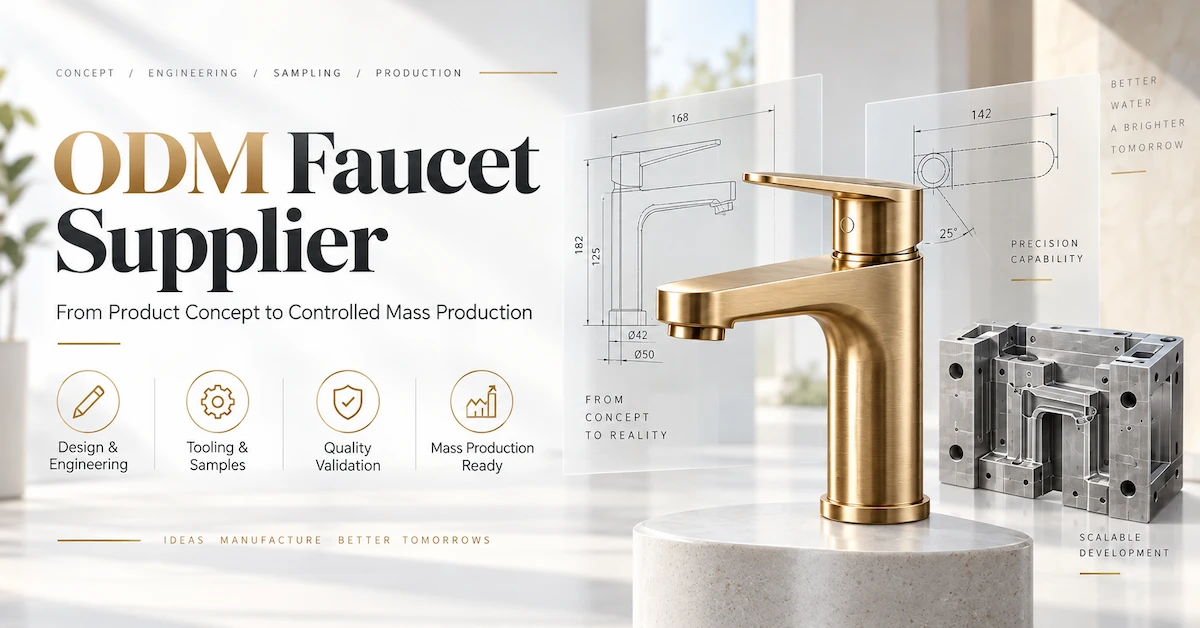
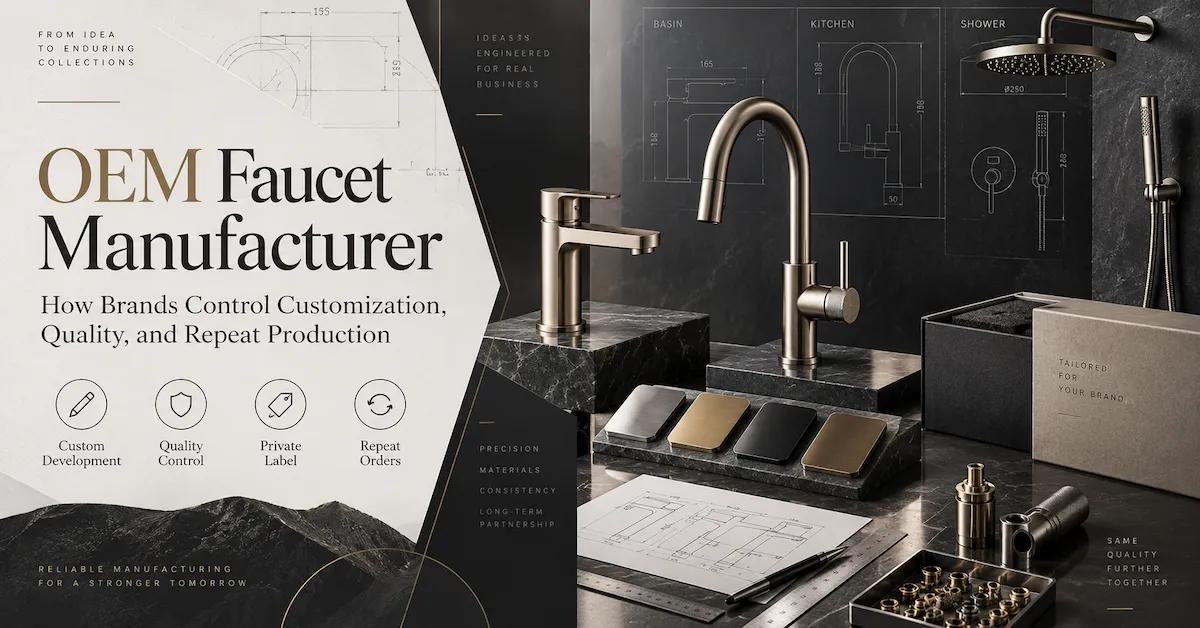
An OEM faucet manufacturer should do more than place a buyer's logo on a standard faucet. For serious B2B programs, OEM means turning an agreed product configuration into a controlled, repeatable item that can be manufactured, inspected, packaged, and reordered against the same specification. Depending on the project, this may involve selecting an existing faucet platform, changing the finish, handle, cartridge, aerator, hoses, mounting components, packaging, instructions, branding, or other agreed features while keeping the final configuration under revision control.
That distinction matters because buyers are not purchasing only a physical faucet. They are purchasing a product definition that must remain stable across samples, mass production, subsequent shipments, and after-sales replacement. AG Valve presents multiple bathroom and kitchen faucet categories through its faucet product range, while its About Us page describes manufacturing and product-development capabilities that can support OEM evaluation. The buyer's task is to connect those capabilities to the exact product being sourced rather than assuming every catalog model has the same OEM scope.
Which Buyers Benefit Most From Working Directly With an OEM Faucet Manufacturer?
OEM manufacturing is particularly relevant to bathroom brands, importers, wholesalers, distributors, hotel procurement companies, property developers, sanitaryware businesses, kitchen and bathroom cabinet manufacturers, and retail private-label programs. Each group needs a different level of customization. A distributor may primarily need a stable product, packaging, finish, and brand identity; a hotel buyer may focus on installation consistency, room-to-room standardization, spare parts, and phased delivery; a bathroom brand may require more control over appearance, components, artwork, documentation, and future product revisions.
OEM is less useful when the buyer has not yet defined the basic application. Asking a factory to customize “a premium bathroom faucet” without identifying whether it is intended for a basin, bathtub, shower, kitchen sink, commercial kitchen, or another installation creates unnecessary uncertainty. A practical starting point is to review existing platforms through the AQBATH product catalog, decide which category is closest to the required product, and then define what actually needs to change.
Choose the Right Existing Platform Before Starting Customization
A common OEM mistake is to treat every project as a completely new product. If an existing platform already satisfies the installation geometry, operating method, market requirement, and desired product position, modifying that platform may reduce development complexity compared with creating a new structure.
AQBATH currently organizes products across several faucet applications and also maintains a dedicated Top Fixed Faucets range. Buyers interested in installation-oriented differentiation can separately review Top Fixed Kitchen Faucets and Top Fixed Basin Faucets. These categories provide useful starting points for OEM discussions, but category membership alone should never replace a model-specific drawing and approved configuration.
The correct question is therefore not “Can you customize faucets?” but “Which existing product platform is closest to our required application, and which changes can be made without creating unnecessary engineering, tooling, testing, or compliance risk?”
Build an OEM Faucet Specification Before Requesting Final Pricing
An OEM faucet manufacturer can quote more accurately when the buyer provides a controlled requirement instead of a mood board and target price. The specification should distinguish confirmed requirements from optional preferences and unresolved items. This makes it easier for purchasing, engineering, the manufacturer, and any certification or project team to work from the same information.
| Requirement Area | What the Buyer Should Define | Why It Matters |
|---|---|---|
| Product application | Basin, kitchen, bathtub, shower, commercial or other use | Determines the basic product platform |
| Installation method | Deck, wall, top-fixed or other required arrangement | Controls mounting compatibility |
| Target market | Country or sales region | Influences connections, documentation and compliance review |
| Main material | Required body and critical component materials | Prevents vague “high quality” specifications |
| Cartridge/valve | Required function and approved configuration | Affects operation and serviceability |
| Aerator/outlet | Required outlet behavior or project requirement | Influences user experience and flow configuration |
| Connections | Hose, thread and installation requirements | Must match the intended market and site |
| Finish | Chrome, black, brushed or approved custom finish | Requires visual consistency |
| Branding | Logo method and location | Affects tooling, marking or surface process |
| Packaging | Retail, project or private-label packaging | Changes cost and production preparation |
| Documentation | Drawing, instructions, inspection and applicable certificates | Supports technical approval |
| Spare parts | Parts to remain available after shipment | Reduces maintenance and warranty risk |
This table should become the basis for sample approval and quotation comparison. If the final order differs from the initial inquiry, the updated specification should identify the change rather than allowing several email versions to become competing product definitions.
Separate Cosmetic OEM Changes From Engineering Changes
Not every customization request carries the same risk. Changing carton artwork is fundamentally different from changing the faucet body, cartridge, mounting system, spout geometry, or internal waterway. Buyers should divide OEM requirements into cosmetic, component, structural, and documentation changes so that each can be evaluated appropriately.
A logo, printed box, label, instruction manual, or approved finish may be relatively straightforward when applied to an existing product platform. A new handle can appear cosmetic but may affect the cartridge interface or operating clearance. Changing spout height or reach can influence basin or sink compatibility. Changing the cartridge, aerator, supply hose, valve, or water-contact component can affect testing and documentation. A new body geometry may require tooling and a broader engineering review.
This is why an experienced OEM faucet manufacturer should identify which requests can be handled as configuration changes and which require engineering validation rather than giving every customization request the same answer.
Control Materials and Components at Part Level
A specification such as “brass faucet with ceramic cartridge” is usually not detailed enough for a private-label program. Buyers should identify which material applies to the faucet body and then separately control the handle, cartridge or valve, aerator, supply hoses, seals, mounting components, shower accessories where applicable, and visible decorative parts.
AG Valve's About Us page describes manufacturing processes and quality-control capabilities related to faucet production. For OEM procurement, the important question is how those capabilities are applied to the selected product. Buyers should request confirmation of critical materials and components for the approved model and agree on whether substitutions require notification or approval.
This becomes especially important after the first successful order. Without a controlled component specification, a later batch may remain visually similar while using a different component configuration. Repeat-order consistency therefore depends as much on change management as it does on the first sample.
Evaluate Manufacturing Capability Through Product Risk
Factory capability should be evaluated by asking how each process affects the product. Casting influences body integrity and basic geometry. Machining affects threads, sealing surfaces, cartridge locations, mounting features, and dimensional consistency. Polishing prepares visible surfaces before finishing. Plating or other finish processes influence appearance and durability. Assembly brings together the approved components, while functional testing is intended to identify issues before packaging.
Instead of asking only how many machines a factory owns, ask how the selected OEM product will move through development, production, inspection, and final release. The useful factory questions are: Which processes are controlled internally? Which components are externally sourced? Which dimensions are critical? What is inspected during incoming, in-process, and final control? How is a change to an approved component managed?
This approach aligns manufacturing capability with purchasing risk and prevents a factory tour from becoming a collection of equipment photos without a connection to the actual product.
Use the Approved Sample as a Controlled Reference
The first sample that looks good should not automatically become the production standard. A useful OEM sample must be linked to an identifiable drawing, component configuration, finish, branding requirement, and packaging revision. If the next sample contains changes, it should be recorded as another revision rather than being casually described as “the latest sample.”
For basin or kitchen faucets, install the sample in a representative basin, sink, countertop, or cabinet where practical. Review faucet geometry, mounting access, handle clearance, hose routing, water landing point, operation, leakage, visible finish, and cleaning access. For shower and bathtub products, review the complete outlet configuration, controls, connections, mounting arrangement, and concealed components where applicable.
The purpose of sample approval is not simply to confirm appearance. It is to create a physical reference that supports the written production specification.
Define QC Requirements Instead of Asking for “Strict Quality Control”
“Strict QC” has little purchasing value unless the buyer understands what is checked and what constitutes acceptance. AG Valve describes testing capabilities on its company page, but each OEM program should identify the checks that apply to the selected product.
A basin faucet may require dimensional verification, assembly checks, operation, leakage testing, finish inspection, component confirmation, and packaging verification. A shower configuration may need additional checks related to diverter or outlet operation. Where material, coating, life-cycle, or corrosion-related testing is required, the buyer should confirm the test method, conditions, frequency, and acceptance criteria rather than relying only on a test name.
For final inspection, define which items are 100% functional checks and which may be sampling inspections where appropriate. If inspection reports are required, agree on their format before production instead of requesting documents only after the shipment is ready.
Certification Documents Must Match the Product and Market
An OEM buyer should never assume that a certificate displayed by a manufacturer automatically covers every product, component, custom configuration, finish, or destination market. Compliance review should begin with the target country and the exact proposed model.
Ask the OEM faucet manufacturer to identify which existing documents apply to the selected configuration and whether any proposed change affects that scope. Check the certificate holder, product or model information, standard, validity, manufacturing location where relevant, and controlled configuration. If a required document does not cover the proposed product, keep that issue open rather than treating a company-level certificate list as proof.
This becomes more important when private-label buyers request component changes after sample approval. A commercially attractive customization should not quietly create a compliance problem.
Compare Three OEM Development Routes Before Committing Budget
Not every project needs the same development depth. Buyers can reduce cost and risk by choosing an OEM route that matches the commercial objective.
| OEM Route | Typical Scope | Main Advantage | Main Risk to Control | Suitable Buyer |
|---|---|---|---|---|
| Existing model + private label | Logo, packaging, documentation and approved finish | Lower development complexity | Assuming branding approval equals full product approval | Distributors and emerging brands |
| Existing platform + component/appearance changes | Handle, finish, accessories, cartridge or other agreed modifications | Greater differentiation without a completely new platform | Component compatibility and revision control | Established private-label brands |
| Deeper custom development | New geometry, structure, tooling or substantially changed configuration | Greater product differentiation | Development cost, tooling, validation and schedule | Brands with defined product-development strategy |
The appropriate route depends on target volume, market position, differentiation needs, technical risk, development budget, and launch schedule. Buyers should avoid paying for a completely new structure when an existing product can meet the requirement, but should also avoid forcing extensive changes onto a platform that no longer suits the intended product.
MOQ, Capacity, and Lead Time Should Be Confirmed for the Actual Configuration
A universal MOQ or fixed lead time is rarely meaningful across every OEM project. Quantity conditions can change with finish, component choice, packaging, tooling, artwork, and production complexity. Lead time can also depend on whether the project uses an existing model or requires samples, engineering changes, new tooling, additional testing, or customized packaging.
The buyer should therefore ask the manufacturer to divide the project schedule into technical confirmation, sample preparation, sample approval, packaging approval, production, inspection, and shipment preparation. This makes delays easier to diagnose and prevents “30 days lead time” from being interpreted differently by purchasing and production.
For repeat programs, capacity should also be discussed in relation to forecast volume. Factory-wide capacity is useful background, but it does not guarantee a particular production allocation for one customer's product.
OEM Faucet Cost Is More Than the Unit Price
Comparing only faucet unit prices can hide the largest OEM risks. Buyers should review sample charges, tooling where required, customized components, finishes, packaging, printing, testing, applicable certification work, inspection, freight, spare parts, and potential warranty exposure. Some costs occur once, while others repeat with every order.
Undefined product scope can be more expensive than a slightly higher quotation. If one factory prices a faucet with one cartridge and hose specification while another uses a different configuration, the two prices are not directly comparable. If one quotation includes private-label packaging and another does not, the same issue applies.
A useful commercial comparison therefore starts after the configuration is aligned. Price should be the result of an agreed product definition, not the tool used to guess what the product specification might contain.
Protect Repeat Orders With Change Control
The first shipment is not the end of an OEM program. For a distributor or brand, the more difficult challenge is making the second, fifth, and tenth order consistent with the approved product. That requires a controlled model number, drawing revision, major component specification, finish reference, packaging artwork, labels, instructions, testing criteria, and approved sample.
Changes do not have to be prohibited, but relevant changes should be visible. If a component becomes unavailable, the factory should identify the proposed replacement and allow the buyer to assess whether reapproval is required. If the buyer changes artwork, finish, or packaging, that change should also receive a revision.
This process turns an OEM product from a one-time sample into a repeatable commercial asset.
What Should You Send an OEM Faucet Manufacturer for an Accurate RFQ?
A useful OEM inquiry should identify the product application, destination market, buyer type, preferred existing model or reference design, required installation method, materials, faucet geometry where relevant, cartridge or valve requirement, aerator, hoses, connection type, finish, branding method, packaging, documentation, expected initial quantity, forecast volume, target launch schedule, and any required spare-parts arrangement. Drawings, basin or sink dimensions, installation photographs, packaging references, and logo files can be included when available.
Buyers can first review the AQBATH product range and available product catalog resources, then submit a defined project through the Contact Us page. A structured inquiry gives the manufacturer enough information to distinguish an existing product, an OEM configuration, and a project requiring deeper development.
Frequently Asked Questions
1. What is an OEM faucet manufacturer?
An OEM faucet manufacturer produces faucets according to an agreed buyer specification, which may include an existing product platform together with branding, finish, packaging, components, accessories, or other approved configuration changes. The exact responsibility depends on the project agreement.
2. Is OEM the same as private label?
Not always. Private label often focuses on selling an existing or lightly modified product under the buyer's brand. OEM can include deeper control of specifications, components, finishes, packaging, and configuration. The terms are used differently across suppliers, so the project scope should be defined instead of relying only on the label.
3. Do I need a new mold for an OEM faucet project?
Not necessarily. If an existing faucet platform meets the required installation and product structure, branding or configuration changes may not require a new body mold. New geometry or structural changes may require new tooling, which should be evaluated separately.
4. What information should I prepare before requesting an OEM faucet quotation?
Prepare the application, target market, preferred faucet type, installation conditions, materials, finish, required components, branding, packaging, documentation requirements, expected quantity, forecast volume, and desired project schedule. More complete information produces a more comparable quotation.
5. Can I customize the finish without changing the faucet structure?
Potentially, but the availability of a finish should be confirmed for the selected model and order conditions. Approve a physical finish reference when appearance consistency is important, particularly for hotel projects and coordinated bathroom product ranges.
6. Can an OEM faucet manufacturer change the cartridge or aerator?
Such changes can be evaluated, but critical components should not be treated as arbitrary substitutions. Cartridge and aerator choices can affect function, flow, service parts, and potentially documentation, so the final approved configuration should identify them clearly.
7. How should I approve an OEM faucet sample?
Compare the sample with the agreed drawing and specification, install it in a representative application where practical, verify operation and mounting, review the finish and components, and record the sample revision. Keep the approved sample as a production reference.
8. Does the manufacturer's certificate automatically cover my private-label faucet?
That should not be assumed. Confirm whether the exact product and configuration fall within the relevant document's scope and whether proposed changes require additional review. Certification should be checked against the destination market and selected product.
9. How do I reduce repeat-order quality variation?
Use one controlled specification connected to the approved model, drawing revision, components, finish, packaging, instructions, inspection criteria, and physical sample. Require relevant changes or substitutions to be reviewed before they enter normal production.
10. How can I start an OEM faucet project with AQBATH?
Start by reviewing the AQBATH faucet products and deciding which existing product family is closest to your project. Then send your target market, application, required configuration, finish, branding, packaging, expected quantity, and project schedule through AQBATH Contact Us for project-specific evaluation.
Conclusion
Choosing an OEM faucet manufacturer is ultimately a decision about product control and repeatability, not simply logo customization or unit price. Bathroom brands, distributors, hotel procurement teams, importers, and private-label buyers should define the application first, select the correct product platform, control critical materials and components, approve a documented sample, connect QC and compliance to the exact configuration, clarify commercial terms, and establish change control before mass production. AQBATH provides multiple faucet categories, top-fixed installation products, manufacturing information, catalog resources, and project inquiry channels that buyers can use as the starting point for OEM evaluation. Review the product range, learn more about the manufacturer's capabilities through About Us, and submit a defined OEM requirement through Contact Us so the appropriate existing platform or customization route can be assessed.