


Short answer: A dependable brass commercial faucet is not approved because the product page says “brass” or because the body feels heavy in a sample. A B2B buyer should verify the actual body and water-contact materials, component construction, cartridge and seals, finish process, mounting system, leakage and operation checks, packaging, spare parts and change-control plan. The manufacturer should connect those claims to the exact model, finish and production revision quoted for the project.
This guide is for restaurant equipment buyers, hotel procurement teams, plumbing contractors, importers, distributors, commercial property developers and faucet brands. It answers a practical sourcing question: how can a buyer compare brass commercial faucets and qualify a manufacturer before placing a repeat or project order? The focus is supplier evidence and specification control, not a generic description of brass as a material.
“Brass” is a starting specification, not a complete quality statement. Different parts of a faucet may use different materials, and the same body material can perform differently when casting quality, machining, seals, cartridge selection, surface preparation, installation and maintenance are not controlled. A responsible quotation should show what is confirmed, what is project-specific and what still requires technical review.
Discuss a Brass Commercial Faucet Project
What a brass commercial faucet specification should prove
A commercial faucet specification should allow design, purchasing, quality, installation and maintenance teams to make the same decision. It should identify the product, define the interfaces, state the materials and describe how acceptance will be checked. If a requirement exists only in a sales message, it can disappear when the project changes hands or when a later production batch is released.
For a brass commercial faucet, the visible body is only one part of the evidence chain. A buyer also needs to understand the handles, spout, cartridge housing, valves, seals, hoses, adapters, mounting hardware and finish. A brass body may provide a solid base for machining and assembly, but it does not automatically prove the quality of the internal cartridge, the safety of every water-contact component, the stability of the coating or the suitability of the installation kit.
| Buyer question | Evidence to request | Why it matters in commercial use |
|---|---|---|
| What is actually brass? | Material declaration and component map | Prevents a general body claim from being applied to every component. |
| How is the body made? | Casting, forging, machining and inspection information | Links the material to dimensional stability, threads and sealing surfaces. |
| Can the faucet survive its application? | Leakage, operation, finish and applicable lifecycle checks | Separates a suitable project configuration from a showroom sample. |
| Can the same product be supplied again? | Revision, lot, packaging, spare-parts and change-control records | Reduces variation across phases, properties and replacement orders. |
Why brass can be useful for commercial faucet projects
Brass is widely considered for commercial faucets because it can provide a stable base for threaded connections, machined passages, mounting features and other structural interfaces. It can also support a range of surface finishes and product forms. Those potential advantages are useful when a faucet must be installed repeatedly and serviced over time.
However, the procurement decision should be based on the complete design rather than the material name. A well-made brass body with poor seals can leak. A correct body with an unsuitable mounting kit can create installation rework. A polished body with weak surface preparation can show finish defects. A product that passes factory inspection but uses an unapproved substitute component in a later batch can create a new field problem.
Mechanical structure and threaded interfaces
Commercial installations place repeated loads on the body, handle, spout and connections. Operators may move a spout frequently, pull a spray head, connect a hose or clean the fixture many times per day. The buyer should ask which parts carry the load and how threads, seats, mounting points and sealing surfaces are controlled.
Do not ask only for the body material. Ask for a drawing or component map that shows the structural parts and the interfaces that affect installation and service. If a zinc-alloy handle, stainless-steel accessory or polymer insert is included, that does not automatically make the product unsuitable. It does mean the buyer should understand the role and evidence for each material.
Machining and sealing surfaces
A commercial faucet depends on accurate surfaces around cartridges, valves, threads, washers and connectors. Casting or forging creates the starting form, but machining, deburring, cleaning and inspection affect how the assembly seals and operates. Ask the supplier which dimensions are critical to function and how they are checked in production.
For repeat projects, record the approved drawing revision and the critical dimensions that the supplier must control. A full measurement report may not be required for every shipment, but the project should define which inspection records are available and what happens when a critical dimension is out of tolerance.
Finish compatibility
Brass can be used under chrome, brushed, matte, black or other finish systems, but the finish route is part of the product specification. Preparation, polishing, plating or coating, handling and packaging all influence the delivered surface. A buyer should approve a finish sample and define the visible surfaces, inspection lighting, defect limits and replacement process.
Do not convert a salt spray result or a finish test hour into a universal number of years in service. Test method, specimen, finish stack, cleaning environment and acceptance criteria must be considered together. For a project, request the applicable report for the exact model and finish rather than relying on a generic factory statement.
Seven checks for qualifying a brass commercial faucet manufacturer
The following checks are designed for a commercial investigation or RFQ. They help a buyer distinguish a manufacturer with a controlled product file from a supplier that is only presenting a similar-looking catalogue image.
1. Verify the material claim at component level
Request a material declaration that identifies the body and other significant components. Ask which parts are water-contact, structural, visible or replaceable. If the project requires a specific material limit, declaration, certification or destination-market document, state the exact requirement and model coverage in the RFQ.
Be careful with words such as “solid brass.” Ask what the phrase means in the supplier's specification. Does it refer to the main body only? Does it include the spout, handle base or mounting hardware? Is the component cast, forged, machined or assembled from multiple parts? The answer should be recorded in the approved technical file.
2. Verify the manufacturing route
Ask the manufacturer to describe the relevant production route: brass casting or forging, machining, drilling, thread creation, polishing, assembly and inspection. The goal is not to demand confidential process parameters. The goal is to understand whether the supplier controls the steps that affect the model being quoted.
Useful evidence can include factory photographs, a process flow, inspection points, equipment scope, sample records and a description of how nonconforming parts are handled. Public AQBath information identifies capabilities including lead-free brass casting, forging, precision machining, polishing and electroplating. These published capabilities support initial screening; the buyer still needs to confirm which process and controls apply to the ordered SKU.
3. Verify cartridge, seals and water-contact components
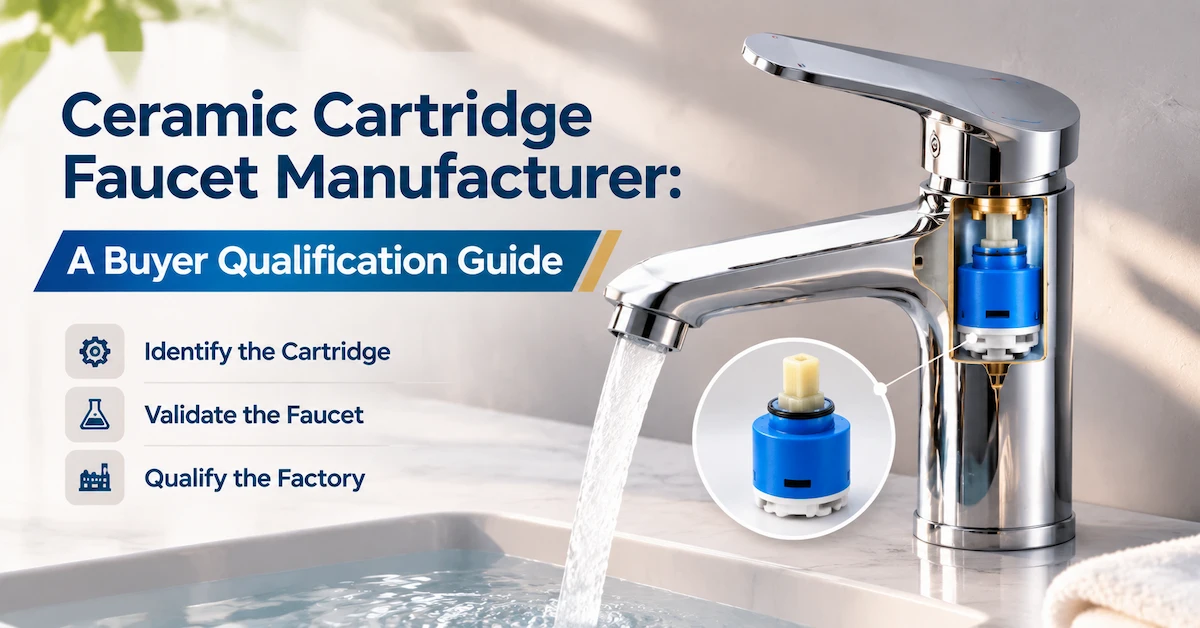
A commercial faucet does not operate through the brass body alone. The cartridge, valves, O-rings, washers, hoses and aerators or spray components influence leakage, control feel, maintenance and replacement. Ask the supplier for the component reference and for the documents required by the destination market or project engineer.
For a private-label or multi-property order, record the cartridge and seal references in the bill of materials. If the supplier proposes a substitution, require an engineering review. A visually identical cartridge can have different dimensions, operating behavior or service parts.
4. Verify the application and duty cycle
Define whether the faucet is for a restaurant wash station, hotel guest room, public washroom, staff area, foodservice line, healthcare-adjacent space or another environment. Record expected usage, operator behavior, water conditions, cleaning chemicals, temperature and access for service. The right specification for one commercial application may be wrong for another.
Ask the manufacturer to identify the intended application of the model and any known limitations. Do not request a lifecycle promise unless the supplier can define the test method, sample, cycle conditions and acceptance rule. A credible answer may be narrower than a marketing claim, but it is more useful for project risk control.
5. Verify installation and maintenance fit
Request the current drawing, installation guide and parts list. Check mounting-hole size, deck thickness, base footprint, reach, height, rotation, backsplash clearance, hose length, connection type, fixing hardware and service access. For a restaurant, also review spray-head movement, hose or support arrangement and cleaning access. For a hotel basin, review vanity access, splash control and replacement space.
Use a representative mock-up before bulk release. Record installation time as a project observation, not as a universal promise. Confirm that the actual kit matches the guide and quotation, and that installers can identify each component without relying on verbal instructions.
6. Verify quality and test evidence
Ask for the inspection plan and the records applicable to the model. Depending on the project, this may include material analysis, dimensional checks, leakage testing, operation testing, finish inspection, coating testing or product lifespan testing. The supplier should identify the specimen or production lot, method, acceptance criteria and result.
A factory capability page is not a model-specific test report. A report from one finish or production revision does not automatically qualify another. Keep the model, finish, drawing revision and lot reference visible in the evidence package.
7. Verify commercial continuity
Request MOQ, sample timing, production lead time, packaging, branding, spare parts and quotation validity for the exact configuration. Ask how the supplier handles phased deliveries and what happens if a component, coating supplier, packaging material or production location changes.
Commercial continuity is part of quality. A hotel, restaurant group or distributor may need the same appearance and service parts long after the initial order. The manufacturer should explain how the buyer can identify the installed model and how replacement parts will be matched to the approved revision.
Build a brass commercial faucet specification sheet
A concise specification sheet gives different departments one controlled reference. It should not duplicate every factory process document. It should identify the requirements that affect approval, quotation, inspection, installation and repeat supply.
| Specification block | Fields to define | Supplier response |
|---|---|---|
| Identity | Model, application, handle, spout, finish and drawing revision | Exact proposed configuration and deviations |
| Materials | Body, water-contact parts, cartridge, seals, hoses and structural accessories | Material declaration and component references |
| Dimensions | Mounting hole, deck, height, reach, rotation, clearances and connections | Current drawing and installation assumptions |
| Finish | Finish code, limit sample, visible areas and defect criteria | Finish process description and inspection record |
| Testing | Leakage, operation, finish, material and applicable market tests | Method, sample or lot identity, result and acceptance |
| Supply | MOQ, lead time, packaging, spare parts and change notification | Commercial assumptions and owner for each open item |
Use a status field for each line: confirmed, sample required, project-specific, deviation or not confirmed. Do not let an empty cell become an accidental approval. This approach makes supplier comparison more honest and gives engineering a clear list of questions before the quotation is accepted.
Compare brass commercial faucets by application, not by material label
Material is important, but application determines the evidence burden. A hotel guest-room faucet may prioritize appearance consistency, quiet operation, basin compatibility, service access and replacement control. A restaurant or foodservice faucet may need a different review of spray function, hose movement, cleaning, spout reach and operator workload. A public washroom may require high-traffic maintenance planning, accessibility review and vandal-resistance considerations.
Commercial kitchen and foodservice use
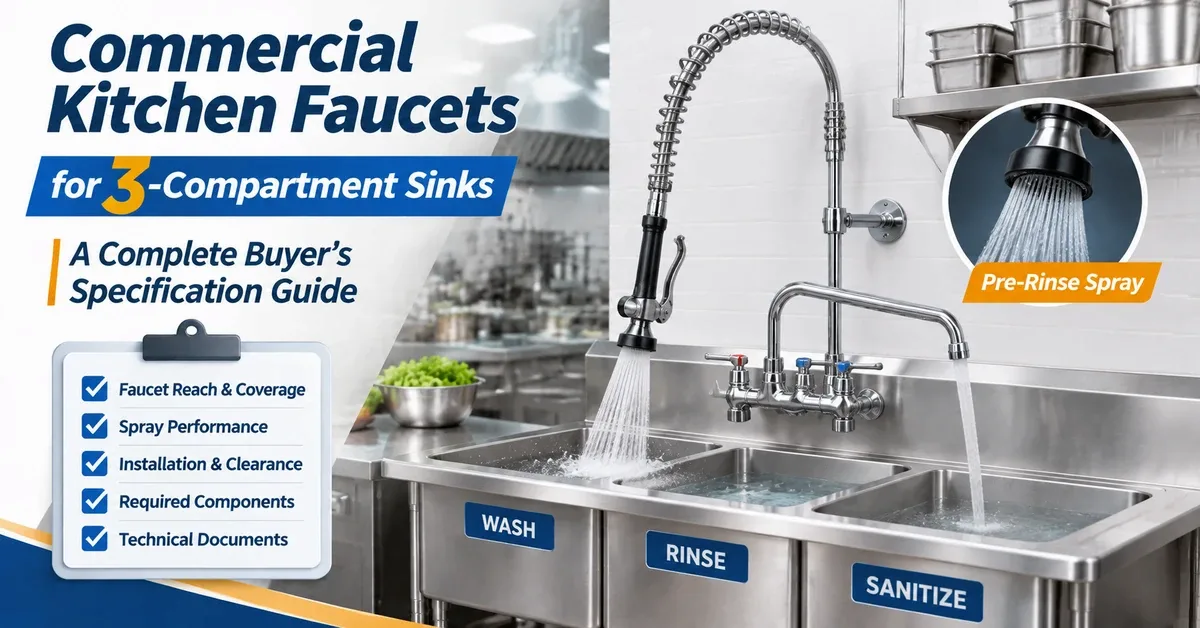
For a commercial kitchen, review the complete work envelope. A pre-rinse faucet may include a spray head, swing spout, hose, spring or support arrangement. The sink deck, shelf, backsplash, wall and adjacent equipment can limit movement. The buyer should verify connections, mounting, hose routing, clearance, cleaning access and replacement parts on a physical mock-up.
AQBath publicly presents the C0001CP commercial pre-rinse kitchen faucet for professional kitchen applications and describes a spray head, swing spout and OEM/ODM discussion. Those statements make it a relevant starting point for a commercial kitchen RFQ. The buyer should still request the exact body material, finish, mounting kit, connection specification, installation guide, packaging and test evidence for the quoted configuration.
Hotel and commercial washroom use
For a hotel or commercial washroom, review the full basin interface and maintenance path. Confirm that the spout reaches the basin without excessive splash, the handle has sufficient clearance, the body fits the deck and the mounting hardware can be serviced inside the vanity. The finish should be approved against a physical sample and kept consistent across project phases.
The public A0053-01 basin faucet page describes a brass body, single-handle operation and hospitality or commercial washroom use, with a drawing available. Treat that as a product reference, not as a complete approval file. Confirm the dimensions, water connections, mounting kit, finish, applicable certificates and installation evidence for the actual hotel or washroom project.
High-traffic public and institutional use
Public and institutional environments can place greater emphasis on repeated operation, cleaning, service access and misuse risk. The buyer should define how the faucet will be inspected and maintained, which replacement parts must be stocked and which visual defects are unacceptable. The manufacturer should state what has been tested and what remains a project responsibility.
Use standards and certificates correctly
Standards and certificates are useful only when the buyer confirms their scope. A document may apply to one model, one configuration, one material range, one destination market or one production location. The buyer should ask for the certificate holder, covered models, applicable standard or edition, validity and any limitations. Do not place a logo on a product page as a substitute for a certificate matrix.
Depending on the destination market and application, the project may need plumbing, drinking-water contact, building, accessibility, flow or surface-finish requirements. The manufacturer should identify the documents it can provide, while the importer, engineer or local compliance professional confirms which requirements legally apply. A brass body alone does not determine compliance.
Ask for a traceable document package
Link each certificate or test record to the model and revision. If the approved sample uses a different handle, hose, finish or cartridge from the document, flag the difference before approval. For a private-label program, retain the factory reference even when the document carries the buyer's brand.
Do not overstate public capability
AQBath's public company profile identifies Ningbo Yinzhou Anqi Valve Co., Ltd. / AG Valve in Ningbo, Zhejiang, China, established in 2006. It describes production capabilities including brass casting, zinc alloy die casting, forging, welding, pipe bending, cold stamping, precision machining, polishing and electroplating, and quality capabilities including material analysis, coating testing, dimensional measurement, hardness testing, lifespan testing, leakage testing and electroplating salt spray testing.
This information helps a buyer understand the manufacturer's stated entity and capability scope. It does not prove that every brass commercial faucet configuration has the same material, certification, test result, MOQ, lead time or packaging. The RFQ should turn the public starting point into written, model-specific evidence.
Write the commercial faucet RFQ so suppliers can answer
A precise RFQ reduces both buyer risk and supplier misunderstanding. Send the application, quantity, destination market, installation environment, target finish, basin or sink drawing, required documents, sample deadline, production schedule and packaging expectations. If the buyer has a preferred brass specification, state whether it is a mandatory requirement or a target for supplier review.
| RFQ field | Buyer provides | Manufacturer returns |
|---|---|---|
| Project application | Restaurant, hotel, washroom, distributor or other use | Recommended model and application assumptions |
| Material target | Brass scope, water-contact requirements and documents | Material declaration and component map |
| Installation interface | Hole, deck, clearance, connections and site constraints | Drawing, guide, parts list and deviations |
| Quality evidence | Required tests, inspection points and acceptance criteria | Applicable records with model and lot traceability |
| Commercial scope | Quantity, MOQ target, sample date and delivery phases | Price, MOQ, lead time, packaging and quotation validity |
| Continuity | Spare-parts horizon and change-notification expectations | Part references and change-control route |
Request that suppliers mark each line as complies, deviation, not applicable or not confirmed. A transparent deviation is easier to evaluate than a vague promise. It also gives the buyer a practical basis for a technical clarification call.
Send Your Brass Faucet RFQ Requirements
Release and after-sales control for repeat orders
After the supplier is selected, the buyer should preserve the approved configuration through production and installation. Use four release gates: technical file approval, physical sample approval, production-lot verification and after-sales feedback review.
Technical file approval
Approve the drawing, materials, cartridge and seals, finish, installation guide, parts list, applicable certificates, test plan, packaging and commercial assumptions. Record open items and do not let a missing document disappear into the purchase order.
Physical sample approval
Inspect the sample under the intended light and install it where possible. Check appearance, alignment, operation, basin or sink interaction, connections, mounting and service access. Use the sample as a visual reference but retain the drawing and specification as the technical references.
Production-lot verification
Confirm that the lot uses the approved model and revision. Check the carton label, finish, accessory bag, packaging protection and available inspection records. If the order is large or phased, define the sampling and shipment release method before production begins.
Complaint and replacement feedback
Record leakage, finish damage, loose handles, missing parts, installation confusion and replacement requests by model, finish and lot. A pattern may indicate a product, process, packaging, installation or training issue. The supplier should provide containment, root-cause review and corrective action when appropriate.
FAQ for brass commercial faucet buyers
What makes a brass commercial faucet different from a residential faucet?
The difference is determined by the application and specification, not only by the material. Commercial products may need different operating clearance, spout or spray function, installation interfaces, inspection records, packaging, spare parts and support for repeated or shared use. Confirm the intended application with the manufacturer.
Does brass automatically mean the entire faucet is brass?
No. “Brass” may describe the main body while the handle, cartridge, seals, hoses, adapters and other components use different materials. Ask for a component-level material declaration and identify the water-contact and structural parts relevant to the project.
Is a heavier brass faucet always better?
No. Weight alone does not prove machining quality, sealing performance, cartridge quality, finish durability or installation compatibility. Use the drawing, material evidence, inspection plan, test records, sample and project acceptance criteria together.
What should be tested before a commercial brass faucet is approved?
The test plan depends on the model, application and market. Common project checks may include material verification, dimensions, leakage, operation, finish appearance, coating or surface performance and applicable compliance documents. The manufacturer should state the method, sample or lot, result and acceptance criterion.
Should every commercial faucet use the same finish test requirement?
Not necessarily. Finish type, substrate, application, cleaning environment, test method and acceptance criteria affect the appropriate requirement. The buyer should avoid comparing one generic hour number across different finishes or specimens and should request evidence for the ordered configuration.
What MOQ and lead time should a buyer expect?
MOQ and lead time depend on the model, finish, branding, packaging, component availability, tooling and order quantity. Do not publish a universal number without a supplier quotation. Request the MOQ, sample timing, production lead time and assumptions for the exact brass commercial faucet configuration.
Can a brass commercial faucet be used in a hotel bathroom?
It can be considered when the model, basin interface, finish, material, installation, testing, certification and maintenance requirements fit the hotel project. A commercial classification or brass body alone does not prove suitability. Approve the configuration through a representative mock-up and documented project review.
How do I ask AQBath for a suitable brass commercial faucet?
Use the AQBath contact page and provide the application, target model or drawing, finish, quantity, destination market, installation constraints, required documents, packaging and delivery schedule. Ask for the exact material declaration, drawing, parts list, quality evidence, MOQ and lead time for the quoted configuration.
Conclusion
Choosing a brass commercial faucet should be an evidence-based specification decision. Confirm what is brass, how the body and critical interfaces are made, which cartridge and seals are used, how the finish is controlled, how the faucet is installed, which tests apply and how the supplier will preserve the same configuration through repeat orders.
AQBath's public information provides a useful starting point through its Ningbo manufacturing identity, published brass and faucet production capabilities, quality activities and commercial kitchen and hospitality product references. Final approval still requires model-specific evidence, including the drawing, material file, finish sample, installation package, inspection and test records, packaging, spare-parts plan, MOQ, lead time and change-control agreement.