
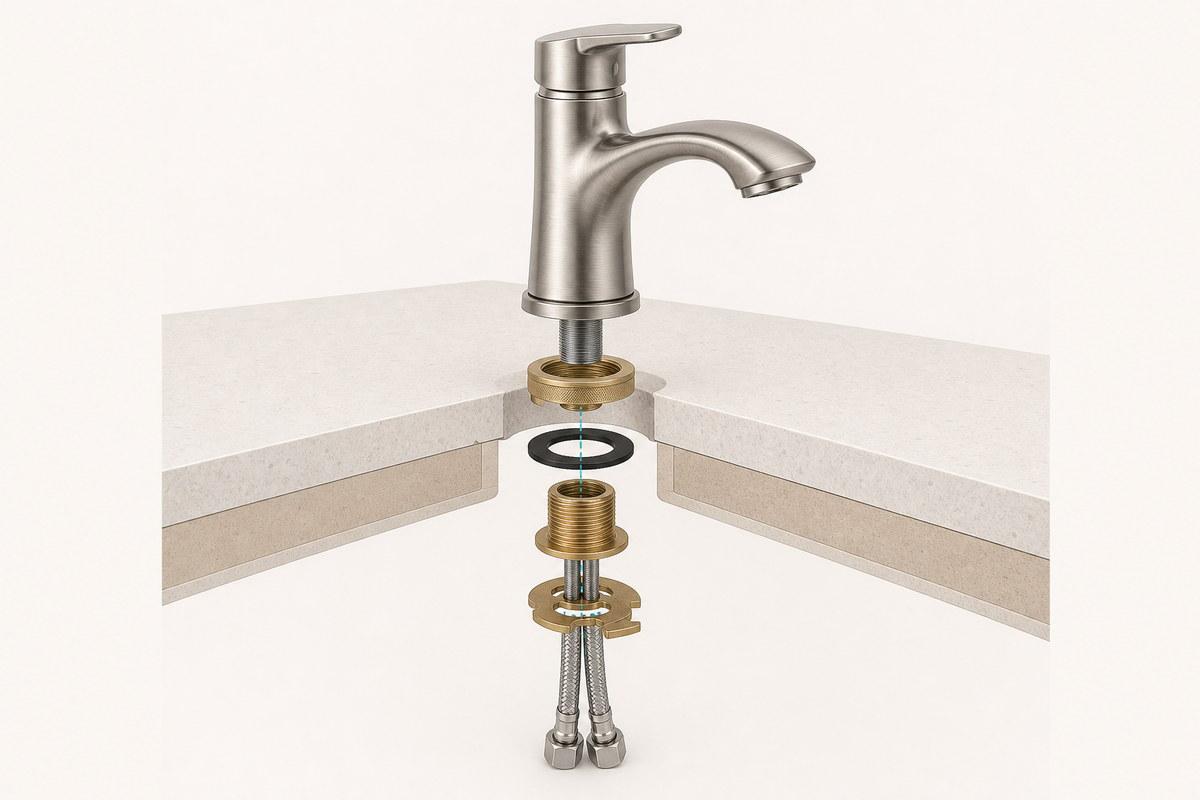
What Is a Top Fixed Faucet? Top-Mount vs Under-Sink Installation
A top fixed faucet uses a mounting system designed to be positioned, aligned, and tightened mainly from above the countertop or sink deck. A conventional faucet is typically secured with a nut or bracket reached from inside the cabinet. Moving the critical fastening work above the deck can make installation easier where a basin, drain, disposal unit, shelving, or a shallow cabinet restricts access.
That difference matters in apartment blocks, hotels, renovation programs, and other repeated installations. It does not mean every top-fixing model fits every countertop, requires no under-sink connection work, or guarantees a fixed labor saving. Buyers still need to verify the mounting hole, deck thickness, base support, hose routing, local plumbing requirements, and the exact installation method for the selected SKU.
This guide explains how the system works, where it creates value, what can go wrong, and how to compare AQ Bath top-fixed kitchen and basin faucet options without relying on unsupported performance claims.
1. Product Positioning: What Makes a Faucet “Top Fixed”?
The term describes the mounting method, not the waterway, finish, flow rate, or application by itself.
The faucet body passes through the deck opening, while an accessible collar, anchor, expanding fastener, or other model-specific assembly is tightened from above. Supply hoses still pass below the deck and must be connected to the water stops.
AQ Bath currently groups both kitchen and basin products in its Top Fixed Faucets collection, including kitchen SKUs A0060-1-3, A0060-1-1, A0060-1-4 and A0060-01-01, plus basin SKU A0061-1. The public category confirms the range; the exact hardware and dimensions should come from the current drawing, specification sheet, and sample for each model.
The most useful buyer definition is therefore:
A top fixed faucet is a deck-mounted faucet whose primary fixing and alignment steps can be completed from the visible side of the sink or countertop, reducing dependence on access to the mounting nut from inside the cabinet.
That is a practical installation feature. It should not be turned into a universal promise such as “tool-free,” “fits every deck,” or “80% faster” unless a supplier provides a documented test method, comparison baseline, sample size, and applicable installation conditions.
2. Buyer Types—and When This System Is Not the Right Choice
A top fixed faucet is especially relevant to:
-
Apartment developers and project contractors managing repeated layouts, short programs, and consistent installation checks.
-
Plumbers and installation teams working around deep bowls, narrow vanities, disposal units, or occupied cabinets.
-
Hotels and facilities teams that value quicker access during replacement and room-by-room refurbishment.
-
Importers, wholesalers, and private-label brands looking for a clear, demonstrable feature that also needs controlled specifications and packaging.
-
Retail and e-commerce teams trying to reduce installation confusion through better instructions, complete accessory packs, and compatibility guidance.
However, the system may not be suitable when:
- The existing hole is outside the permitted diameter range.
- The deck is thicker or thinner than the approved range.
- The substrate cannot resist the required clamping load.
- The faucet base conflicts with the sink rim.
- The top-access tool cannot engage after the backsplash and sink are in place.
- A heritage or multi-hole configuration requires a different mounting system.
For procurement, “not suitable until verified” is more accurate than “universally compatible.”
3. Best-Fit Scenarios for Quick-Install Faucet Projects
Multi-Unit Apartments
Repeated kitchens and bathrooms make process variation visible.
A mounting method that is easier to access can support standardized work instructions, but the project should still approve one representative deck, cabinet, sink, and faucet combination before releasing the product for multiple units.
This mock-up process allows the contractor to identify possible conflicts before installation begins across an entire building.
Hotel Room Renovation
Hotel cabinet interiors may already contain traps, shelves, stored items, and fixed joinery. Above-deck fastening can reduce the amount of work performed in that restricted area.
It can also simplify replacement planning when guestrooms must return to service quickly. However, the maintenance team must still confirm water connection access and hose routing below the countertop.
Kitchen or Bathroom Retrofit
Existing sinks are often retained while faucets are replaced.
A top-mounted system can be helpful where the original underside nut is difficult to reach. It cannot solve an incompatible hole, damaged deck, corroded supply stop, or insufficient clearance by itself.
The existing installation should be inspected before ordering replacement products in volume.
New Construction with Off-Site Preparation
Project teams can validate the assembly on a countertop mock-up, create a standard installation kit, and train installers before site deployment.
This is where repeatability, labeling, and accessory completeness can matter as much as the mounting mechanism itself.
4. Technical Specifications Buyers Must Confirm
Do not issue a bulk purchase order based only on a lifestyle image, product title, or general marketing description.
Ask for the following model-specific information.
| Specification field | What to confirm | Why it affects the project |
|---|---|---|
| Mounting hole | Minimum, maximum, and recommended diameter | Determines whether the fixing system and hoses pass through correctly |
| Deck thickness | Approved minimum and maximum | Affects thread engagement, clamping force, and stability |
| Base footprint | Diameter or dimensions and gasket area | Confirms coverage of the hole and clearance from the sink rim or backsplash |
| Faucet height and reach | Overall height, spout height, projection, and rotation | Controls vessel clearance, landing point, splash, and user access |
| Hose and connection | Length, thread, inlet size, and market-specific adapter | Prevents site mismatch and hose strain |
| Mounting components | Collar, gasket, anchor, plate, fastener, and installation tool | Ensures the delivered kit matches the approved sample |
| Body and handle material | Material by component, not only by series name | Avoids assuming every visible and structural part uses the same alloy |
| Cartridge and aerator | Supplier, type, flow option, and service method | Affects control feel, leakage risk, flow, and replacement planning |
| Finish | Finish code, master sample, and acceptable color range | Controls batch consistency and cleaning requirements |
| Compliance | Certificate number, holder, model coverage, market, and validity | Prevents a company-level claim from being mistaken for SKU certification |
The widely used ASME A112.18.1/CSA B125.1 standard covers kitchen, sink, lavatory, bath, shower, and other plumbing supply fittings.
Buyers should identify the standard, code, and certification route required in the destination market, and then verify that the exact model is included.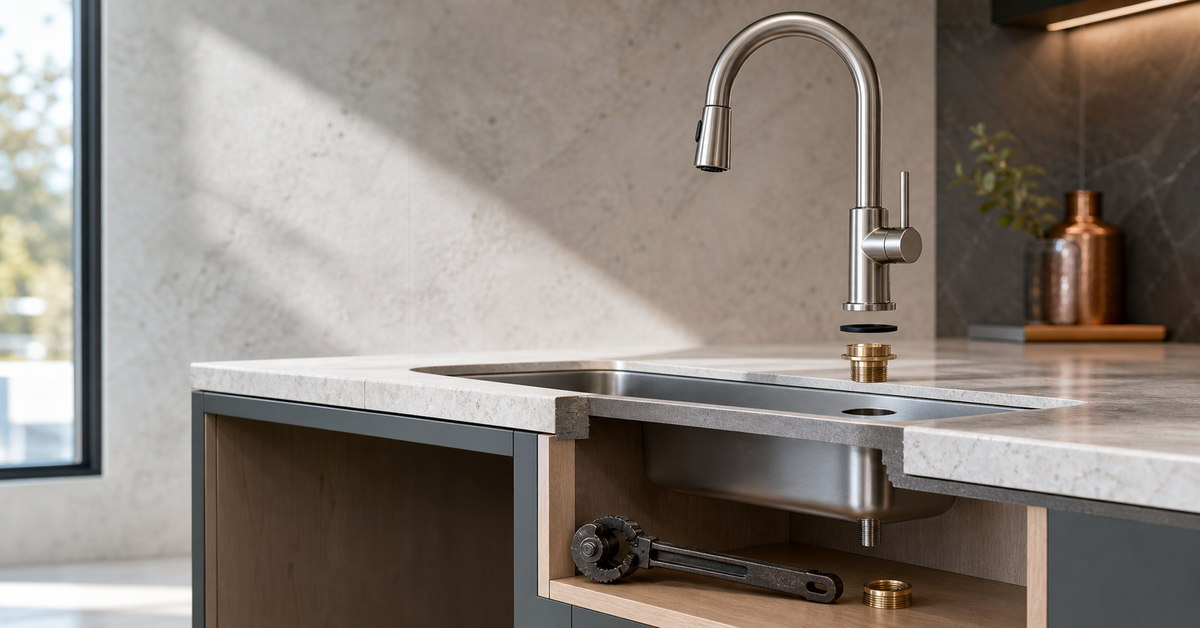
5. Materials and Components: Look Beyond the Faucet Body
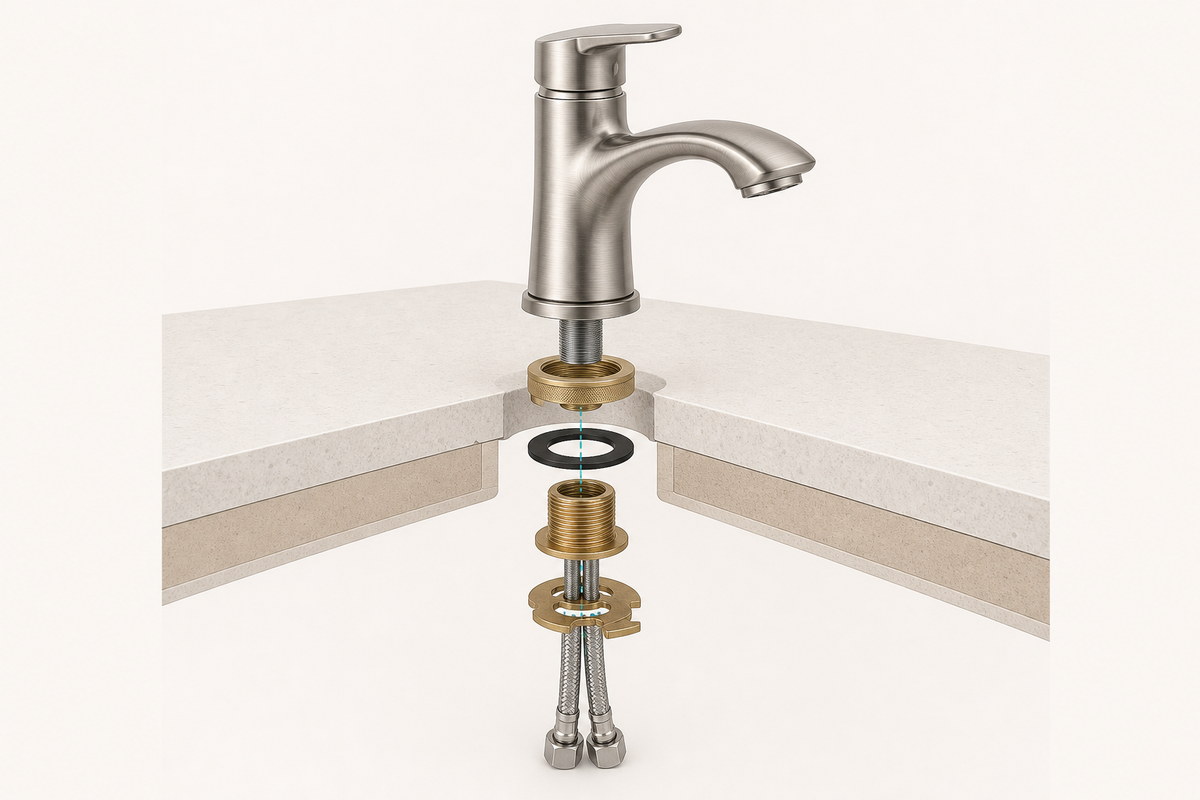
A reliable comparison separates the body, spout, handle, internal waterway, mounting hardware, hoses, seals, cartridge, and aerator.
“Brass faucet” may describe the principal body while other parts use stainless steel, zinc alloy, engineering polymer, silicone, or rubber for valid functional reasons.
For a top fixed faucet, pay particular attention to the load path:
-
The base and gasket distribute pressure and protect the visible deck.
-
The anchor or mounting collar converts the tightening action into clamping force.
-
A stabilizing plate may be required on thin or flexible decks.
-
Thread quality influences assembly consistency and resistance to loosening.
-
Braided hoses and connectors need the correct length, bend radius, thread, and market-specific approval.
-
The cartridge and aerator should be treated as service components with identifiable specifications.
Material declarations should be tied to a bill of materials or controlled specification.
Where a lead-free claim applies, ask for the governing definition, test method, certificate holder, and covered SKUs rather than accepting a general website statement.
Suggested illustration position:
top-fixed-faucet-mounting-system.jpg
ALT: Exploded top fixed faucet mounting components
6. Workmanship and Installation: A Controlled Six-Step Method
The precise installation sequence varies by model, but a controlled project installation normally follows six stages.
Step 1: Inspect the Deck
Confirm the mounting-hole diameter, deck thickness, flatness, structural condition, and clearance from the sink rim and backsplash.
The deck should be clean, stable, and capable of supporting the clamping load.
Step 2: Check the Installation Kit
Match the faucet, gasket, mounting parts, hoses, adapters, installation tool, and instructions to the approved sample and packing list.
Missing or substituted components should be reported before installation begins.
Step 3: Route the Hoses
Prevent twisting, sharp bends, abrasion, and interference with drawers, traps, shelving, or waste-disposal units.
The hoses should not be forced into a position that creates constant tension.
Step 4: Position and Tighten from Above
Align the spout and handle, seat the gasket evenly, and use the model-specific tightening procedure or torque guidance.
Do not overtighten stone, glass, ceramic, or composite decks. Excessive force can damage the countertop without necessarily improving faucet stability.
Step 5: Connect Below the Deck
Isolate the water supply, connect the correct hot and cold lines, support the hoses, and follow applicable local plumbing requirements.
Top fixing simplifies the primary fastening step; it does not remove the need for below-deck water connections.
Step 6: Commission and Record
Flush the system, check the handle and spout operation, inspect every joint under static and flowing conditions, and record the result for the project sample or installed room.
This method is also an ergonomic design consideration.
NIOSH notes that construction tasks involving stooping, kneeling, twisting, stretching, and other awkward postures can increase musculoskeletal risk. Moving a fastening step above the deck may reduce exposure to some awkward work, but the complete installation still includes below-deck connections and should be assessed as a whole.
See the NIOSH guide Simple Solutions: Ergonomics for Construction Workers.
7. Quality Control and Certification Evidence
AQ Bath’s research material identifies relevant manufacturing and testing capabilities, including material analysis, dimensional measurement, hardness, lifecycle, leakage, coating, and salt-spray testing.
A buyer should convert those capabilities into a product-specific quality-control plan.
At minimum, request:
- Incoming material verification linked to a batch or purchase lot.
- Critical dimensions and sampling frequency for the body, mounting parts, and connectors.
- Assembly and thread checks for the top-fixing hardware.
- Leakage and function test conditions, including pressure, temperature, hold time, sample size, and acceptance criteria.
- Cartridge lifecycle method and the number of cycles required by the applicable standard or buyer specification.
- Finish controls, including substrate preparation, coating system, adhesion, thickness where relevant, color master, and corrosion-test conditions.
- Final kit verification for accessories, instructions, labels, and packaging.
- A certificate matrix showing the certificate number, holder, covered models, destination market, issue date, and expiry date.
Certification must be checked at SKU level.
ISO management-system certificates do not replace product certification. Likewise, the U.S. EPA states that its WaterSense faucet label currently applies to private lavatory and bar-sink products within its scope—not to every kitchen or public-lavatory faucet.
A mounting method alone never makes a model WaterSense labeled. Buyers can review the current scope on the EPA Bathroom Faucets page.
8. Capacity, Sampling, and Lead-Time Questions
Public AQ Bath material supports OEM/ODM, product design, mold design, manufacturing, surface treatment, testing, and bulk supply.
However, it does not publish a universal MOQ, sample time, tooling time, or production lead time that can safely be applied to every SKU.
Ask the supplier to build a schedule around the following approval gates:
- Requirement freeze and target-market review.
- Existing model selection or custom-design decision.
- Drawing, finish, packaging, and compliance confirmation.
- Tooling or fixture requirement, ownership, and approval.
- Functional sample and appearance sample approval.
- Test plan and document release.
- Pilot or pre-production sample.
- Bulk production, inspection, packing, and shipment.
Lead time depends on whether the buyer:
- Selects an existing model.
- Changes only branding and packaging.
- Requests a new finish.
- Modifies components.
- Opens completely new tooling.
These paths should be separated in the quotation instead of being covered by one vague delivery promise.
9. AQ Bath Model Comparison: Use the Range as a Shortlist
The public category provides a starting point, not a complete specification database.
| Model | Public positioning | Likely shortlist use | Confirm before quoting |
|---|---|---|---|
| A0060-1-3 | Top Fixed Kitchen Faucet: Elegance & Functionality | Standard kitchen, apartment, hotel, or light-commercial use | Material, dimensions, cartridge, flow, finish, hole, and deck range |
| A0060-1-1 | Top-fixed kitchen faucet with pull-down sprayer | Kitchens needing extended sink coverage | Correct product copy, spray modes, hose retraction, reach, and mounting kit |
| A0060-1-4 | Easy-to-install kitchen faucet | Standardized new-build or renovation package | Detailed configuration, dimensions, flow, finish, and certification |
| A0061-1 | Quick-installation basin faucet | Apartment, hotel, and standard washbasin projects | Hole and deck range, hose, cartridge, aerator, finish, and warranty terms |
| A0060-01-01 | Tall single-handle kitchen faucet | Deep-sink or large-vessel clearance; OEM and wholesale | Height, reach, rotation, material, flow, connectors, and mounting method |
The A0060-1-1 public page has been flagged in the research workbook for mismatched body copy.
Use the category title only as an initial lead and obtain a controlled specification before publication or purchase.
10. Top-Fixed vs Traditional Under-Sink Mounting
Suggested illustration position:
top-fixed-versus-under-sink-installation.jpg
ALT: Top fixed versus under sink installation view
| Decision factor | Top-fixed approach | Traditional under-sink approach |
|---|---|---|
| Primary fastening access | Mainly from above the deck | Mainly from inside the cabinet |
| Restricted cabinet impact | Can reduce dependence on access around the bowl and drain | Access may be limited by bowl depth, traps, shelves, or disposal units |
| Training need | Model-specific top-access sequence and tool | Familiar mounting nut or bracket sequence |
| Compatibility risk | Hole, deck thickness, anchor travel, and top-tool clearance | Hole, deck thickness, nut or bracket clearance, and wrench access |
| Rework risk | Mis-seated gasket, incorrect anchor engagement, or overtightening | Cross-threaded nut, uneven bracket, or insufficient wrench access |
| Water connections | Still completed below the deck | Completed below the deck |
| Labor claim | Must be measured on the real project | Establish the project baseline under the same conditions |
The correct commercial test is a controlled site trial.
Use the same sink, deck, cabinet, supply condition, installer skill level, and acceptance checklist. Record preparation, fastening, connection, commissioning, and rework separately.
A top fixed faucet may save time in the fastening stage without changing every other stage.
The system can also reduce hidden costs when it improves access, instruction clarity, kit completeness, or repeatability. Conversely, an incompatible deck or poorly controlled accessory pack can erase those gains.
Evaluate total installed cost, not unit price alone.
11. OEM/ODM Options and the Evidence Package to Request
For private-label or project work, customization can include:
- Logo and branding.
- Faucet finish.
- Handle style.
- Cartridge or aerator option.
- Hose and connection set.
- Mounting kit.
- Packaging.
- Installation instructions.
- Product labels.
- Spare-parts plan.
New geometry or structural changes may require design review, prototypes, tooling, and additional validation.
A complete RFQ should include:
- Destination market and required code or certification.
- Buyer type, project, and expected operating environment.
- Forecast, order quantity, delivery windows, and service-parts horizon.
- Sink and countertop drawings.
- Mounting-hole diameter and deck thickness.
- Cabinet and backsplash constraints.
- Required faucet height, reach, rotation, and flow.
- Cartridge, hose, and connector requirements.
- Finish master and color tolerance.
- Logo, packaging, and instruction language.
- Test standards, sampling plan, reports, and document retention.
- Tooling ownership and intellectual-property terms.
- Engineering change-control requirements.
- Golden-sample approval process.
This information makes quotations easier to compare and reduces the risk of selecting a faucet based on appearance alone.
12. Project Verification Checklist and Next Step
Suggested illustration position:
top-fixed-faucet-project-checklist.jpg
ALT: Project team checks top fixed faucet deck fit
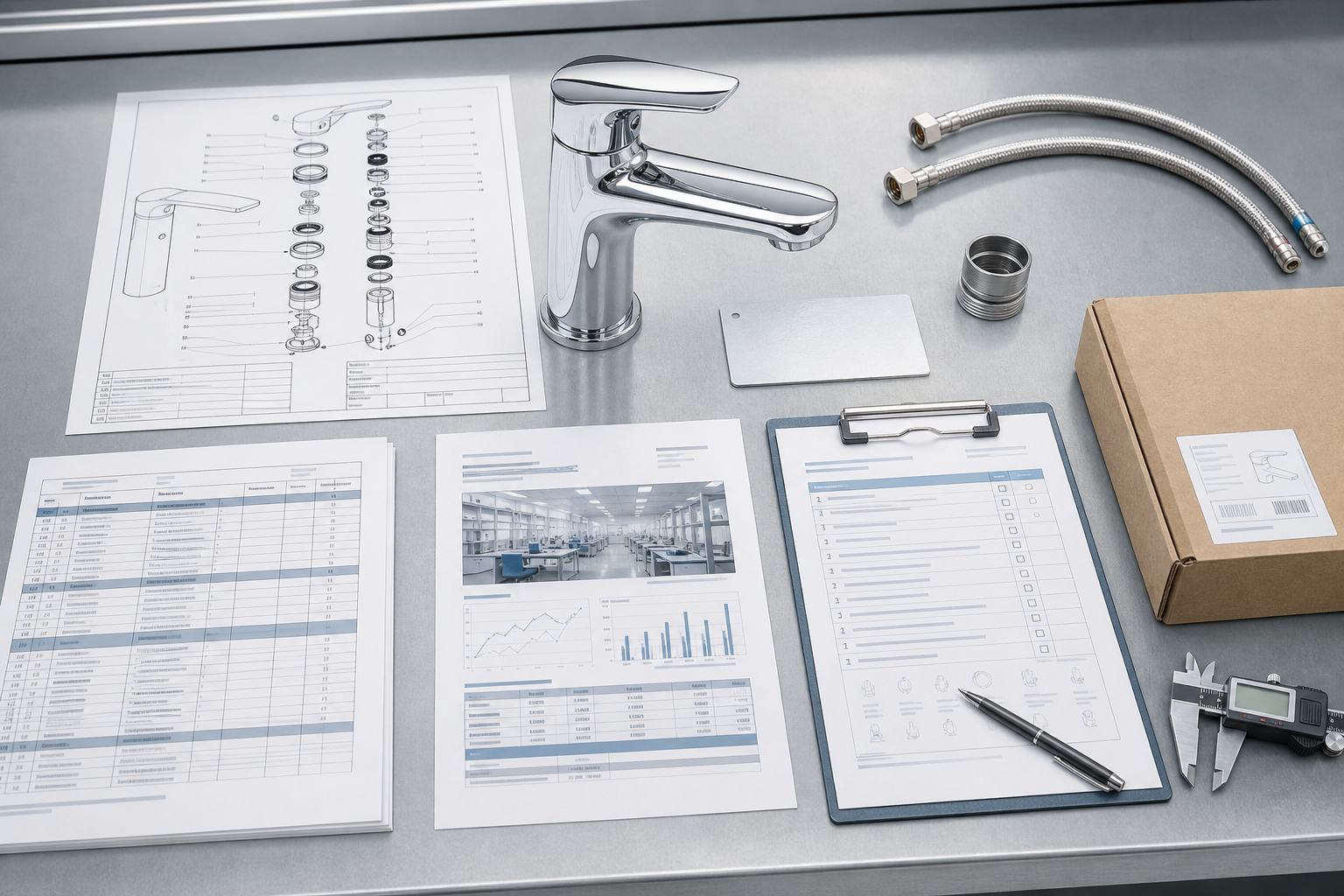
Before approving a top fixed faucet for bulk purchase, verify the following on a representative mock-up:
-
The approved mounting-hole and deck-thickness ranges match the actual project.
-
The faucet base fully covers the opening and sits flat without rocking.
-
The fixing hardware engages correctly and does not damage the countertop.
-
The spout lands inside the bowl with acceptable clearance and splash behavior.
-
The handle clears the wall, backsplash, mirror, and adjacent accessories.
-
Hoses route without twisting, abrasion, compression, or drawer interference.
-
Market-specific connectors and certified components match the order.
-
Static and flowing leakage checks pass under the agreed conditions.
-
The finish, accessory pack, instructions, and labeling match the golden sample.
-
Installers can repeat the approved method and record any exceptions.
Next step: Send AQ Bath the sink or countertop drawing, hole diameter, deck thickness, destination market, quantity, preferred finish, and required certification.
Ask for a model comparison, controlled drawing, installation instructions, sample, and model-specific evidence package before confirming the order.
13. Frequently Asked Questions
1. Is a top fixed faucet the same as a deck-mounted faucet?
Not exactly.
Both are mounted through a sink or countertop deck, but “top fixed” highlights that the primary securing and alignment work is performed from above. A conventional deck-mounted faucet may still use a nut or bracket tightened from below.
2. Does it eliminate all under-sink work?
No.
The installer normally still connects the hot and cold supplies below the deck and checks the cabinet for hose routing, interference, and leaks.
3. Is a top fixed faucet always faster to install?
It can simplify the fastening stage when underside access is restricted.
However, the total installation time depends on the deck, cabinet, old-faucet removal, supply condition, accessories, installer experience, and commissioning requirements.
The complete process should be measured on a representative project mock-up.
4. Can it fit an existing faucet hole?
Only if the model’s approved hole diameter, deck-thickness range, base footprint, and hardware clearances match the existing deck.
Measure the installation first and verify the dimensions against a controlled product drawing.
5. Does “quick install” mean no tools are required?
Not as a general rule.
Some systems use a supplied top-access tool or common hand tool. Follow the model-specific instructions and do not repeat a tool-free claim without supporting evidence.
6. Can it be installed on stone, wood, stainless steel, or composite decks?
Potentially, but each substrate needs suitable thickness, flatness, support, sealing, and tightening control.
Thin or flexible decks may need a stabilizing plate. Brittle materials should not be overtightened.
7. What commonly causes a top-fixed faucet to loosen?
Possible causes include:
- An uneven deck.
- An incorrectly seated gasket.
- Insufficient or excessive tightening.
- Incomplete anchor engagement.
- A flexible substrate.
- A missing stabilizing plate.
- Use of an unapproved mounting kit.
8. How should a buyer compare top-fixed models?
Compare:
- Mounting-hole and deck-thickness ranges.
- Base footprint.
- Faucet height and reach.
- Spout rotation.
- Mounting components.
- Material by component.
- Cartridge and aerator.
- Hose and connection type.
- Finish.
- Certification.
- Test plan.
- Packaging.
- Spare-parts availability.
9. Are all AQ Bath top-fixed models certified for every market?
Do not assume so.
Request the certificate number, certificate holder, covered model list, destination market, issue date, expiry date, and downloadable document for the exact SKU.
10. What should be approved before mass production?
Approve the:
- Controlled drawing.
- Bill of materials or material specification.
- Finish master.
- Golden sample.
- Mounting kit.
- Market-specific connectors.
- Installation instructions.
- Labels and packaging.
- Quality-control and test plan.
- Compliance documents.
- Engineering change-control process.
Conclusion
A top fixed faucet can make the primary fastening stage more accessible by moving critical fixing and alignment work above the sink or countertop.
That feature is particularly valuable in repeated apartment installations, hotel renovation, retrofit projects, and cabinets with restricted underside access. However, it does not eliminate below-deck water connections, guarantee universal compatibility, or automatically produce a fixed labor saving.
The strongest procurement decision combines the mounting concept with verified dimensions, controlled materials, a complete accessory kit, model-level certification, installation trials, and documented quality checks.
Before placing a bulk order, test the selected faucet on a representative sink, countertop, and cabinet assembly. Confirm the hole diameter, deck thickness, faucet footprint, spout reach, hose routing, mounting components, finish, certification, and complete installation process.
When these details are controlled, a top fixed faucet can become more than a marketing feature—it can support repeatable installation, clearer project planning, and lower avoidable rework.
SEO信息
SEO title:
Top Fixed Faucet vs Under-Sink Installation Guide
Meta description:
Learn how a top fixed faucet mounts from above, where it can simplify project installation, what to verify, and how it compares with under-sink hardware.
Suggested URL:/blog/top-fixed-faucet-vs-under-sink-installation
Primary keyword:top fixed faucet
图片命名与ALT文本
| 类型 | 图片文件名 | ALT文本 |
|---|---|---|
| 封面 | top-fixed-faucet-vs-under-sink-cover.jpg |
Top fixed faucet over a cutaway stone counter |
| 插图1 | top-fixed-faucet-mounting-system.jpg |
Exploded top fixed faucet mounting components |
| 插图2 | top-fixed-versus-under-sink-installation.jpg |
Top fixed versus under sink installation view |
| 插图3 | top-fixed-faucet-project-checklist.jpg |
Project team checks top fixed faucet deck fit |
以上4条英文ALT均为 45个字符。