

What should a premium faucet manufacturer prove?
Short answer: A premium faucet manufacturer should prove that it can translate a design brief into a controlled product, reproduce the approved appearance and operating feel in mass production, and keep that result stable across finishes, models and repeat orders. The evidence is not a luxury-style catalogue or a heavy sample. It is a connected file containing the current drawing, bill of materials, water-contact component list, finish standard, approved samples, critical dimensions, inspection plan, test scope, packaging reference, revision status and change-control rules.
This guide is written for design-led bathroom brands, premium distributors, showroom groups, architects' procurement partners, hospitality developers and private-label buyers. Their commercial question is specific: how can they distinguish a genuinely controlled premium program from an ordinary faucet presented with premium language? The answer lies in design fidelity, surface preparation, tactile consistency, component control, model-specific evidence and disciplined replenishment. Those controls make high-end faucet production repeatable instead of subjective.
Premium does not mean one material, one finish or one price band. A visually restrained chrome basin mixer can be premium if the geometry, interfaces, surface, handle feel, documentation and after-sales parts are controlled. A decorative faucet can still fail the premium brief when gaps vary, color shifts between lots, the cartridge changes without notice, or service parts cannot be identified. Buyers should therefore define premium as a measurable product position rather than a marketing adjective.
| Premium dimension | What the buyer experiences | What the manufacturer must control |
|---|---|---|
| Visual fidelity | Clean geometry, aligned parts and consistent color | Drawings, visible-surface zones, polishing standard, finish master and tolerances |
| Tactile quality | Stable handle movement, deliberate stops and secure joints | Cartridge reference, assembly method, torque controls and functional checks |
| Installed performance | Correct reach, clearance, flow behavior and service access | Installation drawing, connection specification, sample installation and leakage checks |
| Repeat quality | The reordered item matches the approved collection | Golden sample, lot traceability, revision control and approved-change procedure |
| Ownership experience | Clear care information and identifiable replacement parts | Care guide, spare-parts list, packaging and corrective-action process |
Discuss a Premium Faucet Brief
Define the premium customer before selecting the product
A supplier cannot engineer a meaningful premium offer until the buyer defines who will specify, purchase, install, use, clean and service it. A showroom collection may prioritize immediate visual distinction and coordinated finishes. A boutique hotel may value room-to-room appearance, cleaning resistance and fast replacement. A premium residential brand may care about packaging, sound, handle feel and a family of matching basin, bath and shower products. These are different briefs even when the same faucet silhouette appears in all three.
State the position without vague adjectives
Replace words such as “luxury,” “best” and “high quality” with product decisions. Define the target application, selling channel, reference price position, intended room type, finish palette, expected cleaning pattern, target market, installation system and after-sales promise. Add the reasons a buyer should notice the product: a specific profile, a cleaner joint, coordinated metal tones, a distinctive handle, easier service access or a controlled family across several applications.
Also define what the collection is not. A sculptural faucet designed for a private vanity may be inappropriate for a high-traffic public washroom. A delicate decorative finish may not suit aggressive cleaning. A customized platform may not suit a buyer who needs immediate stock and interchangeable commodity parts. Excluding the wrong use case protects the premium position because the product is not forced into conditions it was never approved to serve.
Map the collection, not just the hero SKU
Premium ranges are judged as families. Create a collection map showing the basin faucet, tall basin faucet, widespread or dual-handle option, bath or shower products, kitchen model where relevant, accessories, finish codes and shared design cues. Identify which components are common and which are model-specific. A coherent range may use a repeated handle language and finish standard while requiring different internal waterways, mounting systems and test plans.
This collection map prevents an expensive late discovery: the hero basin faucet is ready, but the companion products cannot match its finish, proportions or delivery schedule. A capable premium faucet manufacturer should explain where a design language can be shared and where engineering must remain application-specific.
Turn design intent into an engineering release
A premium sample can look correct while the production definition remains incomplete. The engineering release closes that gap. It should connect the product name and model code to a controlled drawing, revision, bill of materials, finish code, component references and approved samples. Every file should describe the same configuration. If the quotation names one cartridge, the drawing shows another connection and the sample carries no revision label, the product is not ready for approval.
Control the geometry buyers can see and feel
Critical dimensions are not limited to mounting holes and threads. On a premium product, buyers also notice the relationship between the handle and body, the consistency of a shadow gap, the alignment of a spout, the transition between cylindrical surfaces and the position of a logo. Define visible-surface classes and identify dimensions that influence both installation and perceived precision.
Use drawings with datums, tolerances and revision dates. Add photographs or render views only as supporting references; they do not replace dimensions. For an assembled product, consider tolerance stack-up. Several individually acceptable parts can create a visibly uneven joint when their variations accumulate. The manufacturer should identify which dimensions need tighter control because they affect the final visual relationship.
Define the operating signature
Handle feel is part of the brand experience, but “smooth operation” cannot be inspected consistently. Record the approved cartridge or valve reference, handle travel, stop positions, operating direction and any relevant torque range or comparison method. Check multiple samples, not only the hand-finished presentation unit. The objective is not to chase an arbitrary number; it is to make the intended feel reproducible and to prevent silent component substitution.
| Design statement | Controlled requirement | Approval evidence |
|---|---|---|
| “Minimal silhouette” | Defined profile, transitions, logo position and visible joint limits | Current drawing plus signed appearance sample |
| “Premium finish” | Finish code, substrate preparation, tone range, gloss or texture and defect criteria | Master panel, golden faucet and relevant test plan |
| “Smooth control” | Approved cartridge, handle travel, assembly and operating acceptance | Functional sample and recorded inspection method |
| “Easy to maintain” | Service access, care limits and replaceable-part identity | Installation trial, care guide and spare-parts list |
Verify materials and components without relying on weight
A heavy faucet may feel substantial, but weight alone does not prove material grade, waterway safety, machining accuracy or long-term reliability. Request a component-level description of the body, spout, cartridge, seals, hoses, aerator, check valves where applicable, mounting parts and decorative pieces. Mark which components contact water, hold pressure, carry structural load, remain visible or require replacement during service.
Separate the body claim from the complete waterway
“Brass body” describes one part of the product. A responsible specification identifies the complete water-contact route and the evidence required for the destination market. The buyer should confirm the alloy or material declaration, supplier controls and applicable model-level documents rather than assuming that a general factory certificate covers every faucet. When a polymer, stainless steel, elastomer or another metal is used appropriately, document its function instead of hiding it behind an all-brass claim.
Treat purchased components as part of the premium promise
Cartridges, hoses, aerators and seals can change operating feel, flow behavior, installation and after-sales performance. Record the approved reference and substitution rule. Ask how incoming components are identified, inspected and linked to production lots. A beautifully polished body does not protect the brand if the buyer cannot obtain the correct cartridge later or if an unapproved hose changes the installation interface.
Material evidence should be proportional to risk. It may include supplier declarations, incoming inspection, material spectral analysis, component certificates, dimensional records and independent testing where required. The purpose is not to collect the largest document bundle. It is to connect each important claim to the exact product revision being purchased.
Make finish control the signature of high-end faucet production
Surface finish is often the first premium signal and the first source of rejection. Color names such as brushed gold, gunmetal, matte black or chrome do not define a production standard. The specification should identify the substrate, preparation route, finish code, approved tone, gloss or texture, visible zones, acceptable variation, inspection lighting and defect criteria. If the process changes by model or component, identify those differences before approving a coordinated range.
Approve preparation before judging color
Coating cannot hide every underlying defect. Casting condition, machining marks, polishing direction, edge treatment and cleaning influence the final surface. Review the product before and after finishing. On reflective surfaces, waviness and pits may become more visible after plating. On brushed surfaces, inconsistent grain direction can make matching parts look like different colors even when the coating is similar.
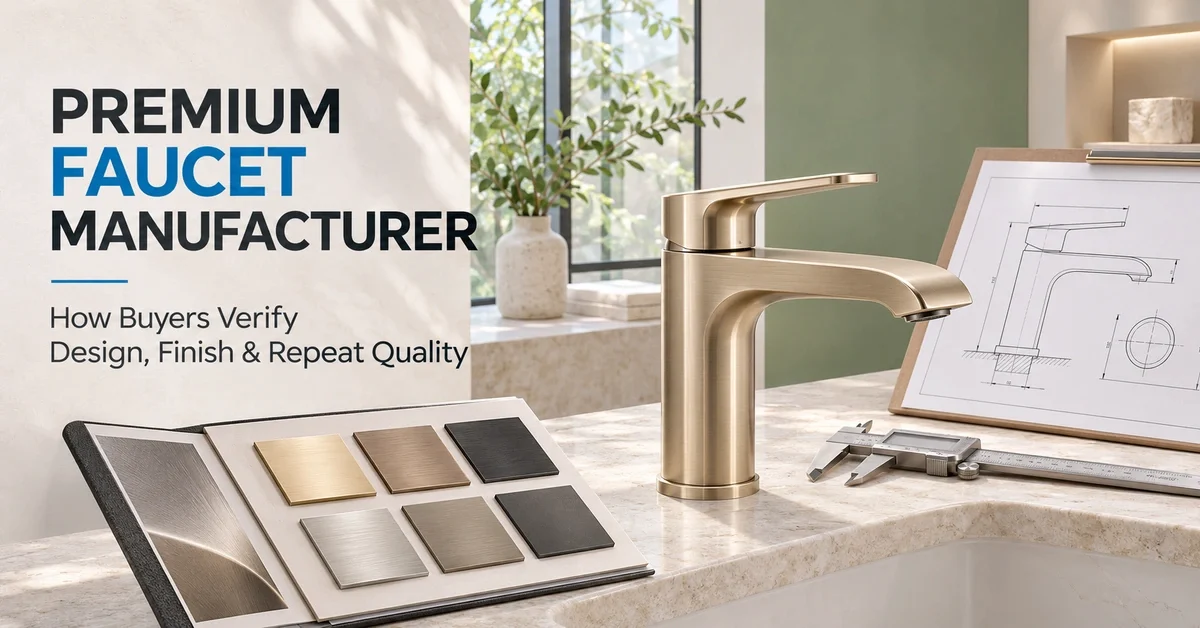
A useful finish file includes a master panel for color control and an approved assembled faucet for the interaction between geometry and finish. The panel is easier to measure and store; the assembled sample reveals edge coverage, recesses, joints and part-to-part consistency. Date and label both references, record how they are stored, and define who may approve replacement masters.
Connect finish testing to the real use condition
Salt-spray testing, coating thickness, adhesion, color measurement, abrasion and cleaner-resistance checks answer different questions. ISO 9227 describes salt-spray test methods, but a result should not be converted into an unsupported promise of years in service. Record the method, specimen, finish stack, exposure, defect definition and acceptance requirement. For an actual project or branded range, the buyer should also review cleaning products, water conditions, handling and packaging abrasion.
Luxury faucet quality control is strongest when appearance inspection and technical testing support the same finish specification. A pass/fail report without a finish code or matching sample has limited value. Conversely, a beautiful master sample without a repeatable process and inspection method cannot protect later orders.
Use a sample ladder instead of one showroom sample
A single sample is often asked to prove too much. Separate sample purposes so every approval is explicit. A design sample checks proportion and visual direction. An engineering sample checks geometry, interfaces and function. A finish sample checks color, texture and visible quality. A packaging sample checks protection and presentation. A pilot or pre-production sample checks whether the intended production route can reproduce the approved configuration.
Create a signed golden sample with limits
The golden sample should carry the model, revision, finish, date and approval status. Note any approved deviations and any provisional components. Keep matching references with the manufacturer and buyer where practical. For subjective appearance features, add limit samples or photographs showing the boundary between acceptable and unacceptable rather than expecting inspectors to interpret “minor variation” the same way.
Install and handle the sample
Mount the product on the intended or representative basin, vanity, wall or sink. Check reach, outlet position, splash, handle clearance, supply connection, fixing access, service access and visible alignment. Use the intended cleaning method and handle the product under normal lighting. A premium product must survive the transition from presentation table to installed fixture without losing its visual or functional logic.
Before releasing mass production, compare a pilot unit with the golden sample and current document file. The pilot should use production-intent materials, components and processes. This is a decisive gate for a premium faucet manufacturer: it shows whether the approved idea has become a controlled production result.
Request a Sample and Finish Review
Audit the manufacturing chain for design fidelity
The relevant question is not whether every process is in-house. It is whether the manufacturer knows which process creates each product characteristic, controls outsourced work, identifies lots and prevents unapproved changes. A premium collection can involve design, mold development, casting or forging, machining, polishing, finishing, assembly, testing and packaging. The buyer should see how the approved model moves through that route.
Development and tooling
Review who owns the industrial design, engineering drawing, mold and revision history. Confirm how design changes are assessed for waterway, wall thickness, machining access, sealing surfaces, installation and compliance. A design that is attractive but difficult to polish or inspect may produce unstable visible quality. Early manufacturability review is therefore part of premium execution, not a concession to production.
Forming and machining
Ask which parts are cast, forged, formed, machined or purchased. Identify sealing surfaces, threads, mounting interfaces and visible concentric features. Review first-piece approval, gauges, tool-life control and the response to porosity or dimensional nonconformance. The goal is to prevent hidden variation from appearing later as leakage, misalignment or difficult assembly.
Polishing, finishing and assembly
Observe how visible surfaces are classified and protected between operations. Confirm that the finish supplier, whether internal or external, receives the correct substrate and specification. At assembly, check component identification, fixture condition, torque or fit instructions, line clearance and segregation of defects. A premium line should not rely on final inspection to sort quality into existence; each upstream step should prevent or detect the defect it can create.
AQBath's public AG Valve company profile identifies Ningbo Yinzhou Anqi Valve Co., Ltd. in Ningbo, Zhejiang, China, established in 2006. It lists product design, mold design and mold manufacturing; lead-free brass casting, zinc-alloy die casting, forging, welding, pipe bending, cold stamping, precision machining, polishing and electroplating; and quality capabilities including material spectral analysis, coating testing, 3D image measurement, hardness testing, lifespan testing, leakage testing and electroplating salt-spray testing. These are relevant capability signals for supplier screening. They do not prove that every capability, certificate or test applies to every model, finish and destination market.
Build luxury faucet quality control around critical characteristics
A premium inspection plan should follow the product risks, not a generic checklist. Mark critical-to-quality characteristics in the drawing and control plan. Some protect safety and sealing; others protect installation, visual alignment, operating feel or collection consistency. Define the method, stage, equipment, frequency, acceptance rule, record and escalation owner for each one.
| Control stage | Premium risk to control | Useful evidence |
|---|---|---|
| Incoming material and components | Wrong alloy, cartridge, hose, seal or finish input | Approved supplier list, material/component identity and inspection record |
| Machining | Interface error, leakage path or visible misalignment | First-piece record, critical dimensions and calibrated measurement |
| Surface preparation | Pits, waves, uneven brushing or edge distortion | Visible-zone standard, process sample and defect limits |
| Finishing | Color drift, gloss variation, weak adhesion or incomplete coverage | Finish code, master panel, lot identity and relevant test record |
| Assembly and function | Wrong component, inconsistent feel, leakage or loose joint | Work instruction, component verification, leakage and function record |
| Final appearance and packing | Visible defect, mixed finish, missing part or transport abrasion | Golden-sample comparison, accessory check and approved pack reference |
Sampling frequency should reflect process capability, defect severity, order history and buyer requirements. One percentage is not appropriate for every characteristic. Leakage may be checked differently from color, dimensions or packaging. Record the actual plan rather than using “100% QC” as a marketing phrase. A complete plan also defines what happens when a check fails: containment, lot identification, reinspection, root-cause work, buyer notification and release authority.
Interpret tests and certifications at model level
Testing is useful only when its scope matches the product decision. Ask which model, component, finish, specimen, production location and revision were tested. Record the method, conditions, acceptance criteria and result. A test name without those details is not enough to approve a premium collection.
Use finish tests as a system
Salt-spray exposure can support corrosion-related evaluation. Coating thickness, adhesion, color, gloss, abrasion and chemical compatibility address other risks. ISO 2409, for example, describes a cross-cut method for assessing coating separation, but the applicable method and acceptance requirement still need to be agreed for the actual finish. The buyer should avoid copying one test result from a chrome product to a colored finish or from a flat panel to a complex assembled faucet without confirming relevance.
Separate company credentials from product approval
A quality-management certificate describes a management system; it is not proof that a specific faucet meets every plumbing, drinking-water or market requirement. Likewise, a certificate logo on a company page should trigger model-level verification, not automatic approval. Check the certificate holder, manufacturing site, model or family coverage, applicable standard, status, authorized mark and consistency with the production bill of materials.
AQBath publicly displays company-level certifications and lists several testing capabilities. A buyer evaluating a specific premium faucet manufacturer proposal should request the documents relevant to the quoted SKU and market. The absence of a required model link should remain an open item in the RFQ rather than being filled with an assumption.
Control premium OEM and ODM decisions before mass production
OEM may start from an existing platform with agreed changes to finish, handle, components, logo, packaging or accessories. ODM may involve deeper design and engineering responsibility. The label is less important than the responsibility map. Define who owns the design, drawings, tooling, finish master, validation plan, compliance work, packaging artwork and change approval.
Customization can create dependencies. A custom handle may require new tooling and a unique insert. A new finish may need a separate development run and sample master. A different cartridge can change handle geometry and operating feel. A branded carton can become obsolete after a regulatory or component change. The premium faucet manufacturer should identify these dependencies before quotation approval, not after the buyer commits to a launch date.
For a design-led brand, intellectual-property handling should also be explicit. Use clear file naming, access control, ownership terms and an approval path for design changes. The buyer should know whether the project uses an exclusive design, a customized standard platform or a widely offered model. This distinction affects commercial positioning, tooling rights, replenishment and the risk of visually similar products appearing elsewhere.
The public Faucet Manufacturing & OEM category provides a useful starting point for reviewing AQBath's manufacturing and customization content. For an actual program, request a model-based responsibility and validation plan rather than relying on a general OEM statement.
Compare quotations by the cost of protecting premium position
Two quotations can look comparable while covering different work. Normalize the product configuration, finish development, samples, tooling, tests, documents, inspection, packaging, spare parts, Incoterm and change-control obligations. Then identify exclusions and one-time charges. The lowest unit price may transfer design, compliance or quality work back to the buyer.
| Quotation item | Hidden premium risk | Buyer clarification |
|---|---|---|
| Unit price | Different cartridge, finish stack, accessories or inspection scope | Attach one controlled configuration to every offer |
| MOQ | Minimum may apply by model, finish, component or packaging run | Request the minimum for the exact collection and phase |
| Sample charge | Sample may be hand-finished or use provisional parts | State sample purpose, production intent and approval status |
| Tooling and development | Ownership, maintenance and revision rights may be unclear | Define deliverables, ownership, life, storage and change approval |
| Lead time | Clock may exclude approvals, finish development or packaging | Use milestones from complete input to approved dispatch |
| Warranty | Replacement promise may lack lot traceability and root-cause action | Define claim evidence, response, spares and corrective action |
MOQ, development cost and lead time depend on model, finish, tooling, components, packaging, test scope and order plan. AQBath's public pages do not establish one universal figure for a premium program. Request project-specific terms and record when the schedule starts, which approvals are prerequisites and what changes can reset it.
Send an RFQ that a premium faucet manufacturer can answer
A useful RFQ removes the ambiguity that creates attractive but incomparable offers. Include the following information:
- Buyer type, sales channel, destination market and intended application.
- Collection map, target models, reference images and design ownership status.
- Installation drawings, basin or sink geometry, connection requirements and service access.
- Material and water-contact requirements, cartridge expectations and replaceable parts.
- Finish codes, color references, visible-surface classes, cleaning environment and sample needs.
- Required standards, certificates, tests and destination-market document review.
- Forecast by model and finish, sample quantity, launch phases and repeat-order expectation.
- Branding, packaging, instructions, labels and spare-parts requirements.
- Requested drawings, BOM detail, sample ladder, inspection plan and change-control response.
- Commercial basis, requested milestone schedule, Incoterm and quotation validity.
Ask the supplier to classify every response as confirmed, proposed, buyer decision, sample required, document pending or excluded. This is particularly useful in high-end faucet production, where an unanswered finish or component question can later be mistaken for approval.
FAQ about premium faucet manufacturing
What is a premium faucet manufacturer?
A premium faucet manufacturer converts a defined design and performance position into a documented product that can be sampled, inspected, manufactured and reordered consistently. The term should describe controlled results, not simply a high price, decorative finish or luxury claim.
How is a premium faucet different from a standard faucet?
The difference depends on the brief. It may involve more controlled geometry, tighter visible alignment, a distinctive finish, selected components, coordinated collection design, better documentation, more demanding sample approval, packaging presentation or stronger replenishment control. Every claimed difference should have a specification and evidence.
Does a heavier faucet always indicate better quality?
No. Weight can influence perceived substance but does not prove alloy, waterway safety, machining, cartridge quality, coating performance or reliable assembly. Review the component construction and model-specific evidence.
Which sample should be approved before high-end faucet production?
Approve the engineering configuration, physical finish reference, installed function, packaging and a production-intent pilot. One showroom sample should not be assumed to approve every dimension, component, finish, document and pack detail.
What does luxury faucet quality control include?
Luxury faucet quality control should cover material and component identity, critical dimensions, surface preparation, finish consistency, visible defects, assembly, leakage, function, packaging, traceability and change control. The plan must define methods and acceptance rules for the actual model.
Can one certification cover an entire premium collection?
Only when the certificate or listing scope explicitly covers the applicable models, configurations, manufacturing site and standard. Verify the current scope. Do not infer model compliance from a company logo or a certificate for another product.
How should buyers control finish consistency on repeat orders?
Use a coded finish specification, stored master panel, approved assembled sample, controlled inspection conditions, lot identification and written change notification. Review matching components together because substrate and geometry can affect perceived color.
What should I send to request samples or a quotation?
Send the application, target market, collection map, drawings or references, finish direction, components, quantity forecast, sample goals, required documents, packaging, schedule and open design decisions. A detailed brief allows the manufacturer to identify assumptions before pricing.
Conclusion
A premium faucet is not created by adding a premium label to a familiar product. It is created by controlling design intent, geometry, water-contact materials, components, surface preparation, finish, operating feel, installation, inspection, packaging and replenishment as one connected specification. The buyer should approve evidence in stages and require the production file, samples and commercial offer to describe the same configuration.
The strongest premium faucet manufacturer proposal is therefore the one with the fewest hidden assumptions. Before award, request a model-based drawing and BOM, finish masters, production-intent sample, critical-quality plan, relevant test and certification scope, spare-parts references and change-control commitment. AQBath's public manufacturing capabilities and faucet platforms provide a starting point; final approval should follow a technical review of the exact product, market and order plan.