

How to Evaluate a Quick-install Kitchen Faucet Before Buying
A Quick-install Kitchen Faucet is designed to reduce the time and effort involved in fitting a mixer to a sink or countertop. That sounds straightforward, but installation speed depends on more than a faucet being top-mounted. The mounting hardware, underside access, hose connections, deck-hole arrangement, seals, and the clarity of the installation instructions all affect the real job. This guide explains what buyers should check when comparing a quick-install design, especially for kitchen renovation, replacement, OEM, and private-label programs.
The decision is not simply whether a faucet looks modern. Buyers need to establish whether the visible design matches the installation environment, whether the supplied components are suitable, and which technical details still need confirmation from the manufacturer.
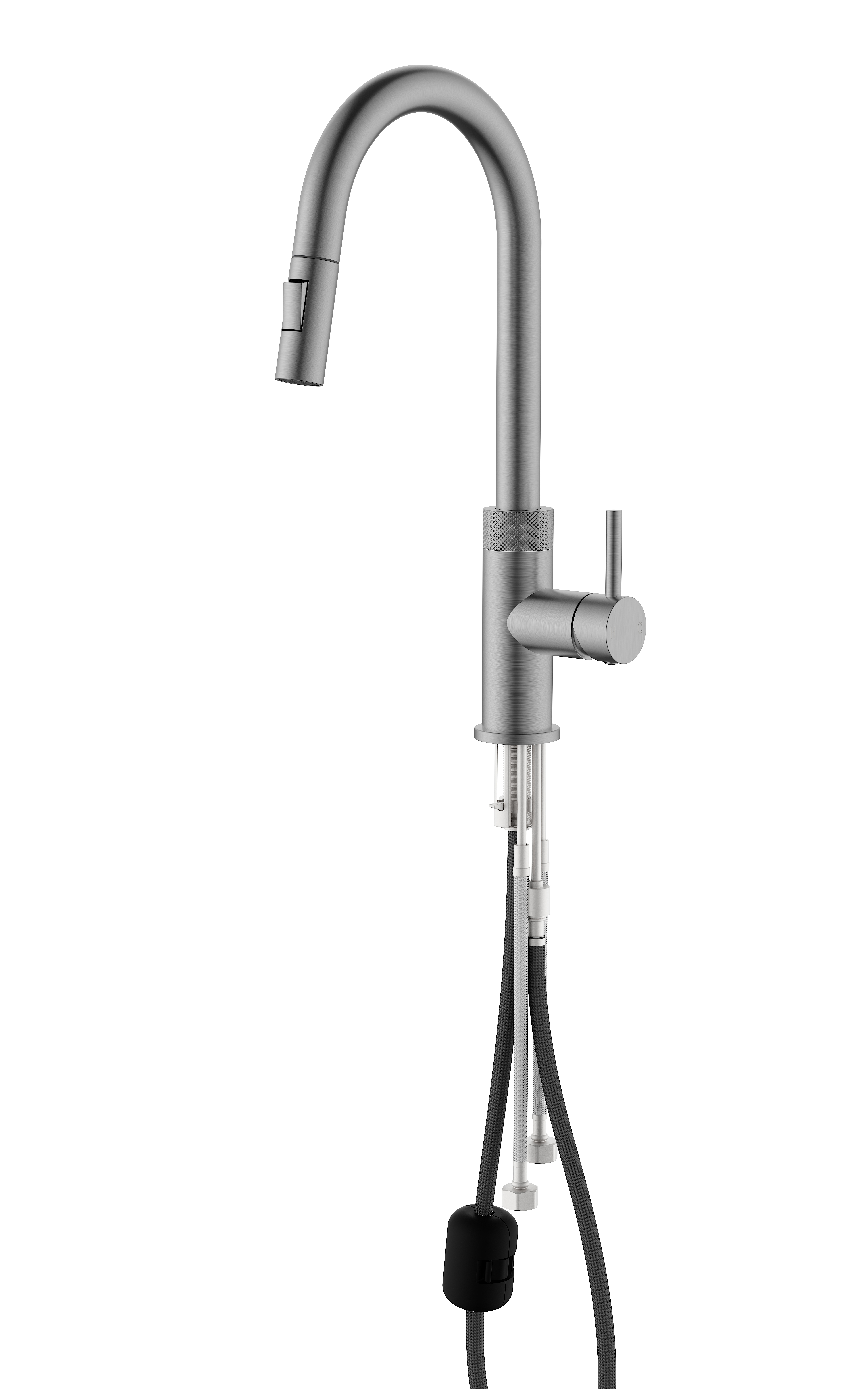
Quick reference: what this faucet design offers
| Feature | What is visible or reasonably indicated | What still needs confirmation |
|---|---|---|
| Mounting | Top-mounted, deck-installation format with a threaded shank, washers, seals, and nuts shown underneath | Required hole diameter, deck thickness range, and whether a single-hole or multi-hole sink is needed |
| Spout | Tall, curved gooseneck with useful clearance for cookware | Spout rotation range, reach, overall height, and clearance requirements |
| Spray function | Detachable spray head with a visible outlet screen or aerator and control button | Whether the mechanism is pull-down or pull-out, spray modes, hose length, and docking method |
| Control | Separate cylindrical handle with visible hot and cold markings | Cartridge construction, operating angle, serviceability, and temperature-control behavior |
| Finish | Brushed or satin metallic appearance in the main view; other light and dark variants may be available | Base material, coating process, corrosion testing, and exact finish names |
This comparison is useful because it separates visible product attributes from specification items that should not be assumed. A faucet can appear installation-ready while still requiring a particular hole size, connection standard, or countertop thickness.
Why installation design matters in the field
Kitchen faucet replacement work is often performed in an awkward space below the sink. There may be limited room for a wrench, old plumbing may be corroded, and the installer may be working around a basin, waste disposal unit, water filter, or cabinet structure. A top-mounted design can simplify the sequence by allowing the main body to be positioned from above while the retaining hardware is tightened below.
The pictured configuration includes a broad mounting base or escutcheon, a threaded mounting shank, washers or seals, and nuts. These parts are important because they stabilize the faucet against the deck and help manage water around the mounting opening. They do not, by themselves, prove that every sink or countertop will accept the faucet. The buyer should obtain the installation drawing before placing an order, particularly when the product is intended for replacement work.
An Easy Install Kitchen Faucet should also be judged by hose routing. The visible flexible braided hose is useful for connecting the spray head and accommodating movement, but routing must remain free from sharp bends, cabinet hardware, and stored cleaning products. A hose that is technically long enough may still work poorly if it catches below the sink or fails to retract cleanly.
Understanding the visible construction
High-arc spout and spray head
The tall gooseneck spout creates clearance for filling large pots and washing cookware. That geometry is practical in a residential kitchen, although height and reach should be checked against overhead cabinets, shelves, and windows. The detachable spray head gives the user more control when rinsing a sink, vegetables, or the sides of a pan than a fixed outlet would provide.
The spray head appears to include an outlet screen or aerator and a control button. It is not safe to infer the number of spray modes from the image alone. Buyers should ask whether the button switches between stream and spray, pauses the flow, or serves another function. The pull-down versus pull-out arrangement should also be confirmed rather than assumed from the hose path.
Handle and water control
The separate cylindrical control handle carries hot and cold indicators. Clear markings are a small but worthwhile usability feature, especially in rental housing, hospitality settings, and kitchens used by multiple people. The handle position and operating arc should be reviewed alongside the backsplash and adjacent wall because a tight installation can limit movement.
The cartridge type is not supplied in the available product information. That matters for sourcing teams planning spare parts, maintenance instructions, or long-term private-label support. Ask for the cartridge specification, replacement procedure, and available service components before treating the faucet as a complete program item.
Body, finish, and assembly
The main finish appears brushed or satin metallic. A Stainless Steel Kitchen Faucet may refer to a faucet made from stainless steel, a faucet with a stainless-looking finish, or a product marketed with stainless steel as one of its variants. Those are not interchangeable descriptions. The exact body material, coating technology, and substrate should be documented in the supplier’s technical file.
From a manufacturing standpoint, a faucet of this type may involve metal casting or forging, CNC machining, spout forming, polishing or brushing, seal installation, hose assembly, and final leak and function checks. Those are common industry processes, not confirmed details of this particular product. A buyer should request the actual material declaration and quality-control procedure rather than relying on appearance.
Selection criteria for residential and project buyers
Start with the installation environment. Confirm the number and size of sink or countertop holes, the deck thickness, the underside clearance, and the type of water-supply connections available. For a replacement project, measure the existing opening and compare it with the new faucet’s mounting drawing. A broad base may conceal an old mark or an oversized opening, but that should be verified.
Next, examine operational requirements:
- Required spout height, reach, and rotation range
- Pull-down or pull-out spray-head configuration
- Number and type of spray functions
- Hose length and retraction or docking method
- Handle clearance and hot/cold marking location
- Connection hose sizes and thread standards
- Flow performance and pressure requirements
None of these values are supplied here, so they belong on the technical-question list. This is particularly important for multifamily housing, hospitality, and light commercial packages. A product that suits a home renovation may not meet a project’s water-efficiency, plumbing approval, duty-cycle, or maintenance requirements.
Common purchasing mistakes
The first mistake is treating a faucet image as a dimensional drawing. A high-arc shape may look suitable, yet the spout can interfere with a shelf or fail to reach the center of the basin. The second is assuming that all included hoses use the same connection standard. Compatibility should be confirmed with the actual supply valves and installation region.
Another frequent error is specifying the finish without defining the material and process behind it. Terms such as brushed, satin, black, or light metallic describe appearance, not necessarily durability. For a private-label program, request finish samples, care instructions, and any available corrosion or surface-performance data. Do not promise a service life or corrosion resistance that the supplier has not documented.
Finally, buyers sometimes focus on the faucet body and overlook the underside hardware. Washers, seals, nuts, hose guides, and mounting plates influence installation quality. Confirm what is included in the standard package and whether replacement seals or hoses can be purchased later.
Practical advice for OEM and distributor sourcing
For OEM or distributor programs, build the product brief around measurable information. Request a dimensional drawing, exploded parts view, bill of included components, installation instructions, connection details, and packaging specification. If multiple finish variants are offered, ask whether the variants use the same base components and whether the color or coating process changes the order requirements.
It is also sensible to define the inspection plan before production approval. The plan may cover appearance, handle operation, hose movement, mounting stability, connection integrity, and leak or function testing. The exact test method and acceptance criteria should come from the manufacturer or project standard; they should not be invented from a product photograph.
For end users, the most useful next step is simpler: obtain the installation sheet and verify the measurements before removing the old faucet. Keep the sink cabinet clear during installation, protect the finish from tools, and inspect every connection for leaks after the water is restored. A short check at this stage is cheaper than repairing a cabinet base later.
Frequently asked questions
Is this faucet suitable for every kitchen sink?
No. It appears to be a deck-mounted, top-mounted format, but the required hole arrangement, hole diameter, deck thickness, and connection details are not provided. Confirm those points before purchase.
Is it definitely a pull-down faucet?
Not from the available information. The product includes a detachable spray head and flexible hose, but the exact pull-down or pull-out mechanism needs confirmation from the supplier.
Can the body be described as stainless steel?
The finish appears metallic, but the exact body material is unknown. Buyers should request a material declaration before using Stainless Steel Kitchen Faucet as a technical specification.
Is it appropriate for commercial installation?
It may be considered for hospitality, multifamily, or light commercial use if the required plumbing approvals, performance data, and duty rating are available. Residential appearance alone is not evidence of commercial suitability.
Next step: convert the image into a verified specification
This faucet presents a practical installation concept: a deck-mounted body, high-arc spout, separate hot-and-cold control, detachable spray head, and visible mounting hardware. The right buying decision depends on the details behind that layout. Ask for the dimensional drawing, material and finish information, connection specifications, spray-head configuration, included components, and applicable test or approval documents. With those items in hand, a sourcing team can decide whether the product is ready for a replacement job, a project package, or a broader OEM program without confusing attractive geometry with verified performance.