

Why the search for a European vintage faucet keeps coming up in kitchen projects
A European vintage faucet is rarely just a style choice. For many buyers, it sits at the intersection of design, function, and a very practical question: how do you give a kitchen or prep area a classic look without losing day-to-day usability? That question matters whether you are specifying a sink for a hospitality build, refreshing a residential kitchen, or trying to make a newer space feel less generic.
The appeal is easy to understand. Vintage European forms tend to favor graceful curves, visible metalwork, and a more deliberate two-handle arrangement. They bring a sense of permanence that mass-market single-lever fixtures often do not. But appearance alone is not enough. Sourcing teams and product designers still need to think about installation, valve behavior, finish durability, and how the faucet will actually be used over years of service.
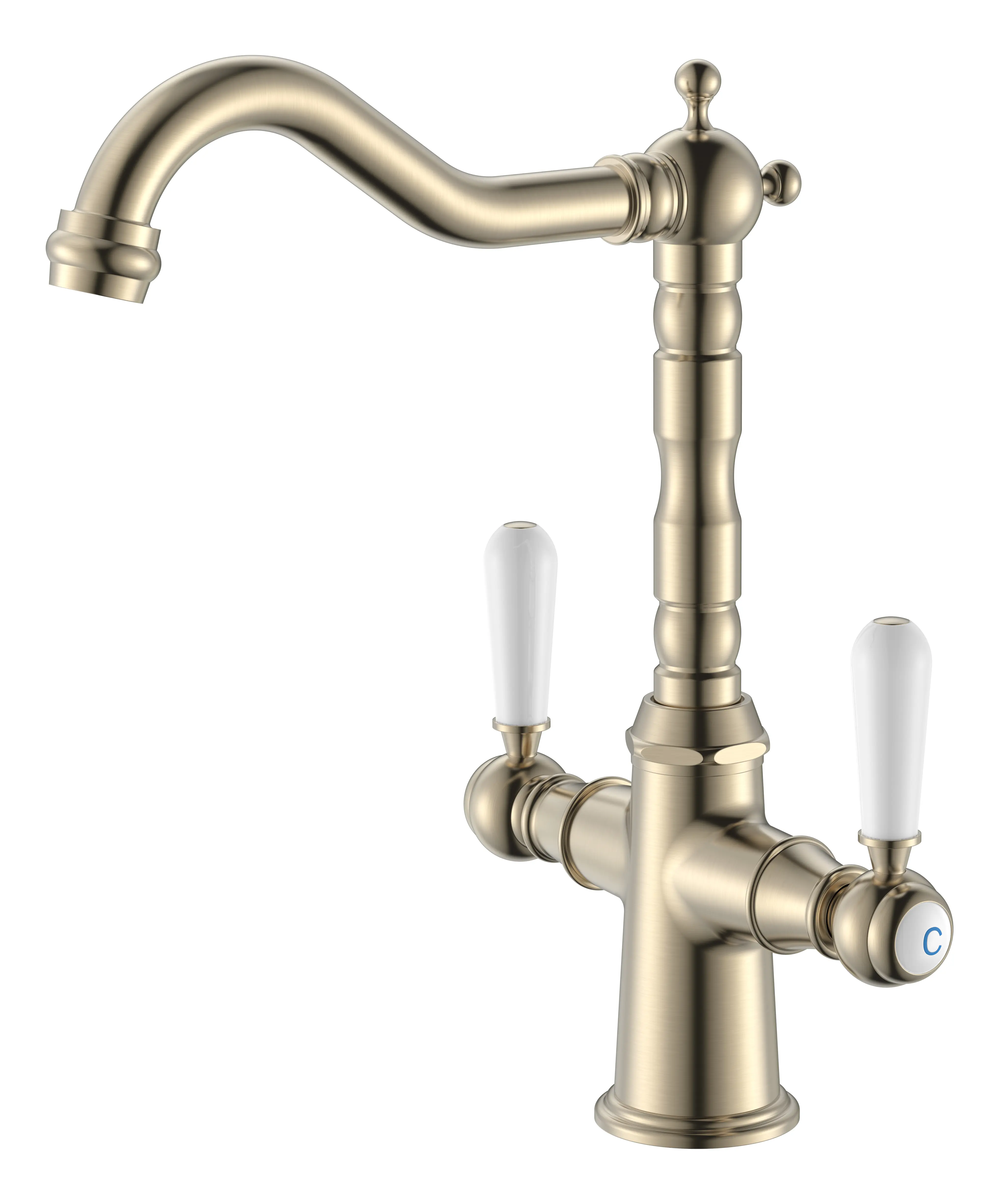
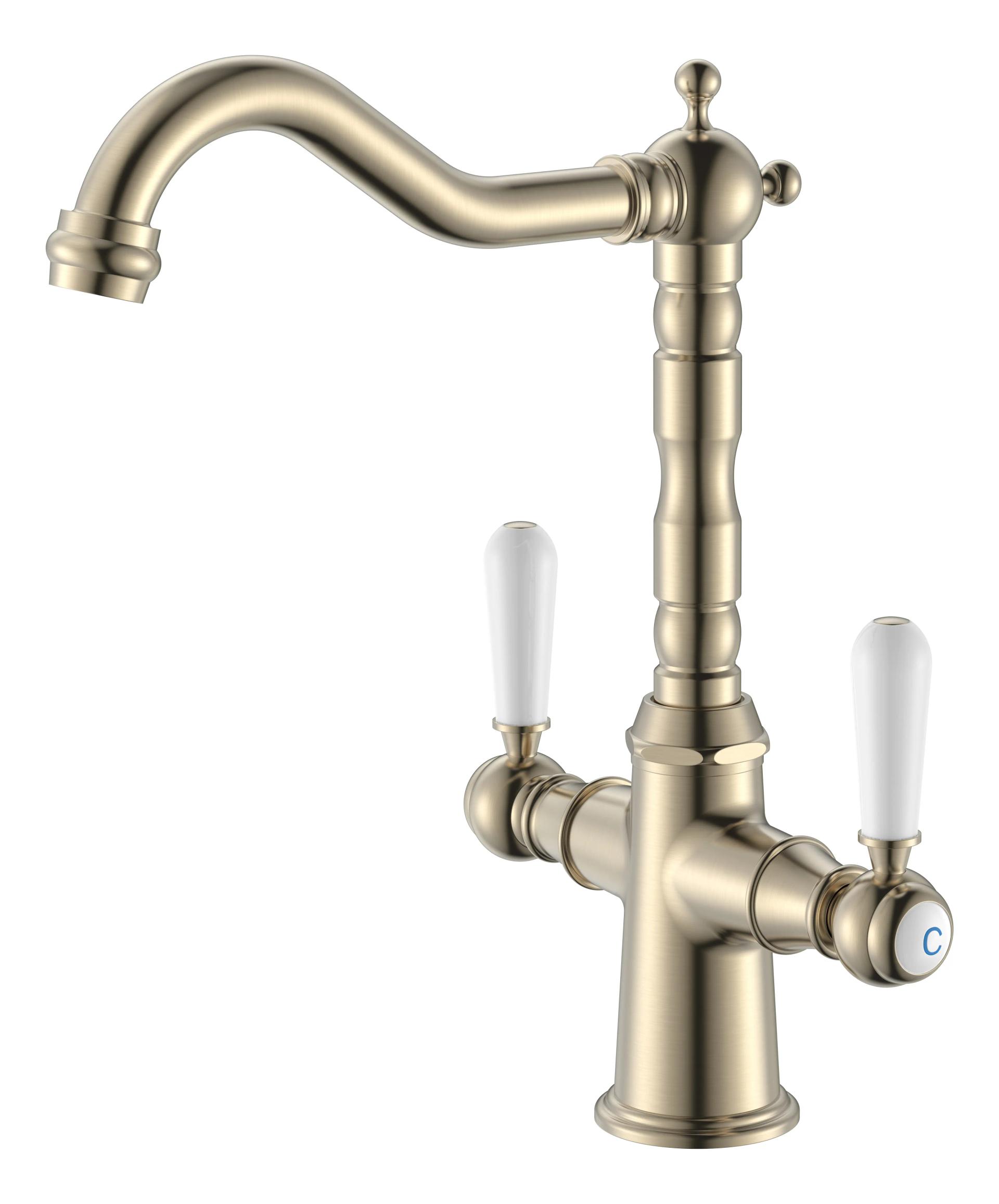
This is where a careful reading of the design helps. The faucet described here has a high-arc gooseneck spout, two side handles, and a deck-mounted base. That combination pushes it toward a traditional look while still fitting the needs of a working sink. It is the kind of fixture people notice immediately, but it also has to earn its place through utility.
What the observed design tells you at a glance
From the visible features, this is a two-handle faucet assembly with a tall cylindrical body and a curved swivel-style spout. The white lever handles sit on either side, and the right handle carries a blue “C” marking, which indicates cold water control. A matching hot-side marking is not visible, so any final interpretation should stay cautious.
The overall profile is consistent with a European vintage faucet style, or at least with a faucet that borrows from that language. It has the kind of composed geometry that works well in kitchens where the sink area is meant to read as part of the room rather than pure utility hardware. That matters in front-of-house food service, boutique hospitality, and residential remodeling alike.
A few things are worth noting carefully. The visible finish appears brushed or satin metallic, with a brass-toned, champagne-like, or nickel-like impression. That is not the same as confirming base material. From an image alone, the alloy cannot be verified, and neither can the internal valve type, water performance, or compliance claims. Buyers sometimes assume a warm metallic look means solid brass or a particular plating stack. It may be, but it also may not. That distinction affects both cost and long-term maintenance.
Why two-handle vintage styling still has a place in modern sinks
There is a reason vintage European bathroom faucet styling keeps showing up in kitchen and bar discussions too, even when the application is not a bathroom at all. Two handles offer a more tactile temperature adjustment, and for some users that is preferable to a single mixing lever. You can make small corrections without overshooting. In busy service environments, that can be useful when different operators have different habits.
The other advantage is visual balance. A central spout with separate hot and cold controls creates a symmetrical arrangement that suits deep sinks, apron-front basins, prep sinks, and bar stations. The form reads as deliberate. It can also make a compact sink area feel more finished, which is often the real reason designers reach for a European brass vintage faucet look in the first place.
There is a tradeoff, of course. Two handles mean two moving parts on the exterior and potentially more wear points over time. That is not a dealbreaker, but it is a maintenance consideration. In a private home, that may be acceptable. In a commercial kitchen, it deserves a little more scrutiny.
Materials and finish: what to verify before you specify
The visible faucet appears to have a metallic brushed or satin surface, but that is only the starting point. In fixture sourcing, finish appearance and substrate are not the same thing. A plated brass body, a stainless-like finish over another alloy, or a cast metal body with post-machined details can all look similar at first glance.
For a buyer, the important questions are straightforward:
How is the finish expected to age under water, detergents, and repeated wiping?
Will the surface show fingerprints, water spots, or patina in a way that fits the intended space?
Are replacement parts available for the handles or valves if the faucet is installed in a high-use area?
Those questions sound basic, but they are where many style-driven selections go wrong. A European vintage faucet can look right in a mockup and still disappoint after six months if the finish is too delicate or the handle action feels loose.
Likely manufacturing approach, based on the visible construction
The visible structure suggests a typical metal-fabrication path: casting for the body, machining for mating surfaces and functional interfaces, then surface finishing for the final look. That is common practice in faucet manufacturing, though the exact alloy and process cannot be confirmed from the image alone.
Why does this matter? Because the manufacturing route often influences weight, feel, corrosion behavior, and consistency from one unit to the next. A well-made faucet should feel stable at the base, with handles that move cleanly rather than wobbling. The spout should look proportionate to the body, not improvised. On a vintage European style, those details matter because the design depends on visual honesty. If the proportions are off, the whole fixture starts to look decorative in the wrong way.
Where this style fits best
This type of faucet is a natural fit for several sink environments.
In a residential kitchen, it suits traditional, transitional, and even some industrial interiors where the owner wants warmth rather than chrome minimalism.
In a prep sink or bar sink, the high-arc form provides practical clearance for filling containers and cleaning glassware.
In a commercial or semi-commercial wash station, the two-handle layout may appeal when operators want clear hot/cold separation and a more durable, serviceable visual style.
It is less persuasive in ultra-modern spaces where a low-profile monobloc fixture is expected. That is not a flaw. It simply means the design has a defined audience.
Selection criteria buyers should use, beyond the look
If you are comparing a vintage European bathroom faucet style to similar kitchen-ready fixtures, do not stop at the silhouette. A more useful comparison looks something like this:
1. Handle feel
The handles should move smoothly and return to a firm stop. Rough action is usually a warning sign, especially for a faucet that will be used multiple times a day.
2. Base stability
A tall spout can create leverage. The mounting interface needs to feel secure, particularly on a deck-mounted installation.
3. Finish suitability
A satin metallic look can hide minor wear better than mirror-polished surfaces, but only if the finish is properly applied.
4. Compatibility with the sink and usage pattern
The faucet should match the hole pattern, sink depth, and the type of work being done. A bar sink and a busy kitchen sink do not ask for the same thing.
5. Serviceability
If the faucet will be used in a commercial or shared environment, it should be possible to service common wear components without replacing the entire unit.
Common mistakes when buyers chase a vintage look
The first mistake is assuming every European vintage faucet is built the same way. They are not. Some are primarily decorative, while others are genuinely robust working fixtures. The pictures may not make that obvious.
The second mistake is treating a brass-toned surface as proof of brass construction. A European brass vintage faucet can describe color, style, or material intent, but unless the supplier states the substrate clearly, you should not fill in the blanks yourself.
The third mistake is ignoring ergonomics. Two white lever handles may look refined, but they still need to be easy to grip when wet or soapy. That is especially important in kitchens where hands are constantly in motion.
The fourth mistake is forgetting that vintage styling can clash with overly contemporary sinks and countertops. The faucet may be beautiful, but if the surrounding materials are too stark, the result can look staged rather than integrated.
Practical buyer advice for sourcing and specification
If you are preparing an RFQ or narrowing supplier options, ask for the details that matter in real use:
Confirm the base metal or alloy.
Request finish descriptions in writing, not just marketing names.
Verify the hole pattern and installation style.
Ask about valve or cartridge type if replacement service matters to you.
Clarify whether the spout swivels and how that motion is controlled.
Check whether the faucet is intended for kitchen, prep, bar, or wash-station use.
That last point is easy to overlook. A fixture that looks right in a staged photo may not be intended for the same duty cycle as a faucet in an active food-prep area. And if the project is a hospitality or multi-unit build, that difference becomes expensive quickly.
FAQ: quick questions buyers usually ask
Is a European vintage faucet only for period interiors?
No. It works well in transitional spaces too, especially where the goal is to soften a modern kitchen with a warmer, more traditional focal point.
Is the observed faucet definitely brass?
Not from the image alone. The finish appears brass-toned or nickel-like, but the exact substrate is not confirmed.
Is two-handle control a drawback?
Not necessarily. It depends on user preference and service context. Some buyers prefer the precision and traditional look, while others want the speed of a single lever.
Can this style work in a commercial setting?
Yes, especially in prep or bar applications, but the buyer should pay attention to durability, maintenance access, and the expected duty cycle.
What decision this article should help you make
If you are choosing a European vintage faucet for a project, the real decision is not “old style or new style.” It is whether the fixture gives you the visual character you want without creating avoidable service problems later. That means checking the finish, the mounting method, the handle feel, and the suitability for the sink’s actual workload.
A well-chosen vintage-style faucet can anchor a room. A poorly chosen one becomes a maintenance note. The difference is usually in the details that are easy to skip when a piece looks good in the catalog.
If you are comparing options for a residential kitchen, prep sink, or bar installation, start with the visible construction, then ask for the missing technical information before you commit. That is the safer way to buy a fixture that looks classic and still behaves like a working tool.