
Commercial Pre-Rinse Faucet Buying Guide: How to Choose the Right Model for a Busy Kitchen
A commercial kitchen faucet has a fairly simple job: deliver water where it is needed, when it is needed, and keep doing it through a long working day.
In a professional kitchen, however, that simple job becomes more demanding. Staff may repeatedly rinse cookware, remove food residue, clean large sinks, and switch between different tasks within minutes. A faucet that works well in a residential kitchen is not automatically the right choice for a restaurant, hotel kitchen, catering operation, or food preparation area.
That is why commercial buyers should look beyond appearance and unit price.
This guide explains the main factors to consider when sourcing a commercial pre-rinse faucet, including spray head design, hose arrangement, overhead spring, installation, maintenance, specifications, model selection, and supplier evaluation. The AQ Bath C0001CP is used as a practical reference because its published configuration combines a pre-rinse spray head, overhead spring, hose and swing outlet for commercial kitchen applications.
Quick answer: For a high-frequency kitchen, start with the workstation and cleaning tasks. Then compare spray coverage, hose movement, mounting requirements, maintenance access, replacement parts, applicable certifications and total project cost. Do not choose a model based only on its appearance or advertised water-flow claims.
1. What Is a Commercial Pre-Rinse Faucet?
A commercial pre-rinse faucet is designed around cleaning work rather than general hand-washing.
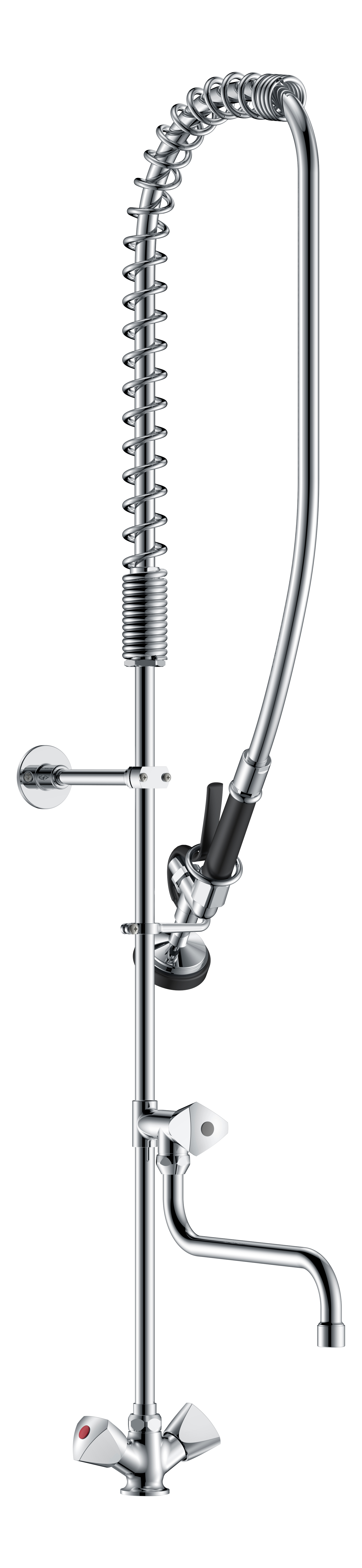
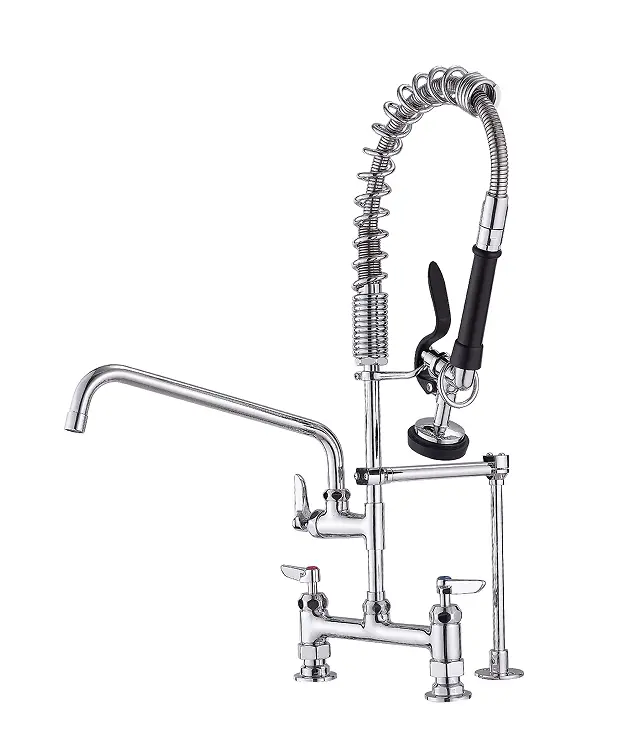
Its typical configuration includes a vertical support structure, flexible hose, spring or support arm, spray head and a separate outlet or swing spout. The spray head gives the operator more direct control over rinsing, while the flexible assembly allows the working range to extend beyond a conventional fixed faucet.
This configuration is particularly useful before dishwashing or final cleaning. Instead of holding cookware directly under a short fixed stream, an operator can bring the spray head toward the item being cleaned.
The AQ Bath C0001CP Commercial Pre-Rinse Kitchen Faucet is listed for commercial kitchen use and combines a spray gun, swing outlet and overhead spring. The published application information covers restaurants, hotels, catering and food-preparation environments.
The important point for buyers is that “commercial” should describe the working environment, not simply the visual style of the faucet.
2. Who Should Buy a Commercial Pre-Rinse Faucet?
The right buyer profile is usually defined by frequency of use and cleaning workload.
A commercial pre-rinse faucet is worth considering for:
-
Restaurants with continuous dishwashing activity
-
Hotel and resort kitchens
-
Catering and banquet kitchens
-
Central kitchens
-
Food preparation areas
-
Commercial dishwashing stations
-
Restaurant-equipment distributors
-
Kitchen equipment project contractors
For procurement teams, there is another consideration: standardization.
A hotel group or restaurant chain may need dozens or hundreds of similar workstations. In that situation, the faucet has to be evaluated as part of a project rather than as an individual product.
Questions such as replacement-part availability, installation consistency, packaging, model continuity and documentation can become just as important as the faucet itself.
3. Where Does a Pre-Rinse Faucet Make the Most Sense?
Different kitchen environments create different requirements.
Restaurant kitchens
Restaurants often have repeated rinse cycles throughout the day. The faucet should provide practical spray coverage and remain easy to operate during busy periods.
Hotel kitchens
Hotel kitchens can experience sharp peaks during breakfast, banquets and events. Procurement teams may also need consistent products across several properties.
Central kitchens
Central food-preparation operations place more emphasis on workflow, cleaning efficiency, sanitation practices and maintenance.
Catering and banquet kitchens
These environments may handle large cookware and large batches of dishes. The working range of the faucet becomes an important selection factor.
Light commercial kitchens
Cafés, bakeries and smaller food businesses may not need the same configuration as a heavy-duty restaurant. A more compact commercial faucet may be more appropriate.
This is why there is no single “best” commercial faucet. The better question is: which configuration matches the actual workstation?
4. The Five Components Buyers Should Compare
A commercial pre-rinse faucet is easier to evaluate when its major components are considered separately.
1. Spray head
The spray head is the part operators interact with most frequently.
Check:
-
Spray pattern
-
Grip and operating feel
-
Trigger or control arrangement
-
Cleaning access
-
Replacement availability
-
Compatibility with the hose assembly
Do not judge the spray head only by its appearance. A component that is difficult to clean or replace can create unnecessary maintenance work later.
2. Flexible hose
The hose determines how freely the spray head can move.
Important questions include:
-
How long is the hose?
-
Does it return smoothly?
-
Is the hose protected from unnecessary bending?
-
Can replacement hoses be sourced separately?
The exact hose specification should be confirmed from the product specification sheet before a project order.
3. Overhead spring
The overhead spring supports the working structure and helps organize the spray assembly.
For a busy kitchen, buyers should consider the spring together with the hose and spray head rather than treating it as a decorative element.
4. Swing outlet
A swing outlet can provide a second water-delivery position for filling containers or carrying out tasks that do not require the spray head.
That makes the configuration more flexible than a spray-only setup.
5. Mounting system
The mounting point is easy to overlook during procurement.
Before ordering, confirm:
-
Sink deck configuration
-
Mounting hole requirements
-
Available clearance
-
Water connection arrangement
-
Thickness of the mounting surface
-
Access for installation and future servicing
A technically good faucet can still become a poor project choice if the workstation does not accommodate it.
5. Specifications That Should Be Included in an RFQ
A professional RFQ should contain more than a product photo and quantity.
At minimum, buyers should request:
| Specification | What to Confirm |
|---|---|
| Product model | Exact SKU and configuration |
| Application | Restaurant, hotel, central kitchen, etc. |
| Mounting | Hole size, mounting method and deck requirements |
| Spray head | Type, operating method and replacement availability |
| Hose | Length, material and replacement option |
| Spring | Structure and serviceability |
| Swing outlet | Included or optional |
| Water connections | Thread/interface requirements |
| Flow rate | Rated value and test conditions |
| Working pressure | Required operating range |
| Materials | Body and key component materials |
| Finish | Finish type and maintenance requirements |
| Certification | Applicable certification for the target market |
| Packaging | Carton, labeling and project requirements |
| Spare parts | Available replacement components |
| Lead time | Sample and mass-production lead time |
One recurring procurement problem is asking for a quotation before defining these fields.
When two suppliers quote different configurations under the same product name, the prices may look comparable even though the products are not.
6. Materials and Workmanship: What Should Buyers Ask?
Material selection should be tied to the actual component.
A supplier may use different materials for the faucet body, handle, tube, spring, hose and internal components. Therefore, a generic statement such as “metal faucet” is not sufficient for a technical RFQ.
AQ Bath's research material identifies capabilities including brass casting, zinc-alloy die casting, forging, welding, tube bending, machining, polishing and electroplating.
The same material also records several quality-control capabilities, including material analysis, dimensional measurement, hardness testing, life testing, leakage testing and salt-spray/coating testing.
For a B2B buyer, the more useful question is not simply:
“Is this faucet brass?”
It is:
“Which component uses which material, what is the applicable specification, and how is the material verified?”
That distinction matters when different models are being compared across price levels.
7. Quality Control: Don't Stop at “Leak-Proof”
A supplier saying that a faucet is tested is helpful, but it does not tell the buyer enough.
For leakage testing, for example, the procurement team should ask about:
-
Test pressure
-
Holding time
-
Water temperature
-
Sampling method
-
Acceptance criteria
-
Test records
The same principle applies to durability testing.
If a supplier mentions life testing, ask what component was tested, under what conditions, for how many cycles, and according to which standard or internal procedure.
AQ Bath's internal research specifically flags pressure, holding time, temperature and sampling ratio as information that should be supported by test documentation before stronger claims are published.
This is a useful rule for any commercial faucet purchase:
A test name is not the same thing as a test result.
8. Certifications: Match the Certificate to the SKU
Certification is another area where buyers should be careful.
The company research lists market-related certifications and standards such as CUPC, NSF, CE, WaterMark and SNI in its source material. However, the research also identifies an important verification issue: a company-level list of certifications does not automatically mean every faucet SKU carries every certification.
For procurement, build a simple certificate matrix:
| Item | Required Information |
|---|---|
| Certificate | Certificate name and number |
| Holder | Legal entity named on certificate |
| Product | Exact covered SKU |
| Market | Country/region |
| Validity | Issue and expiry date |
| Standard | Applicable standard |
| Documentation | Current certificate copy |
This is especially important for distributors and importers entering a new market.
If a certificate is not confirmed for the exact SKU, write “to be confirmed” rather than assuming coverage.
9. C0001CP vs. Other Commercial Faucet Options
The C0001CP is one of the more clearly documented commercial kitchen models in the available AQ Bath research.
Other commercial kitchen SKUs listed include 9920DH-1, 9920DH-2, C0002CP, C0006CP and C0007CP. However, the available public information does not provide enough technical detail to make a reliable specification-by-specification comparison for all of them.
That limitation itself is useful for buyers.
| Model / Option | Published Direction | Best Starting Point | Information to Confirm |
|---|---|---|---|
| C0001CP | Pre-rinse, spray gun, swing outlet, overhead spring | High-frequency commercial kitchen | Flow, pressure, hose length, certification |
| 9920DH-1 | Commercial kitchen faucet | Commercial workstation | Spray configuration, mounting, specifications |
| 9920DH-2 | Commercial kitchen faucet | Commercial workstation | Difference from 9920DH-1 |
| C0002CP | Commercial kitchen series | Professional kitchen | Exact configuration |
| C0006CP | Commercial kitchen series | Professional kitchen | Exact function and components |
| C0007CP | Commercial kitchen series | Professional kitchen | Exact function and components |
For a serious project, do not turn missing information into assumptions. Request the latest specification sheet and sample.
10. Cost: The Cheapest Faucet May Not Be the Lowest-Cost Option
Unit price is visible. Maintenance cost is not.
A commercial faucet should be evaluated across its expected operating lifecycle.
Consider:
Purchase price + installation cost + replacement parts + maintenance labor + downtime risk + replacement cost
For example, if a faucet is inexpensive but difficult to service, a restaurant may spend more on labor and downtime over several years.
For hotel and chain projects, standardization can also reduce complexity. Keeping fewer configurations across a project can simplify spare-parts management and technician training.
This is why a purchasing team should ask suppliers for more than an FOB or EXW price.
Request:
-
Spare-part pricing
-
Packaging details
-
Sample cost
-
Replacement component availability
-
Warranty terms
-
Lead time
-
MOQ
-
OEM/ODM conditions
11. OEM and ODM Considerations
A commercial faucet can be purchased as an existing SKU or developed as part of a private-label program.
AQ Bath's research identifies design, mold design and mold manufacturing as part of its manufacturing capability, with OEM/ODM applications across its product range.
For an OEM or ODM project, buyers should clarify:
-
Product brief
-
Target market
-
Required application
-
Material specification
-
Dimensions
-
Finish
-
Components
-
Certification requirements
-
Prototype approval
-
Mold ownership
-
Packaging
-
Mass-production approval
The most expensive mistake is often not a tooling charge. It is an unclear specification that causes repeated samples, late changes or inconsistent production.
For private-label buyers, the RFQ should therefore define what is fixed and what can still change.
12. A Practical Buying Checklist
Before approving a commercial pre-rinse faucet, run through this checklist:
Application
-
Is the faucet intended for residential or commercial use?
-
How many hours per day will it be operated?
-
What type of cleaning work will it handle?
Installation
-
Does the sink deck support the mounting configuration?
-
Is there enough vertical and horizontal clearance?
-
Can technicians access the connections?
Performance
-
Is the spray coverage suitable?
-
Is the hose movement adequate?
-
Is a swing outlet needed?
-
Are flow and pressure requirements documented?
Quality
-
What materials are used?
-
What leakage tests are performed?
-
Is durability testing available?
-
Can the supplier provide test records?
Compliance
-
Which market will the faucet enter?
-
Which certifications are mandatory?
-
Does the certificate cover the exact SKU?
Commercial
-
What is the MOQ?
-
What is the sample lead time?
-
What is the mass-production lead time?
-
Are spare parts available?
-
What are the warranty terms?
A buyer who can answer these questions will usually make a much better purchasing decision than one who compares price alone.
13. FAQ: Commercial Pre-Rinse Faucet Buying Questions
1. What is a commercial pre-rinse faucet used for?
It is mainly used for high-frequency rinsing and cleaning tasks in professional kitchens, such as restaurants, hotels, catering operations and food-preparation areas.
2. Is a commercial pre-rinse faucet suitable for a home kitchen?
It can be, but the large working structure and commercial-oriented configuration may be unnecessary for a typical residential kitchen. Selection should depend on available space and actual cleaning habits.
3. What is the purpose of the overhead spring?
The spring supports the spray assembly and helps organize the working position of the flexible hose and spray head.
4. Why does the hose length matter?
It determines how far the operator can move the spray head around the sink. The correct length depends on sink dimensions and workstation layout.
5. Should I choose a spray-only faucet?
Not necessarily. A model with a spray head and swing outlet may provide greater flexibility for different kitchen tasks.
6. What specifications should I request from the supplier?
Request the exact SKU, dimensions, materials, mounting details, hose length, spray configuration, flow rate, pressure range, certification coverage, packaging and spare-parts information.
7. How should I compare two commercial faucet models?
Compare the same technical fields first. If one supplier provides less information, ask for the missing specifications before comparing prices.
8. Does a company certification cover every faucet model?
No. Certification coverage should be verified against the exact product SKU, certificate holder, market and validity period.
9. What should I ask about leakage testing?
Ask for the test pressure, holding time, temperature, sampling method and acceptance criteria rather than accepting “leak tested” as a complete specification.
10. Can a commercial pre-rinse faucet be customized?
Depending on the supplier and project, OEM/ODM customization may cover configuration, finish, packaging and other product-development requirements. Tooling ownership, certification and final specifications should be agreed in writing.
Conclusion: Buy for the Kitchen Workflow, Not the Product Photo
A commercial pre-rinse faucet is a small component in a professional kitchen, but its daily workload can be surprisingly high.
The best selection process starts with the workstation.
Understand how the faucet will be used. Check the sink and mounting conditions. Compare the spray head, hose, spring and swing outlet. Then move into materials, testing, certification, spare parts and commercial terms.
For buyers considering the AQ Bath C0001CP, its commercial pre-rinse configuration provides a useful starting point for restaurants, hotels and other professional kitchen environments. The final decision should still be based on the project's actual water connections, dimensions, operating requirements, certification needs and confirmed product documentation.
If you are sourcing commercial kitchen faucets for a new project, replacement program or private-label range, prepare your application details and required specifications before requesting a quotation. That makes supplier responses easier to compare—and reduces surprises after the order is placed.
Need a commercial faucet recommendation? Share your sink dimensions, target market, estimated quantity and application with AQ Bath, and request the latest model specification and certification documents for review.