



Commercial Pre-Rinse Faucet Buying Guide: How to Specify the Spray Valve, Hose, Spring, and Spout
A commercial pre-rinse faucet should be specified as a complete working system—not selected only by appearance or quoted price.
The spray valve must remove food residue efficiently. The hose must reach every required working area without excessive stress. The spring must support repeated movement. The faucet body, spout, mounting system, seals, connections, and replacement parts must all suit the kitchen’s actual operating conditions.
For restaurants, hotels, central kitchens, and foodservice equipment dealers, choosing the wrong configuration can lead to slow cleaning, premature hose wear, leaks, difficult maintenance, and expensive workstation downtime.
This commercial pre-rinse faucet buying guide explains what professional buyers should confirm before approving a faucet for sampling, project use, or bulk production.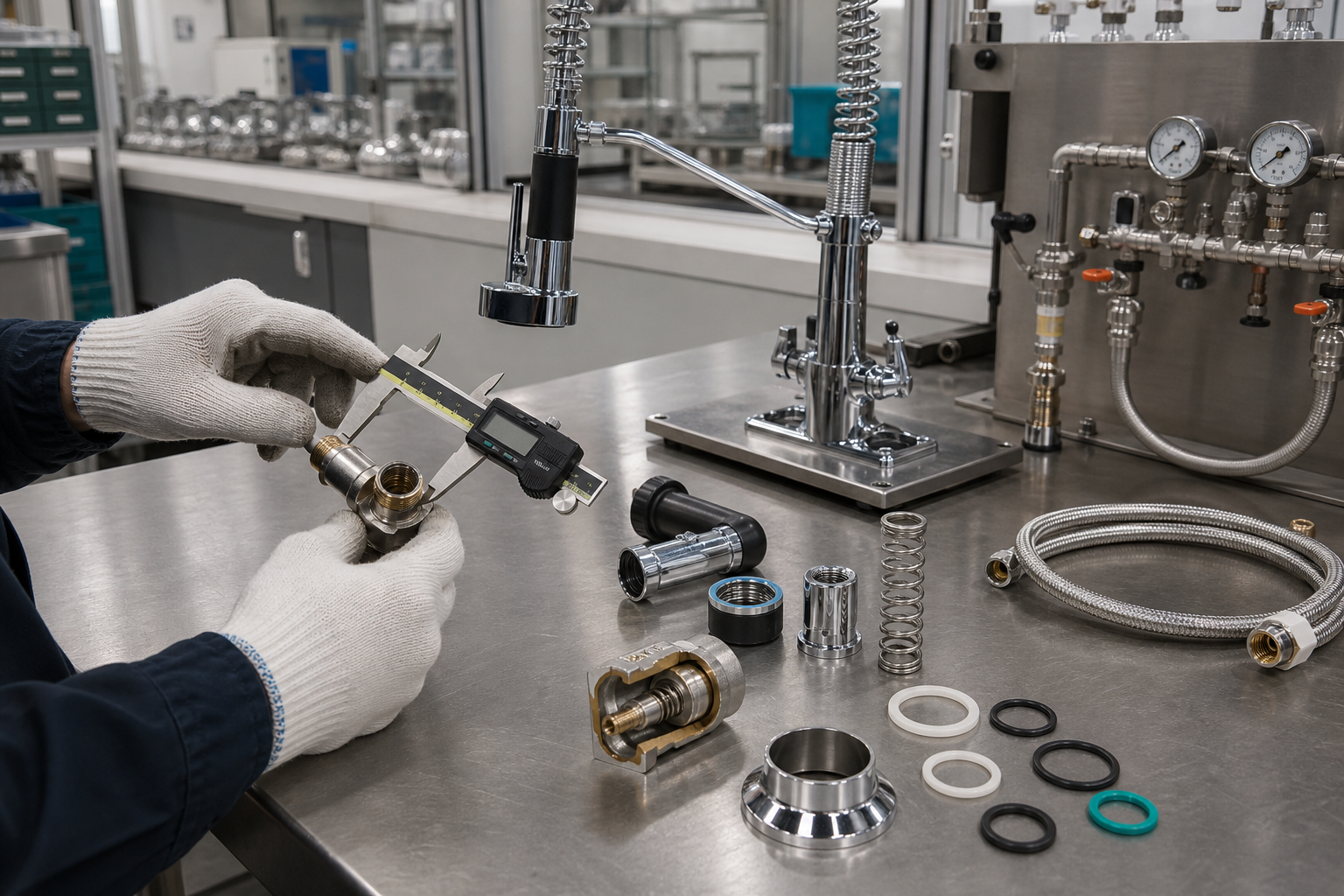
1. What Is a Commercial Pre-Rinse Faucet?
A commercial pre-rinse faucet is a high-use sink fitting designed primarily to remove food residue from dishes, cookware, and foodservice items before warewashing.
A typical system includes:
-
A trigger-operated pre-rinse spray valve
-
A flexible hose
-
An overhead support spring
-
A faucet or mixing-valve body
-
Deck- or wall-mounting hardware
-
Hot and cold water connections
-
An optional swing spout for filling sinks or containers
The U.S. Department of Energy defines the commercial pre-rinse spray valve itself as a handheld, release-to-close device used to remove food residue before commercial dishwashing or warewashing.
The spray valve is therefore only one part of the complete faucet assembly. Buyers must evaluate both the valve and the workstation supporting it.
Commercial pre-rinse units are commonly used in:
-
Restaurant dishwashing stations
-
Hotel and banquet kitchens
-
Central kitchens
-
Catering facilities
-
Food-preparation areas
-
Commercial sink systems
-
Institutional kitchens
2. Who Should—and Should Not—Use One?
A commercial pre-rinse faucet is a strong fit when a sink experiences frequent rinsing, large cookware, peak-hour cleaning, or repeated use by multiple operators.
It is usually suitable for:
-
Restaurants with continuous dishwashing
-
Hotels and event kitchens
-
Foodservice equipment manufacturers
-
Commercial sink distributors
-
Central kitchens and food-preparation facilities
-
Dealers building complete wash-station packages
-
Projects that require replaceable service parts
It may not be the best choice for:
-
Low-use residential kitchens
-
Small sinks without sufficient vertical clearance
-
Installations where the hose or spring could obstruct shelving
-
Workstations used mainly for filling containers
-
Sites without access to replacement spray valves, hoses, or seals
-
Projects whose connections and mounting dimensions have not been confirmed
A residential pull-down faucet may look similar in photographs, but it is not automatically a substitute for a heavy-duty commercial assembly.
Usage frequency, serviceability, hose construction, mounting stability, spray-valve design, and replacement-part availability must be compared.
3. Match the Faucet to the Workstation
Start with the kitchen workflow—not the supplier’s product title.
High-volume warewashing
Restaurants and hotel kitchens need a spray valve that can repeatedly remove food residue without causing excessive operator fatigue.
Hose reach, spray force, trigger feel, spring balance, cleaning efficiency, and spare-part availability are critical.
Dual-purpose washing and filling
A pre-rinse spray valve is intended for directed rinsing. If employees also need to fill sinks, pots, or containers, consider a system with a separate swing spout.
The spray valve and swing spout should operate independently without obstructing one another.
Compact commercial kitchens
Cafés, bakeries, and small food outlets may require a shorter riser, more compact spring, or limited swivel range.
A large commercial faucet can become an obstruction if the sink or workstation is undersized.
Retrofit projects
For an existing kitchen, record:
-
Mounting-hole dimensions
-
Inlet spacing
-
Connection threads
-
Sink width and depth
-
Backsplash clearance
-
Shelf height
-
Available overhead space
-
Underside installation access
These measurements should be confirmed before selecting a model or requesting a sample.
Conceptual comparison of deck-mounted and wall-mounted installations. Final connections and structural support must follow the project drawings and local requirements.
4. Seven Components That Determine Performance
Conceptual overview of the principal components in a commercial pre-rinse faucet system. It is not a model-specific engineering drawing.
4.1 Spray valve
Check the:
-
Spray pattern
-
Release-to-close action
-
Guard bumper
-
Trigger comfort
-
Tested flow rate
-
Spray-force data
-
Cleaning procedure
-
Replacement method
Higher flow does not automatically mean better cleaning. Spray pattern, force, pressure, and application all affect how effectively water removes residue.
Ask the supplier to state the test method and conditions behind any performance figure.
4.2 Flexible hose
Confirm the hose:
-
Overall length
-
Internal tube material
-
Reinforcement structure
-
Maximum operating temperature
-
Bend radius
-
Swivel behavior
-
Connection type
-
Replacement part number
A hose that is too short limits coverage. A hose that is unnecessarily long may drag, kink, rub against the sink, or place avoidable stress on its connections.
4.3 Overhead support spring
The spring supports and guides the hose.
Review its:
-
Height
-
Diameter
-
Surface protection
-
Retainer design
-
Support behavior
-
Alignment
-
Fatigue-test conditions
-
Replacement method
The hose should return to a practical working position without excessive pulling force or uncontrolled movement.
4.4 Swing spout
If the system includes a secondary spout, specify its:
-
Reach
-
Height
-
Swivel range
-
Outlet type
-
Flow requirement
-
Intended filling task
Make sure the spout does not interfere with the spray hose or limit access to the sink.
4.5 Faucet body and controls
Confirm the:
-
Body material
-
Valve or cartridge structure
-
Handle design
-
Sealing system
-
Hot and cold identification
-
Service access
-
Replacement valve or cartridge number
Spare seals, stems, cartridges, and handles should have controlled part numbers instead of being described only as “standard parts.”
4.6 Mounting system
Identify whether the faucet will be deck-mounted or wall-mounted.
For deck mounting, confirm:
-
Hole number and diameter
-
Deck thickness
-
Mounting-stud length
-
Reinforcement requirements
-
Underside access
-
Sealing method
For wall mounting, confirm:
-
Inlet centers
-
Wall support
-
Connection depth
-
Adapter requirements
-
Backsplash clearance
-
Final spout position
4.7 Water connections
State the required:
-
Inlet thread
-
Connection size
-
Hose size
-
Adapter requirements
-
Water-pressure range
-
Operating-temperature range
-
Target country or market
Do not assume that one connection standard fits every market.
5. Commercial Pre-Rinse Faucet Specification Checklist
A professional RFQ should contain measurable requirements rather than phrases such as “high quality” or “heavy duty.”
| Specification field | What the buyer should state or request | Why it matters |
|---|---|---|
| Application | Restaurant, hotel, central kitchen, café, or equipment package | Determines duty and configuration |
| Estimated use | Operating hours and peak usage | Helps evaluate durability requirements |
| Mounting | Deck or wall mounting | Changes the body and installation hardware |
| Sink dimensions | Width, depth, backsplash, shelf and overhead clearance | Prevents fit and reach problems |
| Inlet specification | Thread, size and connection centers | Avoids site adapters and rework |
| Water conditions | Pressure and temperature range | Affects flow, spray and sealing |
| Spray-valve performance | Tested flow rate, spray force and test method | Makes performance comparable |
| Hose | Length, material, reinforcement and connection type | Affects reach and service life |
| Spring | Height, support behavior and corrosion protection | Affects movement and operator comfort |
| Swing spout | Required or not; reach and swivel range | Separates rinsing from filling tasks |
| Main materials | Body, riser, spring, hose, handles and internal parts | Prevents vague material claims |
| Surface finish | Finish code, color tolerance and coating structure | Controls appearance and corrosion risk |
| Valve components | Cartridge or stem type and replacement part number | Supports maintenance |
| Testing | Leak, flow, dimensional, cycle and finish tests | Establishes acceptance criteria |
| Compliance | Standard, certificate number, covered model and validity | Prevents certificate misuse |
| Spare parts | Spray valve, hose, spring, seals and cartridges | Reduces downtime |
| Packaging | Parts list, installation guide, labels and protection | Reduces damage and missing parts |
For U.S. projects, buyers should check the latest requirements for the exact spray valve.
DOE currently directs manufacturers to the applicable standard in 10 CFR 431.266 and the test procedure in 10 CFR 431.264. Because regulatory rulemaking may change, verify the current position through the DOE commercial pre-rinse spray valve page before finalizing a purchasing specification.
6. How to Evaluate Materials and Finishes
Do not ask only, “Is the faucet brass or stainless steel?”
A commercial assembly can contain multiple materials:
-
Brass valve bodies or fittings
-
Stainless-steel springs, tubes, or external components
-
Reinforced polymer hose liners
-
Zinc-alloy handles or non-critical components
-
Elastomer seals and washers
-
Ceramic or metal valve components
-
Chrome, nickel, painted, PVD, or other finishes
The supplier should identify the material of each critical component.
A series name containing the word “brass” does not prove that every component uses the same material.
For brass components, request:
-
Material grade
-
Chemical-composition requirements
-
Applicable material standard
-
Inspection or test method
-
Batch or lot identification
-
Relevant material report
If a “lead-free” claim is required, define the target standard, covered water-contact component, test method, and exact SKU.
For finishes, request information about:
-
Base material
-
Surface preparation
-
Coating structure
-
Coating thickness where relevant
-
Color and gloss tolerance
-
Adhesion testing
-
Corrosion testing
-
Cleaning-chemical limitations
-
Approved reference sample
Salt-spray hours should not be presented as a guaranteed number of real-life service years.
Actual corrosion also depends on humidity, salt exposure, cleaning chemicals, surface damage, maintenance, installation environment, and the underlying material.
7. Workmanship Details Buyers Often Miss
A faucet can use acceptable materials and still fail because of inconsistent workmanship.
Inspect or document:
-
Tube-bending accuracy
-
Welding consistency
-
Machined-thread quality
-
Sealing-surface finish
-
Hose-crimp quality
-
Spring alignment
-
Valve assembly
-
Plating coverage
-
Sharp edges or burrs
-
Handle movement
-
Spout swivel resistance
-
Mounting stability
For OEM or project orders, approve a signed reference sample and a controlled specification before mass production.
Any change to the hose, spray valve, seal, cartridge, finish, connection, or critical supplier should require documented buyer approval.
8. Testing, Compliance, and Certificate Verification
Conceptual quality-control scene. Actual inspection equipment, sampling plans and acceptance limits should be confirmed with the manufacturer.
The 2024 edition of ASME A112.18.1/CSA B125.1 includes commercial pre-rinse spray valves within the scope of plumbing supply fittings.
A buyer’s quality plan may include:
-
Incoming-material verification
-
Critical-dimension inspection
-
Assembly inspection
-
Leak or pressure testing
-
Flow measurement
-
Spray-performance testing
-
Valve-cycle or functional testing
-
Hose and connection inspection
-
Coating or finish testing
-
Packaging verification
The exact standards, pressures, temperatures, cycle counts, sampling levels, sample sizes, and acceptance limits must be written into the purchasing specification.
“Passed testing” is not meaningful without defined conditions and traceable records.
WaterSense status
Do not ask for a current WaterSense label for a commercial pre-rinse spray valve.
The U.S. Environmental Protection Agency sunset the specification for this product category on January 1, 2019. EPA still provides useful technical information about efficiency, spray force, lifecycle performance, and test development on its pre-rinse spray valve resource page.
How to verify NSF or other certifications
If a project requires NSF/ANSI/CAN 61, NSF/ANSI 372, or another certification, verify:
-
The certificate or listing owner
-
The exact model number
-
Covered materials or components
-
Intended water-contact use
-
Issue and expiry dates
-
Current listing status
-
Limitations or conditions in the listing
Use the official NSF product listings instead of accepting a logo or company-level statement as proof that every product is covered.
A factory certification, management-system certificate, or certificate for another model does not automatically establish compliance for the faucet being purchased.
9. Capacity, Sampling, and Lead Time
MOQ and lead time should not be separated from the selected configuration.
Production timing can change because of:
-
New tooling
-
Custom finishes
-
Material availability
-
Certification testing
-
Hose or spray-valve sourcing
-
Custom logos and packaging
-
Pre-production samples
-
Approval delays
-
Order quantity
-
Inspection requirements
Ask the supplier to separate the schedule into:
-
Specification confirmation
-
Engineering or drawing approval
-
Tooling, if required
-
Sample production
-
Sample testing and approval
-
Pilot production
-
Mass production
-
Final inspection
-
Packaging and shipment
Request both sample and mass-production lead times.
Also define what event starts the schedule: purchase order, deposit, approved drawing, final artwork, signed sample, or another agreed milestone.
10. AQ Bath Commercial Model Shortlist
AQ Bath’s public commercial kitchen faucet series currently lists C0001CP, 9920DH-1, 9920DH-2, C0002CP, C0006CP, and C0007CP.
| Model or group | Publicly described positioning | Suitable shortlist use | Parameters to confirm |
| C0001CP | Commercial pre-rinse unit with overhead spring, spray function and additional swing spout | Restaurant, hotel and foodservice wash stations | Flow, spray force, pressure, hose length, dimensions, materials, tests and applicable certificates |
| 9920DH-1 / 9920DH-2 | Listed in the commercial kitchen faucet series | Buyers comparing alternative workstation configurations | Exact model differences, mounting, outlets, reach, materials and service parts |
| C0002CP / C0006CP / C0007CP | Listed as commercial kitchen faucet models | Dealers and project buyers building a wider commercial range | Configuration, intended duty, dimensions, performance and model-specific compliance |
The public website does not currently provide every purchasing parameter needed to complete a professional comparison.
Buyers should request a controlled specification and model comparison before choosing by product title or model number alone.
The C0001CP product page presents the product for restaurant, hotel, catering, commercial dishwashing, and food-preparation applications. It also refers to OEM/ODM customization.
However, buyers should still verify performance figures, materials, certificates, dimensions, factory-capacity statements, and applicable standards through current model-specific documents.
11. Compare Total Cost, Not Only Unit Price
The lowest quotation is not always the lowest-cost faucet.
A practical review should consider:
Total cost = product cost + installation + water and hot-water use + replacement parts + maintenance labor + downtime + replacement risk
Common hidden-cost risks include:
-
Incorrect mounting dimensions
-
Insufficient hose reach
-
Excessive or unsuitable flow
-
Poor access to service parts
-
No local replacement spray valve
-
Unverified certification
-
Inconsistent finish
-
Unclear material specifications
-
Difficult installation
-
Missing instructions or accessories
Request separate prices for:
-
Complete faucet
-
Replacement spray valve
-
Replacement hose
-
Spring and support components
-
Seals and valve parts
-
Optional swing spouts
-
Custom finishes
-
Certification work
-
New tooling
-
Customized packaging
-
Recommended spare-part kits
This makes quotations easier to compare and exposes long-term operating risks before the purchasing decision.
12. OEM/ODM Requirements and RFQ CTA
For private-label or project orders, provide:
-
Target country or market
-
Application and operating intensity
-
Sink drawing or workstation photograph
-
Deck- or wall-mounting requirements
-
Inlet size and thread
-
Water pressure and temperature
-
Required spray-valve performance
-
Hose length and working range
-
Swing-spout requirements
-
Material and finish
-
Required standards and certificates
-
Order quantity
-
Logo and packaging requirements
-
Spare-part expectations
-
Sample and mass-production schedule
AQ Bath publicly presents design, tooling, metal forming, machining, polishing, plating, assembly, and testing capabilities, together with OEM/ODM support.
Buyers can review the company’s faucet catalog and support resources before preparing an RFQ.
For an accurate recommendation, send the sink dimensions, installation method, target market, required documents, expected quantity, and operating conditions.
Contact AQ Bath to request a commercial model comparison, controlled specification sheet, available test documents, spare-parts proposal, and quotation.
13. Frequently Asked Questions
1. What flow rate should a commercial pre-rinse faucet have?
There is no single ideal flow rate for every kitchen.
Evaluate flow together with spray force, spray pattern, water pressure, cleaning task, applicable regulation, and user requirements. Ask for test data obtained under stated conditions.
2. Can commercial pre-rinse spray valves still receive a WaterSense label?
No. EPA sunset the WaterSense specification for this product category in January 2019.
U.S. buyers should verify the current DOE requirements and test procedure instead of requesting a new WaterSense label.
3. Is a commercial pre-rinse faucet the same as a residential pull-down faucet?
No.
A commercial unit is generally designed around a separate hose, overhead spring, trigger spray valve, serviceable components, and higher-frequency operation.
4. Should I choose deck mounting or wall mounting?
Choose based on existing water connections, sink design, backsplash, structural support, installation access, maintenance access, and cleaning requirements.
Confirm all relevant dimensions before ordering.
5. Do I need a swing spout?
Choose a swing spout if the workstation must fill sinks, pots, or containers in addition to pre-rinsing.
Confirm that the spout and spray hose can operate without interfering with each other.
6. How long should the hose be?
The hose should reach all required sink areas without dragging, kinking, rubbing, or creating unnecessary operator effort.
Measure the actual working envelope rather than copying another project’s hose length.
7. Is brass always better than stainless steel?
Not automatically.
Performance depends on the material grade, component function, manufacturing process, water-contact requirements, finish, maintenance, and operating environment.
8. How should I verify a certificate?
Check the certificate owner, exact model, scope, applicable components, issue and expiry dates, limitations, and official listing status.
A company-level logo does not prove that every SKU is certified.
9. Which spare parts should be purchased with the faucet?
Common service items include:
-
Spray valve
-
Hose
-
Spring
-
Seals
-
Cartridges or valve stems
-
Spout outlets
-
Mounting parts
-
Model-specific repair kits
The recommended list should reflect the installed quantity, operating intensity, local service capacity, and expected replenishment time.
10. What information does a supplier need for an accurate quote?
Provide the application, sink dimensions, mounting method, connections, pressure, temperature, quantity, materials, finish, target market, certification requirements, packaging, spare parts, and delivery schedule.
Conclusion
A reliable commercial pre-rinse faucet is the result of a clearly specified system.
Instead of comparing quotations by appearance and unit price, compare the spray valve, hose, spring, spout, mounting, materials, test conditions, compliance evidence, replacement parts, and supplier change-control process.
The more precise the RFQ, the easier it becomes to compare suppliers, approve samples, control production, and reduce long-term maintenance risk.
Next step: Review the AQ Bath commercial kitchen faucet series, download the catalog, or contact the sales team with your sink drawing, mounting dimensions, target market, required quantity, and compliance requirements.