
Brass vs Stainless Steel Faucet: Materials, Costs and Risks
When evaluating a brass vs stainless steel faucet, the material name printed on a product page is only the beginning. A reliable sourcing decision also depends on the exact alloy, which components touch water, how the body is manufactured, the finish system, local compliance requirements and whether the supplier can prove what was used.
This guide is written for faucet brands, importers, distributors and project buyers. It is not simply a consumer comparison of appearance or weight. Its purpose is to help purchasing and engineering teams define a verifiable faucet material specification before requesting samples or placing an OEM order.
Quick Answer
There is no universally best faucet metal.
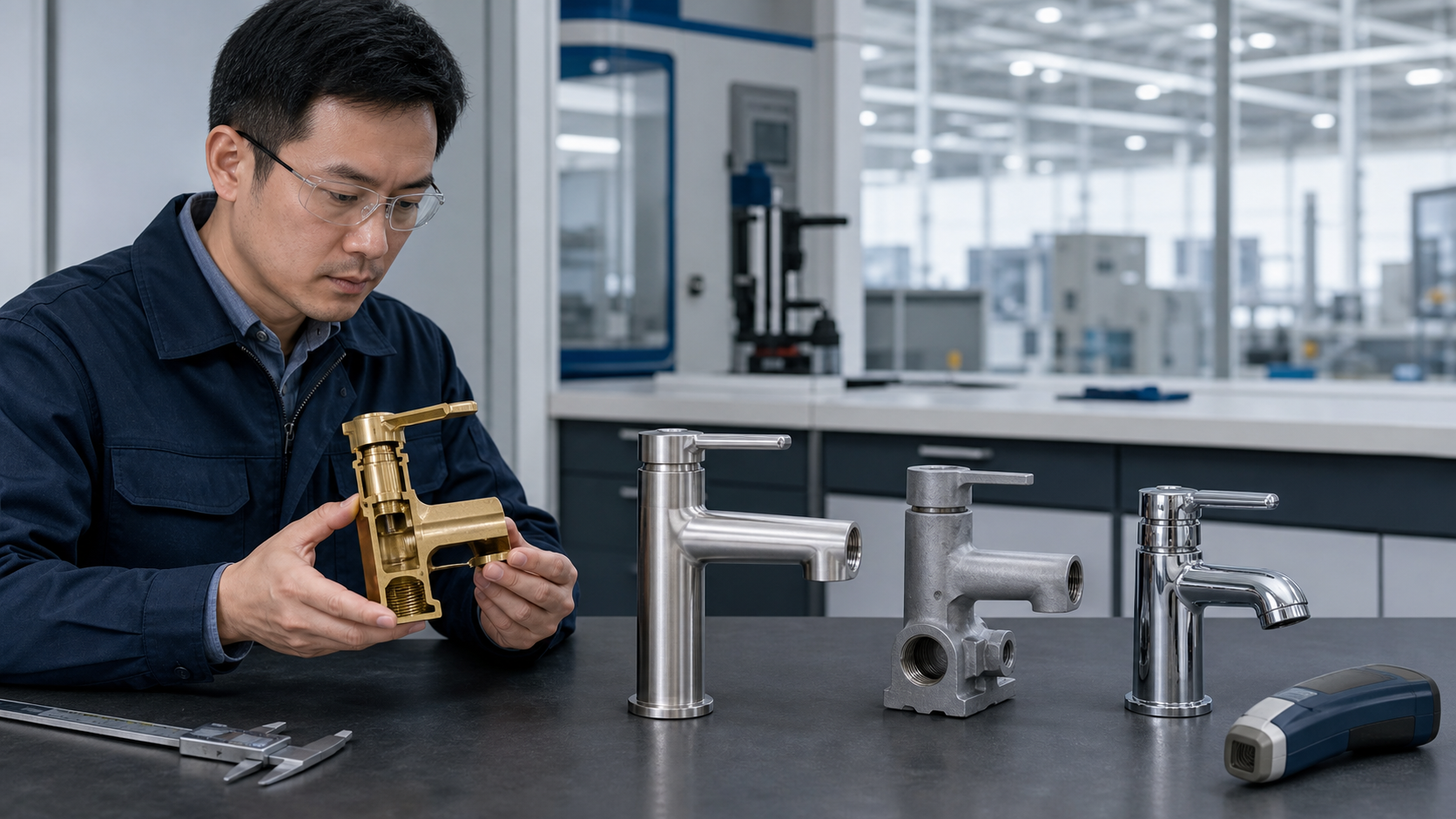
A properly selected brass alloy is widely used for machined, cast and pressure-bearing plumbing components. Stainless steel can offer strong corrosion performance and a distinctive unplated appearance, but its grade, manufacturing route and service environment still matter. Zinc alloy is highly suitable for economical, complex die-cast components, especially handles and decorative parts, but buyers should not automatically assume it is suitable for every water-contact application.
Therefore, a brass vs stainless steel faucet decision should be made component by component—not from the marketing description of the finished faucet.
Brass, Stainless Steel and Zinc Alloy at a Glance
For a brass vs stainless steel faucet comparison to be useful, the buyer must also understand where zinc alloy fits in the product architecture.
| Decision factor | Brass | Stainless steel | Zinc alloy |
|---|---|---|---|
| Common faucet roles | Bodies, waterways, connectors and machined pressure-bearing parts | Bodies, spouts, tubes, handles and external shells | Handles, bases, covers and complex decorative castings |
| Main production routes | Casting, forging and machining | Tube fabrication, casting, forming, welding and machining | High-pressure die casting |
| Key strength | Established plumbing applications and good machinability | Corrosion resistance with a suitable grade and process | Complex shapes, productive casting and good surface finish |
| Main sourcing risk | Unverified alloy or lead-content claim | Unverified grade, weak weld quality or unsuitable finish | Use in an unsuitable wetted or load-bearing position |
| Finish options | Polishing, plating, painting and selected PVD systems | Brushed, polished, painted, plated or selected PVD systems | Commonly plated or painted after appropriate preparation |
| Cost implication | Influenced by copper price, weight and machining | Influenced by grade, fabrication, welding and machining | Often efficient for high-volume complex die-cast parts |
| Compliance question | Which alloy and which lead-content standard? | Which grade and product-level approval? | Does this component contact drinking water? |
These are sourcing tendencies rather than automatic pass/fail rules. Final suitability depends on the model, market and documented test plan.
Start With the Wetted-Part Map
A faucet is an assembly, not a single piece of metal. The body, handle, cartridge housing, spout, inlet tubes, fasteners, aerator and decorative shell may use different materials.
The most important distinction is between:
-
Wetted parts: Components whose surfaces come into contact with water.
-
Non-wetted functional parts: Components that transmit force or support the assembly without contacting water.
-
Decorative parts: Handles, shells, covers or trim pieces whose main purpose is appearance.
A zinc alloy handle outside the waterway creates a different risk profile from a zinc alloy internal water chamber. Likewise, an external stainless steel shell does not prove that the internal waterway is stainless steel.
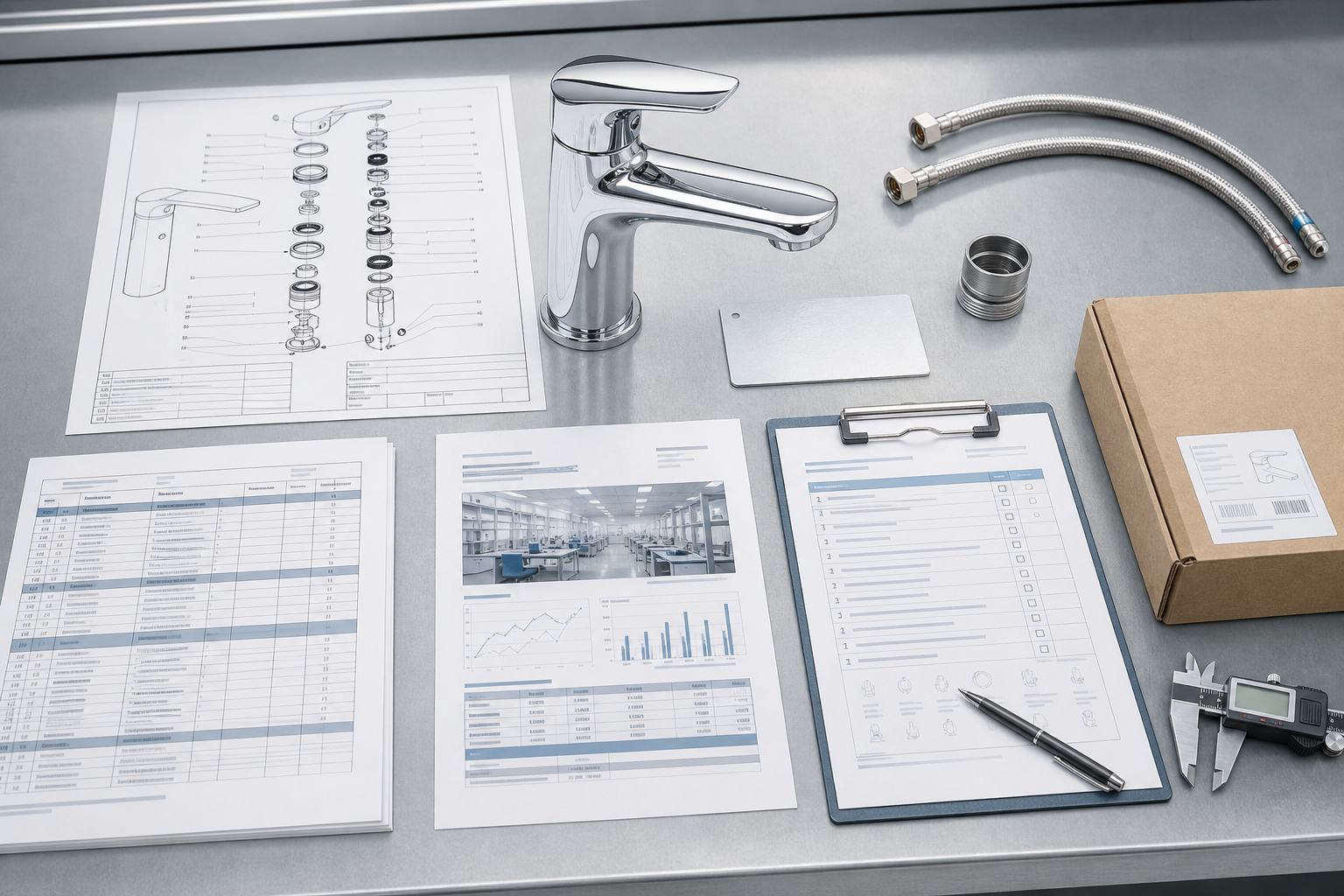
Ask the supplier for an exploded drawing or material map that identifies every water-contact component. The map should use component names and alloy codes—not vague descriptions such as “metal,” “premium brass” or “stainless construction.”
Brass Faucet Bodies: Strengths and Risks
Brass is a family of copper-zinc alloys rather than one fixed formula. The Copper Development Association documents the extensive use of copper alloys in plumbing products because of their combination of manufacturability and corrosion performance.
Why manufacturers use brass
Brass can be cast, forged and machined into bodies with threaded connections, valve seats and internal passages. Suitable alloys may provide:
-
Good machinability for accurate threads and sealing surfaces
-
Established casting and forging processes
-
Compatibility with common decorative finish systems
-
Useful strength for pressure-bearing components
-
A long history in plumbing applications
What buyers must verify
“Brass body” is not a complete specification. The purchase document should identify:
-
The exact alloy designation or agreed composition range
-
Which brass components contact water
-
The applicable lead-content requirement
-
The casting or forging process
-
Material-analysis and product-test requirements
-
The procedure for approving material substitutions
Lead historically improved the machinability of some copper alloys. Modern regulated products may require alternative compositions and adapted manufacturing processes. A “lead-free brass faucet” claim must therefore be supported by the relevant standard and test documentation—not inferred from color, weight or supplier wording.
Certain alloy-and-water combinations may also be vulnerable to forms of corrosion such as dezincification. The buyer should match the alloy and applicable product standard to the destination market and expected water conditions.
Stainless Steel Faucets: Grade Matters
Stainless steel is also a family of alloys. A supplier should not use the word “stainless” as a substitute for a grade declaration.
Organizations including worldstainless and the Nickel Institute document the use of properly selected stainless steel in drinking-water systems.
Why buyers select stainless steel
Depending on the grade and construction, stainless steel may provide:
-
Good corrosion resistance
-
A brushed or polished finish without conventional chrome plating
-
Useful strength in comparatively thin fabricated components
-
A clean material story for selected product ranges
-
Compatibility with tube-based and welded designs
Risks that a grade name does not solve
A 304 or 316 declaration alone does not guarantee a successful faucet. Performance can also depend on:
-
Chloride concentration and water chemistry
-
Welding quality and treatment of heat-affected areas
-
Surface condition, polishing and passivation
-
Wall thickness and thread design
-
Crevices that retain moisture or cleaning chemicals
-
Cross-contamination during fabrication
-
The materials used in internal fittings and connections
For coastal, high-chloride or aggressive cleaning environments, the buyer should review the complete assembly and expected exposure rather than approving a product solely because “316” appears on a quotation.
Where Zinc Alloy Fits
Zinc alloy should neither be dismissed automatically nor accepted without limits.
The International Zinc Association describes zinc die casting as a productive method for making precise, complex components with good surface quality. These characteristics make zinc alloy attractive for handles, escutcheons, bases, covers and other detailed parts.
Practical advantages
-
Complex shapes can be consolidated into one casting
-
High-volume die casting can be cost-efficient
-
Fine surface detail supports decorative finishing
-
Machining requirements may be reduced
-
Consistent geometry can simplify assembly
Practical limitations
The precise alloy, casting quality, mechanical load, temperature and service environment remain important. Published zinc alloy engineering data show that mechanical properties vary by composition and casting conditions. Long-term loading and elevated temperatures also require consideration.
Corrosion behavior in water is not universal; it changes with water chemistry and the component environment. The IZA’s corrosion guidance is one reason buyers should distinguish a decorative external part from a permanent potable-water pathway.
A well-engineered value faucet may legitimately combine a compliant brass or stainless waterway with zinc alloy decorative components. The risk begins when the quotation, sample and production BOM do not describe that architecture consistently.
Brass vs Stainless Steel Faucet: Lead and Potable-Water Compliance
Material composition and finished-product compliance are related, but they are not identical.
In the United States, NSF/ANSI/CAN 372 addresses lead content. NSF explains that the standard generally uses a maximum weighted average lead content of 0.25% for the wetted surfaces of pipes, fittings, fixtures and related components, with a separate 0.2% limit for solder and flux.
However, NSF 372 is a lead-content standard. It does not by itself evaluate every substance that could be extracted into drinking water. Depending on the product and market, standards such as NSF/ANSI/CAN 61 or other national requirements may also apply.
Before accepting a compliance claim, verify:
-
The certificate holder
-
The exact model or product family
-
The standard and certification scope
-
Whether the finish or configuration matches the ordered SKU
-
The certificate’s current status
-
Whether components supplied by subcontractors are covered
-
The destination market’s separate installation requirements
A logo on a general company page should never replace model-level verification.
Corrosion: Separate the Waterway From the Finish
Internal corrosion and external finish failure are different problems.
Internal waterway risks
These depend on alloy composition, water chemistry, temperature, stagnation, galvanic combinations, deposits and internal geometry.
External finish risks
These depend on substrate preparation, polishing, plating or coating layers, thickness, adhesion, curing, porosity, cleaning chemicals and installation environment.
Salt-spray testing can help reveal coating discontinuities or compare controlled specimens. However, ISO 9227 states that salt-spray methods are not intended to rank materials for long-term corrosion resistance or directly predict real service life.
A responsible test specification should therefore define:
-
The test method and edition
-
Sample preparation
-
Exposure duration
-
Evaluation area
-
Acceptance criteria
-
Treatment of edges, threads and intentional contact marks
-
Whether the test applies to raw material, coating coupons or finished products
Do not accept “passed salt spray” without this context.
How Material Choice Affects Cost
A lighter quotation does not automatically mean a cheaper total product, and a heavier faucet does not automatically mean better quality.
Cost is normally shaped by a combination of:
-
Raw-material price and component weight
-
Casting, forging, forming or welding route
-
Tooling investment and expected production volume
-
Machining time and tool wear
-
Scrap and rework rate
-
Surface-preparation requirements
-
Finish complexity
-
Testing and certification scope
-
Assembly labor
-
Packaging and logistics weight
Zinc die casting may be economical for complex high-volume parts. Brass may offer efficient machining and established body-production methods but is exposed to copper price and product weight. Stainless steel cost varies significantly with grade and whether the component is formed, welded, cast or extensively machined.
The correct comparison is a costed BOM for the same design and performance requirement—not three unrelated finished faucets.
Finish Compatibility Must Be Validated
A finish sample approved on brass should not automatically be treated as approval for the same finish on zinc alloy or stainless steel.
Substrate differences can affect:
-
Polishing marks and visual depth
-
Pretreatment and intermediate layers
-
Plating adhesion
-
Color consistency
-
PVD or painted-coating appearance
-
Corrosion at pores, edges and threads
-
Resistance to bathroom cleaners
-
Production-to-production variation
Approve finish limit samples for each substrate. If one model uses several base materials, inspect them together under the same controlled lighting because nominally identical finishes can look different across the assembly.
How to Verify the Faucet Material
A brass vs stainless steel faucet evaluation should combine paperwork with physical verification.
1. Request a controlled BOM
The BOM should list the component name, drawing number, material designation, finish and revision. Material descriptions must be consistent across the quotation, specification sheet, drawing and sample approval.
2. Obtain material evidence
Depending on risk and order size, this may include:
-
Supplier material certificates
-
Incoming-material inspection records
-
Spectrometer or suitable XRF reports
-
Accredited laboratory composition reports
-
Traceability from raw material to production lot
The test method must be suitable for the alloy and elements being measured. A handheld analyzer is useful, but it should not be treated as infallible.
3. Verify the production sample
Weight, appearance and magnet response can support screening, but none reliably identifies every alloy. Use an appropriate analytical method when the material is commercially or legally important.
4. Check coating separately
Use an agreed method to evaluate layer thickness, adhesion, appearance and corrosion performance. Base-metal verification does not prove coating quality.
5. Control changes
The purchasing agreement should prohibit unapproved changes to base material, alloy grade, component supplier, wall thickness and finish process.
Recommended RFQ and Inspection Checklist
| RFQ item | What the supplier should provide | Why it matters |
| Component material map | Exploded drawing with wetted parts identified | Prevents whole-product material ambiguity |
| Alloy specification | Recognized alloy code or composition range | Makes the claim measurable |
| BOM revision | Controlled BOM linked to the approved sample | Prevents undocumented substitutions |
| Compliance scope | Standard, certificate holder and covered model | Confirms that evidence applies to the SKU |
| Material test method | Device or laboratory method and sampling plan | Defines how composition will be verified |
| Finish specification | Process, color limit, thickness and test criteria | Controls appearance and surface durability |
| Performance tests | Pressure, leakage, operation and lifecycle plan | Connects material selection to product function |
| Golden sample | Signed and dated approval sample | Creates a physical acceptance reference |
| Change control | Written notification and buyer approval | Reduces production drift |
| Lot traceability | Raw-material and finished-lot records | Supports investigation and corrective action |
Applying the Framework to an OEM Supplier
A supplier website is useful for initial screening, but it is not the final evidence package.
AQ Bath’s public manufacturing and quality overview presents capabilities including brass casting, zinc alloy die casting, forging, machining, polishing and electroplating, along with material and product inspection equipment. Buyers can also review its product range and online catalog.
These pages help establish whether the supplier’s general process range matches the project. Before approving a model, request the controlled BOM, alloy reports, wetted-part drawing, finish specification and model-level compliance evidence.
If a catalog title, web page and technical document describe a product differently, resolve the discrepancy in writing before sampling or ordering. The signed specification and approved BOM should become the controlling documents.
For a material review or customized quotation, send your target market, annual volume estimate, finish, compliance requirements and preferred component architecture through the AQ Bath contact page.
Frequently Asked Questions
1. Is brass always better than stainless steel for a faucet?
No. Both can perform well when the alloy, design, manufacturing process and water environment are appropriate. The better option is the one supported by a complete specification and relevant evidence.
2. Is a zinc alloy faucet automatically low quality?
No. Zinc alloy is commonly useful for complex decorative and non-wetted components. The buyer should verify its location, mechanical load, coating system and suitability for the intended environment.
3. Is 316 stainless steel always necessary?
No. Material selection depends on water chemistry, chloride exposure, cleaning chemicals, fabrication and the applicable standard. Grade alone does not determine complete product performance.
4. Does a heavy faucet prove that it is brass?
No. Weight is only a screening clue. Geometry, wall thickness and mixed materials can change product weight. Composition testing is more reliable.
5. Can a magnet identify stainless steel?
Not conclusively. Magnetic response varies with stainless grade and processing history. It cannot replace alloy analysis.
6. Does chrome plating reveal the base metal?
No. Chrome-plated brass, stainless steel and zinc alloy can look similar. Buyers should verify the substrate through the BOM and appropriate testing.
7. Does NSF 372 mean the faucet passed every drinking-water test?
No. NSF 372 primarily addresses lead content. Other extraction, performance or market-specific requirements may still apply.
8. Which material is most economical?
It depends on the component. Zinc die casting can be efficient for complex volume parts, brass can be effective for machined plumbing bodies, and stainless can suit fabricated or unplated designs. Compare complete costed BOMs.
9. What is a sensible value-engineered construction?
One possible architecture uses verified compliant materials for wetted and pressure-bearing parts, with zinc alloy reserved for suitable handles or decorative covers. The exact design must still pass applicable tests.
10. What documents should I request before ordering?
At minimum, request the controlled BOM, wetted-part map, alloy specification, material report, finish specification, test plan, model-level certification evidence, approved sample and change-control agreement.
Conclusion
The real brass vs stainless steel faucet decision is not “Which metal sounds more premium?” It is “Which verified material belongs in each component for this market, waterway, finish and price target?”
Brass, stainless steel and zinc alloy can all contribute to a reliable faucet when their roles are deliberately engineered. Define the alloy, separate wetted from non-wetted parts, verify compliance at model level and connect every claim to measurable inspection criteria. That approach gives buyers a far stronger basis for supplier comparison than material names alone.