


What are buyers really trying to say when searching for bathroom faucet manufacturers ?
People rarely search for bathroom faucet manufacturers simply because they want a sink faucet. They're usually tackling a procurement challenge: finding a supplier that provides faucets that look good, are of good internal quality, and offer consistent quality throughout the entire batch. The same principle applies to residential bathroom collections, kitchen fixture projects, and private-label bathroom products. A batch of substandard products can lead to installation complaints, warranty claims, and endless communication problems between the product, purchasing, and sales teams.
In reality, decisions are not solely based on appearance or shape. Buyers need to understand whether a factory is capable of handling metalworking, surface treatment, valve core systems, and the packaging specifications required for export or channel sales. Therefore, many teams also compare Chinese faucet manufacturers, brass faucet manufacturers, or OEM faucet manufacturers within the same procurement cycle. They are trying to differentiate between design capabilities and production reliability.
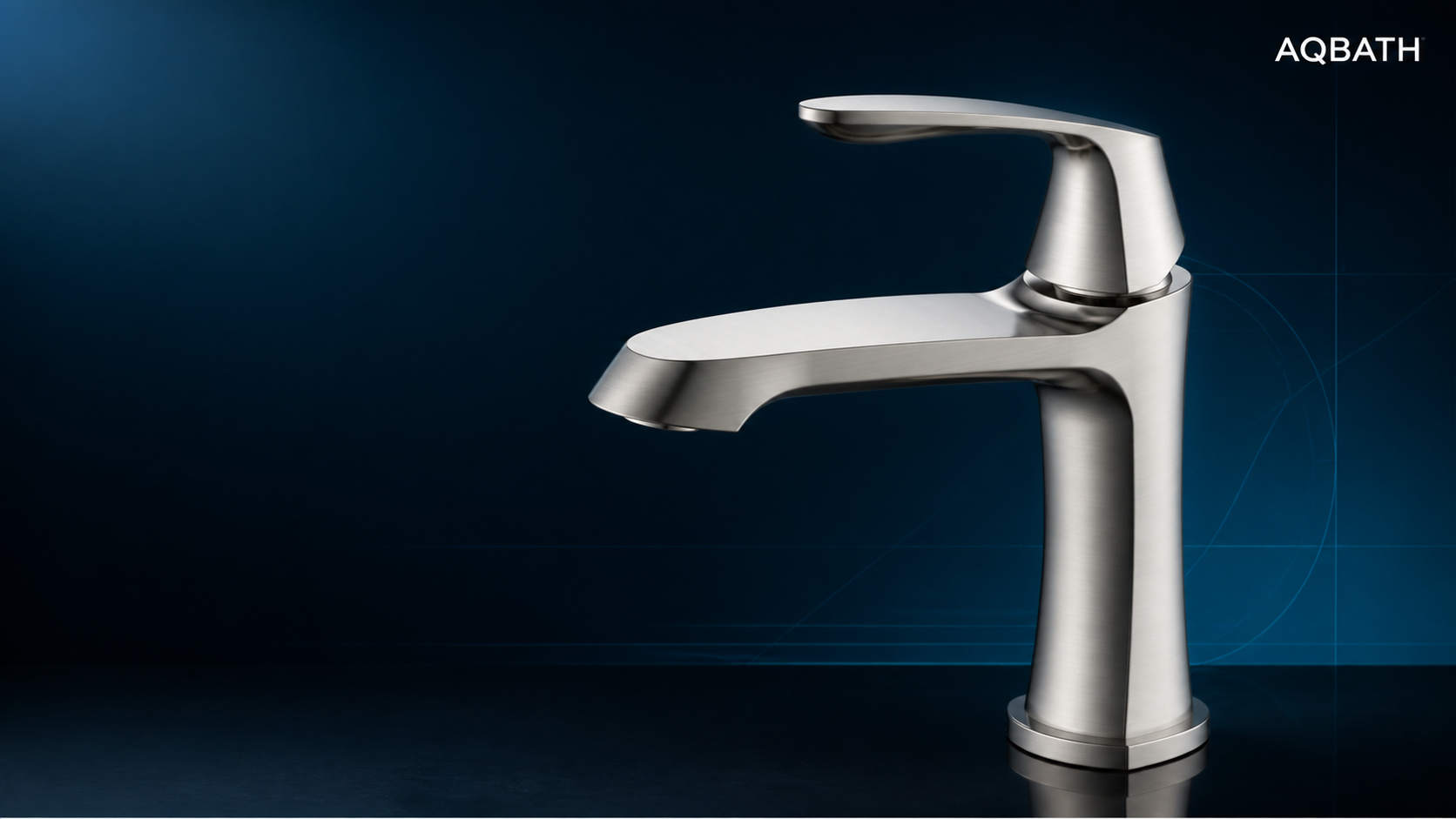
The faucet shown in the picture is a good example; it appears simple at first glance, but is actually well-made. This faucet appears to be a single-handle, high-arch hybrid faucet with a clean cylindrical base and a brushed or nickel-like metallic finish. The tall gooseneck spout provides ample space for rinsing food, washing dishes, or filling pots. This geometric design is very practical in kitchens and utility sinks, but the picture itself doesn't fully reveal its specific model, materials, or internal structure.

Buyer's Quick Guide: Things to Note Before Placing an Order
If you are screening suppliers, start with issues that affect product stability, rather than issues that only affect appearance.
A reputable faucet supplier should be able to explain in detail the faucet body material, surface treatment, valve core compatibility, installation method, and packaging details, rather than being vague. If a company cannot explain how the faucet body is manufactured, which parts are processed after casting, or how the surface coating is protected during transportation, it usually means you should look for other suppliers.
For projects that require a kitchen faucet manufacturer rather than a purely decorative supplier, practicality is paramount. Clearance under the spout, one-handed operation, and a sturdy countertop mounting base are all essential for everyday use. Even if the photos in the brochure are carefully retouched, a faucet that looks beautiful but is prone to splashing, loosening, or leaving marks is hardly a good product.
Why the story of metals and surface treatment processes is so important
From a procurement perspective, the success of a faucet hinges on the combination of its body metal and surface finish. The image shows a reflective silver finish, but this doesn't necessarily indicate whether the body is stainless steel, chrome-plated brass, or some other alloy. Buyers should be cautious about this, as incorrect judgment could lead to problems later regarding compliance, durability, or pricing.
Brass is typically associated with robust and durable plumbing hardware, while stainless steel is often chosen for its cleaner look and greater corrosion resistance. Both are viable options depending on the design, water quality, and target market. The key is the manufacturer's ability to consistently produce products that meet the chosen specifications. For example, one brass faucet manufacturer might focus more on body casting and machining capabilities, while another might excel in surface finishing and assembly. These skills are not identical, and purchasing teams sometimes confuse them.
User-friendly visible design features
The high-curve faucet isn't just for show; it provides ample space for pots, kettles, and tall containers. The single lever control on the right allows for easy adjustment of water flow and temperature, essential for busy kitchens and families who need to operate the faucet with one hand. The compact base also contributes to a cleaner look after installation, making it particularly suitable for modern countertops.
Here's a little buying tip: If a faucet looks simple, people sometimes assume it will be durable for everyday use. But that's not always the case. How a faucet feels after three months of use depends on the spout's reach, the handle's rotation angle, and the amount of water splashing, not on the photos in the showroom.
How to evaluate a factory based solely on product photos?
When evaluating a faucet OEM manufacturer, don't just start with pictures. Ask for detailed information that demonstrates control over the production process.
First, confirm whether the faucet body is cast, forged, or machined from bar stock. Then inquire about the surface treatment and protection methods. Next, check if the factory can maintain design consistency across different order sizes, ensuring the appearance and texture remain unaffected. This is crucial for brand projects that require consistency across seasons or channels.
Pay attention to those often-overlooked details: whether the aerator is installed correctly, the stability of the handle, the installation accessories, packaging protection, and traceability labels on the faucet. These may seem insignificant, but they can affect returns and installation times. Suppliers who can handle these issues well are generally more reliable than those who only focus on aesthetics.
Common mistakes buyers make when purchasing faucets
A common mistake is focusing too much on the surface color while ignoring the internal structure. Another mistake is assuming that factories that manufacture bathroom fixtures are also good at producing kitchen products. Kitchen use places higher demands on faucets: higher spout height, more frequent handle operation, and easier contact with splashes and cleaning agents.
Another issue is the confusion between ordinary faucet traders and genuine Chinese faucet manufacturers. Trading companies are still useful, but if you need engineering support, custom packaging, or consistently high product quality over the long term, you need to know exactly who is responsible for the production of the faucet body and who is responsible for the final assembly. This distinction can save time later on.
Practical procurement advice for product teams and purchasing managers
Use samples to assess their ergonomic design. Can you easily turn the handle? Does the spout height match the sink depth? Does the footprint match the countertop space? These are simple questions, but they can prevent costly mistakes later.
For your own-brand product line, inquire with suppliers whether they can meet the requirements of OEM faucet manufacturers , such as customized branding, packaging changes, and consistent specifications across the entire product line. If your product line covers bathroom and kitchenware, you may need to separate responsibilities: one partner may be responsible for the production of bathroom faucets, and another for kitchen faucets, unless the factory can demonstrate consistency across multiple product categories.
Finally, don't let beautiful product photos obscure the technical rigor. A faucet in a picture may look simple and practical, which is often a good sign for mainstream retail or project applications. But the final decision depends on what lies beneath the surface: material control, assembly quality, and whether the supplier is willing to provide detailed specifications of critical aspects.
What should we ask next?
If you are screening candidate products, request product drawings, material declarations, finish options, and assembly specifications from the manufacturer. A supplier's ability to respond clearly and consistently is often more valuable than a beautifully designed catalog. A reliable faucet product line is built on repeatable production, not just pretty curves.
For buyers comparing kitchen and bathroom faucet collections, the wisest course of action is to request samples and compare them under actual installation conditions. This is where a good faucet manufacturer demonstrates its value.