

A hot and cold water kitchen faucet is one of the most commonly specified fixtures in residential kitchens, apartments, hotels, rental properties, and commercial buildings. It connects to separate hot and cold water supplies and allows the user to control both flow volume and outlet temperature.
However, B2B buyers should not evaluate a kitchen faucet only by its appearance, price, or handle style.
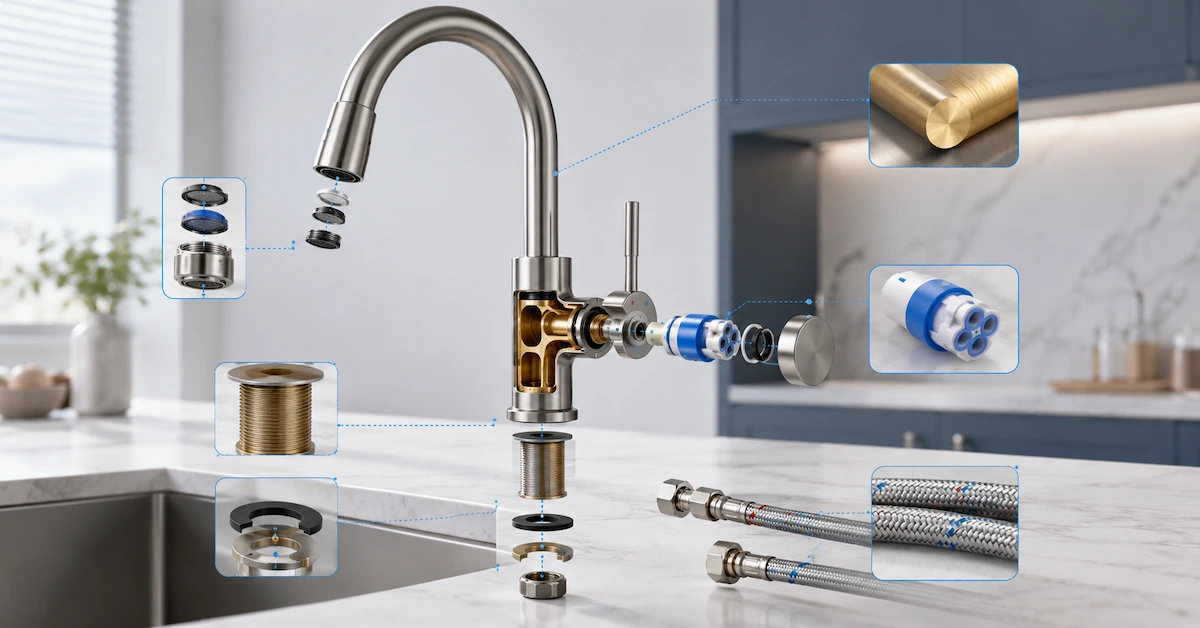
The performance of the finished product depends on the faucet body, cartridge, inlet hoses, seals, spout structure, aerator, mounting hardware, surface treatment, and manufacturing consistency.
For importers, distributors, kitchen brands, and project buyers, the most important question is not simply whether the faucet works during sample inspection. The product must also remain stable throughout mass production and long-term use.
A complete evaluation should cover:
- Faucet body material
- Hot and cold water inlets
- Mixing cartridge
- Handle mechanism
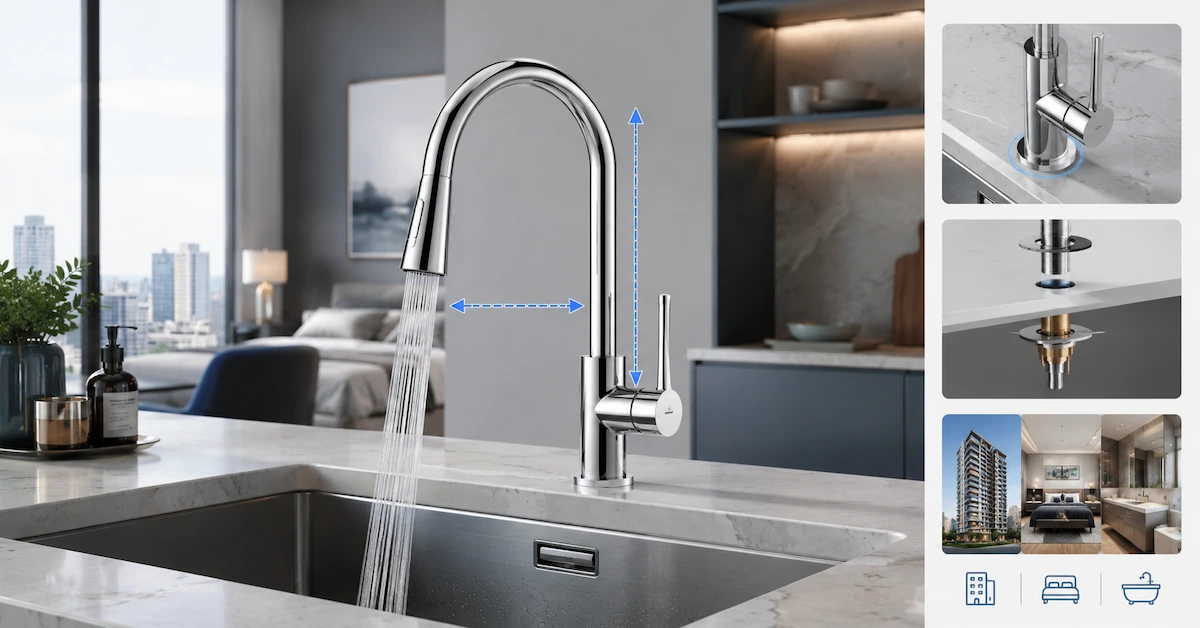
- Spout height and reach
- Aerator performance
- Flexible inlet hoses
- Installation hardware
- Surface finish
- Leakage testing
- Certification
- Packaging
- Replacement parts
What Is a Hot and Cold Water Kitchen Faucet?
A hot and cold water kitchen faucet receives water through two separate inlet connections. One inlet connects to the hot water supply, while the other connects to the cold water supply.
An internal cartridge or valve system controls how much water enters from each inlet. The mixed water then flows through the faucet body and exits through the spout.
The two most common control structures are single-handle and two-handle faucets.
Single-Handle Kitchen Faucet
A single-handle faucet uses one lever to control both water flow and temperature.
The user normally lifts or moves the handle to control flow volume and moves it from side to side to change the ratio between hot and cold water.
This design is commonly selected for:
- Modern residential kitchens
- Apartment projects
- Hotels
- Rental properties
- Kitchen brands
- Private-label retail programs
Its compact appearance and one-handed operation make it suitable for many mainstream markets.
Two-Handle Kitchen Faucet
A two-handle faucet has separate controls for hot and cold water.
This structure may be selected for:
- Traditional kitchen designs
- Farmhouse-style kitchens
- Selected regional markets
- Commercial applications
- Projects requiring separate water control
A two-handle design may require additional mounting holes and more installation space than a single-handle model.
Which B2B Buyers Need This Product?
Different buyers evaluate the same faucet from different commercial and technical perspectives.
Importers and Distributors
Importers need products that comply with local installation standards, plumbing connections, certification requirements, packaging regulations, and market preferences.
Their main concerns usually include:
- Stable bulk production
- Competitive landed cost
- Market-specific certification
- Low warranty risk
- Consistent surface finishes
- Reliable production schedules
- Replacement parts
- Clear product documentation
Kitchen and Bathroom Brands
Brands generally require greater customization and product differentiation.
Common requirements include:
- Private-label Logo
- Exclusive product appearance
- Custom surface finishes
- Cartridge selection
- Aerator configuration
- Branded packaging
- Instruction manuals
- Market-specific accessories
- Complete product series
Sink Manufacturers
Sink manufacturers may combine a faucet with a stainless steel sink, workstation sink, kitchen cabinet, or complete kitchen package.
In this situation, buyers must coordinate:
- Mounting-hole diameter
- Faucet base dimensions
- Spout height
- Spout reach
- Sink bowl depth
- Sink bowl width
- Hose length
- Spout rotation
A faucet should be tested together with the intended sink before mass production begins.
Hotel and Apartment Project Buyers
Project buyers are usually more concerned about installation efficiency, product consistency, maintenance, replacement parts, and project delivery.
For projects involving hundreds or thousands of units, even a small installation problem can create significant labor costs and construction delays.
What Specifications Should Buyers Confirm?
Before placing an order for a hot and cold water kitchen faucet, buyers should create a detailed specification sheet.
| Specification | Information to Confirm | Why It Matters |
|---|---|---|
| Faucet structure | Single-handle or two-handle | Determines operation and installation |
| Body material | Material grade and component location | Influences durability and compliance |
| Cartridge | Type, diameter, brand and test requirement | Controls mixing and shutoff |
| Installation | Deck-mounted, wall-mounted or top-fixed | Must match the sink and countertop |
| Mounting holes | Number and required diameter | Prevents installation problems |
| Spout height | Vertical distance from base to outlet | Affects container clearance |
| Spout reach | Distance from faucet center to outlet | Determines where water enters the sink |
| Spout rotation | Fixed, limited or full rotation | Important for single- and double-bowl sinks |
| Inlet connection | Thread type and regional standard | Must match the local plumbing system |
| Hose length | Actual usable length | Influences installation convenience |
| Flow rate | Flow at a defined water pressure | Affects performance and compliance |
| Surface finish | Chrome, brushed, matte or custom | Influences appearance and corrosion resistance |
| Working pressure | Approved operating range | Helps prevent leakage or weak flow |
| Certification | Exact standard and covered models | Reduces market-access risk |
| Packaging | Neutral or customized packaging | Supports wholesale and private-label sales |
Exact technical values should be confirmed for each product model. Buyers should not assume that every faucet in a supplier’s catalog uses the same material, cartridge, hose, or testing standard.
How Does Material Affect Faucet Quality?
Material selection influences product strength, corrosion resistance, machining performance, water-contact safety, weight, and cost.
Brass Faucet Bodies
Brass is widely used for kitchen faucet bodies because it can be cast, forged, machined, polished, plated, and assembled into complex water-control structures.
However, buyers should not accept a general description such as “brass faucet” without further details.
Important questions include:
- What brass grade is used?
- Does the material meet lead-content requirements?
- Which components are made of brass?
- Is the body cast or forged?
- How is the material verified?
- Does the material meet the target market’s standard?
For products intended for drinking-water applications, material composition and certification scope should be verified before production.
Zinc Alloy Components
Zinc alloy may be used in handles, decorative covers, bases, or other non-water-contact components.
Its suitability depends on:
- Component location
- Mechanical load
- Water-contact status
- Surface treatment
- Corrosion-resistance requirement
- Target price level
The buyer should request a component-level material list rather than relying on a general product description.
Stainless Steel Components
Stainless steel may be used in spouts, hoses, fasteners, springs, or selected faucet bodies.
The exact stainless steel grade should be confirmed because different grades provide different levels of corrosion resistance and manufacturing performance.
Why Is the Cartridge Important?
The cartridge is one of the most important components in a single-handle kitchen faucet.
It controls:
- Water opening and closing
- Flow volume
- Hot and cold water mixing
- Temperature adjustment
- Handle movement
- Internal sealing
A cartridge that performs well during a short sample demonstration may still fail after repeated use.
Professional buyers should confirm:
- Cartridge type
- Cartridge diameter
- Cartridge supplier
- Ceramic-disc material
- Seal material
- Operating cycle requirement
- Replacement availability
- Compatibility with the faucet body
Cartridge performance can also be affected by water pressure, water quality, temperature variation, assembly accuracy, and internal machining tolerances.
For a private-label product program, using a standardized and replaceable cartridge can reduce long-term warranty and spare-parts risks.
How Should the Faucet Match the Kitchen Sink?
A hot and cold kitchen tap should be selected together with the sink rather than as an isolated product.
Spout Height
A high-arc spout provides more space for cleaning large pots, trays, and containers.
However, excessive faucet height combined with a shallow sink can increase splashing.
Spout Reach
Spout reach determines where the water lands inside the sink.
If the reach is too short, the water may fall too close to the back wall. If the reach is too long, the water may fall close to the front edge and cause splashing.
Sink Depth
A deeper sink can help control splashing, but the actual result also depends on:
- Faucet height
- Flow rate
- Aerator design
- Water pressure
- Outlet angle
Single-Bowl and Double-Bowl Sinks
For a double-bowl sink, a rotating spout, pull-out faucet, or pull-down faucet can provide better working coverage.
Before approving a model, buyers should test the faucet with the intended sink dimensions or review a combined installation drawing.
Single-Handle vs Two-Handle Kitchen Faucets
| Factor | Single-Handle Faucet | Two-Handle Faucet |
| Temperature control | One lever mixes hot and cold water | Separate hot and cold controls |
| Operation | Convenient for one-handed use | Requires adjustment of two handles |
| Appearance | Common in modern kitchens | Often used in traditional designs |
| Installation | Frequently requires one mounting hole | May require multiple mounting holes |
| Main control component | Mixing cartridge | Separate valves or cartridges |
| Cleaning | Compact base area | More external components |
| Best application | Residential and modern projects | Traditional ranges and selected markets |
Neither structure is universally better.
The correct option depends on:
- Target customer preference
- Installation environment
- Market positioning
- Maintenance requirements
- Product price level
- Available mounting holes
Top-Fixed vs Conventional Installation
Conventional kitchen faucets are commonly secured from below the sink or countertop.
This installation method can become difficult when the cabinet contains:
- A deep sink bowl
- Storage equipment
- Water filters
- Waste-disposal units
- Drainpipes
- Limited working space
A top-fixed or above-the-deck mounting system allows the installer to complete important fastening work from above the countertop.
Potential benefits include:
- Easier installation access
- Less work inside a confined cabinet
- Faster product replacement
- Reduced installer fatigue
- More consistent installation
- Better suitability for renovation projects
A top-fixed hot and cold water kitchen faucet can be especially useful for hotels, apartments, rental properties, and multi-family housing projects where many units must be installed within a limited schedule.
Buyers should still verify:
- Countertop thickness
- Mounting-hole dimensions
- Base stability
- Installation tools
- Fastening structure
- Replacement procedure
Which Certifications Should Buyers Check?
Certification requirements depend on the country, product structure, application, and water-contact components.
Common certifications or compliance requirements may include:
- cUPC
- NSF
- WaterMark
- CE
- SNI
- Lead-content requirements
- Local plumbing standards
A supplier may hold several certificates, but buyers should not assume that every certificate covers every model.
Before ordering, verify:
- Certificate number
- Issuing organization
- Applicable standard
- Listed manufacturer
- Manufacturing location
- Covered product category
- Covered model numbers
- Certificate validity
- Water-contact components
A certificate for a cartridge, hose, or aerator does not automatically prove that the complete assembled faucet is certified.
What Quality Tests Should Be Required?
A complete quality-control plan should cover raw materials, machining, surface treatment, assembly, functional performance, appearance, and packaging.
Material Inspection
Material inspection may include:
- Supplier material certificates
- Spectral analysis
- Hardness testing
- Component identification
- Batch traceability
This helps ensure that production materials match the approved specification.
Dimensional Inspection
Important dimensions can include:
- Base diameter
- Mounting-hole size
- Thread dimensions
- Spout height
- Spout reach
- Cartridge cavity
- Handle alignment
- Hose connection
Critical dimensions should be inspected using appropriate gauges or measurement equipment.
Leakage and Pressure Testing
Finished products should be tested for leakage at relevant sealing and connection points.
The buyer should define:
- Test pressure
- Test duration
- Testing medium
- Sampling rate
- Acceptance standard
- Whether every unit requires testing
These requirements should be included in the purchase specification.
Surface Inspection
Surface inspections should check:
- Scratches
- Pitting
- Uneven color
- Plating defects
- Polishing marks
- Coating adhesion
- Batch color differences
For corrosion-resistance testing, the buyer should define the test method, finish type, duration, and acceptance criteria.
Functional Inspection
Functional testing should include:
- Handle movement
- Water shutoff
- Temperature adjustment
- Spout rotation
- Aerator performance
- Hose connections
- Mounting stability
- Accessory completeness
Common B2B Procurement Risks
Choosing the Lowest Quotation
A low quotation may use a different cartridge, shorter hose, thinner finish, lower-grade packaging, or less complete testing.
Quotations should be compared using the same bill of materials and technical specification.
Unclear Material Descriptions
Descriptions such as “metal faucet” or “brass kitchen faucet” may not explain which components use which materials.
Request a detailed bill of materials.
Incorrect Certification Scope
A supplier may have a valid certificate that does not cover the exact product being ordered.
Verify the listed model and current certificate status.
No Installation Testing
A faucet may look correct but still have unsuitable mounting dimensions, thread standards, hose lengths, or spout geometry.
Sample approval should include installation with the intended sink.
Sample and Mass-Production Differences
A high-quality sample does not guarantee consistent mass production.
The purchase agreement should define:
- Approved sample
- Bill of materials
- Product drawing
- Finish standard
- Testing requirements
- Packaging specification
- Pre-shipment inspection
How Does OEM and Private-Label Customization Work?
OEM kitchen faucet customization can be divided into several levels.
Basic Customization
- Logo marking
- Product labels
- Color boxes
- Barcodes
- Instruction manuals
- Finish selection
- Accessory combinations
Product Configuration Customization
- Cartridge selection
- Aerator selection
- Hose length
- Inlet connection
- Handle design
- Spout configuration
- Mounting hardware
Full ODM Development
- New product appearance
- Structural development
- Mold design
- Prototype production
- Sample testing
- Certification preparation
- Pilot production
- Mass production
Before requesting a quotation, the buyer should provide:
- Target market
- Product reference
- Expected quantity
- Required material
- Surface finish
- Installation method
- Certification requirements
- Packaging requirements
- Target price level
- Required delivery schedule
AQBATH supports kitchen faucet and related sanitary hardware manufacturing for international B2B buyers. Its stated capabilities include product design, mold development, brass casting, zinc-alloy die casting, forging, precision machining, polishing, electroplating, assembly, and quality testing.
Buyers can review the available AQBATH faucet product range before discussing an OEM or project order.
Supplier Evaluation Checklist
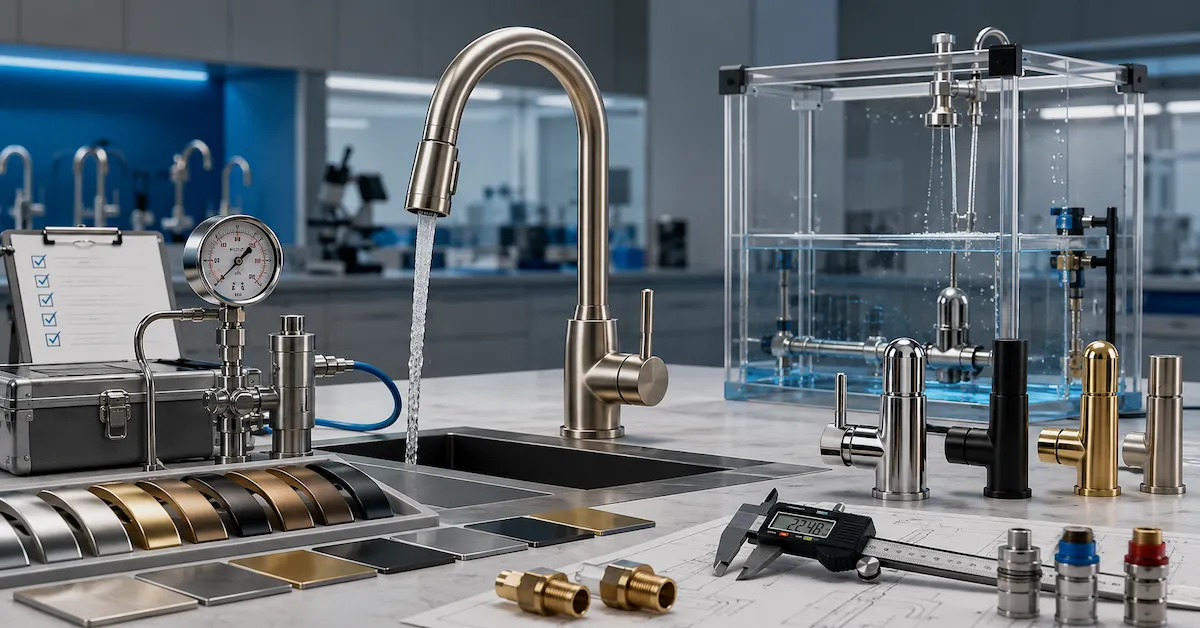
Before selecting a supplier, confirm the following:
- Does the supplier manufacture the product directly?
- Can the supplier explain the material used in each major component?
- Is the cartridge replaceable and consistently available?
- Are installation dimensions clearly documented?
- Are certifications valid for the selected model?
- Are leakage and pressure tests clearly defined?
- Can the factory control finish consistency?
- Does the approved sample use mass-production materials?
- Are accessories included in the product specification?
- Are replacement parts available?
- Does the factory support OEM or ODM development?
- Are production and inspection stages clearly defined?
- Can the supplier provide branded packaging?
- Is pre-shipment inspection available?
- Does the supplier understand the target market’s standards?
More information about AQBATH’s manufacturing background is available on the About Us page.
Frequently Asked Questions
What is a hot and cold water kitchen faucet?
A hot and cold water kitchen faucet connects to separate hot and cold supply lines. An internal cartridge or valve regulates the flow from both inlets and mixes the water before it exits through the spout.
Is a single-handle or two-handle kitchen faucet better?
A single-handle model is convenient and compact, while a two-handle model provides separate hot and cold controls. The correct choice depends on the target market, style, installation layout, and maintenance requirements.
What is the best material for a kitchen faucet?
The best material depends on the application, market requirements, budget, and certification needs. Buyers should evaluate the complete material structure rather than only the external body.
Why is a ceramic cartridge important?
A ceramic cartridge controls mixing, flow, shutoff, and handle movement. Its performance affects leakage risk, temperature adjustment, operating feel, and product lifespan.
Can kitchen faucets be customized for private-label brands?
Yes. Customization may include Logo, packaging, finish, cartridge, aerator, hose, handle, spout, connection size, mounting hardware, and complete product development.
How can buyers verify faucet certification?
Check the issuing organization, applicable standard, certificate number, listed manufacturer, production site, covered models, and current validity.
What information is needed for an accurate quotation?
Provide the product type, target market, material, finish, installation method, connection standard, certification, quantity, packaging, and expected delivery date.
Should every faucet be tested for leakage?
The buyer and supplier should agree on the inspection plan. For bulk orders and project products, the testing pressure, duration, method, sampling rate, and acceptance criteria should be clearly documented.
What are the advantages of a top-fixed kitchen faucet?
A top-fixed faucet can reduce installation work beneath the sink and may improve efficiency in apartments, hotels, rental properties, and renovation projects.
How can buyers reduce differences between samples and bulk orders?
Use an approved sample, signed specification, bill of materials, dimensional drawing, surface standard, test plan, packaging requirements, and pre-shipment inspection.
Conclusion
Choosing a hot and cold water kitchen faucet for wholesale, private-label distribution, or project installation requires more than selecting an attractive design.
Buyers should evaluate the faucet body, cartridge, water-contact materials, inlet connections, spout dimensions, sink compatibility, installation method, surface treatment, certification scope, testing requirements, packaging, and replacement-part availability.
The safest purchasing decision is based on a detailed and approved specification rather than price or appearance alone.
A reliable supplier should be able to explain how the product is designed, manufactured, assembled, inspected, customized, and controlled during mass production.
AQBATH works with international importers, distributors, sanitary ware brands, and project buyers. To discuss kitchen faucet models, OEM customization, certification requirements, or project specifications, contact AQBATH with your target market, expected quantity, product requirements, and delivery schedule.