


China Faucet OEM Manufacturer: 12-Point Due Diligence Checklist
Buyers looking for a reliable faucet OEM manufacturer with a China sourcing team should not focus solely on catalogs and quotes. The real challenge is to verify that the supplier can consistently meet your drawings, material requirements, finished product standards, market regulations, packaging specifications and delivery schedules.
A beautiful website, extensive product range, or competitive quotes do not prove that the supplier controls the process behind the finished product. Importers and private labels require evidence of the legal entity, manufacturing plant, bill of materials, production records, test reports and shipped goods.
This 12-point due diligence checklist helps brand owners, wholesalers, distributors and project buyers evaluate faucet OEM or ODM suppliers before approving molds or placing volume production orders. 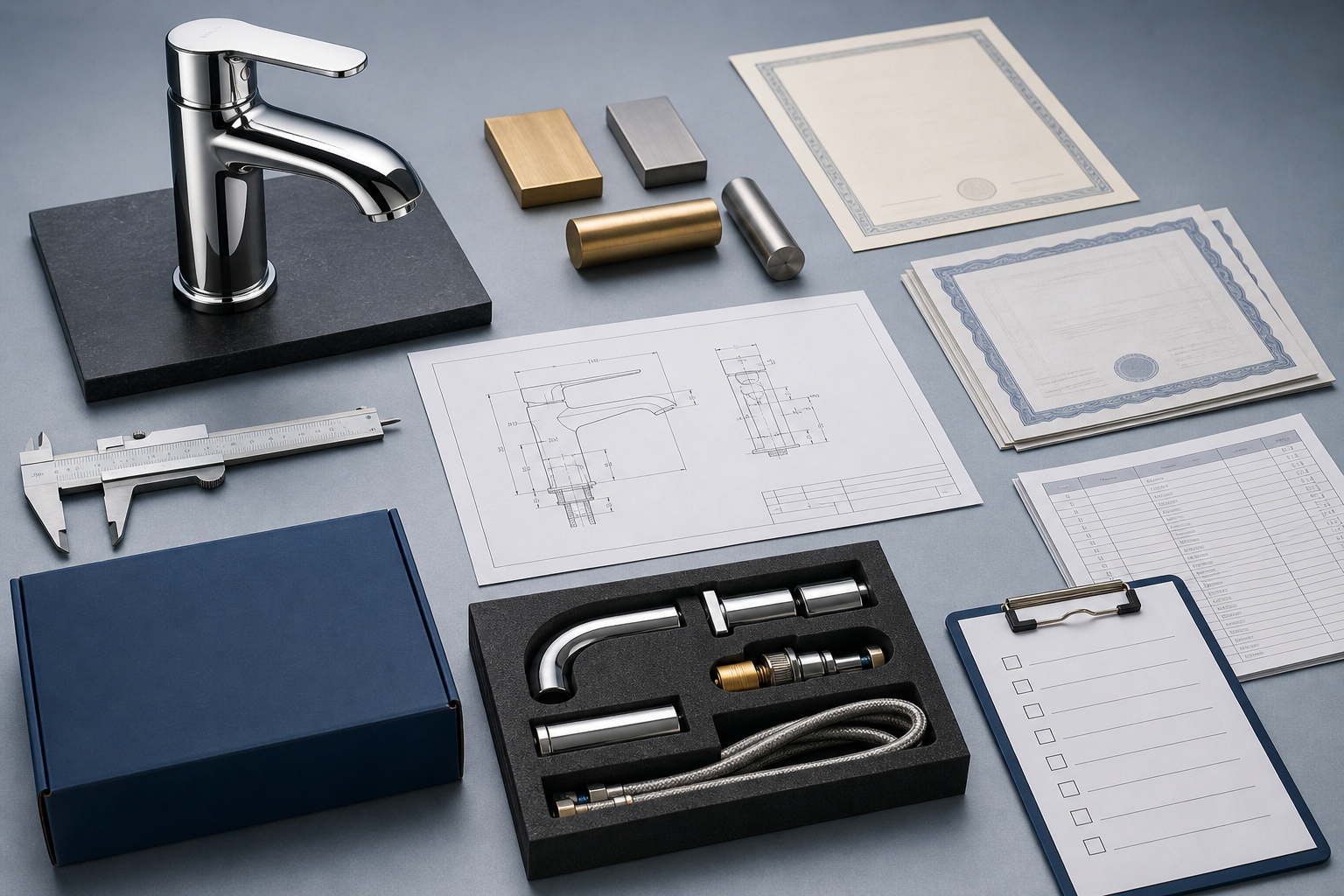
1. Decide whether you need OEM, ODM or standard wholesale supply
The first step is to define the right business model.
| Supply model | What does the supplier offer | Most suitable | Main Buyer Risk |
|---|---|---|---|
| Standard wholesale | Existing faucet designs and standard packaging | Dealers test market demand | Limited product differentiation |
| Private label | Existing product with buyer's branding and packaging | Importers and Online Brands | Similar products may be sold to competitors |
| Original processing | Produced according to buyer's drawings or specifications | Well-known brands of developed products | Drawing control and manufacturing consistency |
| Original Design Manufacturer | Product development based on buyer’s concept or market brief | Brands in need of design and engineering support | Intellectual Property Ownership, Tool Control and Supplier Dependence |
| Project Supply | Products configured for hotels, apartments or commercial projects | Contractors and Project Buyers | Approval schedule and continuity of replacement parts |
OEM buyers typically control product specifications. ODM suppliers contribute more design, engineering or tooling work. In practice, many faucet development programs combine elements of both models.
Before requesting a quote, please specify whether you require:
-
Existing directory model
-
Private brand packaging
-
Different surface treatments or component configurations
-
Cosmetic retouch
-
Functional redesign
-
New product platform
This distinction affects development costs, minimum order quantities, sample delivery times, certification requirements and intellectual property ownership.
2. Prepare a complete faucet purchasing brief
If the request only contains a product photo and a target price, the supplier cannot provide an accurate quote.
Your purchasing profile should define:
-
Destination Market
-
Residential, hotel or commercial applications
-
Estimated annual output
-
Initial order quantity
-
Faucet type
-
Installation method
-
Body and handle materials
-
Cartridge types and sizes
-
Waterway requirements
-
Import connection and thread standards
-
Target traffic
-
Surface treatment and color
-
Packaging configuration
-
Required spare parts
-
Product certification requirements
-
Samples and release schedule
-
Target Incoterms and delivery location
These ICC Incoterms allocate delivery obligations, costs and risks between buyers and sellers.
A quotation marked "FOB" or "EXW" is incomplete unless it also identifies the named port or location and the applicable Incoterms version.
3. Use this 12-point faucet supplier due diligence checklist
Check 1: Verify legal entity and brand relationship
Confirm that:
-
Sign a production agreement
-
Own or operate a factory
-
Issue an invoice
-
Payment received
-
Possess relevant certificates
-
Export goods
-
Assume liability for warranty claims
Compare business license name, registered address, bank beneficiary, invoicing entity, website identity and certificate holder.
For Chinese suppliers, buyers can search the company name or unified social credit code through the official National Enterprise Credit Information Disclosure System.
Different manufacturing, sales and export entities do not necessarily present a problem. However, the relationship between these entities should be documented before the buyer signs a contract or makes payment.
Check 2: Confirm that the factory is suitable for your product category
Factories with experience in manufacturing standard basin faucets are not necessarily qualified to produce:
-
Thermostatic shower system
-
Commercial pre-rinse faucets
-
Sensor faucet
-
Pull-down kitchen faucet
-
Concealed shower valve
-
Low lead products for specific markets
Request category-specific SKU lists, technical drawings, examples of bill of materials, control plans, test reports and recent production records.
Don’t evaluate manufacturing capabilities based solely on catalog dimensions. Large catalogs may combine products manufactured in-house, products from partner factories, and trade items sourced externally.
Check 3: Map internal and outsourced processes
Request a manufacturing flow diagram showing which operations are performed in-house and which are subcontracted.
Typical faucet production may include:
-
Industrial Design and Engineering
-
Mold and tooling development
-
Brass casting, forging or die casting
-
CNC machining
-
Pipe forming or welding
-
Grinding and polishing
-
Electroplating, PVD or spray painting
-
Component procurement
-
Rally
-
Pressure and leak testing
-
Final inspection
-
Packaging
Outsourcing is common, especially for plating, cartridges, aerators and hoses. The important question is whether the faucet manufacturer qualifies, monitors and tracks these subcontractors.
When evaluatingfaucet OEM manufacturers, Chinasourcing teams should require traceable evidence for every important commercial and technical claim. Production records and controlled documents are more reliable than catalog descriptions, certificate marks or verbal guarantees.
Check 4: Evaluate Design, Engineering and Tool Control
For OEM and ODM solutions, please explain from the manufacturer:
-
Supported CAD and drawing formats
-
Manufacturability Design Review
-
Prototyping methods
-
Tooling quotation details
-
Mold ownership
-
Tool storage and identification
-
Expected tool life
-
Tool maintenance
-
Engineering change approval
-
Tool replacement responsibility
The manufacturing agreement should state ownership of molds, drawings, and product-specific fixtures upon payment. It should also define whether the supplier can use the assets to manufacture products for other customers.
Mold invoices alone do not fully establish mold ownership or product exclusivity.
Check 5: Verify Bill of Materials and Material Control
"Brass faucet" is not a complete material specification.
The controlled materials list should identify the materials required:
-
Faucet body
-
Spout
-
Processing
-
Ink cartridge
-
Waterway
-
Flexible hose
-
Aerator
-
Fasteners
-
Seals
-
Install components
For critical metal components, consider the requirements:
-
Material grade
-
Approved material suppliers
-
Incoming goods inspection method
-
Batch identification
-
Alloy analysis records
-
Applicable restricted substance reporting
-
Material change notification requirements
If the supplier describes the product as "lead-free," ask for the precise alloy definition, test standards, test components, report numbers, and models covered.
General marketing claims should not replace technical evidence at the SKU level.
Inspection 6: Check dimensions and manufacturing controls
Ask which product dimensions are critical to functionality and how the factory measures them.
Relevant evidence may include:
-
Approved engineering drawings
-
Tolerance table
-
First article inspection report
-
Caliper and instrument records
-
Three-dimensional measurement report
-
Instrument calibration records
-
Process Control Plan
-
Nonconforming product procedures
Dimensions affecting the cartridge base, sealing surfaces, threads, nozzle rotation and mounting stability should receive more attention than purely cosmetic measurements.
For custom products, please ensure drawings include revision numbers. Purchase orders, inspection reports, and approved samples should all reference the same revision.
Check 7: Verification Functional Test
Don't accept claims like "100% tested" without defining actual tests.
Requires documented test conditions, including:
-
Test pressure
-
Test time
-
Water or air test medium
-
Leak acceptance criteria
-
Sampling level
-
Device identification
-
Operator records
-
Batch traceability
-
Troubleshooting process
-
Reinspection Procedure
Product validation testing may also include:
-
Flow measurement
-
Handling lifecycle testing
-
Nozzle rotation test
-
Pull-out hose circulation
-
Thermal Cycle
-
Ink cartridge durability test
-
Shunt functional test
-
Installation strength test
Test results are meaningful only if the model, sample, method, conditions, date and acceptance criteria are determined.
Inspection 8: Control surface finish and corrosion risk
Chrome, brushed nickel, matte black and PVD finishes require different process controls.
Approval before mass production:
-
Real color extreme sample
-
Gloss or texture range
-
Acceptable visual defects
-
Coating structure
-
Coating thickness requirements
-
Coating thickness measurement method
-
Adhesion requirements
-
Corrosion test methods
-
Packaging Protection
When reviewing salt spray claims, ask if the report states:
-
Applicable test standards
-
Exposure conditions
-
Test time
-
Sample preparation
-
Evaluation methods
-
Acceptance Criteria
-
Test models and surface treatments
"Passed salt spray testing" is not a repeatable product specification in itself.
Check 9: Separate management system certification from product certification
ISO 9001 and ISO 14001 are related to management systems. They do not automatically certify every faucet model the company makes.
This International Organization for Standardization explains ISO sets standards but does not certify companies themselves. Certification is carried out by an external certification body.
For each management system certificate, verify:
-
Legal certificate holder
-
Authentication address
-
Certification Scope
-
Issuing agency
-
Accreditation status
-
First issue date
-
Expiration date
-
Current certificate status
Product certification must be checked individually.
For North American projects, buyers can search for related manufacturers and products through the following methods:
Certification logos displayed in the website footer or catalog do not imply coverage of all products. Match the exact model, manufacturing location, materials, listing standards and target market.
Check 10: Establish a golden sample and change control system
Approved samples should be used as production references.
Create a signed golden sample record containing:
-
Model
-
Drawing modification
-
BOM revision
-
Complete code
-
Approved Color Samples
-
Parts brand or specification
-
Packaging version
-
Functional test results
-
Approval date
-
Buyer's signature
-
Supplier signature
Manufacturing protocols should require written approval before changes:
-
Body material
-
Ink cartridge
-
Aerator
-
Flexible hose
-
Seal
-
Electroplating suppliers
-
Complete process
-
Manufacturing Route
-
Packaging
-
Production location
Without formal change control, suppliers may provide products that look similar but are technically different from the approved samples.
Check 11: Testing Capability and Delivery Reliability
Stated annual production capacity does not necessarily equal available production capacity.
Requirements:
-
Monthly production capacity by product line
-
Current production utilization
-
Bottleneck process
-
Tooling ability
-
Electroplating line distribution
-
Key parts delivery time
-
Peak season schedule
-
Sample delivery time
-
Mass production delivery time
-
Delay in material recycling program
-
On-time delivery history
Ask the supplier to develop a back schedule based on the requested shipping date.
The schedule should include:
-
Drawing Approval
-
Workwear
-
Prototyping
-
Sample evaluation
-
Product testing
-
Packaging approval
-
Component procurement
-
Production
-
Final inspection
-
Ocean shipping booking
Exceptionally short lead times may indicate that the supplier has excluded tooling, testing, component procurement, or packaging approval from their schedule.
Check 12: Confirm traceability, packaging, spare parts and CAPA
Finished cartons should have traceable production and inspection records.
Define which identifiers will appear in:
-
Faucet body
-
Inner box
-
Outer box
-
Inspection report
-
Packaging list
-
Replace components
-
Warranty records
Please also check for future availability of the following features:
-
Replace the ink cartridge
-
Flexible hose
-
Aerator
-
Installation Kit
-
Shunt
-
Seals
-
Complete matching components
When defects occur, suppliers should provide containment measures, root cause analysis and corrective actions, not just replacement of goods.
Agree on response times, evidence requirements and responsibilities for sorting, rework, replacement and associated logistics costs.
4. Understand the OEM/ODM production process
Controlled faucet development projects typically follow the following sequence:
| Stage | Requires buyer approval or evidence |
| Requirement definition | Market, Application, Volume and Compliance Introduction |
| Product selection or concept | Reference model or approved design direction |
| Project | Controlled drawings and product specifications |
| Workwear | Mold Agreement and Development Plan |
| Prototype | Size, appearance and functionality review |
| Gold Sample | Sign approval record |
| Pilot production | Process verification and defect review |
| Compliance Verification | Model-specific test reports or product listings |
| Packaging Verification | Artwork, labels and shipping protection |
| Mass production | Production and inspection records |
| Pre-shipment inspection | Quantity, process, packaging and function |
| Transportation | Final documentation and traceability information |
Don't release for mass production just because a cosmetic sample looks acceptable. Cosmetic samples may be manufactured using different materials or processes than the intended production version.
5. Construct comparable inquiry packages
Sending the same RFQ package to each shortlisted supplier makes it easier to compare quotes.
Includes:
-
Product drawings or reference pictures
-
Required materials
-
Finish specifications
-
Cartridge requirements
-
Hose and aerator requirements
-
Connection standards
-
Traffic target
-
Destination Market
-
Compliance requirements
-
Estimated annual demand
-
Trial order quantity
-
Packaging specifications
-
Inspection standards
-
Spare parts requirements
-
Tool Ownership Terms
-
Required Incoterms
-
Samples and production plans
Require suppliers to separate:
-
Product unit price
-
Tooling fee
-
Sample fee
-
Testing fee
-
Certification fee
-
Packaging costs
-
Spare parts cost
-
Inspection fee
-
Freight related costs
This prevents an apparently lower unit price from hiding excluded costs or specifications.
6. Compare total risk, not just unit price
A lower quote can become more expensive when it results in duplicate sampling, production delays, product sorting, rework, air freight, or warranty replacement.
Useful business comparisons should include:
| Cost or risk | What to compare |
| Unit price | Same BOM, surface treatment and packaging basics |
| Workwear | Ownership, life expectancy, maintenance and replacement |
| Sample | Number of rounds and refundable fees |
| Test | Standards, laboratory and model coverage |
| Check | Control and third-party costs included |
| Defects | Benefits, Redress and Claims Process |
| Logistics | Designated Incoterms location and mode of transport |
| Inventory | Minimum order quantity, delivery time and reorder flexibility |
| Warranty | Parts, shipping and claims requirements |
| Product changes | Approval process and re-verification fees |
Even if the initial unit price is higher, a supplier that provides clear technical documentation and stable change control is likely to represent lower total landed risk.
7. Protect product design, molds and intellectual property rights
For custom faucets, define the following ownership:
-
Industrial design
-
Engineering drawings
-
Molds and tooling
-
Product-specific fixture
-
Packaging artwork
-
Brand Equity
-
Test report
-
Product photography
-
Engineering improvements made during development
Conduct appropriate liberalization reviews for target markets before approving designs.
Public tools such as WIPO Patent Scope and USPTO Patent Publication Search are useful starting points, but database searches are not a substitute for professional legal advice.
A confidentiality agreement by itself does not address issues of mold ownership, design rights, exclusivity or post-termination use. These topics should appear in the manufacturing agreement.
8. Conduct remote or on-site factory audits
If an in-person review is not available immediately, request a live video walkthrough rather than relying solely on an edited company video.
Request to view:
-
Factory entrance and corporate image
-
Raw material receiving area
-
Production equipment
-
Tool storage area
-
Work in process identification
-
Inspection laboratory
-
Device Calibration Label
-
Unqualified material area
-
Assembly station
-
Stress testing station
-
Packaging line
-
Finished product warehouse
-
Sample room
The auditor should select records, cartons, and production samples during the visit. Suppliers should not be allowed to present only pre-selected documents.
For important projects, compare what you see in the audit with the process flows, equipment lists, production plans and quotes provided by the supplier.
9. Evaluate AQ Bath as a potential supplier
When evaluating AQ Bath or any otherfaucet OEM manufacturer, Chinaimporters should start with public information and then verify each important claim through current company, production, testing and certification documents.
Public InformationAQ Bath About Us Page introduces a Ningbo faucet and bathroom products company founded in 2006. This page describes design and mold development capabilities, manufacturing processes, and testing resources.
Competencies shown in the company's public materials may include:
-
Brass casting
-
Zinc alloy die castings
-
Forging
-
Welding
-
Bend pipe
-
Cold stamping
-
Precision machining
-
Polish
-
Electroplating
-
Material spectral analysis
-
Dimensions
-
Hardness test
-
Life cycle testing
-
Leak test
-
Salt spray test
Buyers can view this company's:
These disclosure statements are useful for initial supplier screening but should not replace qualification documents.
Prior to approval, please require:
-
Current business license
-
Description of the relationship between the legal corporation, AQ Bath and any other selling or manufacturing name
-
Factory address and production scope
-
Current management system certificate
-
Product certificate holders and model coverage
-
Category-specific manufacturing processes
-
List of production and testing equipment
-
Calibration records
-
Test reports for specific models
-
Sample Control Plan
-
Recent Production Evidence
-
Tools and IP Terminology
-
Corrective Action Procedure
-
Warranty policy
If specifications differ between product list pages, detail pages, catalogs, or quotes, please resolve the inconsistency with signed drawings and controlled materials lists before ordering.
10. Who should use this checklist?
This guide applies specifically to:
-
Private label kitchen and bathroom brands
-
Faucet importers and wholesalers
-
Regional dealer
-
Buyers of hotel and apartment projects
-
E-commerce brands develop exclusive products
-
Procurement team shifts from trade supply to direct manufacturing
-
Buyers enter new regulated market
The full listing may be too much for buyers purchasing very small amounts of existing inventory without customization.
However, legal entity, payment, specification and certification checks should still be completed before placing an order.
11. Warning signs during supplier qualification review
Further investigate whether the supplier:
-
Avoid identifying contracting factories
-
Send certificates with different company names without explanation
-
Unable to connect certificate to exact model
-
Refuse to provide controlled drawings
-
Use inconsistent material descriptions
-
Quote before confirming key specifications
-
Commitment to certification for every product
-
Unable to explain the outsourcing process
-
Reject reasonable change control requests
-
Offer unrealistic tooling or production lead times
-
Unable to provide traceable test records
-
Request payment to unknown beneficiary
-
Think of your website logo as proof of certification
-
Cannot identify approved gold sample
-
Reject reasonable factory audit
-
Unable to provide written corrective action process
Incomplete documentation may lead to an inconsistency. Some unresolved inconsistencies indicate higher procurement risks.
12. Request factory and quality files before ordering
A useful supplier profile should contain enough evidence for engineering, procurement, and quality teams to make the same qualification decisions.
Request the following packages:
-
Business License
-
Company identity and payment entity description
-
Factory Introduction
-
Product Category Matrix
-
Manufacturing process diagram
-
Production equipment list
-
Quality Control Plan
-
Calibration Overview
-
Sample inspection report
-
Related certificates and lists
-
Test reports for specific models
-
Examples of standard BOM and drawings
-
Capacity and delivery time statement
-
Packaging specifications
-
Traceback example
-
Warranty Procedure
-
Corrective Action Procedure
-
OEM/ODM and mold terminology
To discuss an OEM, ODM or private label faucet program with AQ Bath, please send your target market, product type, expected annual production, finished product, certification requirements and target timeline via the AQ Bath contact page.
FAQ
1. What is the typical MOQ for OEM faucet orders?
There is no universal minimum order quantity. This depends on whether the product is standard, private label, recolored, modified, or newly processed. Packaging, cartridge, hose and finished product suppliers may also specify separate minimum quantities. Request written minimum order quantity details for each product, component and finish.
2. How long does it take to customize a faucet project?
This timeline is dependent on design complexity, tooling, sample rounds, compliance testing, packaging and component availability. Ask the manufacturer for a milestone-based project schedule rather than relying on an overall lead time number.
3. How to determine whether the supplier is a factory or a trading company?
Check the legal entity, registered business scope, factory address, equipment, employee responsibilities, production records and export documents. Trading companies can still provide value, but their roles and responsibilities should be transparent.
4. Does ISO 9001 mean that the faucet is certified?
No. ISO 9001 deals with quality management systems. Product compliance must be established by evidence of appropriate model-specific certification, listing or testing required for the intended market.
5. How should I verify cUPC, NSF or other certification claims?
Request a certificate or listing number, certificate holder, manufacturing location, standard and covered models. Search the official catalog of the relevant certification body and verify that it contains the accurate product configuration.
6. What needs to be approved before mass production?
Approval of at least engineering drawings, bill of materials, finished product samples, gold samples, packaging, labels, test plans, compliance evidence, inspection standards and production plans.
7. Who should own the faucet mold?
Ownership is a business decision but must be defined in writing. If the buyer pays for special tooling, the agreement should address ownership, storage, maintenance, access, exclusivity, transfer and disposition.
8. Should I use a third-party inspection company?
Third-party inspections can be valuable for first orders, high-value shipments, or factories without an established performance history. It should complement the supplier's process controls, not replace them.
9. What is the biggest risk in purchasing private label faucets?
One of the most common risks is specification drift. Volume-produced products may differ from approved samples because of changes in unapproved materials, components, finished product suppliers, or manufacturing processes. Controlled BOM and change notification systems reduce this risk.
10. What information should I send when making my first inquiry?
Send target market, product type, application, reference images or drawings, materials, finishes, connections, process requirements, compliance goals, quantities, packaging requirements and required delivery dates. A complete procurement brief results in a more reliable quote.
Conclusion
The best faucet OEM manufacturer that Chinese buyers can choose is not necessarily the factory with the largest catalog or the lowest price. Suppliers can tie every important commercial claim to controlled technical evidence.
Verify company identity, product category experience, process ownership, bill of materials, testing, certification scope, sample control, capacity, traceability and corrective action systems before releasing tooling or volume production.
This rule transforms supplier selection from a simple price comparison to a manageable quality and supply chain decision.