
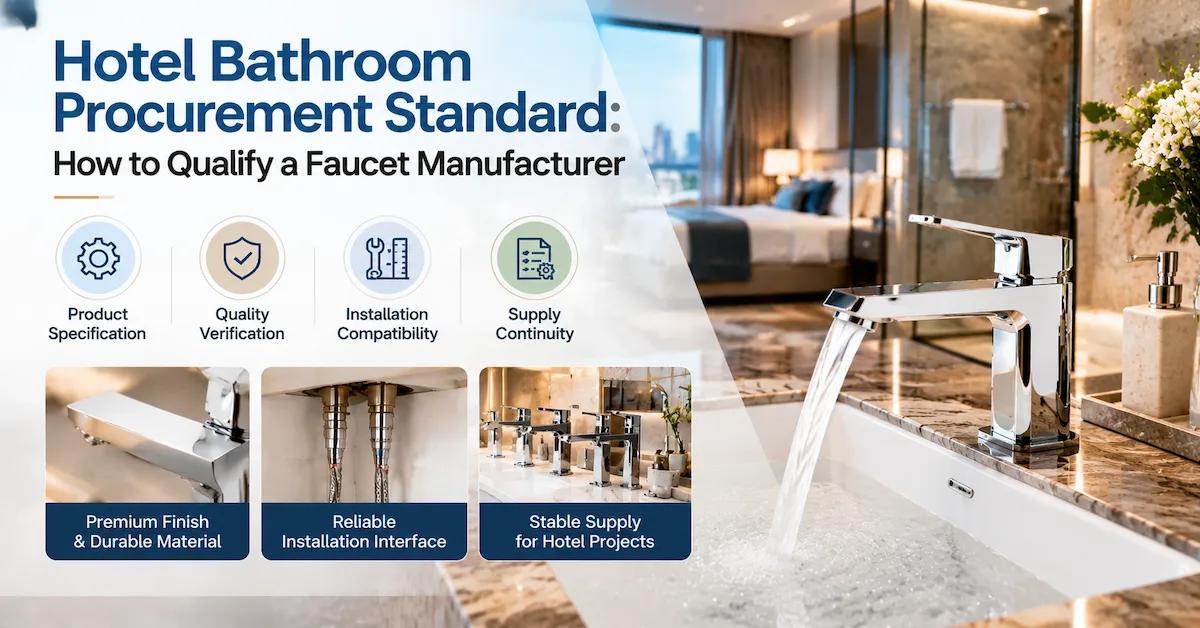
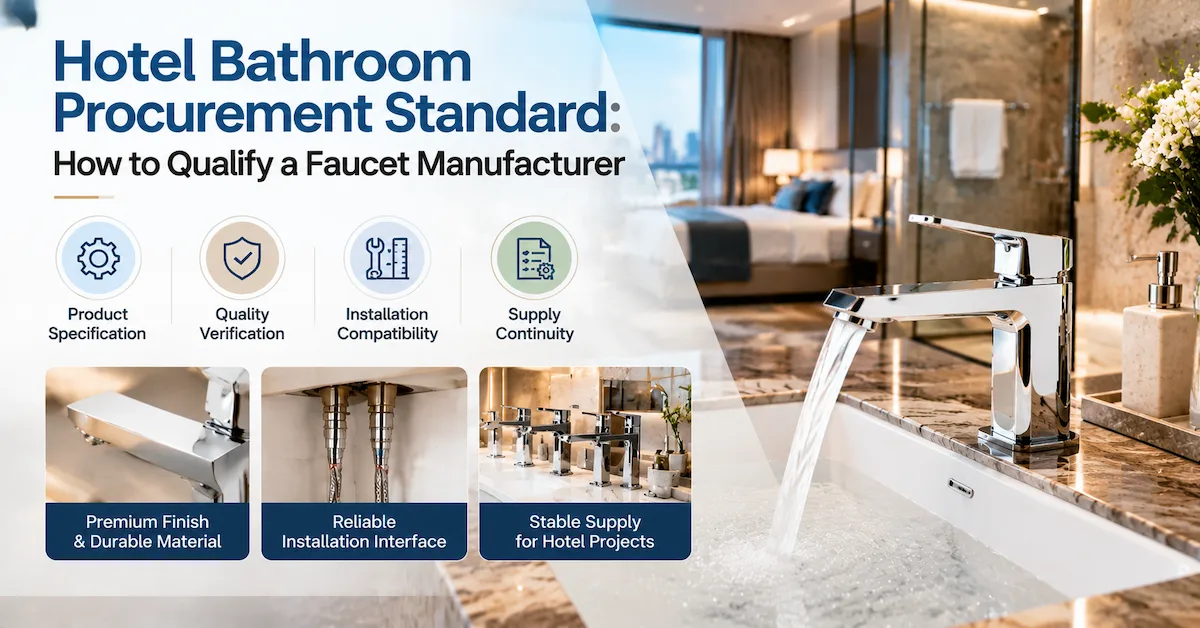
Short answer: A workable hotel bathroom procurement standard manufacturer is not simply the factory offering the lowest faucet price. The manufacturer must help the hotel buyer convert the project brief into a controlled product standard covering model identity, body material, cartridge, finish, dimensions, water connections, installation, testing, packaging, spare parts, documents and change control. The buyer should approve that standard on a representative mock-up before releasing the same configuration across rooms, phases or properties.
There is no single global hotel bathroom procurement standard that automatically fits every country, hotel group or project. A five-star guest room, a limited-service hotel, a serviced apartment and a public hospitality washroom can have different water conditions, cleaning routines, design requirements, installation constraints and certification obligations. The practical solution is a buyer-owned standard supported by manufacturer evidence and a repeatable approval process.
This guide is for hotel owners, developers, procurement teams, interior designers, plumbing contractors, hospitality distributors and faucet brands. It explains how to qualify a faucet manufacturer, build a project specification, compare quotations and control repeat supply without inventing unverified model data. Public AQBath information is used as a starting point for entity and product context; model-specific dimensions, MOQ, lead time, certificates and test results must be confirmed in the project RFQ.
Discuss Your Hotel Faucet Standard
What a hotel bathroom procurement standard should control
A hotel procurement standard is a controlled set of requirements that allows a buyer to approve one product configuration and reproduce it across a defined project. It should be readable by design, purchasing, engineering, installation, quality and after-sales teams. If a requirement exists only in an email or a verbal promise, it is difficult to audit and easy to lose when the project moves from sample room to bulk production.
For faucets, the standard should connect the visible design to the hidden interfaces. A finish sample may look correct while the mounting kit, supply hose, cartridge, spout reach or service clearance is unsuitable. A brass body may meet the design brief while the project still lacks a clear leakage test, installation sequence, carton label or spare-parts reference. Standardization means controlling the complete product and supply process, not just selecting a photograph.
| Standard area | Buyer requirement to define | Evidence to request from the manufacturer |
|---|---|---|
| Product identity | Model, finish, handle, spout, configuration and drawing revision | Current drawing, product label, approved sample and revision register |
| Material and construction | Body material, visible component materials, cartridge and seals | Material declaration, component map and applicable test records |
| Installation interface | Hole, deck, clearance, connection, hose and fixing requirements | Dimensional drawing, installation guide, parts list and mock-up support |
| Performance and quality | Leakage, operation, finish, flow and project acceptance checks | Inspection plan, test method, sample result and lot release record |
| Supply continuity | MOQ, lead time, packaging, spare parts and phased delivery assumptions | Commercial quotation, packaging specification and change-control process |
Why the lowest faucet quotation can fail a hotel standard
Hotel buyers often compare unit price before they normalize the specification. One supplier may quote a complete brass-body faucet with a defined finish, installation kit, carton protection and inspection package. Another may quote a visually similar product while excluding adapters, custom packaging, sample engineering, testing or replacement parts. The lower number is not a lower total cost if the project later pays for rework, room delays, emergency purchases and inconsistent replacement stock.
Price also hides configuration differences. A quotation may omit whether the faucet is deck mounted or wall mounted, whether the hose is included, whether the finish is standard or project-specific, whether the cartridge is the same across phases, and whether the proposed model is available with the required certificate. The procurement team should convert all assumptions into named fields before ranking suppliers.
Normalize the commercial comparison
Ask every bidder to separate product price, sample cost, tooling or modification cost, testing cost, packaging, branding, spare parts, inspection, freight assumptions and documentation. Ask the supplier to identify the model revision and the validity period of the quotation. A hotel project that runs in phases should also ask what happens if the first order and the later order use different finishes, components or packaging materials.
Separate product approval from supplier approval
A manufacturer can have relevant production capability while a specific hotel configuration remains unapproved. Conversely, one successful sample does not automatically qualify a later component change. Keep three decisions visible: the factory is suitable for the project, the exact faucet configuration is approved, and the shipment lot is released against the approved standard.
Use lifecycle cost as a procurement field
Lifecycle cost includes installation effort, leak and finish complaints, replacement time, spare-parts availability, room access, cleaning damage and the cost of maintaining multiple non-interchangeable models. The buyer does not need to invent a savings percentage. Instead, request evidence and record the assumptions so the project can compare offers on the same basis.
Build the hotel bathroom faucet standard in eight layers
The following layers turn a design intention into a procurement document. The standard should include a requirement, a verification method and an owner for each layer. A blank field should be marked pending rather than silently treated as acceptable.
1. Application and room-type definition
Start with where the faucet will be used: guest room basin, suite, public washroom, staff washroom, spa, restaurant kitchen, service area or another hospitality location. Record the expected usage intensity, cleaning routine, water environment, accessibility needs, basin or sink type and project phase. A guest room basin faucet and a foodservice pre-rinse faucet may both be described as hotel products, but their operating conditions and installation evidence are different.
Map each approved model to the room type and fixture schedule. If the same faucet is planned for several rooms, confirm that the basins, countertop thicknesses, backsplash conditions and supply connections are genuinely compatible. Do not use one standard merely because the finish is the same.
2. Product identity and dimensional control
Define the model code, handle type, spout geometry, mounting method, finish code, overall envelope and drawing revision. Include the mounting-hole diameter, deck thickness, base footprint, height, reach, rotation, clearance and service space that affect installation. If a dimension is configuration-dependent, state which variant controls it.
For phased hotel projects, keep a product matrix that shows which models are approved for each room type. A substituted model should not enter the matrix through a sales email. It should pass the same design, technical and mock-up review as the original.
3. Material and water-contact requirements
Specify the body material and identify the materials of handles, spouts, covers, adapters, cartridges, seals and other relevant components. Where the market or project requires a material declaration, define the document and the model coverage needed. Do not accept a broad statement such as “high quality metal” when the project needs a controlled material reference.
The buyer should also identify which components contact water and which are decorative or structural. Material selection, surface preparation and connection design can influence leakage, finish durability and service behavior. A manufacturer should be able to state what is standard, what is optional and what changes when the configuration is customized.
4. Finish and appearance acceptance
Define the finish name, finish code, approved color or limit sample, visible surfaces and acceptance conditions. For hotel projects, finish consistency matters because a replacement faucet installed months later should not look obviously different from the original room set. Record the viewing conditions and the process for approving a revised finish.
Finish evidence can include production photographs, coating or surface inspection records and a sample comparison. Do not turn a salt spray hour into a universal service-life promise. Use the test method, sample, acceptance criteria and application context together, and request the configuration-specific evidence before approval.
5. Installation and compatibility
Installation requirements should cover the basin or sink interface, hole, deck, mounting hardware, seals, supply lines, connection types, hose routing, clearances and service access. The installation guide should identify the current model and kit. If the hotel contractor supplies adapters or shut-off valves, those items should be identified in the project responsibility matrix.
Approve the installation on a representative mock-up. Record preparation, mounting, connection, flushing, leak inspection and handover. A mock-up is not only a design display; it is a controlled test of whether the standard can be executed by the intended installation team.
6. Performance and inspection
Define what the supplier and site team must check. Typical fields include leakage at the body and connections, handle or valve operation, spout movement, spray function where relevant, drainage, surface damage, alignment and visible contamination after installation. The exact method and conditions should be agreed with the manufacturer and project engineer.
Separate factory inspection from site commissioning. The factory may inspect materials, dimensions, assembly, leakage or finish before shipment. The installer must still verify the building connection, flush the line and inspect the completed installation. One check cannot replace the other.
7. Packaging, labeling and spare parts
Packaging is part of the procurement standard because it protects the finish and helps the site team identify the right product. Define the carton label, model code, finish, room or phase reference where appropriate, inner protection, accessory bag labeling and spare-parts packaging. Do not assume that a bulk carton designed for a warehouse is suitable for phased hotel room installation.
Specify the spare-parts list and the record that will identify the installed model. The project may need cartridges, seals, hoses, mounting hardware or finish-specific replacement components. The quantity and storage plan should be determined by the installed population, service access, replenishment time and consequence of downtime rather than by an invented percentage.
8. Change control and repeat supply
Define what requires buyer approval: body material, cartridge, seal, hose, connector, finish chemistry, plating supplier, mounting kit, packaging, label, drawing, certificate coverage or production location. The manufacturer should provide a notification route and state when a new sample or requalification is required.
A hotel group that buys the same visual style for several properties needs a controlled baseline. A change that looks minor at the factory can affect the installer, replacement stock, certificate file or room handover. Keep the approved revision in the purchase order, quality agreement and project document register.
What a hotel buyer should request from the manufacturer
A supplier response should contain more than a product link and a unit price. Use the following request list to create a comparable information package. If a document is not ready at quotation stage, ask the manufacturer to state when it will be delivered and who owns it.
| Requested item | Why it matters to hotel procurement | Required status |
|---|---|---|
| Legal manufacturer and factory profile | Confirms who makes the product and what capabilities are actually stated. | Company identity, location, manufacturing scope and contact owner |
| Model drawing and specification | Allows the fixture, design and installation teams to check compatibility. | Exact model, finish, revision and relevant dimensions |
| Material and component declaration | Prevents a visual sample from hiding an unapproved material change. | Body, visible parts, water-contact parts and component sources |
| Finish sample and inspection evidence | Controls appearance consistency and surface risk across phases. | Approved sample, finish code and defined inspection criteria |
| Installation package | Reduces site improvisation and repeated installation questions. | Guide, parts list, connections, clearances and commissioning steps |
| Quality and test records | Supports approval and shipment release decisions. | Applicable method, sample identity, result and lot connection |
| Commercial and supply data | Makes total cost and phased delivery assumptions visible. | MOQ, lead time, packaging, sample timing and quotation validity |
Ask the supplier to label each item as confirmed, available after configuration, buyer supplied, deviation or not confirmed. This format gives procurement, engineering and quality teams a shared view of risk and prevents an unanswered line from being scored as a pass.
Request a Hotel Project RFQ Review
Evaluate AQBath product fit without overclaiming
AQBath's public pages provide useful starting points for hotel procurement discussions, but a buyer should keep published product information separate from project approval evidence. Ningbo Yinzhou Anqi Valve Co., Ltd. / AG Valve is publicly identified as a Ningbo, Zhejiang, China manufacturer founded in 2006. Its public company information describes lead-free brass casting, zinc alloy die casting, forging, welding, pipe bending, cold stamping, precision machining, polishing and electroplating, along with quality capabilities such as material analysis, coating testing, dimensional measurement, hardness testing, lifespan testing, leakage testing and electroplating salt spray testing.
These published capabilities help answer the initial entity questions: who the manufacturer is, where it is located and what production and quality activities it describes. They do not replace a hotel project's model-specific evidence. The buyer still needs the exact drawing, material file, finish approval, installation guide, applicable certificates, test plan, packaging specification, MOQ and lead-time confirmation.
Hospitality basin application
The public A0053-01 single-handle basin faucet page describes a brass body, single-handle operation and hospitality or commercial washroom use, and indicates that a drawing is available. This makes it a logical product reference for a guest-room basin standard. The project team should verify basin-hole compatibility, deck thickness, spout position, handle clearance, supply hoses, fixing kit, finish and service access on the exact configuration.
The page does not establish a universal hotel procurement standard or guarantee that every finish, market, connector and production batch uses identical components. The correct next step is to send the basin drawing, finish requirement, quantity, destination market and project schedule for a model-specific review.
Commercial kitchen and service application
For hotel kitchens, the public C0001CP commercial pre-rinse kitchen faucet page describes professional kitchen use, a spray head and swing spout, and OEM/ODM discussion. It can be a starting point for a hotel foodservice specification, but the installation and procurement standard should separately verify the sink deck, hose or support arrangement, spray head, swing-spout movement, clearances, cleaning method, connection kit and replacement parts.
The hotel buyer should not use a guest-room basin standard for a commercial kitchen simply because both products are faucets. The application, usage intensity, operator movement, cleaning environment and service access are different. Maintain separate model matrices and separate acceptance criteria where the project risk is different.
Use the manufacturer profile as a qualification input
The AQBath company profile can support an initial manufacturer review. A procurement team should then ask which processes, test capabilities and product documents apply to the actual hotel configuration. Public information is a useful start for an RFQ; it is not a substitute for written confirmation and technical review.
Run a hotel mock-up before releasing the bulk order
The mock-up is where the procurement standard becomes observable. Install the approved model on the actual or representative basin, countertop, sink, wall, cabinet and plumbing arrangement. Use the proposed installation kit and the intended finish. Review the product from both the guest or operator side and the maintenance side.
Design and fit review
Confirm the faucet is aligned, reaches the basin correctly, clears the backsplash, rotates as intended and leaves the required service space. Check that the handle can be operated without striking a wall, mirror, shelf or accessory. For public or accessible rooms, review the project-specific reach, clearance and operating requirements with the responsible designer or engineer.
Installation and commissioning review
Record the sequence from unpacking to handover. Confirm the parts bag, mounting hardware, supply lines, adapters and labels. Flush the lines according to the approved procedure, open the water gradually, inspect the body and connections, operate the faucet and check the surrounding surface for damage or contamination. Document any correction rather than hiding it in an informal note.
Maintenance and replacement review
Ask the maintenance team to identify the model, access the service components and reinstall a replacement part using the available documents. The exercise reveals whether the model label is visible, whether the parts reference is useful and whether the cabinet or vanity provides enough access. A procurement standard that ignores maintenance can create a long-term hotel operating problem.
Release the standard only after discrepancies close
The mock-up should produce an action list with an owner and due date. Update the drawing, guide, parts list, finish sample, packaging note or installation checklist where necessary. The bulk order should reference the approved revision. If a later change affects the interface or appearance, repeat the relevant review instead of relying on the original approval.
Control phased hotel supply and model substitution
Hotel projects are often delivered in phases, and the risk of inconsistency increases when the original model is unavailable or when a property group adds a new location. A substitution should be treated as a controlled engineering decision. Compare body dimensions, mounting method, water connections, cartridge, finish, installation kit, packaging, spare parts and certificates before approving it.
| Change proposal | Minimum review | Release decision |
|---|---|---|
| Different body or component material | Material declaration, water-contact review, drawing and sample | Buyer and technical approval before production |
| Different finish or plating process | Limit sample, finish evidence, inspection criteria and packaging check | New sample or requalification when required |
| Different hose, adapter or fixing kit | Installation mock-up, connection and service-access review | Updated guide and installer briefing |
| Different packaging or label | Carton protection, model identity and site handling review | Shipment release against the new approved pack |
| Different production phase or factory | Capability, quality records, sample comparison and audit scope | Written change approval and traceable lot release |
A substitution may be technically acceptable, but it is not automatically equivalent. Keep the decision visible to the hotel owner, designer, contractor and maintenance team. Otherwise, one property may receive a product that looks similar but uses different spare parts or requires a different installation method.
Questions to include in a hotel faucet procurement RFQ
Use the questions below to make the supplier response practical for design, procurement, installation and after-sales teams.
- Which exact model, finish, handle, spout and mounting configuration is being quoted?
- Which body, visible, structural and water-contact materials apply to the quoted configuration?
- What are the mounting-hole, deck-thickness, clearance, reach and connection requirements?
- Which hoses, adapters, seals, fixing parts, tools and labels are included?
- Which items are optional, buyer supplied or dependent on the destination market?
- What installation guide, drawing, parts list and commissioning checklist will be supplied?
- Which factory inspections and test records apply to the ordered model and lot?
- What finish sample and inspection criteria will control appearance across phased deliveries?
- What MOQ, sample timing, lead time and packaging assumptions apply to the project?
- What spare parts are recommended and how will the installed model be identified later?
- Which changes require written buyer approval and a new sample or requalification?
- Who is the responsible technical contact for a mock-up, installation or quality question?
Send the hotel room schedule, basin or sink drawings, countertop details, destination market, finish preference, quantities, phased delivery dates, installation requirements and document list with the RFQ. Better input produces a more comparable manufacturer response.
FAQ about a hotel bathroom procurement standard manufacturer
Is there one universal hotel bathroom procurement standard?
No. A practical standard depends on the hotel brand, property type, room fixture, destination market, water conditions, cleaning environment, installation system and operating requirements. Buyers should create a controlled project standard and ask the manufacturer to confirm each field for the exact product configuration.
What does a hotel bathroom procurement standard manufacturer provide?
The manufacturer should provide the evidence needed to define and reproduce the product: model drawing, material and component information, finish reference, installation package, quality or test records, packaging details, spare-parts information and change-control support. The exact documents depend on the project and market.
Should hotel buyers standardize one faucet across every room?
Not always. Standardization can reduce spare-parts complexity and installer learning, but different basins, room types, accessibility requirements and public areas may need different configurations. Use a model matrix that shows where each approved faucet is permitted and which interfaces must match.
How should a hotel buyer compare faucet manufacturers?
Normalize the comparison around the exact model, materials, finish, installation kit, test evidence, packaging, MOQ, lead time, spare parts, documentation and change control. A unit-price comparison without these fields can rank incomplete quotations above more reliable offers.
What should be approved in a hotel bathroom mock-up?
Approve fit, appearance, mounting, connections, hose routing, handle and spout operation, flushing, leakage checks, service access, packaging identification, installer instructions and replacement-part references. Record the approved drawing, sample, finish, guide and revision.
Does a brass body prove that a faucet is suitable for a hotel?
No. Brass may be an important material requirement, but hotel suitability also depends on the cartridge, seals, finish, dimensions, installation, testing, cleaning environment, project documents and supply support. Material should be verified as part of the complete standard.
Can a hotel use a public product page as its procurement specification?
A product page is useful for initial screening and product selection. It normally does not replace the order-specific drawing, installation guide, material declaration, test plan, certification matrix, packaging specification or commercial quotation. Ask the manufacturer to confirm the exact configuration in writing.
How can a buyer request AQBath project documentation?
Use the AQBath contact page and include the application, model or target configuration, finish, destination market, quantity, basin or sink drawing, installation requirements and requested documents. Ask the team to confirm the current drawing, guide, parts list, MOQ, lead time, packaging and quality evidence for the project.
Conclusion
A hotel bathroom procurement standard manufacturer should help the buyer control the complete faucet system, not only supply a visually attractive product. The standard should define the model, materials, finish, dimensions, installation interface, testing, packaging, spare parts, phased supply and change-control rules. A representative mock-up should prove that the approved configuration can be installed, commissioned, maintained and repeated across the project.
AQBath's public information provides a starting point for that conversation through its Ningbo manufacturing identity, published production and quality capabilities, and product references for hospitality basin and professional kitchen applications. The final hotel approval still requires written, configuration-specific evidence: drawing, sample, materials, finish, installation package, test records, certificates where applicable, packaging, MOQ, lead time and a named technical contact.