



How to Write a Faucet Specification Sheet: A Buyer’s Guide
A complete faucet specification sheet turns a product idea into measurable purchasing requirements. Without one, two suppliers may quote faucets that look identical in photographs but use different body materials, cartridges, hoses, aerators, finishes, testing methods and packaging.
That makes quotations difficult to compare and increases the risk of sample rejection, unapproved material changes, certification problems and inconsistent mass production.
This guide explains what brands, importers, wholesalers and project buyers should include before requesting prices or approving an OEM faucet order.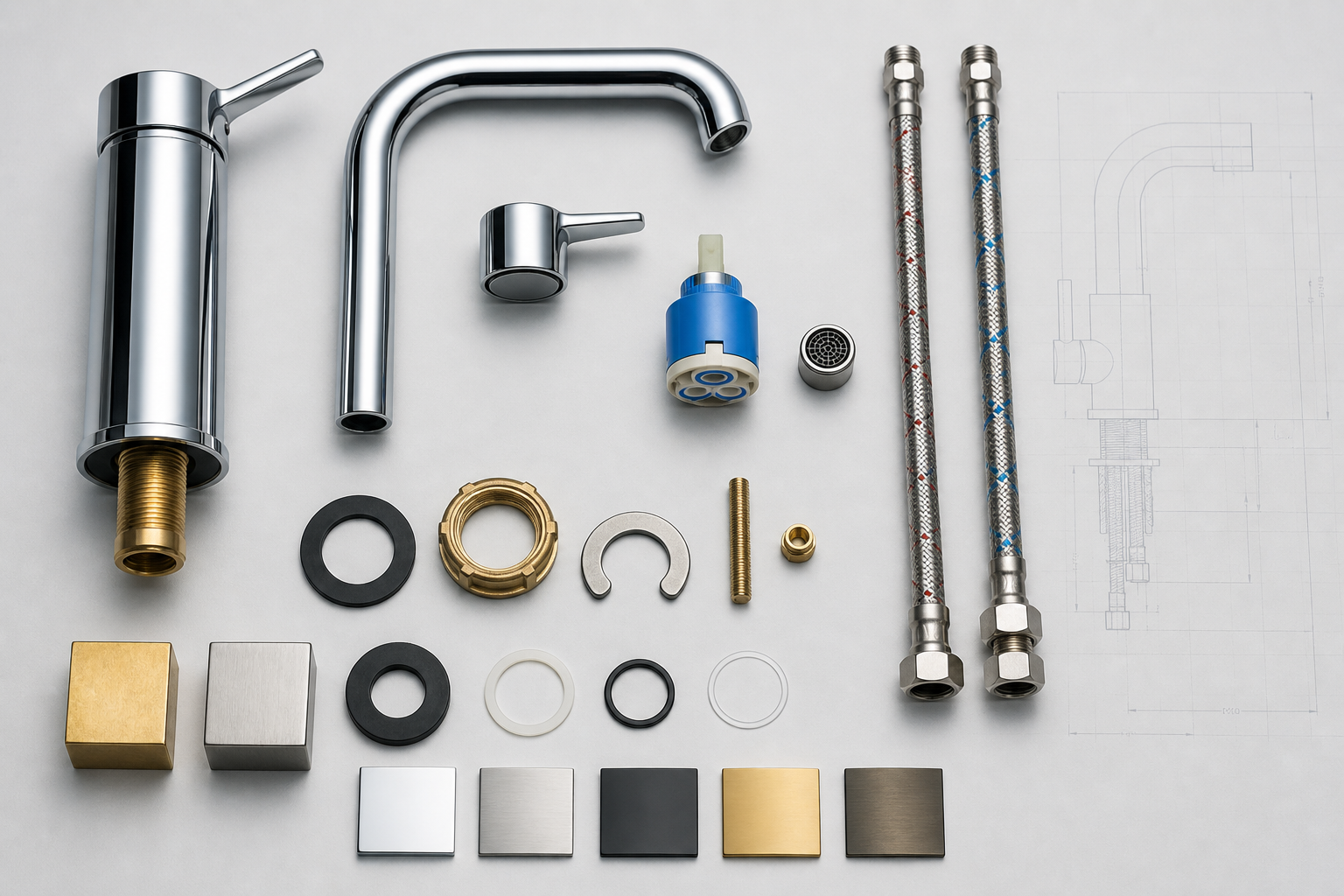
1. What Is a Faucet Specification Sheet?
A faucet specification sheet is a controlled document defining what the supplier must manufacture and how the buyer will determine whether the finished product is acceptable.
It should connect five areas:
-
Product identity
-
Engineering requirements
-
Material and component requirements
-
Performance and compliance requirements
-
Inspection and commercial acceptance requirements
A marketing product page describes the product’s benefits. A technical drawing defines dimensions. A bill of materials lists components. An inspection plan defines how production will be checked.
A professional faucet specification sheet connects these documents through one model number and revision.
Who should use one?
This guide is particularly useful for:
-
Private-label faucet brands
-
Importers and wholesalers
-
Hotel and apartment project buyers
-
E-commerce brands
-
Regional distributors
-
OEM and ODM product managers
-
Purchasing and quality-control teams
A detailed specification may not be necessary for a one-time purchase of a few stock products. However, the buyer should still confirm the model, material, finish, connection, flow rate and market compliance in writing.
2. Define the Market and Application First
Do not start with body material or finish. Start with where and how the faucet will be used.
Record:
-
Destination country or region
-
Residential, hospitality or commercial application
-
Kitchen, basin, bathtub, shower or service-sink use
-
Private-use or public-use installation
-
Expected operating frequency
-
Hot and cold water conditions
-
Typical supply pressure
-
Water-quality concerns
-
Indoor or exposed environment
-
Required service life
-
Applicable plumbing code
-
Required certification or listing
These fields affect almost every later decision.
For example, a residential bathroom faucet, public washroom faucet and commercial kitchen faucet can require different flow targets, durability expectations, outlet designs and serviceability.
The U.S. EPA WaterSense bathroom faucet guidance also distinguishes private lavatory faucets from kitchen and public lavatory products. Do not assume that one efficiency label or flow criterion applies to every faucet category.
3. Establish Product Identity and Configuration
Every document should use the same unique product identification.
Include:
| Field | Example of what to define |
|---|---|
| Buyer model number | Permanent internal SKU |
| Supplier model number | Cross-reference to factory SKU |
| Product category | Kitchen, basin, shower or commercial |
| Configuration | Single-handle, two-handle or sensor |
| Installation | Deck-mounted, wall-mounted or top-fixed |
| Number of holes | One, two, three or project-specific |
| Water supply | Hot/cold mixer or cold-only |
| Finish code | Controlled buyer finish reference |
| Drawing revision | Current approved engineering revision |
| BOM revision | Current approved component revision |
| Packaging revision | Current approved packaging version |
Avoid vague descriptions such as “modern brass kitchen faucet.”
The model number should connect the quotation, drawing, sample report, bill of materials, test record, product certificate, packaging artwork, purchase order and inspection report.
If two configurations use different cartridges, hoses, aerators or mounting systems, they should have separate model numbers or clearly controlled variant codes.
4. Specify Dimensions and Installation Requirements
Overall height alone is not enough to determine whether a faucet fits its intended sink or countertop.
Record at least:
-
Overall faucet height
-
Spout height
-
Spout reach
-
Outlet angle
-
Spout rotation range
-
Base diameter
-
Required mounting-hole diameter
-
Maximum and minimum deck thickness
-
Thread size and thread length
-
Space needed below the deck
-
Handle clearance
-
Pull-out hose length, where applicable
-
Supply-hose length
-
Inlet connection
-
Distance between inlets for wall-mounted models
-
Maximum projection from the wall
-
Installation-tool requirements
Also state the tolerance for each critical dimension.
Dimensions affecting sealing, cartridge seating, mounting stability and threaded connections normally require tighter control than nonfunctional cosmetic dimensions.
Check the faucet against the sink
The specification should connect the faucet with:
-
Sink depth
-
Sink width
-
Number of bowls
-
Faucet-hole position
-
Drain location
-
Intended water landing point
-
Cabinet clearance
-
Backsplash clearance
A high-arc faucet with excessive reach can cause splashing. A short spout may discharge too close to the rear wall of the basin. A pull-down hose can interfere with cabinet shelves or stored objects.
Request a controlled dimensional drawing rather than relying only on product photographs.
5. Create a Component-Level Bill of Materials
A material description such as “brass faucet” does not explain which components are brass.
A faucet may combine brass, stainless steel, zinc alloy, engineering plastic, ceramic, rubber and plated components.
The bill of materials should identify:
| Component | Specification fields |
| Faucet body | Material grade, forming process and water-contact status |
| Spout | Material, construction and rotation design |
| Handle | Material and attachment method |
| Cartridge | Type, diameter, supplier and performance requirement |
| Waterways | Material and potable-water requirement |
| Aerator | Flow rating, thread and spray type |
| Supply hoses | Length, connection, braid and inner-tube material |
| Pull-out hose | Length, construction and cycle requirement |
| Spray head | Material, modes and check-valve requirement |
| Seals | Material and approved application |
| Fasteners | Material and corrosion protection |
| Mounting kit | Components, material and installation method |
| Decorative cover | Material and finish |
| Packaging | Inner protection and carton construction |
For metallic components, specify the required alloy or recognized material standard where necessary.
For critical materials, request:
-
Material certificate
-
Approved supplier
-
Incoming-inspection method
-
Batch identification
-
Alloy-analysis record
-
Restricted-substance evidence
-
Change-notification requirement
Separate lead content from health-effects testing
For products conveying drinking water, “lead-free” must be defined by the applicable market requirement.
NSF/ANSI/CAN 372 addresses lead-content calculation and verification. NSF explains that this standard addresses lead content only; other requirements may also call for extraction or leaching evaluation, such as NSF/ANSI/CAN 61.
Therefore, the specification should not treat “NSF 372,” “NSF 61” and a generic alloy report as interchangeable evidence.
State:
-
Applicable standard
-
Required certification or test
-
Certificate holder
-
Manufacturing location
-
Covered model
-
Wetted components
-
Report or listing number
-
Required validity at shipment
6. Define the Cartridge and Control System
The cartridge is one of the most important functional components in a faucet.
Specify:
-
Ceramic or alternative cartridge type
-
Cartridge diameter
-
Single-lever or two-handle design
-
Hot/cold mixing range
-
Rotation direction
-
Opening angle
-
Torque or operating-force requirement
-
Temperature-limiting feature, if required
-
Pressure-balancing or thermostatic function, if applicable
-
Supplier or approved equivalent
-
Lifecycle requirement
-
Leakage acceptance criterion
-
Replacement availability
Avoid writing only “high-quality ceramic cartridge.” That description cannot be objectively inspected.
If the buyer approves a named cartridge supplier, state whether substitutions are prohibited or require written approval. If equivalent components are permitted, define the technical evidence needed to establish equivalence.
For hotel and project supply, also define the number of replacement cartridges required and how long compatible spares must remain available.
7. Specify the Aerator, Spray Head and Flow Rate
Flow rate must always be connected to test pressure.
Include:
-
Maximum flow rate
-
Minimum acceptable flow, if relevant
-
Test pressure
-
Water temperature
-
Tolerance
-
Aerator or flow-controller model
-
Aerated or laminar stream
-
Spray modes
-
Mode-switching behavior
-
Flow stability at lower pressure
-
Destination-market marking
-
Replacement-aerator availability
Do not specify only “water saving” or “saves 30%.”
A percentage claim requires a defined baseline product, pressure, measurement method and product configuration.
The EPA currently describes WaterSense-labeled private lavatory faucets as independently certified for efficiency and performance. Its product specification page should be checked for the current scope and status before the buyer adds WaterSense requirements.
Kitchen, public lavatory, metering and commercial faucets may have different requirements. Define the product application before selecting a flow target.
8. Control Finish, Color and Surface Quality
A finish name is not a complete finish specification.
“Brushed gold,” “matte black” and “brushed nickel” can vary significantly among suppliers and production batches.
Define:
-
Finish name
-
Buyer finish code
-
Base material
-
Surface-preparation process
-
Coating or plating system
-
Approved physical color sample
-
Gloss range, when relevant
-
Brushing direction and texture
-
Acceptable color variation
-
Coating-thickness requirement
-
Adhesion requirement
-
Visual-defect criteria
-
Corrosion-test requirement
-
Cleaning and maintenance limitations
Use a signed physical limit sample rather than relying only on digital color values or photographs.
The inspection standard should describe acceptable and unacceptable:
-
Scratches
-
Pits
-
Plating burns
-
Color differences
-
Exposed base material
-
Water marks
-
Burrs
-
Uneven brushing
-
Coating contamination
-
Assembly gaps
Do not convert salt-spray hours into service life
ISO 9227:2022 defines several artificial-atmosphere salt-spray test methods.
ISO specifically notes that these tests are useful for detecting coating defects but are not intended to predict long-term corrosion resistance in real service conditions.
A proper requirement should identify:
-
Test method
-
Test atmosphere
-
Sample preparation
-
Exposure period
-
Evaluation area
-
Permitted defects
-
Acceptance criterion
-
Applicable product finish
Avoid writing only “passes 24/48/96-hour salt spray.”
9. Define Functional and Durability Testing
A test requirement should contain four parts:
-
Test method
-
Test conditions
-
Acceptance criterion
-
Required evidence
A useful faucet test matrix may include:
| Test | Conditions to define | Acceptance to define |
| Static pressure | Pressure, duration and water temperature | No leakage or permanent damage |
| Dynamic pressure | Flowing pressure and duration | Stable function and no leakage |
| Seal test | Open/closed positions and test medium | Permitted leakage level |
| Flow test | Pressure and product configuration | Required flow range |
| Cartridge cycling | Cycle count, speed, pressure and temperature | No functional failure or leakage |
| Spout rotation | Angle, load and number of cycles | Smooth movement and no leakage |
| Pull-out hose cycling | Extension, bending and cycle conditions | No rupture, leakage or excessive wear |
| Spray-switch testing | Pressure and cycle method | Reliable switching and retention |
| Mounting strength | Applied force or torque | No loosening or damage |
| Coating adhesion | Method and evaluated area | No prohibited peeling |
| Corrosion testing | Method, atmosphere and duration | Defined defect limit |
| Packaging testing | Drop sequence, vibration or compression | Product remains protected |
For North American programs, ASME A112.18.1/CSA B125.1 is an important supply-fitting standard covering categories such as kitchen, lavatory, shower and commercial pre-rinse fittings.
The buyer should identify the correct current edition and applicable clauses with its compliance adviser or certification body.
Do not copy a test condition from another faucet category without confirming that it applies to the product.
10. Build a Market-Specific Compliance Matrix
A factory-level certificate does not automatically establish compliance for every product manufactured at that factory.
Create a matrix containing:
| Compliance field | Required information |
| Destination market | Country, state, province or project jurisdiction |
| Standard or regulation | Full designation and edition |
| Evidence type | Certificate, listing or laboratory report |
| Certificate holder | Exact legal entity |
| Factory | Covered manufacturing location |
| Model | Exact covered model or family |
| Material | Covered product construction |
| Finish | Covered finish where relevant |
| Issue and expiry dates | Current validity |
| Verification source | Official directory or issuing body |
For North American products, model listings may be checked through directories such as:
A website logo or certificate image is not sufficient if the buyer cannot match it to the exact model, certificate holder and manufacturing location.
For CE, WaterMark, SNI or other regional requirements, obtain market-specific professional guidance and current supporting documents before shipment.
11. Approve a Golden Sample and Control Changes
The final approved sample should be connected to the same controlled documents used for production.
A golden-sample record should include:
-
Buyer model number
-
Supplier model number
-
Drawing revision
-
BOM revision
-
Finish code
-
Physical color reference
-
Cartridge specification
-
Aerator specification
-
Hose specification
-
Packaging revision
-
Sample test results
-
Approval date
-
Buyer approval
-
Supplier approval
The manufacturing agreement should require written approval before changing:
-
Material or alloy
-
Cartridge
-
Aerator
-
Hose
-
Seal
-
Component supplier
-
Plating supplier
-
Coating process
-
Tooling
-
Manufacturing location
-
Packaging material
-
Product marking
If a change affects compliance, the supplier should evaluate whether retesting or certification updates are required.
12. Define Packaging, Marking and Spare Parts
Packaging is part of the specification—not a separate afterthought.
Include:
-
Individual product protection
-
Bag and foam requirements
-
Molded pulp or insert design
-
Separation of metal components
-
Hose and accessory positioning
-
Inner-box dimensions
-
Master-carton dimensions
-
Carton construction
-
Maximum carton weight
-
Pallet requirements
-
Moisture protection
-
Required manuals
-
Installation instructions
-
Barcode
-
Model label
-
Batch code
-
Country-of-origin marking
-
Certification marking
-
Spare-parts packaging
For e-commerce distribution, define parcel-delivery testing and cosmetic acceptance after testing.
For project supply, package replacement components so maintenance staff can identify them without opening multiple faucet cartons.
Also specify the required spare-parts ratio for:
-
Cartridges
-
Aerators
-
Hoses
-
Spray heads
-
Mounting kits
-
Seals
-
Finish-matched components
13. Turn the Specification Into a Comparable RFQ
Send the same controlled faucet specification sheet to every shortlisted supplier.
Ask each supplier to complete a compliance response using these categories:
-
Complies
-
Complies with clarification
-
Alternative proposed
-
Does not comply
-
Information required
Require suppliers to identify every deviation before quoting.
The quotation should separate:
-
Product price
-
Tooling
-
Samples
-
Testing
-
Certification
-
Packaging
-
Spare parts
-
Inspection
-
Freight-related charges
This makes quotations more comparable and prevents an apparently low price from excluding important materials, tests or packaging.
Working with AQ Bath
AQ Bath’s public product collection covers categories including top-fixed, brass-series, commercial kitchen, basin, bathtub, kitchen and shower faucets.
Buyers can also review:
Public product pages are useful for creating an initial shortlist. However, the final purchasing specification should be based on the latest approved drawing, BOM, test evidence and model-specific certification—not only a category name or marketing description.
When requesting an OEM or ODM quotation, send AQ Bath:
-
Destination market
-
Product application
-
Reference model or drawing
-
Estimated annual quantity
-
Initial order quantity
-
Material requirements
-
Finish requirements
-
Flow target
-
Compliance requirements
-
Packaging requirements
-
Sample schedule
-
Target shipment date
Frequently Asked Questions
1. What is the difference between a faucet specification sheet and a technical drawing?
A technical drawing primarily defines dimensions, geometry and tolerances. The specification sheet also covers materials, components, performance, certification, packaging, testing and acceptance criteria.
2. Should the buyer or manufacturer prepare the specification?
The manufacturer may provide a draft, but the buyer should approve and control the final purchasing requirements. Technical fields requiring factory input should be completed collaboratively.
3. How detailed should the bill of materials be?
It should be detailed enough to prevent unapproved substitutions. Critical components such as the body, cartridge, aerator, hoses, seals and mounting system should always be identified.
4. Is “solid brass faucet” an adequate material requirement?
No. The specification should identify which components are brass, the applicable material grade, which parts contact water and what evidence is required.
5. How should flow rate be specified?
State the target flow, tolerance, test pressure, temperature where relevant, faucet configuration and measurement method. Do not state only a percentage water-saving claim.
6. Should I specify a cartridge brand?
Specify a brand when it is necessary for performance, certification or spare-parts consistency. Otherwise, define measurable requirements and an approved-equivalent process.
7. What is a golden sample?
A golden sample is the signed physical reference for appearance, assembly and function. It should be connected to controlled drawing, BOM, finish and packaging revisions.
8. Does a salt-spray result predict real bathroom life?
No. Salt-spray testing can reveal coating defects under defined laboratory conditions, but it does not directly predict service life in every real environment.
9. How do I prevent material changes after sample approval?
Use a controlled BOM and require written approval before the supplier changes any specified material, component, supplier, process or manufacturing location.
10. What should I send when requesting a faucet quotation?
Send the intended market, application, dimensions, materials, components, flow requirements, finish, certification, quantity, packaging, inspection requirements and schedule.
Final Buyer Checklist
Before releasing an order, confirm that the specification contains:
-
Unique model and revision
-
Destination market and application
-
Controlled dimensional drawing
-
Component-level BOM
-
Cartridge specification
-
Aerator and flow requirement
-
Finish and physical limit sample
-
Test methods and acceptance criteria
-
Model-specific compliance evidence
-
Golden-sample approval
-
Change-control requirements
-
Packaging and labeling
-
Spare-parts plan
-
Inspection and defect criteria
-
Approved production and shipment schedule
Conclusion
A strong faucet specification sheet replaces assumptions with measurable requirements. It gives purchasing, engineering, quality and manufacturing teams the same definition of an acceptable product.
The goal is not to create the longest possible document. The goal is to control the requirements that affect installation, safety, performance, appearance, compliance, packaging and long-term service.
Before approving tooling or mass production, connect the quotation, drawing, BOM, golden sample, test plan and certification evidence through one controlled product revision.