
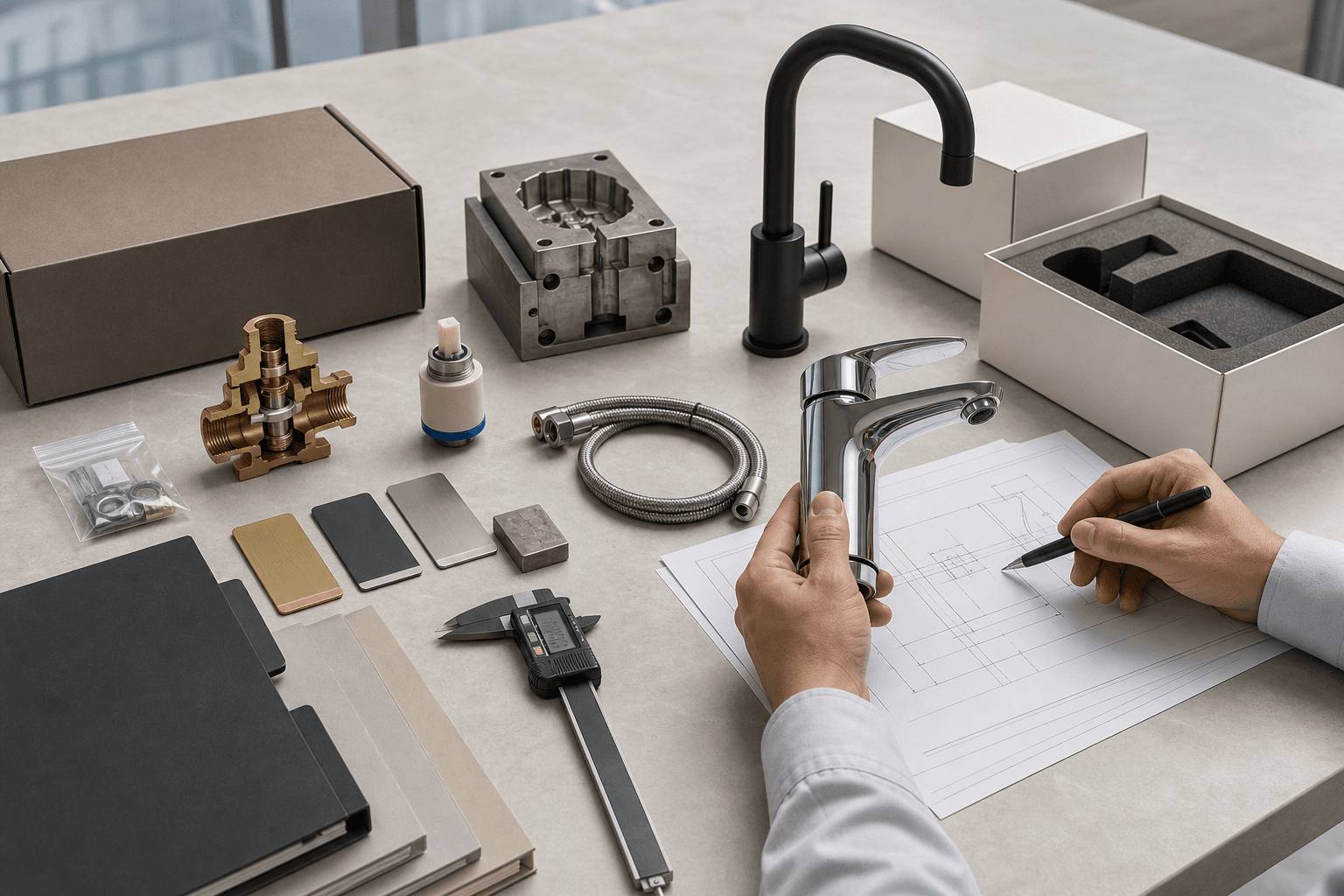
How to Choose a Faucet OEM Manufacturer in China: 12 Checks
Selecting a faucet supplier is not only a price comparison. Choosing a faucet OEM manufacturer in China means approving a legal entity, production system, technical team, quality controls, compliance route, and service relationship. This guide explains how to evaluate a faucet OEM manufacturer in China through 12 evidence-based checks before tooling, samples, or mass production are approved.
The framework is designed for faucet brands, importers, wholesalers, project suppliers, and product managers. It also establishes clear evidence boundaries: website claims can identify capabilities worth investigating, but legal records, certificates, test reports, drawings, signed samples, and contracts must confirm what applies to the selected company and SKU.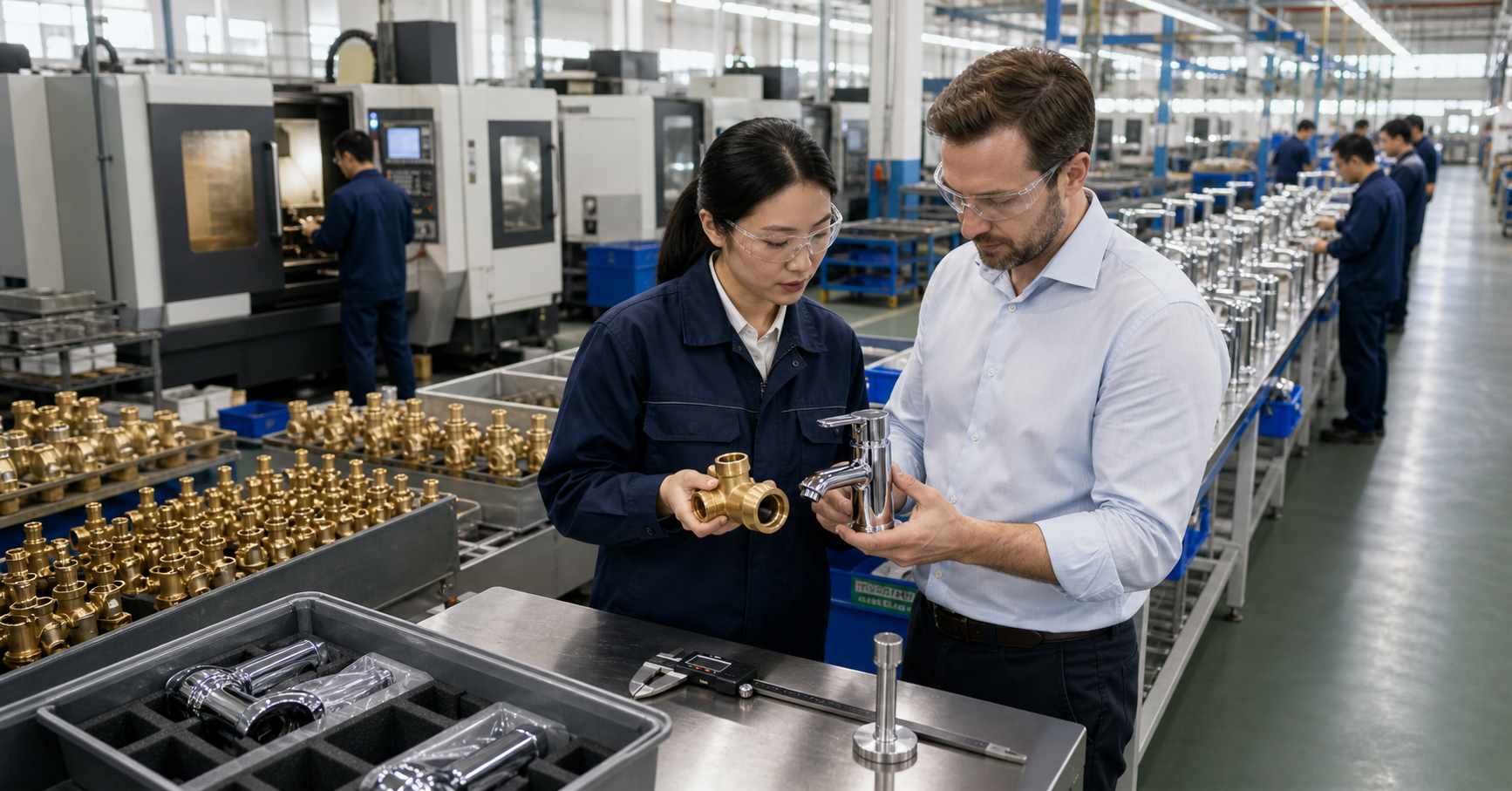
Quick Answer: What Should You Verify First?
Start with four questions:
-
Is the contracting company the same legal entity that owns or controls the factory?
-
Can the factory demonstrate that it makes and tests the faucet category you need?
-
Do certificates and reports cover the correct entity, address, model, material, standard, and validity period?
-
Can the supplier control drawings, samples, components, changes, traceability, packaging, and corrective action throughout production?
A low quotation cannot compensate for an unclear legal identity or uncontrolled specification, and a polished factory presentation does not prove that one SKU meets your requirements. The table summarizes the 12 checks for a faucet OEM manufacturer in China.
| No. | Due-diligence check | Minimum evidence |
|---|---|---|
| 1 | Legal identity and contracting entity | Business license, registered name, address, unified social credit code |
| 2 | Quality-management scope | Current certificate, scope, site address, issuing and accreditation bodies |
| 3 | Real manufacturing scope | Process map, equipment list, production walk-through, subcontractor disclosure |
| 4 | Materials and critical components | BOM, material grade, supplier list, incoming inspection records |
| 5 | Engineering and tooling control | Revision-controlled drawings, tooling agreement, ownership and maintenance terms |
| 6 | Sample approval | Golden sample, signed approval record, deviations and test plan |
| 7 | Quality control and testing | Control plan, inspection instructions, calibrated equipment, test records |
| 8 | Product compliance | Model-level certificates and reports for the destination market |
| 9 | Capacity and delivery | Capacity calculation, bottleneck analysis, lead-time assumptions, contingency plan |
| 10 | Traceability and change control | Lot code, material records, deviation approval, engineering change procedure |
| 11 | Packaging and logistics | Packaging specification, drop or transit validation, labeling and loading plan |
| 12 | IP, commercial terms, and service | NDA, tooling/IP clauses, warranty, spare parts, claims and corrective action |
Use the phrase “faucet OEM manufacturer China” as a search starting point, not as a qualification result. The shortlist becomes meaningful only after these records are checked.
Checks 1–2: Legal Identity and Management-System Evidence
Check 1: Verify the Legal Entity
Obtain the Chinese business license and record the registered name, unified social credit code, legal representative, address, business scope, and status. Match them to the quotation, bank account, invoice, contract, website, and export documents.
China’s official National Enterprise Credit Information Publicity System supports searches by company name or unified social credit code and publishes market-subject credit information.
If a trading company contracts while another entity operates the factory, document who controls engineering, components, tooling, production release, final inspection, payment, and warranty. Trading is not automatically unacceptable; hidden responsibility is the risk.
Check 2: Separate System Certification From Product Approval
Request the full management-system certificate: number, legal entity, site, standard, scope, dates, certification body, and accreditation mark. Confirm its status through the certification or accreditation source.
ISO develops standards but does not issue certificates, and its official certification guidance directs users to accredited-certificate verification resources. ISO 9001 concerns a management system, not every faucet made at the site; product-specific evidence remains necessary.
Checks 3–4: Manufacturing Scope and Material Control
Check 3: Confirm Which Processes Are In-House
Map the product from raw material to shipment. Casting, forging, die casting, tube forming, machining, polishing, finishing, assembly, testing, and packaging may occur at different sites.
Require the faucet OEM manufacturer in China to mark each step as in-house, performed at another company site, outsourced, or purchased as a finished component. Audit the highest-risk steps. Outsourced plating, castings, hoses, cartridges, and spray components still require documented approval, inspection, traceability, and change notification.
AQ Bath’s About Us page lists capabilities in product and mold design, brass casting, zinc-alloy die casting, forging, welding, pipe bending, cold stamping, precision machining, polishing, electroplating, and several inspection methods. These are useful audit leads, not proof that every process is used for every SKU.
Check 4: Lock Materials and Critical Components
A product name such as “brass faucet” does not identify every component. The body, handle, spout, waterways, cartridge, aerator, hose, seals, fasteners, mounting hardware, and finish layers may use different materials.
Control material grades, approved manufacturers and part numbers, finish codes and color limits, regulatory restrictions, incoming checks, supplier documents, and substitution rules in the BOM.
For “lead-free,” corrosion resistance, or cartridge-life requirements, state the standard, method, sample, acceptance limit, and model. Reject claims that cannot be linked to a report and production lot.
Checks 5–6: Engineering, Tooling, and Sample Approval
Check 5: Control Drawings and Tooling Ownership
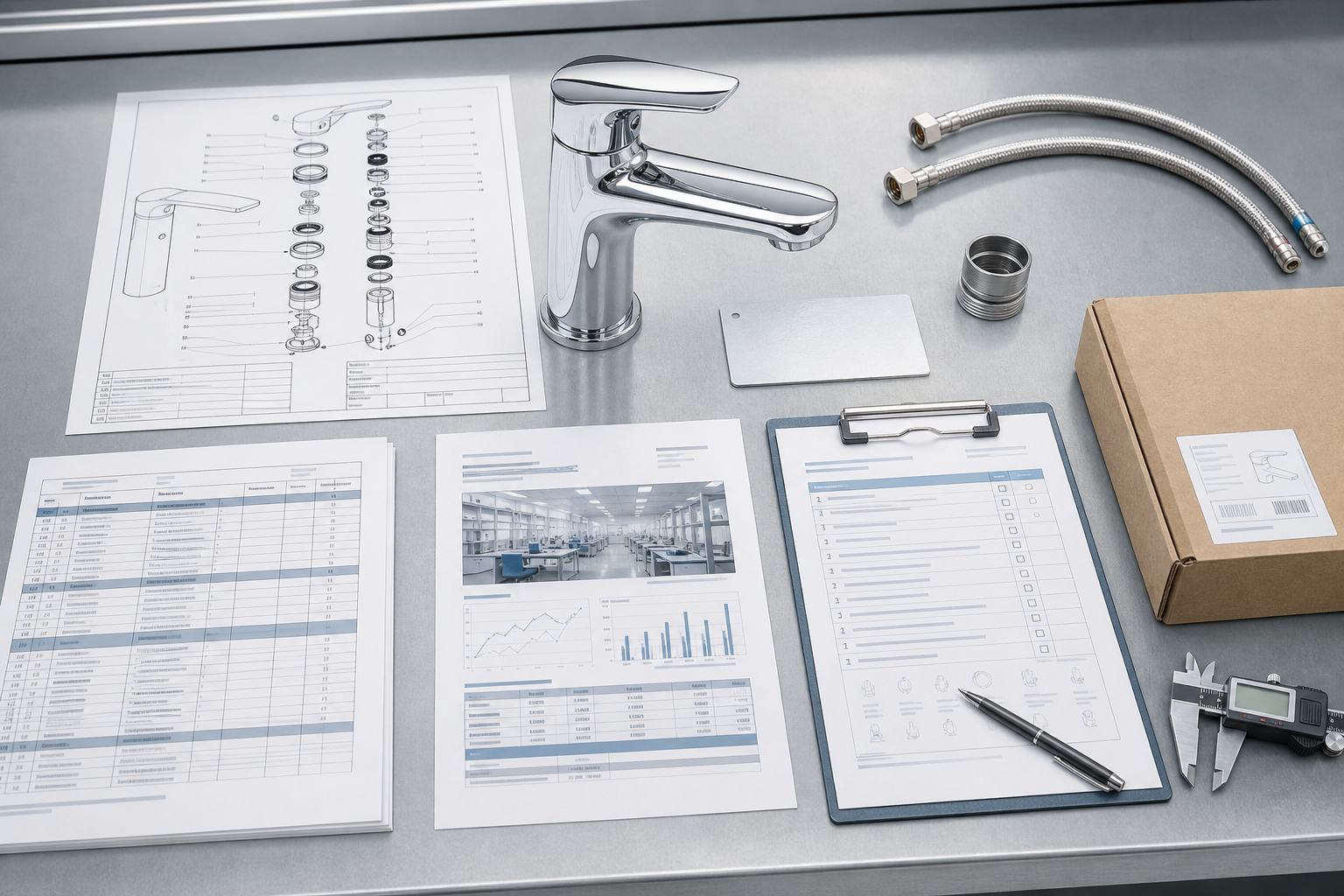
The buyer and supplier should work from one revision-controlled technical package. It may include assembly drawings, critical dimensions, exploded views, BOM, finish specification, logo placement, packaging artwork, and inspection characteristics.
For custom molds or fixtures, define payment, ownership, permitted use, storage, identification, maintenance, repair, access to records, and transfer or disposal at termination. The faucet OEM manufacturer in China should show how obsolete revisions are removed from purchasing, production, inspection, and packaging.
Check 6: Approve a Golden Sample
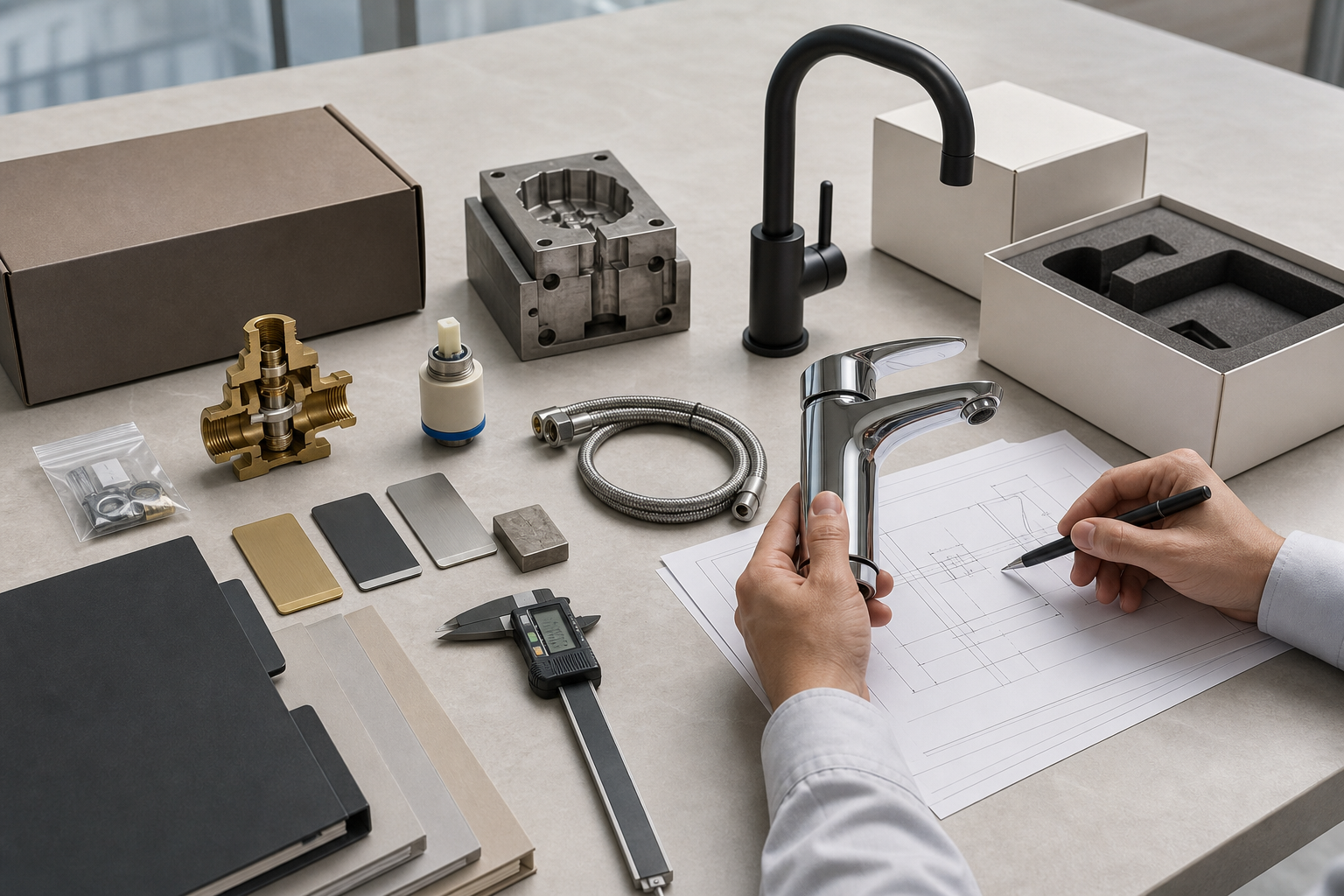
A visual sample alone is insufficient. Tie the approved sample to the drawing revision, BOM, finish, tests, packaging, and written deviations. Record approval responsibility and checked characteristics, and retain controlled samples at both locations when practical. Document temporary tooling or non-production components and require a production-intent sample before release.
Checks 7–8: Quality Controls and Product Compliance
Check 7: Audit the Control Plan and Test Evidence
The supplier should connect each important risk to a control method. Review incoming, in-process, final, and reliability checks rather than asking only whether the factory has “QC.”
Depending on the faucet and market, evidence may include material identification, dimensions, coating or finish checks, hardness, leakage, pressure, flow, operation, lifecycle, salt-spray exposure, assembly torque, appearance, and packaging inspection. The exact list and acceptance limits must come from the approved specification.
For each important test, verify the method, standard, equipment and calibration, sample frequency, conditions, acceptance criteria, record retention, and failure reaction. AQ Bath lists spectral analysis, coating testing, 3D image measurement, hardness, lifespan, leakage, and salt-spray capabilities. Buyers should request the applicable procedure, equipment record, and model-level report instead of treating a capability as a performance guarantee.
Check 8: Verify Product Compliance by SKU
Company certificates, system certificates, and product certificates answer different questions. Create a compliance matrix with one row per quoted SKU and columns for destination market, required standard, certificate number, listed model, applicant or manufacturer, factory address, issuing organization, status, and expiry date.
Check the complete certificate or listing, not a catalogue logo. Confirm that model variants, finishes, flow configurations, connections, and components remain in scope. AQ Bath’s website displays several management and product-related certification references, but does not establish that every mark covers every product. Approval remains conditional on a valid certificate and exact SKU scope.
Checks 9–10: Capacity, Traceability, and Change Control
Check 9: Test the Capacity and Delivery Assumptions
Request a product-specific capacity calculation covering equipment, shifts, cycle time, yield, changeover, maintenance, labor, subcontracting, inspection, packaging, and peak-season constraints. Compare it with the schedule and current commitments. Identify the bottleneck and recovery plan, and define whether lead time starts at deposit, artwork, component, or sample approval. A responsible faucet OEM manufacturer in China explains assumptions instead of promising an unsupported number.
Check 10: Require Lot Traceability and Approved Changes
Define how a carton connects to production date, line, inspection, component batches, and material records. Trace a finished sample backward and a component lot forward. Prohibit unapproved changes to materials, suppliers, construction, process, tooling, finish, tests, labels, or site, and define evidence required for change approval. Records must remain readable and retrievable through the agreed retention period.
Checks 11–12: Packaging, IP, Commercial Terms, and Service
Check 11: Approve Packaging as Part of the Product
Packaging protects the finish, keeps components together, presents the brand, and supports customs and retail requirements. Approve the carton, inserts, bags, protective films, accessory layout, manual, labels, barcode, country-of-origin marking, master carton, pallet, and container-loading method.
Run packaging validation appropriate to the distribution route. A parcel e-commerce channel, mixed wholesale pallet, and full-container project shipment create different risks. Record packaging defects during pilot shipping and update the approved specification.
Check 12: Protect IP and Define After-Sales Responsibility
Use an NDA before sharing drawings, costs, prototypes, tooling concepts, or launch plans. WIPO’s trade-secret guidance identifies confidentiality agreements and access control as reasonable protection measures.
The manufacturing agreement should cover existing and new IP, tooling, artwork, trademarks, permitted production, third-party IP, overruns, subcontracting, termination, and return or destruction of information. Obtain jurisdiction-specific legal advice. Define warranty start, evidence, response, containment, root cause, corrective action, parts, remedy, freight, and escalation.
Build an Evidence Matrix Before Ranking Suppliers
Score evidence, not presentation quality. A simple three-level method works well:
| Evidence rating | Meaning | Purchasing action |
| Verified | Valid record matches entity, site, product, revision, and requirement | May proceed to next gate |
| Conditional | Evidence exists but scope, date, model, or production condition is incomplete | Close the gap before approval |
| Unverified | Verbal or marketing claim without traceable supporting evidence | Do not use as an approved requirement |
Add risk severity and owner to each open item. A missing packaging barcode may be easy to close; an unclear legal entity, unavailable product certificate, unauthorized material substitution, or disputed tooling ownership may stop the project.
This evidence matrix makes comparisons fair when one faucet OEM manufacturer in China offers a low price while another provides stronger control and documentation.
AQ Bath as a Due-Diligence Starting Point
AQ Bath identifies Ningbo Yinzhou Anqi Valve Co., Ltd. as established in 2006 and reports more than 100 employees. Its official site lists household, hotel, and commercial faucets plus related bathroom hardware, and describes design, mold, production, finishing, and quality-control capabilities. Its product catalogue shows product families and representative SKUs, including residential, top-fixed, U.S.-series, European-series, and commercial kitchen faucets.
These public facts can support a shortlist, but they do not replace the due-diligence package. Buyers should still obtain:
-
Current business license and contracting details
-
Current management-system certificates
-
SKU-level product certificates and reports
-
Process and subcontractor map
-
Controlled drawings, BOM, and sample plan
-
Capacity and lead-time calculation
-
Packaging and labeling specification
-
Warranty, spare-parts, IP, and change-control terms
AQ Bath’s official contact page provides the route for submitting product questions and RFQ information.
What to Do During a Factory Audit
Audit one proposed product from legal records through incoming inspection, storage, machining, finishing, assembly, testing, packaging, and shipment. Select records and samples yourself. Check calibration, trace a unit backward, observe a live test, and compare the production drawing with the approved revision.
Record findings, evidence, owners, due dates, and verification. Close major findings with documents, records, samples, tests, or follow-up—not promises. Remote audits should show live buyer-selected areas; consider an independent on-site audit for high-risk tooling or regulated products.
RFQ and Document Package to Request
Send each shortlisted faucet OEM manufacturer in China the same RFQ so quotations are comparable. Include:
-
Buyer company, destination market, channel, and application
-
Product drawings, reference samples, and required configurations
-
Forecast, order quantity, launch date, and delivery locations
-
Material, component, finish, performance, and compliance requirements
-
Inspection, testing, sample, and acceptance plan
-
Packaging, labeling, manual, and pallet requirements
-
OEM logo, artwork, color, and confidentiality requirements
-
Tooling ownership and development milestones
-
Required certificates, reports, and factory records
-
Spare-parts, warranty, claim, and corrective-action expectations
-
Requested cost breakdown, MOQ, payment, lead time, and validity
-
Rules for subcontracting, deviations, and engineering changes
Ask the faucet OEM manufacturer in China to identify every assumption, exclusion, optional cost, and unconfirmed requirement. A detailed quotation should reveal what will actually be supplied, not merely repeat the buyer’s request.
Frequently Asked Questions
1. What is the difference between faucet OEM and ODM?
OEM usually means manufacturing to a buyer-controlled product or specification. ODM generally includes more supplier-led design or an existing platform. Contracts should define ownership and responsibilities because the labels alone are not precise.
2. Is ISO 9001 enough to approve a faucet supplier?
No. It can support confidence in a quality-management system, but it does not certify each faucet. Buyers still need product specifications, controls, samples, test evidence, and market-specific approvals.
3. How can I verify a Chinese faucet company?
Check its business license and unified social credit code in China’s official enterprise information system. Match the legal name, address, bank account, contract, certificate holder, and factory relationship.
4. Should every manufacturing process be in-house?
Not necessarily. Outsourcing can be controlled successfully when subcontractors are approved, requirements are documented, lots are traceable, changes are restricted, and incoming or process verification is effective.
5. What should a golden sample include?
It should be tied to the drawing revision, BOM, finish, approved components, performance tests, packaging, and written deviations. Both sides should retain controlled approval evidence.
6. How do I verify faucet certificates?
Obtain the complete certificate and listing. Check legal entity, factory, model, variants, standard, issuing body, status, and expiry date through the relevant official or issuing source.
7. Who should own a custom faucet mold?
Ownership is a commercial decision, but payment, ownership, use restrictions, storage, maintenance, transfer, and end-of-contract disposal should be explicit in the signed agreement.
8. How can I reduce material-substitution risk?
Use an approved BOM and supplier list, incoming verification, lot traceability, reference samples, and a written change-approval process. Audit records and test selected production lots.
9. What is the best way to confirm production capacity?
Review a product-specific calculation and observe the bottleneck. Include equipment, cycle time, shifts, yield, maintenance, labor, subcontracting, testing, packaging, and current commitments.
10. What should I send AQ Bath for an OEM quotation?
Send the target market, product drawings or references, materials, finish, performance, certificates, quantity, forecast, packaging, branding, sample plan, tooling needs, launch schedule, and warranty expectations.
Approve the Evidence, Not the Sales Presentation
The best faucet OEM manufacturer in China is not simply the supplier with the lowest unit price, largest catalogue, or most certificates displayed online. It is the supplier whose legal entity, processes, materials, engineering documents, samples, tests, compliance scope, capacity, traceability, packaging, IP controls, and service commitments match your project.
Use the 12 checks as gated approvals. Close major evidence gaps before paying for tooling or authorizing mass production. To evaluate AQ Bath for an OEM/ODM project, send the company a controlled RFQ and request the exact factory, quality, certificate, sample, tooling, and commercial documents needed for your destination market and SKU.