
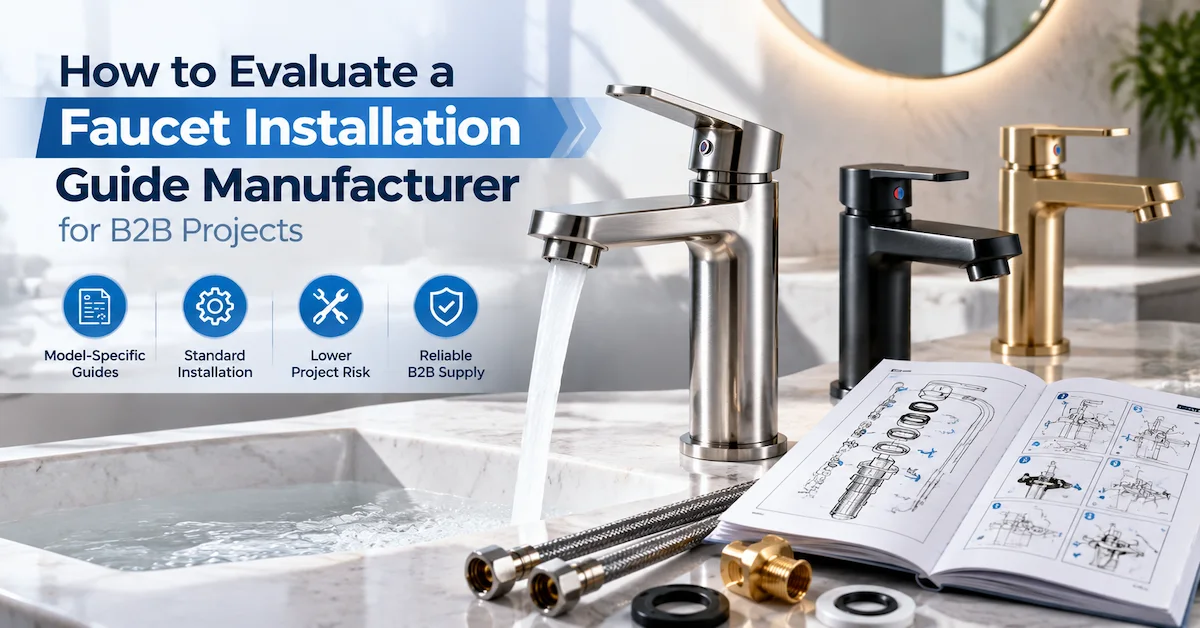

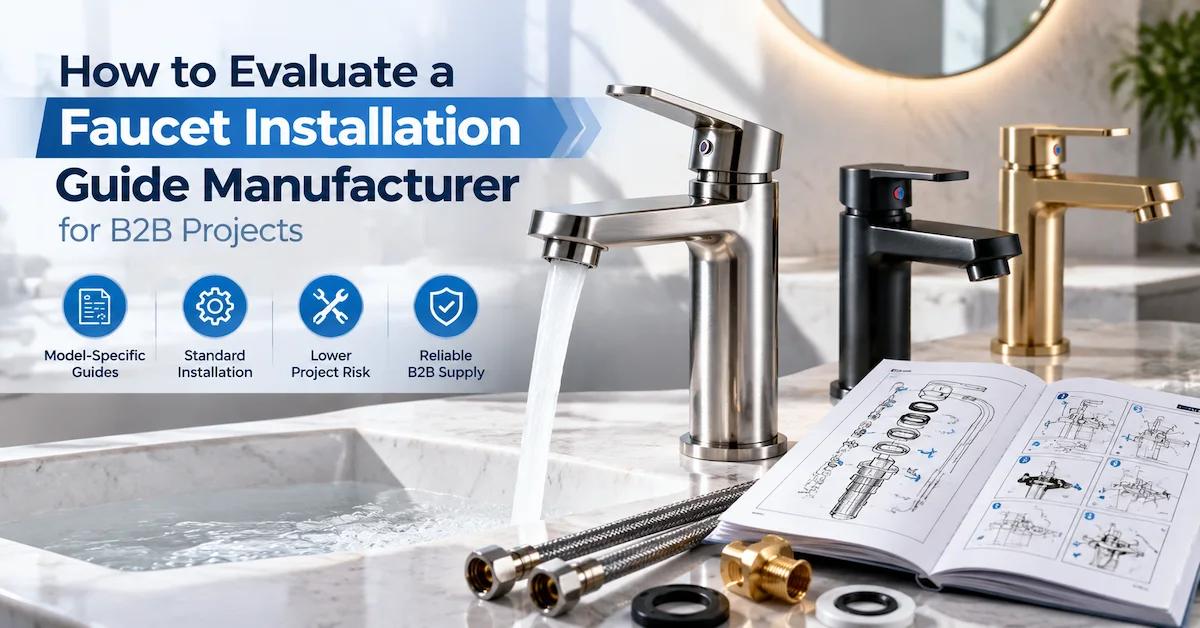
Short answer: A dependable faucet installation guide manufacturer should provide model-specific drawings, the approved mounting envelope, a complete parts list, connection details, installation sequence, flushing and leak-check steps, commissioning criteria, troubleshooting instructions, maintenance guidance and revision control. For a B2B project, the guide should also match the exact finish, accessory kit and production revision being quoted. A generic PDF with a product photograph is not enough to control installation across a hotel, restaurant, apartment or commercial washroom project.
This guide helps importers, faucet brands, distributors, contractors, hotel procurement teams and plumbing project managers evaluate installation documentation before approving a supplier. It treats the installation guide as a quality and project-control document, not just a leaflet placed inside a carton. The goal is to reduce wrong-hole orders, missing parts, connection errors, hidden leaks, installer guesswork and repeat site visits.
Why a manufacturer installation guide matters in B2B projects
Residential buyers can sometimes solve a small installation problem by replacing a washer or calling a local plumber. A project buyer cannot manage risk that way when the same faucet is installed in dozens, hundreds or thousands of rooms. One missing adapter, incorrect deck assumption or unclear hose route can be repeated by every installation crew. The result is not one isolated complaint. It becomes a pattern of rework, delayed handover, disputed responsibility and unplanned spare-parts demand.
A manufacturer installation guide is valuable because it connects the product design to the installation conditions the factory expects. It should tell the installer what the faucet is, what it is not, which components are included, where each component belongs, what site conditions must be checked and how the completed installation is accepted. When the guide is linked to a model number and revision, it also gives procurement and quality teams a common reference during sampling, production and after-sales service.
| Project risk | What a clear guide controls | Business consequence |
|---|---|---|
| The sink or countertop does not match the faucet base | Mounting-hole, deck-thickness and clearance requirements | Prevents site drilling, replacement orders and delayed room completion. |
| Installers cannot identify the correct hardware | Exploded parts diagram, labels and kit contents | Reduces missing-part calls and inconsistent assembly. |
| Supply lines are connected or routed incorrectly | Connection identity, hose routing and service clearance | Reduces cross-connection, kinking, leakage and maintenance access problems. |
| A leak is reported after handover | Flushing, pressure check, visual inspection and sign-off steps | Creates evidence about whether the issue is installation, component or product related. |
What a faucet installation guide manufacturer should document
Before comparing suppliers, define the minimum content your project requires. A professional installation file may contain several documents rather than one page: a dimensional drawing, parts list, step-by-step instruction, connection diagram, cleaning note, commissioning checklist and service-parts reference. The format can vary, but the information should be consistent and traceable.
1. Product identity and revision
The first page should identify the exact model, finish, configuration, language, issue date and document revision. If the same body can be supplied with different handles, spouts, spray heads, hoses or mounting kits, the guide should state which variant it covers. A photograph alone cannot identify a hidden connector or a revised fixing system.
Ask the supplier to show the relationship between the guide and the product drawing. The model number on the carton, product label, drawing, sample approval and installation guide should be consistent. For private-label programs, the buyer's brand name can appear on the document, but the factory model reference and revision should remain available for technical control.
2. Dimensional and installation envelope
A useful guide gives the installer the dimensions that affect fit, not only the overall height of the faucet. Depending on the model, this can include the mounting-hole diameter, deck thickness range, base footprint, spout reach, rotation envelope, backsplash clearance, wall clearance, hose length, connection position and required service space. If a parameter depends on the exact configuration, the guide should say so rather than present one universal value.
For an apartment or hotel program, add the sink, basin or countertop drawing to the approval package. The faucet guide and the project drawing should be reviewed together. A faucet can fit the hole and still collide with a backsplash, fail to rotate over the basin, leave no space for the mounting tool or place the hose connection where the cabinet cannot be closed.
3. Parts list and supplied accessories
Installation failures often begin with an unclear parts bag. The guide should show the faucet body, fixing hardware, seals, washers, nuts, supply hoses, adapters, weights, clips, spray components and any tools included with the exact SKU. Each item should be identifiable by a part number or an illustration that is unambiguous at the installation site.
Do not assume that a component shown in a marketing image is included in every quotation. Ask the supplier to separate standard parts, optional parts, project-specific parts and buyer-supplied parts. If a hose, adapter or shut-off connection is excluded, that exclusion should appear in the RFQ and the site work instruction.
4. Tools, preparation and safety controls
The guide should state the tools and preparation needed before the faucet is placed on the deck. This may include cleaning the surface, checking the hole, confirming the deck support, isolating the water supply, inspecting seals and protecting the finished surface. It should identify any tool that is supplied and any tool that the installer must provide.
A concise safety note is also important. The installer should know when the water supply must be isolated, how to avoid stressing a hose, which surfaces must not be scratched, and whether the system needs to be flushed before the aerator or spray component is installed. Safety text should be specific to the product and local site procedure rather than copied as a generic warning block.
5. Installation sequence and connection logic
The sequence should follow the physical order of the work. It should show how the faucet passes through the deck, how the upper and lower seals are positioned, how the mounting hardware is oriented, how the body is aligned, how the water connections are identified and how moving or pull-out components are routed. If the order changes for a top-access or restricted-access installation, the guide should explain the difference.
Connection diagrams should distinguish hot, cold, mixed, spray, filter or auxiliary connections where applicable. Use labels and arrows rather than relying on color alone because site lighting and camera images may make colors unreliable. The guide should also describe the condition of pipe ends, thread compatibility and the need to avoid twisting a hose while tightening a fitting.
6. Flushing, testing and acceptance
Installation is not complete when the faucet is tight on the deck. The guide should include a controlled commissioning sequence: flush the supply, open the water gradually, inspect each connection, operate the handle or valve through its range, check the spout or spray function, inspect the base and record the result. The exact pressure and duration should be confirmed by the manufacturer or project specification rather than invented by an installer.
Define what a pass means. A project checklist might record dry connections after the test, stable alignment, smooth handle operation, correct hot and cold orientation where relevant, complete drainage from the spout and no interference with the basin or backsplash. Photos of the installed connection area can help close disputes when a defect is reported after other trades have worked around the faucet.
How to evaluate an installation guide before approving the supplier
A document review should take place before the bulk order, not after the first installer discovers an omission. Ask the supplier to send the current guide, drawing, parts list and sample kit for the exact model and finish under discussion. Then review the documents in the same order an installer will use them.
When comparing a faucet installation guide manufacturer, review the document package as evidence of engineering control. The strongest supplier response connects the guide to the product revision, approved sample, installation kit and project site conditions instead of treating documentation as a generic marketing attachment.
Check the model-to-document chain
Compare the model code on the product page, quotation, carton label, drawing, installation guide and sample. Look for differences in handle count, spout length, mounting system, hose type, finish and included accessories. A small suffix can represent a meaningful change. If the supplier says two models use the same guide, ask which dimensions and components are identical and which require a separate appendix.
Check the drawing against the real sample
Place the approved sample beside the drawing and verify the visible interfaces: base, deck opening, supply connection, spout clearance and moving range. Measure the sample only as a verification exercise; the controlled drawing remains the contractual reference. If the sample does not match the drawing, stop approval and ask for a corrected revision. Do not allow the site team to resolve a document conflict through improvisation.
Check the guide from the installer's point of view
Give the document to an experienced installer who was not involved in writing it. Ask that person to identify the parts, explain the sequence and list any unanswered site question. This review often finds issues that a procurement reader misses: a washer that looks identical on both sides, an adapter that is shown but not named, an arrow that points to the wrong connection or a tool that cannot fit inside a completed cabinet.
Check service and replacement logic
A guide should remain useful after handover. It should identify removable parts, cleaning restrictions, service access and replacement references where the manufacturer has approved them. For project buyers, ask how the supplier will support a replacement years later if the original finish or connector changes. A clear part reference is more useful than a promise that spare parts are available.
Check change control
Installation documents can become obsolete when the factory changes a cartridge, hose supplier, fixing bracket, adapter, finish process or packaging kit. Request a written rule for changes that require document revision and buyer approval. For a private-label or multi-phase project, store the approved PDF with the purchase order and require notification before a revised component is shipped.
Installation evidence a manufacturer should provide for an RFQ
When a buyer sends an RFQ, the request should ask for installation evidence alongside price and delivery. This creates comparable quotations and reveals whether the supplier understands the installation environment. A supplier does not need to provide every document at the first email, but it should identify what is available, what is project-specific and what must be confirmed after the configuration is selected.
| RFQ request | Buyer should state | Manufacturer should return |
|---|---|---|
| Application | Hotel, restaurant, apartment, public washroom or other project use | Recommended configuration and installation assumptions |
| Site interface | Sink or basin drawing, hole size, deck thickness and clearance limits | Dimensional drawing, compatibility comments and open questions |
| Installation kit | Required hoses, adapters, seals, tools and labeling | Parts list, included items, exclusions and optional components |
| Commissioning | Leak check, flushing, operation and handover requirements | Installation and test procedure with acceptance criteria |
| Project documents | Language, branding, file format, revision and delivery timing | Current guide, drawing, labels and document-control information |
| Commercial assumptions | Quantity, sample date, installation mock-up and phased delivery | MOQ, lead-time assumptions, sample support and change-control route |
Ask suppliers to mark every answer as confirmed, available after configuration, buyer supplied, deviation or not confirmed. This prevents a blank line from being mistaken for compliance. It also helps procurement compare a lower unit price that excludes installation support with a more complete offer.
Discuss Installation Requirements with AQBath
Use actual product scenarios when reviewing the guide
An installation document should be tested against the product's intended environment. AQBath publishes the C0001CP commercial pre-rinse kitchen faucet for professional settings including restaurants, hotels, catering facilities and dishwashing areas. The public page describes a spray head and swing spout and discusses OEM/ODM cooperation. For this type of product, the installation review should cover the mounting body, supply connections, spray head, hose or support arrangement, swing-spout movement, clearance around the sink and cleaning access.
The public product page does not establish a universal installation dimension or a complete kit list for every order. A buyer should request the current drawing, installation guide, hose and connection specification, included accessories, finish and production revision for the exact C0001CP configuration. If a commercial kitchen uses a wall shelf, backsplash, pre-rinse riser or unusual sink deck, include those dimensions in the RFQ rather than asking the supplier to assume a standard layout.
For hospitality and commercial washroom projects, AQBath publishes the A0053-01 single-handle basin faucet with a brass body and a hospitality or commercial washroom application. The installation review should focus on basin-hole compatibility, deck thickness, fixing access, supply hoses, handle clearance, spout position, splash control and the service space below the vanity.
Again, the public product description is a starting point, not a substitute for the model drawing. The order-specific installation package should identify whether the supplied fixing hardware and hoses match the project's basin, countertop and local connection arrangement. The buyer should approve a physical sample or mock-up before repeating the configuration across rooms.
What the manufacturer evidence can and cannot prove
A company profile can show that a manufacturer has a relevant production scope. AQBath's public company information describes manufacturing processes such as lead-free brass casting, zinc alloy die casting, forging, welding, pipe bending, cold stamping, precision machining, polishing and electroplating. It also lists quality capabilities including material analysis, coating testing, dimensional measurement, hardness testing, lifespan testing, leakage testing and electroplating salt spray testing.
Those statements support initial supplier screening. They do not prove that a specific model has the dimensions, connectors, installation labor time or destination-market documentation required by a project. Ask for the current product documents and treat the factory profile, product page, sample, drawing and guide as separate evidence types that must agree before approval.
Create a controlled installation workflow for the project
The best installation guide becomes more valuable when the buyer turns it into a controlled workflow. The workflow should preserve the manufacturer's technical information while adding project-specific checks for the building, site team and handover process.
Gate 1: design and interface review
Before the sample arrives, compare the faucet drawing with the basin, sink, countertop, backsplash, cabinet and plumbing layout. Record the mounting hole, deck thickness, service clearance, connection positions and expected water conditions. Resolve any interface that is not dimensioned. A drawing with a missing hole tolerance is an open item, not an invitation to use the installer's best judgment.
Gate 2: sample and mock-up installation
Install the exact configuration on a representative mock-up. Use the intended mounting surface, supply arrangement, cabinet depth and accessory kit. Record the time for preparation, mounting, connection, flushing, inspection and correction separately. The purpose is not to promise a universal labor saving. The purpose is to identify the real work content and convert it into a repeatable method statement.
Gate 3: installer briefing and first-article check
Brief the installation crew using the controlled guide and a physical parts kit. Ask the first installer to explain the sequence before beginning. Inspect the first completed unit for alignment, connection identification, hose routing, leaks, operation and finish damage. Photograph the hidden connections as well as the visible faucet. Do not release a full crew until the first-article result is accepted.
Gate 4: batch and site release
For a phased project, check that each shipment uses the approved product revision and installation kit. Packaging labels should make it possible to separate models and finishes. A site team should not discover a revised bracket or adapter only after opening a carton. When the manufacturer changes a component, update the guide, mock-up approval and installer briefing before the new batch is installed.
Gate 5: handover and service record
Keep the final guide, approved drawing, inspection checklist and spare-parts reference with the project handover documents. Record the installed model and finish in the room or asset register. This makes later maintenance faster and helps distinguish a product issue from an installation issue. It also gives the buyer evidence when requesting corrective action from the supplier.
Common weaknesses in manufacturer installation instructions
Not every weak guide is obviously wrong. Some documents contain correct images but still fail to control a project because they omit the information that changes from one site to another. Use the following weaknesses as a review checklist.
| Weakness | Why it creates risk | Buyer response |
|---|---|---|
| The guide uses only a lifestyle photograph | The installer cannot identify hidden parts or interfaces. | Request a dimensional drawing and exploded parts diagram. |
| One guide covers several similar models without a variant table | The wrong hose, bracket or connection sequence may be used. | Require model-specific pages or a clear configuration matrix. |
| Accessories are shown but not marked as included | Procurement and site teams assume different kit contents. | Separate standard, optional and buyer-supplied items in the RFQ. |
| No flushing or final leak-check step | Debris and connection defects can reach handover. | Add a controlled commissioning checklist approved by engineering. |
| No revision or change history | The site may use an obsolete guide after a component change. | Link document revision to the purchase order and batch release. |
How to compare faucet manufacturers on installation support
Installation support is a supplier capability that can be compared, but it should not be reduced to whether a PDF exists. Ask each manufacturer to answer the same questions and score the evidence. A supplier that sends a lower price with no drawing, no kit list and no commissioning method may create more total project cost than a supplier whose quotation includes engineering clarification and a controlled installation package.
A project buyer should also ask whether the faucet installation guide manufacturer will update the document when the mounting kit, hose, connector or internal component changes. This question separates a controlled technical file from a one-time PDF that may no longer match the product shipped months later.
| Evaluation area | Strong response | Weak response |
|---|---|---|
| Model identity | Guide, drawing and sample use the same model and revision. | Supplier sends a generic file with no configuration reference. |
| Interface control | Explains dimensions, clearances, connections and site assumptions. | Tells the buyer to “check the site” without measurable criteria. |
| Kit control | Lists included, optional and buyer-supplied components. | Assumes the installer will source missing adapters. |
| Commissioning | Provides flushing, operation, leak inspection and sign-off steps. | Considers the installation complete once the faucet is tightened. |
| After-sales support | Provides parts references, troubleshooting and change notification. | Offers support only after a site-wide complaint appears. |
A strong installation package does not remove the buyer's responsibility to follow local plumbing rules or to verify the site. It does show that the manufacturer understands the product interfaces and is prepared to document them. That is a practical signal of engineering maturity and supply-chain reliability.
Questions to send with a faucet installation guide RFQ
Use these questions in the inquiry so the manufacturer can respond with product-specific information instead of a generic brochure.
- Which exact model, finish, handle, spout and accessory configuration does the installation guide cover?
- What are the mounting-hole diameter, deck-thickness range, base footprint and required service clearances?
- Which parts, seals, hoses, adapters, fixing hardware and tools are included in the quoted installation kit?
- Which items are optional, buyer supplied or dependent on the destination market?
- How are hot, cold, spray, filter or auxiliary connections identified?
- What flushing, operating and leak-check procedure should the installer follow?
- Which site conditions must be confirmed before the faucet is ordered?
- Does the guide include a revision number and a change-notification process?
- Can the supplier provide a drawing, parts list, guide and sample for a project mock-up?
- What MOQ, sample timing and lead-time assumptions apply to this model, finish and packaging?
- Which replacement parts and troubleshooting references will be available after handover?
- Who is the technical contact responsible for resolving an installation-document question?
Send the sink or basin drawing, countertop thickness, mounting-hole information, cabinet restrictions, destination market, quantity and installation schedule with the inquiry. A manufacturer can give a more useful answer when it can see the interface it must support.
FAQ about a faucet installation guide manufacturer
What should a manufacturer installation guide include?
It should identify the exact model and revision, show dimensions and site interfaces, list the supplied parts, explain preparation and installation sequence, identify connections, describe flushing and leak checks, and provide basic troubleshooting and maintenance information. For a B2B project, the guide should be linked to the approved drawing, sample, finish and accessory kit.
Is a generic faucet installation PDF acceptable for a project?
Only when the supplier proves that the models share the same mounting system, dimensions, connections and kit contents. Otherwise, a generic PDF creates ambiguity. Ask for a model-specific guide or a variant matrix that clearly identifies the differences.
What dimensions should be checked before ordering?
Check the mounting-hole diameter, deck thickness, base footprint, spout height and reach, rotation envelope, backsplash clearance, supply connection position, hose length and service space. The exact list depends on the model and site. Use the manufacturer's current drawing rather than relying on an online photograph.
Does an installation guide replace a professional installer?
No. The guide communicates the manufacturer's product requirements. The installer remains responsible for following applicable site rules, verifying the plumbing system, using appropriate tools and completing the required tests. The guide should make that work more consistent and auditable.
Why are parts lists important for faucets?
Faucets often combine seals, washers, nuts, hoses, adapters, weights, clips and decorative components that may look similar but have different functions. A parts list prevents the installer from substituting an unapproved item and helps procurement confirm what is included in the quotation.
What should a buyer do if the sample and guide disagree?
Pause approval and record the discrepancy. Ask the manufacturer to confirm whether the sample, drawing or guide is current. The corrected document should carry a revision and should be linked to the approved sample and purchase order. Do not allow each site to decide which version to use.
How should a commercial kitchen faucet guide differ from a basin faucet guide?
A commercial kitchen guide may need to address a spray head, swing spout, hose or support arrangement, operator clearance, heavy-use cleaning and a larger working area. A basin faucet guide may focus more on basin-hole fit, deck thickness, handle and spout clearance, cabinet access and vanity service space. The manufacturer should tailor the evidence to the product configuration and application.
Can AQBath provide installation support for an OEM project?
AQBath's public information describes OEM/ODM discussion for its faucet products and identifies manufacturing and quality capabilities. For a specific project, use the AQBath inquiry page to send the model, application, drawing, quantity, finish, destination market and required documents. Confirm the current installation guide, drawing, parts list and revision for the ordered configuration.
Should the buyer request installation photographs?
Photographs can help, especially for a mock-up or a hidden connection area, but they should support rather than replace the drawing and guide. Ask for clear images of the actual model and kit when a part or routing detail is difficult to understand. Keep the images linked to the model and revision.
What proves that an installation guide is ready for bulk use?
A representative mock-up, a completed first-article check, an accepted drawing, a verified parts kit, a controlled installation sequence, a completed leak and operation test, and a documented revision. A polished PDF alone does not prove that installers can repeat the process without rework.
Conclusion
Choosing a faucet installation guide manufacturer should be part of supplier qualification, not an afterthought after the cartons arrive. The right manufacturer provides a model-specific document chain: drawing, parts list, installation sequence, connection information, commissioning checks, service references and change control. The buyer then validates that package on a representative mock-up and carries the approved revision into batch release, site installation and handover.
The practical test for a faucet installation guide manufacturer is simple: can the buyer give the current documents to an installer and receive the same repeatable result across the project? If the answer depends on verbal explanations, unlabelled parts or site improvisation, the installation package is not complete.
AQBath's public information provides a reasonable starting point for a project conversation because Ningbo Yinzhou Anqi Valve Co., Ltd. / AG Valve publishes faucet manufacturing, OEM/ODM and quality-capability information, with products covering commercial kitchen and hospitality washroom applications. Final approval still requires written confirmation of the exact model, materials, dimensions, mounting kit, installation guide, test procedure, packaging, MOQ, lead time and destination-market requirements.