

Commercial Pre-Rinse Faucet Buying Guide: Spray Valve, Hose, Spring, and Spout
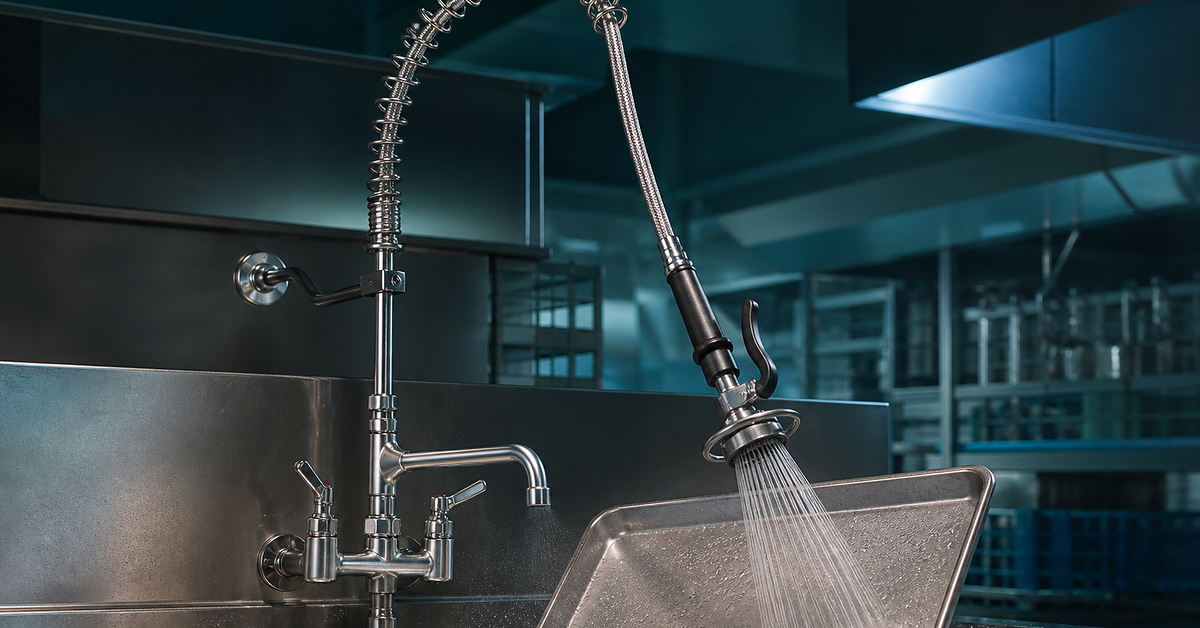
A commercial pre-rinse faucet is not simply a taller version of a residential kitchen faucet. It is a working system built around a handheld spray valve, flexible hose, overhead spring, mixing body, support bracket, and, on many configurations, a separate swing spout. Each component affects reach, operator comfort, cleanability, downtime, and the ability to fit the real warewashing station.
This commercial pre-rinse faucet buying guide helps restaurant operators, hotel procurement teams, foodservice equipment distributors, project contractors, and private-label buyers compare those components without relying on a product photograph alone. The correct choice begins with the sink, dishwashing workflow, water conditions, available wall support, connection standard, and local compliance requirements.
AQ Bath publicly lists C0001CP as a commercial pre-rinse kitchen faucet for heavy-duty OEM supply. Its product page positions the model with a high-pressure spray system, extended reach, a separate swing spout, and OEM/ODM options. However, the public page does not state the exact flow rate, spray force, hose length, dimensions, working pressure, component materials, or model-level certificate numbers. Confirm those fields for the selected SKU before quoting, publishing, or ordering. See the official AQ Bath C0001CP product page.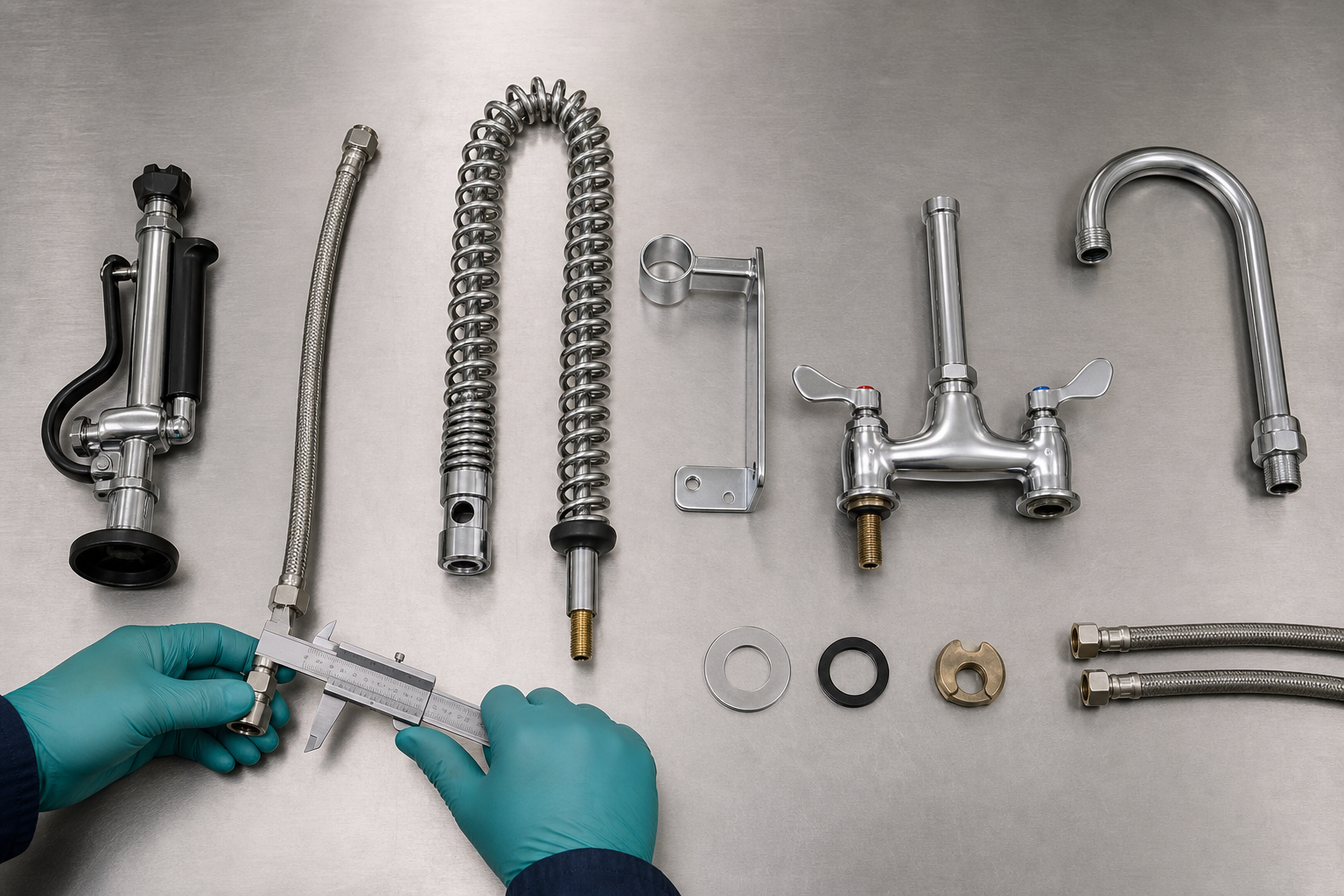
1. Start with the Warewashing Workflow
The first decision is not the faucet finish. It is what the operator must do during a normal shift.
A pre-rinse spray valve is primarily intended to remove food residue from dishes, trays, cookware, and utensils before commercial dishwashing or warewashing. The U.S. Department of Energy defines the device around a handheld, release-to-close valve used for this purpose.
Filling stockpots, washing floors, rinsing produce, and general sink filling are different tasks and may require a swing spout, add-on faucet, or separate wash-down product.
Map the workflow before selecting equipment:
- What items are rinsed: plates, hotel pans, sheet pans, pots, racks, or utensils?
- Where do dirty items arrive, get scraped, get rinsed, and enter the dishwasher?
- Is the station used continuously or only during peak periods?
- Does the operator need both high-coverage rinsing and controlled container filling?
- Can the hose reach every working corner without striking nearby equipment?
- Is there enough vertical clearance for the spring and spray valve?
- Can the wall accept a support bracket?
- How quickly must wear components be replaced?
2. Understand the Complete Faucet System
In this commercial pre-rinse faucet buying guide, a complete assembly includes more than the visible spring and spray head.
| Component | Primary function | What the buyer should confirm |
|---|---|---|
| Mixing body | Controls hot and cold water | Mounting type, inlet centers, handle style, valve parts and connection standard |
| Spray valve | Starts and stops the rinsing spray | Release-to-close action, spray pattern, rated flow, spray force, guard and repair parts |
| Flexible hose | Gives the operator working reach | Length, braid, inner tube, bend behavior, end fittings and replaceability |
| Overhead spring | Supports and returns the hose | Height, stiffness, corrosion resistance and connection to hose and riser |
| Wall bracket | Stabilizes the tall riser | Adjustable reach, wall structure, fasteners and final installation angle |
| Swing spout | Supports filling and lower-flow washing | Length, rotation, outlet, flow control and clearance over sink compartments |
| Mounting hardware | Secures the body to the sink or wall | Deck or wall configuration, hole pattern, thickness range and reinforcement |
| Seals and connectors | Maintain watertight joints | Material, thread, temperature rating and spare-part availability |
Do not assume that every item shown in a marketing image is included in the quoted kit. Ask the supplier to provide a controlled packing list and an exploded parts drawing.
The best comparison separates the spray-valve specification from the full faucet-assembly specification. A compliant or efficient spray valve does not automatically prove that every other part of the assembly meets the project requirements.
3. Match the Mounting Type to the Sink
This commercial pre-rinse faucet buying guide covers deck-mounted, wall-mounted, single-hole, and multi-hole workstations.
Before approving a model, provide:
- Sink drawing and bowl dimensions.
- Backsplash height and thickness.
- Mounting-hole count, diameter, and spacing.
- Distance from the faucet centerline to each bowl.
- Wall distance and available bracket anchor point.
- Overhead shelves, racks, ducts, or cabinets.
- Water-supply position and inlet connection.
- Required swing-spout coverage.
- Clearance for service tools.
A tall spring assembly produces leverage during repeated use. The mounting surface and wall support must be capable of controlling that movement. A bracket fixed only to a weak panel may not stabilize the riser.
4. Evaluate the Pre-Rinse Spray Valve
The spray valve is the operator’s main interface. It should be evaluated for performance, control, comfort, and serviceability.
Confirm the following:
- Release-to-close operation.
- Trigger force and grip comfort.
- Spray pattern and coverage.
- Rated flow and applicable product class.
- Spray-force test result where required.
- Guard or bumper size.
- Handle clip, if permitted by the project and local rules.
- Screen or flow-control service method.
- Temperature and pressure limits.
- Availability of cartridges, washers, bumpers, and complete replacement valves.
EPA’s current information explains that performance evaluation includes both flow rate and spray force. Buyers should review the applicable destination-market rule and the supplier’s test evidence instead of comparing products by gallons per minute alone.
This commercial pre-rinse faucet buying guide therefore treats the spray valve as a tested component, not a generic accessory.
5. Check Hose Length, Bend and Replacement Access
This commercial pre-rinse faucet buying guide treats hose reach as a measured workstation requirement, not a visual preference.
A hose that is too short encourages pulling on the spring, bracket, and faucet body. A hose that is unnecessarily long may drag, kink, strike equipment, or create an untidy working path.
Ask for:
- Nominal and usable hose length.
- Inner-tube material.
- Braid material and construction.
- Minimum bend guidance.
- Temperature and pressure ratings.
- End-fitting threads.
- Swivel or anti-twist features.
- Compatibility with the spring and spray valve.
- Replacement part number.
For a high-use kitchen, the spare-parts plan matters as much as the original hose specification. A standard, documented replacement can reduce downtime and prevent improvised repairs.
6. Assess the Overhead Spring and Wall Bracket
In this commercial pre-rinse faucet buying guide, the overhead spring is evaluated as a working support component. It should not be judged only by visual thickness.
Confirm overall height, coil material, corrosion protection, stiffness, lower connection, upper hose guide, and compatibility with the specified hose. Check that the spring does not contact shelves or ventilation components during normal movement.
The wall bracket stabilizes the riser. Its reach must match the distance to a structurally suitable fixing point. Confirm the adjustment range, bracket material, fasteners, and installation surface.
A project mock-up should test:
- Full spray-valve reach.
- Return behavior after release.
- Riser movement during side loading.
- Hose contact with the spring.
- Clearance above and behind the assembly.
- Access for tightening and future replacement.
If the faucet moves excessively during the mock-up, identify whether the cause is the sink deck, mounting hardware, riser, bracket, wall structure, or installation method. Do not correct movement by overtightening thin stainless steel.
7. Decide Whether You Need a Swing Spout
A pre-rinse spray valve and a swing spout serve different tasks.
The spray valve is suited to targeted rinsing. A swing spout can support sink filling, container filling, and lower-intensity washing. AQ Bath’s C0001CP page publicly describes a dual-function arrangement combining the pre-rinse sprayer with an additional swing spout.
When comparing spouts, confirm:
- Spout length and outlet height.
- Rotation range.
- Coverage of each sink compartment.
- Flow control and outlet type.
- Whether spray and spout can operate as intended under site conditions.
- Clearance from tall cookware and splash guards.
- Replaceable seals and spout repair parts.
8. Verify Flow, Spray Force and Pressure
Flow information must be linked to the destination market, test method, and product class.
For the United States, EPA’s current pre-rinse spray valve guidance explains that DOE rules classify commercial pre-rinse spray valves by spray force:
| Product class | Spray force | Maximum flow rate |
|---|---|---|
| Class 1 | ≤5.0 ozf | 1.00 gpm |
| Class 2 | >5.0 and ≤8.0 ozf | 1.20 gpm |
| Class 3 | >8.0 ozf | 1.28 gpm |
EPA also states that its WaterSense specification for this product category was sunset on January 1, 2019, so new models can no longer earn that WaterSense label.
DOE identifies the current standard at 10 CFR 431.266 and the test procedure at 10 CFR 431.264. DOE’s page also shows ongoing rulemaking activity, so a buyer should check the current regulation at the time of manufacture or import.
Do not claim that C0001CP belongs to a particular flow class without a model-specific test report or certified rating.
For other markets, ask which standard, test procedure, flow limit, and certification route apply. Record:
- Tested flow rate.
- Test pressure.
- Spray force.
- Product class.
- Test method and edition.
- Laboratory and report number.
- Certified model number.
- Date and validity.
- Production configuration represented by the test.
This evidence boundary is essential in any commercial pre-rinse faucet buying guide intended for global buyers.
9. Look Beyond “Durable Materials”
Commercial kitchens combine hot water, frequent handling, food soil, cleaning chemicals, and wet surfaces. Material descriptions should therefore be component-specific.
Request the material for:
- Faucet body.
- Riser.
- Spring.
- Hose braid and inner tube.
- Spray-valve body.
- Trigger and guard.
- Swing spout.
- Handles.
- Wall bracket.
- Mounting hardware.
- Seals and internal valve parts.
A general statement such as “high-quality metal” is not enough for specification or incoming inspection. Link each critical component to a controlled bill of materials or drawing.
Ask how coating adhesion, thickness, corrosion resistance, and batch consistency are evaluated. Do not translate a salt-spray duration directly into years of service life.
10. Build a Product-Specific Test Plan
AQ Bath’s public product page describes manufacturing and assembly-testing capability, but buyers should convert general capability into an agreed test plan for C0001CP or another selected SKU.
The plan can include:
| Control point | Evidence to request | Typical risk addressed |
|---|---|---|
| Incoming materials | Material certificate or analysis by controlled lot | Incorrect alloy or substituted component |
| Critical dimensions | Inspection record against drawing | Mounting and connection mismatch |
| Thread and assembly | Gauge or fit check | Cross-threading, leakage or difficult service |
| Leakage | Pressure, temperature, hold time and acceptance criteria | Joint or valve leakage |
| Flow and spray force | Applicable test method and rated result | Regulatory or operating mismatch |
| Lifecycle | Cycle count, conditions and failure criteria | Trigger, valve or seal wear |
| Hose movement | Flexing, connection and abrasion assessment | Early hose failure |
| Finish | Adhesion, appearance and corrosion-test conditions | Peeling, staining or batch variation |
| Final kit | Packing-list verification | Missing bracket, hose, spout or hardware |
Define sample sizes and acceptance criteria before production. “Tested before shipment” is not a complete quality requirement.
For private-label projects, keep an approved golden sample, controlled drawing, approved component list, packaging standard, and change record. Any change to the spray valve, hose, spring, seals, or flow-control component should trigger a documented review.
11. Confirm Certification at Model Level
The C0001CP product page refers to ISO9001, ISO14001, CUPC, NSF, and EN817 in its broader compliance statement. A buyer should not interpret that sentence as proof that every listed certificate covers C0001CP in every configuration.
Request a certificate matrix showing:
- Certificate or report number.
- Certificate holder.
- Covered model numbers.
- Product description.
- Applicable standard and edition.
- Market or jurisdiction.
- Issue and expiry dates.
- Product configuration.
- Public verification link where available.
ASME A112.18.1/CSA B125.1-2024 covers commercial pre-rinse spray valves as well as other plumbing supply fittings. The exact combination of standards and certifications still depends on the product and destination market.
This commercial pre-rinse faucet buying guide separates management-system evidence from model-level product certification. Likewise, an archived WaterSense-labeled model list is not proof that a current product can carry the WaterSense label.
12. Compare Total Cost and Prepare the RFQ
A commercial pre-rinse faucet buying guide must compare total installed and operating cost, not unit price alone.
Total operating cost may include:
- Water and water heating.
- Operator time.
- Hose or spray-valve replacement.
- Leakage and service calls.
- Service access.
- Spare-parts inventory.
- Kitchen downtime.
EPA notes that replacing older inefficient pre-rinse spray valves can reduce water and energy use, but actual savings depend on the existing valve, operating hours, water temperature, utility rates, and replacement product.
A complete RFQ should include:
- Destination country.
- Facility type and daily operating pattern.
- Sink and backsplash drawing.
- Mounting type and hole pattern.
- Required spring height and hose reach.
- Wall-bracket location.
- Required swing-spout length.
- Inlet connection and supply pressure.
- Required flow class or local limit.
- Material and finish requirements.
- Applicable standards and certificates.
- Test plan and inspection level.
- Forecast and order quantity.
- Logo, packaging, manuals, and labels.
- Spare-parts quantities.
- Sample, pilot, and production schedule.
- Change-control and golden-sample process.
Ask the supplier to identify every assumption and missing field. Quotations are not comparable when one includes the complete pre-rinse system and another excludes the spout, bracket, connectors, or spare parts.
13. Frequently Asked Questions
1. What is a commercial pre-rinse faucet?
It is a commercial sink assembly built around a handheld release-to-close spray valve used to remove food residue before dishwashing or warewashing. The full assembly may also include a mixing body, hose, overhead spring, wall bracket, and swing spout.
2. Is a pre-rinse spray valve the same as a wash-down sprayer?
No. The intended applications and operating patterns differ. Confirm the product definition and local requirements for the task rather than substituting one type based on appearance.
3. What flow rate should I specify?
Specify the flow rate and product class required by the destination market and operating need. For the United States, check the current DOE requirements and model-specific certified rating.
4. Can a new commercial pre-rinse spray valve earn a WaterSense label?
No. EPA sunset the WaterSense specification for commercial pre-rinse spray valves effective January 1, 2019. Current U.S. requirements are addressed through DOE regulation.
5. How long should the pre-rinse hose be?
It should reach the complete working area without constant tension, dragging, sharp bending, or interference. Determine the length from the actual sink and mounting position.
6. Why is the wall bracket important?
The bracket stabilizes the tall riser against repeated side loads. Its reach and fasteners must suit a structurally sound fixing surface.
7. Do I need a separate swing spout?
Choose one when the station also needs controlled sink or container filling. Confirm its length, rotation, outlet position, and clearance on the sink drawing.
8. Is C0001CP certified for my market?
The public page contains broader compliance statements, but buyers should request model-specific certificates, reports, covered-model lists, and validity information before making that claim.
9. Which spare parts should be ordered?
Consider spray valves, bumpers, hoses, seals, valve components, handles, spout seals, connectors, and any model-specific tools. Quantities should reflect operating intensity and service response time.
10. What should be approved before mass production?
Approve the drawing, component specification, complete kit, finish sample, golden sample, flow and test evidence, certificates, packaging, instructions, inspection plan, spare-parts list, and change-control process.
Next Step
Send AQ Bath the sink drawing, mounting arrangement, supply conditions, destination market, required flow class, quantity, finish, certification needs, and spare-parts expectations.
Request the current C0001CP specification, installation drawing, sample, test package, certificate matrix, and complete quotation before confirming the order.