
When buyers compare commercial faucets, the real question is usually not style. It is whether the fixture can survive hard daily use, keep pace with cleanup, and fit the work pattern around a sink that never really stops moving. In a restaurant, prep kitchen, or wash station, the wrong faucet becomes a small but constant bottleneck: splashing, awkward reach, weak clearance over stock pots, or a handle layout that slows down staff when they are already under pressure.
A wall-mounted commercial kitchen faucet with a tall spring coil and pull-down spray assembly is built for that kind of environment. The design is common in foodservice because it gives users vertical clearance, a longer working radius, and fast access to rinse and wash tasks without crowding the sink deck. For sourcing teams and kitchen planners, the decision is less about “what looks best” and more about which faucet layout matches the workflow, mounting conditions, and cleaning burden of the station.
Why this faucet style shows up in busy kitchens
Commercial kitchen faucets are expected to do more than deliver water. They need to support food-prep cleanup, tray rinsing, sink scouring, and the steady stream of small wash tasks that build up across a service shift. A wall-mounted unit with a tall riser and high-arc spout is useful because it frees the sink deck and gives staff room to move large items under the stream.
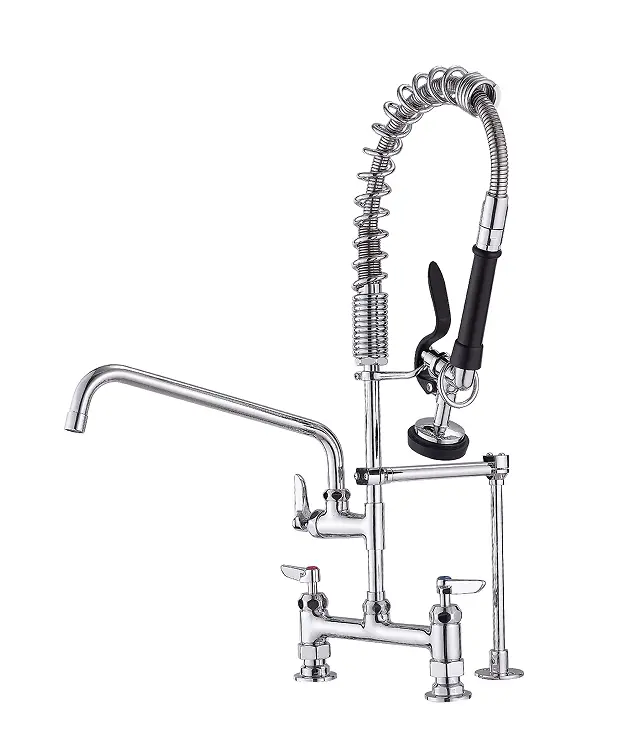
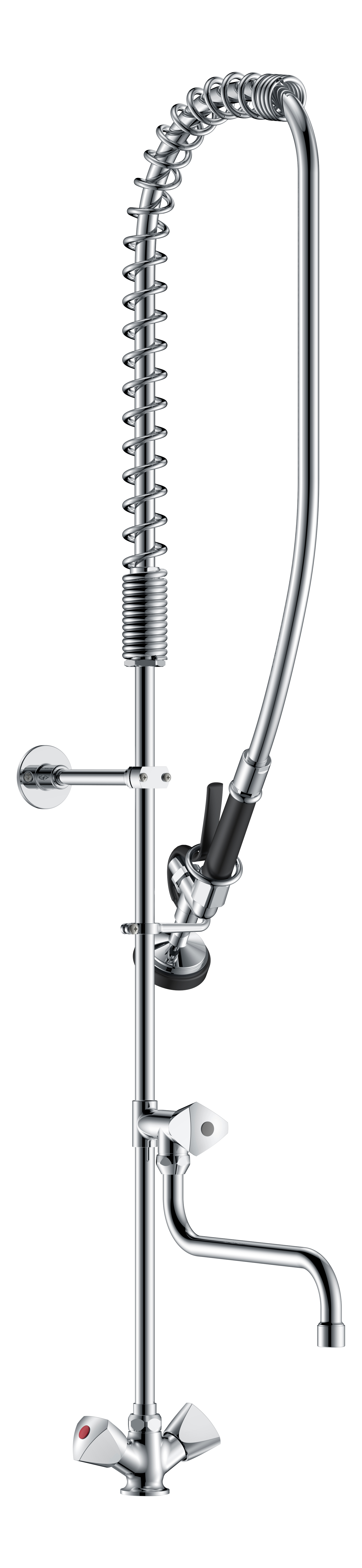
The spring-assisted upper section matters too. In practical terms, it gives flexibility without making the whole fixture feel flimsy. The exposed coil around the spray hose section suggests a design intended for repeated repositioning. That is not a cosmetic detail; it is a clue that the faucet is meant to be used by multiple people, often in a hurry, over and over again.
For buyers, the key advantage is reach. The extended spout and side spray assembly can cover more of the sink basin, which is useful when the basin is large or when work habits are messy and fast. The faucet becomes a tool, not just a water outlet.
What the visible construction tells a buyer
This type of unit is described as predominantly metal with a polished chrome or stainless-steel-like reflective finish. That matters because foodservice buyers usually want a surface that is easy to wipe down and visually straightforward to inspect. In a commercial kitchen, grime shows up quickly. A finish that resists looking dull after a short shift is often valued, even before you get into durability questions.
Visible components include a wall-mount flange, a horizontal inlet arm, a vertical support column, a curved gooseneck spout, and a lower valve body with two manual handles or knobs. There are also mounting and adjustment brackets along the column. Those parts suggest a fixture designed for installation stability and some degree of alignment control. That is useful when the sink, backsplash, or plumbing rough-in is not perfectly cooperative, which is common enough in older kitchens.
One point worth noting: the internal cartridge type, hose length, exact flow behavior, and material grade are not visible here, so those should be confirmed before purchase. In this category, the outside can look solid while the working parts vary a great deal from model to model.
Commercial kitchen faucets: the practical design trade-offs
There is a reason buyers keep returning to this family of products. The design solves several jobs at once, but it is not perfect for every site.
Strengths
The tall form gives clearance over deeper sinks and bulky containers. The pull-down or side spray function helps direct water where staff actually need it instead of forcing them to move the item around the sink. The wall-mounted setup also keeps the basin area cleaner than some deck-mounted alternatives, at least in day-to-day use, because the deck itself has fewer fixed obstructions.
The two-handle manual control at the base can be a plus in kitchens where staff want direct, familiar adjustment rather than a more complex control system. Not every operator wants extra features. Some want robust, obvious hardware that is easy to understand in a rush.
Limitations
Wall mounting reduces installation flexibility. If the plumbing rough-in is off, or if the backsplash layout is not well planned, the faucet can end up awkwardly placed. The exposed spring assembly is functional, but it also adds surfaces that collect splash residue and require regular wiping. That is not a flaw, exactly; it is the trade-off for getting reach and flexibility in a busy work zone.
Also, buyers should not assume every pull down commercial faucet behaves the same. Spray pattern, hose action, and handle feel can vary widely. A faucet that looks similar in a photo may feel very different in daily use.
Where this faucet type fits best
This configuration is most at home in commercial kitchens, restaurant prep sinks, dishwashing stations, catering areas, and other high-use wash zones. It is especially useful where large pots, trays, cutting boards, and containers need to be rinsed quickly. If the sink is part of a production line rather than a decorative front-of-house space, the tall reach and flexible spray access become more than a convenience.
It can also make sense in facilities that prefer a clear work zone around the sink. Because the faucet is mounted to the wall, the basin area stays less cluttered. That can help staff clean more efficiently, but it also helps maintenance teams inspect seals, wipe down surfaces, and notice leaks sooner.
How to evaluate a commercial faucet before buying
Buyers often get distracted by finish and shape. Those matter, but the real selection work happens around fit and function.
Check the sink and wall layout first
Measure the clearance above the basin and the distance the spout needs to reach across the sink. A tall faucet only helps if the basin geometry supports it. Also check wall structure and mounting points. A wall-mounted fixture needs a proper base and a plumbing arrangement that matches the inlet design.
Match the faucet to the task
If the station handles heavy rinse work, a flexible spray assembly is usually worth the added complexity. If the sink is used for light handwashing only, a simpler unit may be easier to maintain. In many foodservice settings, though, the rinse demand is enough to justify the more capable design.
Ask about service parts and internal components
Because the internal cartridge type and hose details are not visible, they should be confirmed with the supplier. That may sound basic, but it is where many projects go wrong. A faucet can be easy to install and still become difficult to service if replacement parts are obscure.
Confirm the cleaning routine
Exposed coils, brackets, and handles all need attention during cleaning. That does not make the product unsuitable. It just means the housekeeping plan should match the hardware. In a professional kitchen, every extra contour is another place for buildup if no one owns the cleaning schedule.
Common buyer mistakes
One common mistake is assuming all commercial kitchen faucets are interchangeable. They are not. Wall mount versus deck mount, fixed spout versus pull-down, and single-control versus two-handle operation can change the way the entire sink station functions.
Another mistake is overvaluing appearance. A polished chrome or stainless-steel-like finish can look sharp, but the actual buying decision should rest on durability, serviceability, and fit. A clean look is nice. A faucet that works without constant adjustment is better.
Finally, some buyers overlook the physical workload of the staff. If the faucet requires awkward wrist angles, too much reach, or too much repositioning, the frustration shows up quickly. In a commercial environment, small inefficiencies compound.
What sourcing teams should ask suppliers
Before approving a purchase order, it is smart to ask for the details that are not obvious from product photos: material specifications, internal valve or cartridge information, hose configuration, mounting requirements, and whether replacement parts are available. If the project has any compliance or sanitation requirements, verify those directly rather than assuming from the product category alone.
For multi-site operators, consistency matters too. The same faucet family across several kitchens can simplify maintenance and spare-parts inventory. That is one reason many operators prefer a fairly standard commercial faucet layout once they have found a workable fit.
FAQ for commercial buyers
Is a wall-mounted faucet better than a deck-mounted one?
Not always. Wall-mounted units free up the sink deck and can improve clearance, but they depend more heavily on plumbing location and wall structure. Deck-mounted designs are sometimes easier to retrofit.
Why choose a spring-coil design?
The spring coil supports flexibility and movement at the spray section. In a foodservice setting, that helps with rinsing and directional control, especially around larger sinks.
Does a reflective finish mean stainless steel?
Not necessarily. The visible finish may resemble stainless steel, but the exact material grade and finish type need to be confirmed with the supplier.
A practical next step
If you are comparing commercial faucets for a restaurant, prep kitchen, or wash station, start with the sink layout and the actual cleaning task. Then compare mounting style, spout reach, spray flexibility, and serviceability. For this type of wall-mounted pull-down unit, the visible design points to a heavy-duty foodservice application, but the final choice should still come down to installation fit and maintenance planning.
If you are building a short list, ask for the missing technical data before you commit. That one step can save a lot of installation trouble later, and in a busy kitchen, that is usually money well spent.