
What are buyers really trying to say when searching for bathroom faucet manufacturers?
When sourcing bathroom faucet manufacturers , procurement teams typically consider more than just a single product. They aim to assess a supplier's ability to consistently produce aesthetically pleasing, solid-feeling, easy-to-install, and durable products, avoiding complaints from contractors or end-users. The same principle applies to kitchen product lines: even with variations in appearance, supply chain issues are largely similar. A polished chrome double-handle faucet may seem simple, but the gap between "looking good in photos" and "reliable in actual use" is precisely where many projects fail.
This is why the buyer's intent is crucial. The decision isn't just about which faucet to buy, but also which factory can provide long-term support for the entire project. For many companies, the shortlist typically includes Chinese faucet manufacturers , brass faucet makers , or OEM faucet manufacturers capable of converting standard faucet bodies into their own branded products. Some buyers will compare kitchen and bathroom product lines side-by-side, which is reasonable; the manufacturing processes in these two areas overlap far more than one might imagine.
The product's form can tell you a lot about the supplier.
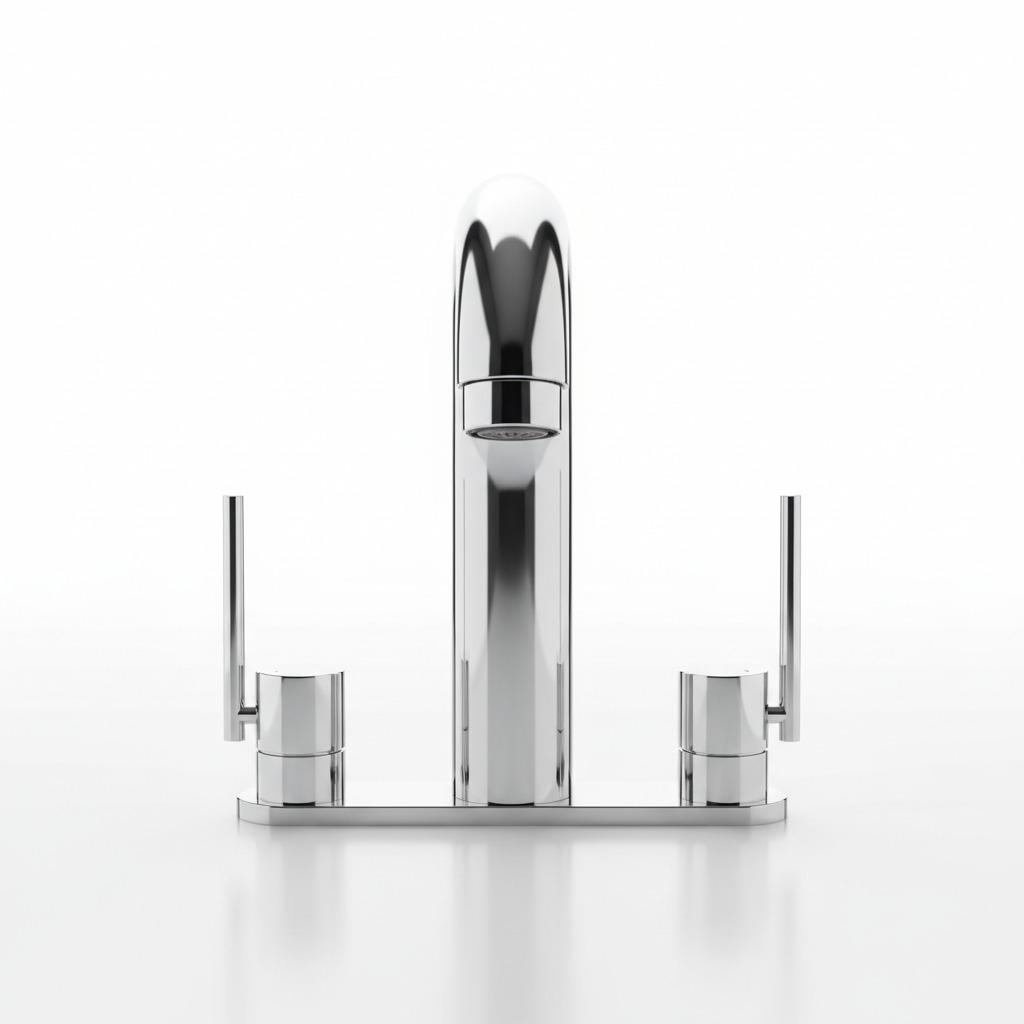
The product showcased here is a kitchen faucet with a double-handle design and a central spout. It features a symmetrical cross-shaped body, smooth cylindrical side caps, and a high-gloss chrome finish. This design combination can provide useful information for engineers or purchasing managers.
First, this design likely relies on a castable or machined metal body, which is then electroplated to enhance the appearance and protect the surface. Second, the smooth transition and rounded top cover indicate that the supplier prioritizes surface finish quality, as electroplating defects will quickly become apparent on a reflective surface. Third, a dual-handle design typically means the factory must maintain consistency in the geometry of both sides. If one handle feels loose or the angle is slightly different, the customer will immediately notice.
Kitchen products can also provide insights for choosing bathroom products. A factory capable of producing faucet bodies with a clean, symmetrical appearance and a stable chrome finish usually also possesses the process control capabilities needed to produce bathroom cooktops. Of course, this doesn't guarantee performance, but it is a useful reference point.
Quick Comparison: What Questions Should You Ask Before Approving a Faucet Supplier?
Core manufacturing capabilities
Inquire with the supplier whether the car body is manufactured using casting, machining, or a hybrid process. The specific manufacturing method affects cost, repeatability, and final quality. If they cannot clearly explain their manufacturing process, this is a warning sign.
Surface smoothness
A polished chrome finish may seem simple, but a closer look at the edges, handle base, and side panels reveals its intricacies. A good finish is not just about shine, but also about even coating, minimal visual waviness, and ease of cleaning.
OEM flexibility
If you require brand customization, packaging changes, or size adjustments, a faucet OEM manufacturer should be able to discuss mold making, sample production, and version control with you frankly. Suppliers who only sell fixed models might be able to help, but they are fundamentally different from true R&D partners.
Bathroom wiring, kitchen wiring, or both?
Many purchasing teams are too rigid in their distinction between bathroom and kitchen faucets. In reality, buyers should consider a manufacturer's production capabilities based on their product range. A kitchen faucet manufacturer capable of producing durable metal bodies and smooth chrome finishes may also produce suitable products for bathroom projects, especially where visual consistency is crucial in real estate developments or retail product lines.
That said, don't assume they're interchangeable. Bathroom faucets and kitchen faucets can differ in installation, application, ergonomic design, and user needs. Kitchen faucets often feature double handles and a central spout for easy control of sink water usage; bathroom faucets, on the other hand, may prioritize a compact size and a different aesthetic design. The safest approach is to assess the manufacturer's product range, not just the titles in a catalog.
Common procurement errors can waste time later on.
The first mistake is judging by appearance alone. A mirror-like polished surface may mask defects in process control, until the first batch of products reveals problems such as inconsistent plating or rough handle operation.
The second scenario involves focusing excessively on irrelevant details while neglecting crucial ones. While the specific valve type, valve core type, flow performance, installation method, size, and certifications are important, the right balance depends on market demand. Do not place an order hastily if the supplier cannot confirm unknown factors during the controlled sample stage.
The third misconception is assuming all metal faucet suppliers are interchangeable. While brass faucet manufacturers and general metalworkers may both produce aesthetically pleasing parts, their strengths differ. The processes required for brass valve bodies, plating quality, and long-term valve integration are entirely different from those for simple decorative metalworking.
Practical buyer advice for screening suppliers
Start with samples and documentation, then compare the items you can actually inspect: handle alignment, surface finish consistency, body symmetry, and the feel of the product. These checkpoints may not seem impressive, but they speak volumes more than fancy sales brochures.
Next, inquire about the production process behind the product. Even if the supplier doesn't disclose all the details, they should be able to describe the body structure, surface treatment processes, and quality inspection procedures in plain language. If the answers are consistently filled with marketing rhetoric, then move on to looking for other suppliers.
Finally, the end use must be considered. The requirements for faucets differ between residential kitchen sinks, utility sinks, and commercial laundry areas. The right manufacturer should be one whose production processes meet these requirements, not just one with the most attractive catalog photos.
What should we do next?
If you're building a faucet product line, product appearance can be a reference, but it's not everything. A well-made, double-handled chrome-plated faucet usually indicates solid and reliable manufacturing, but the real test lies in whether the supplier can maintain the same quality across all orders and product lines. For purchasing teams comparing bathroom faucet manufacturers, kitchen faucet manufacturers, and OEM suppliers, the wisest approach is to review samples first, and then discuss the production process. Often, it's at this stage that truly excellent factories differentiate themselves from those that merely have attractive designs.