
When Faucet Problems Start Appearing Months After Installation
Ask any distributor who has been in the plumbing business for a few years and the stories begin to sound familiar.
A shipment arrives. The faucets look perfect out of the box. Chrome shines. Handles move smoothly. Everything seems fine.
Then, six months later, complaints begin.
A hotel maintenance team reports dripping faucets. An apartment developer finds corrosion forming around the base. A retailer receives returns because the cartridge fails too early.
Most buyers initially blame installation. But in many cases, the root cause traces back to the manufacturing stage. A faucet that appears identical on the outside can perform very differently depending on materials, machining precision, and plating quality.
That is why selecting the right bathroom faucet manufacturer matters far more than choosing the lowest price. At ANQI, faucet engineering begins with the assumption that every unit will eventually face demanding environments—humid bathrooms, fluctuating water pressure, and years of daily use.
The goal is simple: faucets should perform quietly in the background of everyday life without becoming a maintenance problem.
Industry organizations such as the World Plumbing Council repeatedly emphasize that durable plumbing products depend on proper material selection, testing standards, and disciplined manufacturing processes.
What Actually Makes a Faucet Body Reliable
Many buyers assume all faucets are made the same way. In reality, the internal structure varies dramatically between factories.
A reliable bathroom faucet manufacturer typically begins with solid brass casting or stainless steel fabrication. At ANQI, most bathroom faucet bodies are produced using HPB59-1 brass, a copper alloy widely used in plumbing components because of its corrosion resistance and mechanical stability.
After casting, the faucet body moves through a series of machining stages. CNC processing ensures that internal threads, valve seats, and sealing surfaces maintain tight tolerances. Even small dimensional deviations can lead to leaks or unstable cartridge installation.
Below is a simplified comparison of common faucet materials used across the industry.
| Material | Average Lifespan | Corrosion Resistance | Structural Stability |
|---|---|---|---|
| HPB59-1 Brass | 10–15 years | High | Excellent |
| Stainless Steel 304 | 15–20 years | Very High | Excellent |
| Zinc Alloy | 5–8 years | Moderate | Medium |
Brass continues to dominate bathroom faucet production because it provides the best balance between machinability, strength, and long-term corrosion resistance.
The Ceramic Cartridge: A Small Component With Enormous Impact
Inside every faucet lies the component that ultimately determines how long the product will function without leaking: the cartridge.
Modern faucets typically rely on ceramic disc cartridges, which use polished ceramic plates to control water flow. When properly manufactured, ceramic cartridges can withstand extremely high usage cycles.
| Cartridge Type | Typical Cycle Life | Application |
|---|---|---|
| Standard ceramic cartridge | 300,000 cycles | Residential faucets |
| Premium ceramic cartridge | 500,000 cycles | Hotel / commercial faucets |
| Industrial grade cartridge | 700,000+ cycles | High-traffic environments |
At ANQI, cartridges used in our faucet assemblies are tested under repeated opening and closing cycles to simulate long-term usage conditions.
This type of durability testing aligns with guidelines promoted by the U.S. Environmental Protection Agency, which encourages water-efficient plumbing products capable of maintaining performance over extended service life.
Surface Finishing Is Where Many Faucets Quietly Fail
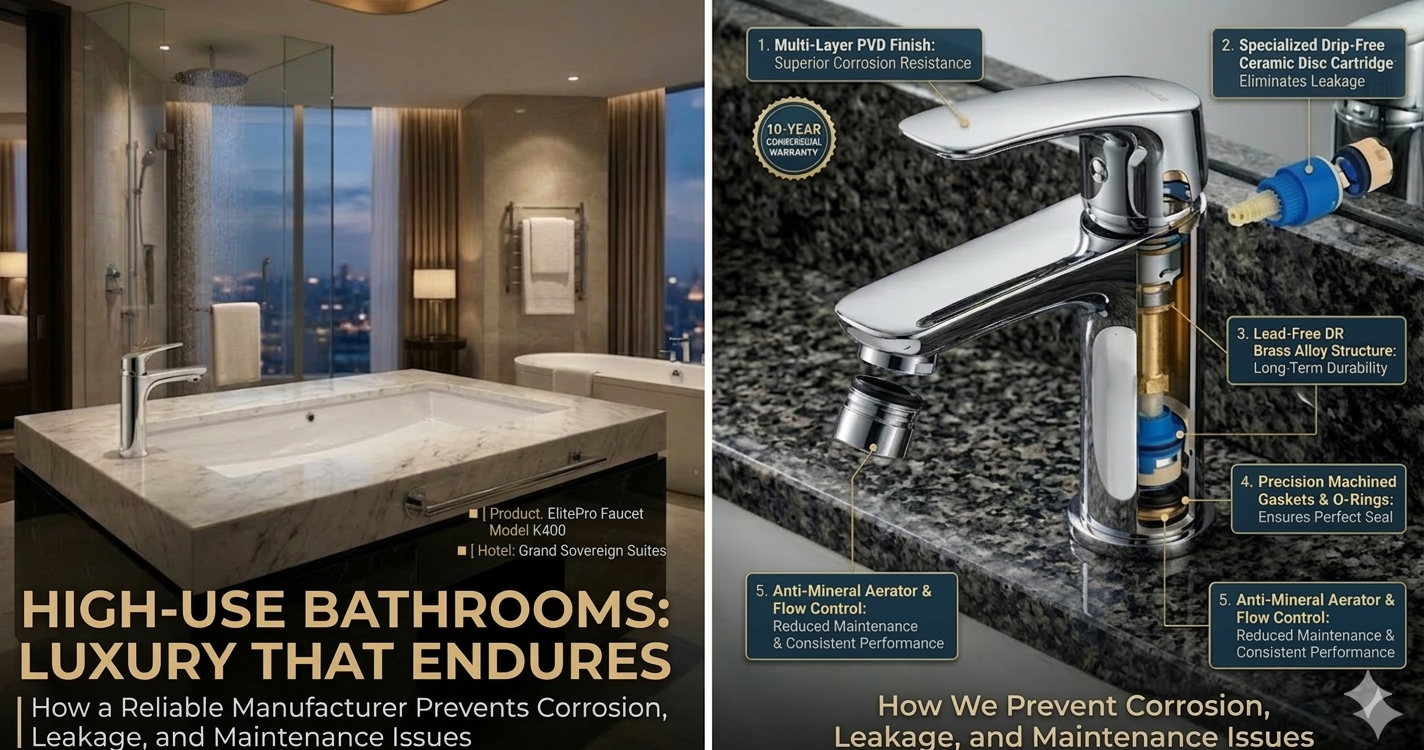
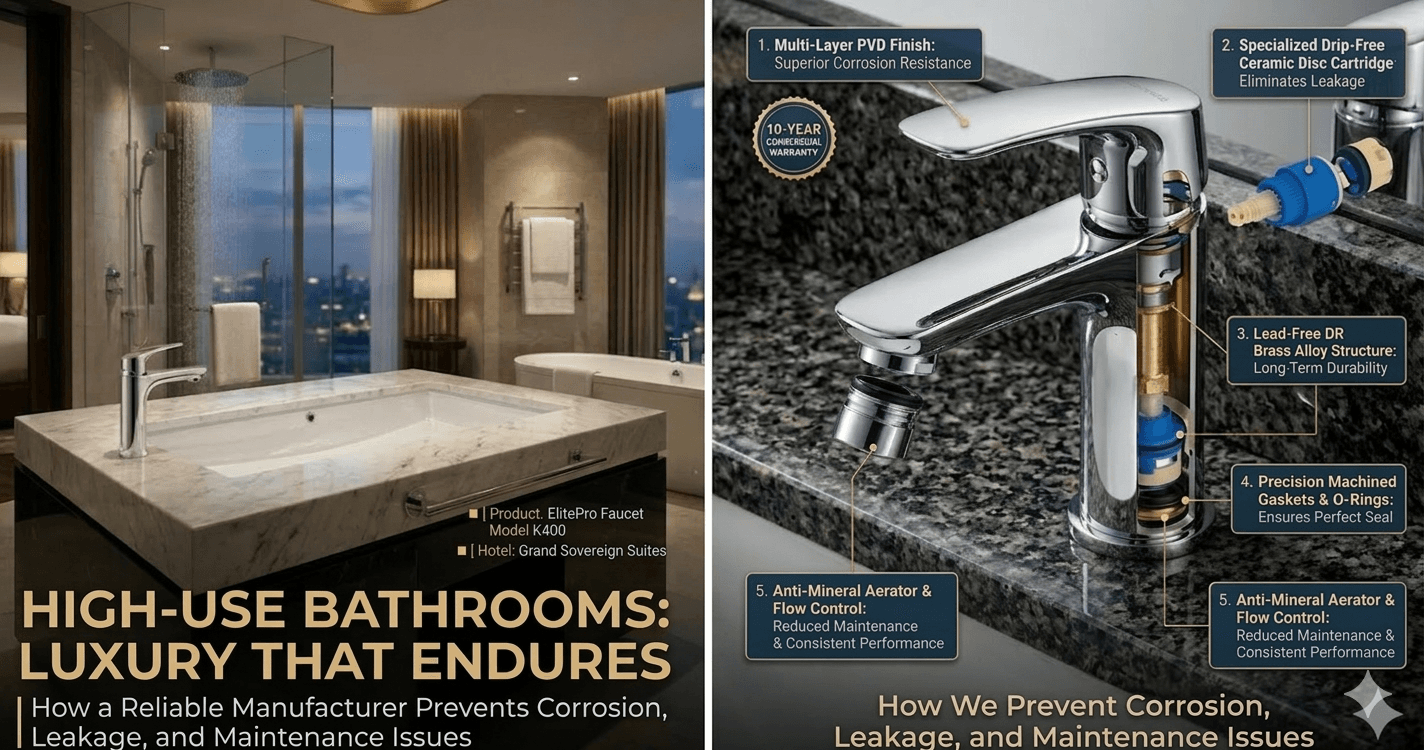
One of the most common reasons faucets begin deteriorating is inadequate plating thickness or inconsistent surface treatment.
Bathrooms are humid environments. Over time, condensation and mineral deposits can attack poorly plated surfaces.
Professional faucet factories evaluate plating durability using salt spray corrosion tests, which simulate years of moisture exposure in a controlled environment.
| Surface Finish | Salt Spray Resistance | Typical Application |
|---|---|---|
| Chrome plating | 48–72 hours | Standard faucets |
| Brushed nickel | 72–96 hours | Mid-range products |
| PVD coating | 120–200 hours | Premium faucets |
PVD coatings are particularly durable because the finish is deposited through a vacuum process that bonds metal particles to the surface at a molecular level.
While this process increases production cost, it significantly improves resistance to scratches, corrosion, and discoloration.
A Hotel Renovation Project That Changed a Distributor's Supplier Strategy
A plumbing distributor in Southeast Asia once approached ANQI during a hotel renovation project involving more than 300 guest rooms.
Their previous supplier had delivered faucets that began leaking after several months. Maintenance staff had to replace cartridges frequently, creating unnecessary operational costs.
After reviewing the installation environment, ANQI recommended a faucet configuration with:
-
solid HPB59-1 brass body
-
ceramic cartridge rated for 500,000 cycles
-
upgraded electroplating thickness
The new faucets were installed across the hotel property.
One year later, the distributor reported that maintenance calls related to faucet failures had dropped dramatically. The improvement was not due to a single feature, but rather a combination of engineering decisions made during manufacturing.
Questions Buyers Often Ask About Faucet Manufacturers
Q: How can buyers verify whether a faucet manufacturer is reliable?
A: Buyers should evaluate material specifications, cartridge brands, plating test results, and factory production capabilities rather than relying only on visual inspection.
Q: What is the expected lifespan of a high-quality bathroom faucet?
A: With proper materials and a ceramic cartridge, many faucets operate reliably for 10–15 years under normal residential conditions.
Q: Does stainless steel outperform brass in faucet production?
A: Both materials are durable. Stainless steel provides lead-free construction, while brass remains widely used due to its machining stability and corrosion resistance.
Why Long-Term Reliability Matters More Than Initial Cost
When buyers evaluate a bathroom faucet manufacturer, the temptation is often to compare prices first. But experienced distributors know that faucet reliability ultimately determines customer satisfaction, maintenance costs, and brand reputation.
Manufacturers who control casting, machining, finishing, and testing internally are far more capable of maintaining product consistency across large production volumes.
At ANQI, our engineering and production teams approach faucet manufacturing with a simple principle: every faucet should leave the factory ready for years of real-world use.
If you would like to explore our full range of faucet designs, visit the ANQI homepage:
https://www.aqbath.com/
For product inquiries, OEM discussions, or project cooperation, you can contact our team directly through the contact page:
https://www.aqbath.com/contact-us/