
Choosing a basin faucet is not just a style decision
A basin faucet looks simple enough from across the room, but the purchase decision is usually more involved than buyers expect. The wrong basin faucet can throw off the whole sink setup: water can splash the counter, the handle can feel awkward under a low cabinet, or the finish can look good on day one and tired within a season. For engineers, sourcing managers, and product teams, the real question is not whether the faucet looks attractive in a photo. It is whether the piece fits the basin, the room, the user, and the service life the project needs.
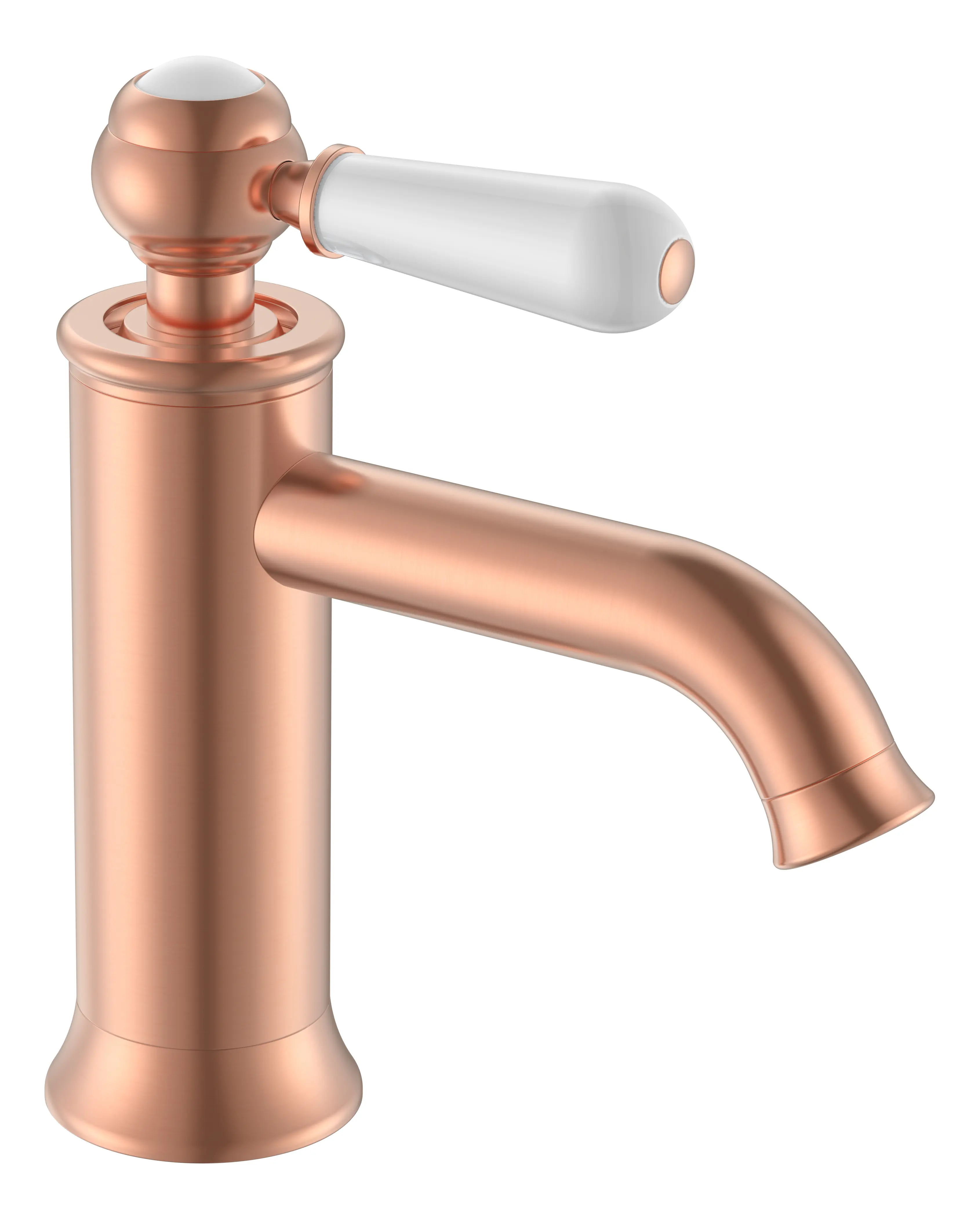
That is especially true for a single-handle bathroom sink tap with a compact cylindrical body and a rose-gold or copper-toned finish. This style has become common in residential bathrooms, hotel washrooms, vanity sinks, and light commercial spaces because it balances a clean appearance with straightforward operation. The challenge is that small visual differences often hide important practical differences. A bathroom basin faucet that suits a guest powder room may not be the best choice for a family bathroom or a high-traffic hospitality installation.
What this faucet style tells a buyer at a glance
The visible product category here is a single-handle basin faucet, sometimes called a bathroom basin faucet or basin mixer tap. From a design standpoint, the body is compact, upright, and cylindrical, with a horizontal spout that curves downward at the outlet. The handle is a white lever with a rounded end cap, which gives the fixture a softer look than the sharp, angular controls seen on many contemporary taps.
That shape matters more than it seems. A compact vertical body is often easier to place on smaller basins or vanity tops, where a long spout would dominate the surface. The single-handle layout also gives users one-handed control, which is useful in bathrooms where convenience often matters more than fine adjustment. It is the kind of fixture that can make a wash area feel intentional without becoming visually heavy.
The rose-gold or copper-colored finish is another important clue. Decorative finishes are often chosen to coordinate with mirrors, cabinet hardware, lighting frames, and accessory sets. In practice, buyers should treat finish selection as part of the room specification, not as an afterthought. A faucet that is mechanically suitable can still be the wrong choice if the tone conflicts with nearby metals or if the surface care requirements exceed the end user’s tolerance.
Where this type of basin faucet fits best
This style is usually strongest in spaces that need a neat footprint and controlled visual impact. That includes:
- Residential bathrooms with vanity basins
- Guest washrooms and powder rooms
- Hotel and hospitality wash areas
- Compact countertop sinks
- Light commercial hand-wash stations where aesthetics still matter
The moderate spout profile suggests a compromise between reach and size. It is not a tall waterfall-style piece, and it is not the ultra-low form often used for very shallow installations. That middle ground can be useful when the sink bowl is not especially deep or when the designer wants a cleaner silhouette. Still, buyers should be careful: a good-looking faucet can be a poor fit if the spout ends too close to the basin wall or too far inside the bowl. That is one of the most common avoidable problems in sink hardware selection.
How to evaluate a basin mixer tap before you commit
For project teams, the best way to assess a basin mixer tap is to separate appearance, installation, and long-term usability.
1. Match the faucet geometry to the basin
The first check is practical clearance. Even without exact dimensions, the visible profile gives a few clues. The body is compact, and the spout is neither extremely long nor unusually high. That usually makes the tap more flexible for smaller basins, but it does not eliminate the need to verify sink depth, splash zone, and handle clearance near walls or backsplashes.
If the basin is shallow, a poorly matched spout can create annoying spray outside the bowl. If the basin is deep, the faucet may still work well, but the user may need to reach farther under the spout. Small ergonomic issues become bigger complaints after installation, especially in hotels or multi-unit residential projects.
2. Look at surface finish as a maintenance decision
The copper-rose-gold finish is visually distinctive, but decorative finishes should be chosen with a realistic maintenance plan. Some end users love warm metallic tones; others are less patient with fingerprints, water spots, or the need for gentler cleaning. A finish that looks polished and premium in a showroom may require more care in a busy household bathroom.
That does not make the finish a bad choice. It simply means the buyer should think about who will clean it and how often. A hospitality project, for example, may value the visual impression enough to justify the upkeep. A high-use family bathroom may need a finish that is easier to keep consistent.
3. Confirm the handle feel and operating logic
The white lever handle suggests a user-friendly control surface, but the internal valve type is not visible from the product image. Buyers should not assume hot/cold mixing performance, cartridge type, or water-saving behavior based on appearance alone. Those details need to come from the specification sheet or supplier confirmation.
That caution sounds obvious, yet it is where procurement mistakes happen. A product can look like a premium basin faucet and still have operating characteristics that do not suit the project. If the faucet is being specified for a hotel, a clinic washroom, or a rental development, handling consistency and durability often matter more than the finish itself.
Manufacturing cues buyers can reasonably infer
The smooth, minimal exterior and cylindrical form suggest a metal body made through casting or machining followed by polishing or plated surface finishing. That is as far as one should go without supplier documentation. The product is clearly a bathroom plumbing fixture, but the substrate material, exact process route, and internal components are not visible here.
For sourcing teams, that uncertainty is not a flaw in the product image; it is a reminder to request the right documents. Ask for the body material, finish system, valve configuration, mounting details, and any test or compliance information the supplier can legitimately provide. If the faucet is intended for export or a regulated market, those checks become part of the commercial due diligence, not just technical curiosity.
Common mistakes when selecting a basin faucet
The most common mistake is buying for style first and function second. Warm metallic finishes get attention quickly, but the faucet still has to work with the basin and the user pattern. A second mistake is ignoring installation context. A countertop-mounted bathroom sink tap may be perfect on one vanity and awkward on another if the basin edge, mirror cabinet, or backsplash is too close.
Another practical issue is over-specifying appearance while under-specifying use case. A supplier can supply a visually similar faucet for residential, hotel, or light commercial settings, but the performance expectations are not the same. Frequent use changes the value equation. Handles are touched more often, surfaces need cleaning more often, and any weak point shows up sooner.
Finally, many teams underestimate how much the finish influences perceived quality. A faucet can be mechanically adequate and still disappoint if the tone clashes with the room palette. That is a buyer problem as much as a design problem, because installation teams usually have limited flexibility once the bathroom is built out.
Practical buying advice for engineering and sourcing teams
When you are evaluating a basin faucet for a project, the safest approach is to build a short checklist around the actual installation.
Confirm the basin type and available mounting space.
Check the faucet’s footprint against the sink deck and surrounding fixtures.
Verify whether the handle action and mixing function meet the project’s expectations.
Ask for finish samples or close-up images if the room depends on color coordination.
Request the non-visual technical data before approving the part for production or procurement.
This style of faucet is attractive because it is versatile, but versatility can hide ambiguity. The image tells you a lot about form and finish, but not everything about performance. A good buyer uses the image as a starting point, then treats the technical sheet as the deciding document.
FAQ
Is this type of bathroom basin faucet suitable for small washrooms?
Often yes, because the body is compact and the profile is controlled. Still, the basin dimensions and mounting clearance must be checked first.
Can I assume the faucet is a hot-and-cold basin mixer tap?
No. The single-handle layout suggests mixing is possible, but the image alone does not confirm the internal valve design or the operating range.
Is the rose-gold finish just decorative?
Primarily yes, from the image alone. It is a design and styling choice, though the exact finish system and wear behavior need supplier confirmation.
Where does this style perform best?
It tends to work well in residential bathrooms, hotel vanity areas, guest washrooms, and other spaces where compact form and visual warmth are both important.
What to ask the supplier next
If this basin faucet is under consideration for a project, the next step is to request the full technical specification, installation drawing, and finish description. Those documents will tell you what the image cannot: actual mounting method, dimensions, internal valve details, and any compliance claims the supplier is making. That is the point where style becomes a specification rather than a guess.
If you are comparing several bathroom sink tap options, put this one beside a few alternative profiles and look at the basin geometry, cleaning burden, and user handling in the same view. The right faucet usually becomes obvious once those basics are lined up.