



Pull-Down Kitchen Faucet Buying Guide for Brands and Projects
The expensive mistake usually begins with an empty sink.
A buyer reviews a handsome high-arc faucet on a white background. The quotation gives an overall height, two spray modes and a finish name. The sample feels solid, the spray head clicks into place, and the product photographs well.
Then it is installed.
The stream lands too close to the front wall of the bowl. Water bounces onto the worktop. The handle touches the backsplash. Under the sink, the hose weight collides with the trap and the spray head stops retracting after a few weeks of use.
None of those problems can be seen in a catalog image.
This pull-down kitchen faucet buying guide is written for retail brands, importers, e-commerce teams, project buyers and OEM product managers who need to evaluate the complete installation—not merely the faucet’s appearance.
Start With the Sink
A pull-down faucet is part of a working geometry that includes:
-
Sink length, width and depth
-
Number and position of bowls
-
Faucet-hole location
-
Worktop thickness
-
Backsplash or window clearance
-
Drain and waste-pipe position
-
Under-sink storage
-
Water pressure
-
The user’s normal washing tasks
The same faucet can behave well on a deep single bowl and splash badly on a shallow double bowl.
That is why experienced buyers ask for the faucet drawing and the intended sink drawing at the same time.
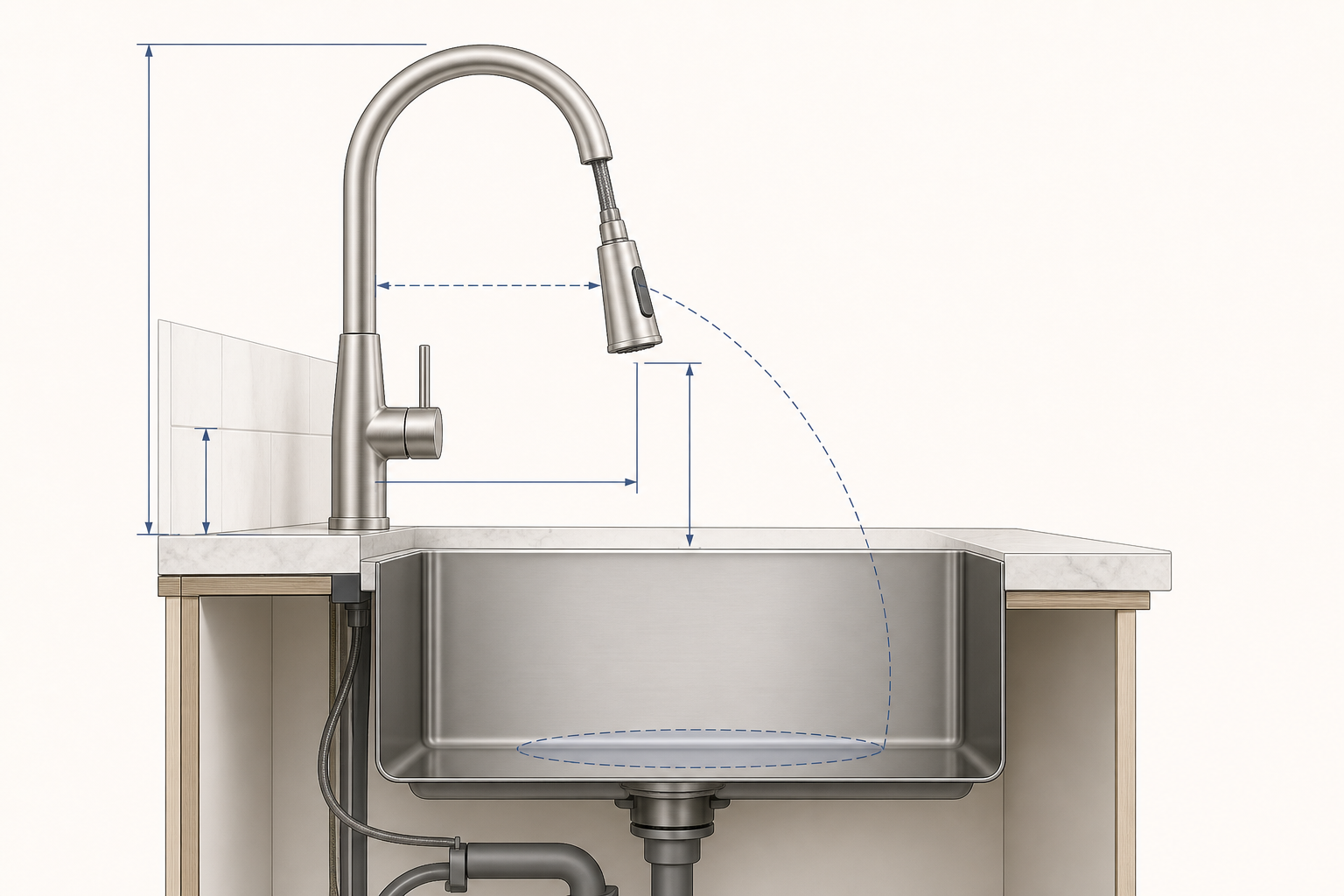
Dimensions That Belong on the Drawing
“High arc” is a style description. It is not a usable dimensional specification.
A controlled drawing should identify at least the following measurements:
| Dimension | What it affects | Common sourcing risk |
|---|---|---|
| Overall height | Cabinet, shelf and window clearance | Faucet is too tall for the installation |
| Outlet height | Space beneath the spray head | Tall pots fit, but splashing increases |
| Spout reach | Water landing position | Stream hits the front or rear wall |
| Base diameter | Appearance and mounting coverage | Base fails to cover the sink opening |
| Mounting-hole range | Sink and worktop compatibility | Installation hole is too large or small |
| Maximum deck thickness | Shank and mounting-hardware fit | Nut cannot engage securely |
| Handle clearance | Backsplash and wall operation | Handle cannot reach full travel |
| Spout swivel range | Access to one or more bowls | Spout strikes a wall or leaves the sink area |
| Hose extension | Cleaning reach | Spray head cannot reach the bowl corners |
| Required cabinet clearance | Hose and weight movement | Retraction system hits pipes or stored items |
Do not let the drawing show only the faucet’s external silhouette. The mounting shank, connectors, hoses, weight and minimum movement envelope matter just as much.
Where Should the Water Land?
Spout reach should be reviewed against the sink rather than treated as an isolated catalog number.
For ordinary stream mode, a practical starting point is to position the water landing area around the useful center of the bowl. That does not mean the geometric center is always correct. The drain location, bowl slope and typical user position also matter.
Water landing too close to the rear can make rinsing awkward. Landing too close to the front can send droplets over the edge. A tall outlet increases the distance through which water falls, which may increase splash on a shallow bowl.
The final result also depends on:
-
Flow rate
-
Supply pressure
-
Aerator construction
-
Stream coherence
-
Spray-head angle
-
Bowl depth
-
Surface shape
-
Objects placed beneath the stream
The most convincing check is simple: mount the production-intent faucet on the intended sink and run it at the expected pressure range.
A drawing review prevents obvious mismatches. A wet test exposes the rest.
High Arc Is Useful, but Not Automatically Better
High-arc faucets are popular because they create working space above the sink and give the kitchen a strong visual focal point. They can be particularly useful for deep pots, baking trays and large single-bowl sinks.
However, additional height brings trade-offs.
A high outlet can:
-
Increase visible splash
-
Interfere with shelves or open windows
-
Make the faucet look oversized on a compact sink
-
Increase leverage on the mounting point
-
Require better structural stability
-
Draw attention to spout misalignment
Compact apartments and shallow sinks do not always benefit from the tallest available model. Product selection should be proportional to the installation.
Pull-Down or Pull-Out?
The two names are sometimes used casually, but they usually describe different product layouts.
| Feature | Pull-down faucet | Pull-out faucet |
| Typical form | High-arc spout | Lower or more horizontal spout |
| Spray-head movement | Primarily downward | Primarily outward |
| Common application | Deep or medium-depth kitchen sinks | Compact sinks and restricted-height areas |
| Visual character | Architectural and prominent | Lower profile and compact |
| Main installation risk | Splash and cabinet clearance | Hose routing and forward reach |
| Main handling risk | Spray-head weight and docking | Hose twist and return alignment |
Neither design is universally superior.
A pull-down faucet normally suits buyers who want a high-arc profile and downward access into a larger bowl. A pull-out format can work well where height is limited or additional horizontal reach is more important.
Spray Modes Need a Written Definition
“Two-function spray head” sounds precise until two suppliers interpret it differently.
The specification should define:
-
Available modes
-
Spray pattern
-
Switching mechanism
-
Whether the button latches
-
Whether the selected mode is retained after shutoff
-
Default mode when water is turned on again
-
Required button force
-
Leakage permitted around the selector
-
Performance at low and high supply pressure
-
Cleaning method for the spray nozzles
The usual combination is an aerated or laminar stream plus a wider spray. Some designs add a temporary pause function or a more concentrated rinsing pattern.
More modes do not automatically create a better product. Every extra button, seal and internal passage adds another point that must remain stable during repeated use.
For e-commerce products, the operating logic should also match the listing copy. If the web page says the faucet returns to stream mode automatically, the shipped product must do that consistently.
Evaluate the Spray Pattern, Not Just the Mode Count
A spray mode should produce an even and controlled pattern.
Inspect it for:
-
Missing or crossed spray jets
-
Jets directed outside the intended cone
-
Uneven water distribution
-
Excessive mist
-
Spray drift at low pressure
-
Noise
-
Water escaping from the selector button
-
Delayed mode switching
-
Unstable switching as pressure changes
Mineral buildup can alter the pattern over time. Flexible spray nozzles may make routine cleaning easier, but their material, attachment and long-term condition still need evaluation.
A supplier-selected beauty sample may produce an excellent spray. Production inspection must confirm that ordinary units do the same.
The Hose Is a Moving Component
The pull-down hose flexes, slides and rubs every time the spray head is used. It should be treated as a wear component rather than a decorative accessory.
The specification should identify:
-
Hose length
-
Inner-tube material
-
Outer braid or protective construction
-
Connector type
-
Seal design
-
Minimum bend radius
-
Temperature and pressure rating
-
Pull-out length
-
Abrasion-control features
-
Supplier and component revision
-
Required lifecycle and pressure tests
Metal braid, polymer braid and smooth-jacket constructions can all have legitimate uses. Their noise, flexibility, abrasion behavior and appearance differ.
The buyer should focus on measurable performance instead of assuming one exterior material is always superior.
Watch the hose entry point
The hose usually passes through a guide inside the spout or faucet body. A sharp edge, rough joint or poorly aligned guide can damage the hose even when the hose itself meets its specification.
Inspect the full contact route.
Why the Spray Head Stops Returning
The user pulls the spray head out. When released, the hose weight or other return system helps draw it back toward the spout.
That sounds simple. Under the sink, it becomes a small mechanical system.
Retraction can fail when:
-
The weight is installed at the wrong point
-
The hose rubs against the cabinet wall
-
The hose loop catches a shutoff valve
-
The weight strikes the drain
-
Supply hoses cross the moving path
-
Cleaning products are stored in the movement area
-
The hose twists during use
-
Internal friction is too high
-
The spray head is too heavy
-
The final docking geometry is misaligned
The installation instructions should show where the weight belongs and how much free space the hose requires.
One illustration is not enough if several cabinet arrangements are common in the destination market. Installers may need a clear prohibited zone around the moving loop.
Counterweight, Magnetic Docking and Mechanical Retention
These features solve related but different problems.
Counterweight
The counterweight helps retract the hose. Its mass and position affect return speed and user effort.
Too little assistance leaves the spray head hanging. Too much can make the hose feel heavy to pull.
Magnetic docking
A magnet can help the spray head complete the last part of its return and remain aligned with the spout. It cannot correct a hose that is trapped behind a waste pipe.
The magnet should also be assessed for corrosion protection, retention and consistent attraction through the finish and docking components.
Mechanical retention
Some spray heads rely on a shaped seat, friction ring or mechanical interface. This can work well, but dimensional variation and wear must be controlled.
A good docking system brings the spray head home smoothly, aligns its face and keeps it seated without demanding a hard push.
What a Return Test Should Look Like
Do not test docking only from one ideal position.
Pull the hose:
-
Straight downward
-
Toward the front of the sink
-
Toward both bowl corners
-
Across a double bowl
-
To partial extension
-
To full intended extension
Then release it in a controlled manner.
Record whether the spray head:
-
Returns without assistance
-
Stops before the seat
-
Rotates during return
-
Docks in the correct orientation
-
Leaves a visible gap
-
Strikes the spout
-
Becomes slower after repeated cycles
The under-sink layout used during the test should represent a real installation, including the drain and supply valves.
The Cartridge Still Matters
The pull-down mechanism receives most of the attention, but the mixing cartridge continues to control shutoff, temperature and flow.
Buyers should verify:
-
Cartridge supplier and model
-
Operating angle
-
Handle torque
-
Temperature-control behavior
-
Shutoff leakage
-
Pressure performance
-
Lifecycle requirement
-
Replacement availability
-
Change-control procedure
A faucet can have an excellent hose and still become a warranty problem if the cartridge begins to drip or the handle torque changes noticeably between production lots.
The cartridge interface, fastening torque and internal body geometry should be controlled together.
Materials: Map the Waterway
“Stainless steel faucet” or “brass faucet” may describe the visible body without explaining the complete water path.
Request an exploded material map showing:
-
Faucet body
-
Internal waterway
-
Mixing chamber
-
Cartridge housing
-
Supply hoses
-
Pull-down hose
-
Spray-head body
-
Spray plate
-
Connectors
-
Seals
-
Aerator or flow regulator
For products intended for drinking-water use, relevant material and product requirements must be verified for the destination market.
NSF states that faucets and plumbing products intended for contact with drinking water should be tested and certified to NSF/ANSI Standard 61. Lead-content requirements may also apply under NSF/ANSI/CAN 372 or other market rules.
Component declarations should be connected to the finished model and production BOM.
Finish Consistency Is Harder on a Mixed Assembly
A pull-down faucet may combine several substrates:
-
Cast or forged body
-
Formed spout tube
-
Plastic or metal spray head
-
Flexible hose
-
Decorative button
-
Coated docking components
Nominally identical finishes can look different across these surfaces.
Compare all visible components together under controlled lighting. Check:
-
Color
-
Gloss
-
Brushing direction
-
Texture
-
Coating coverage
-
Gaps at the docking joint
-
Wear after repeated removal
-
Water spotting
-
Cleaner resistance
-
Production-lot variation
A beautifully finished body does not compensate for a spray head that is visibly warmer, darker or glossier.
Flow Rate and Market Compliance
Flow requirements vary by destination and product category.
For North American projects, ASME A112.18.1/CSA B125.1 covers plumbing supply fittings and related performance requirements. Buyers should verify the applicable edition and model-level certification or listing.
The US EPA’s kitchen faucet guidance also advises buyers to check national and local flow requirements. Importantly, the EPA states that kitchen faucets are not currently eligible for the WaterSense product label. A kitchen faucet should therefore not be marketed as a WaterSense-labeled product simply because it has a reduced flow rate.
For every destination market, confirm:
-
Rated flow and test pressure
-
Product-performance standard
-
Drinking-water requirements
-
Lead-content rules
-
Required certification or registration
-
Product and packaging markings
-
Installation-code requirements
-
Whether electronic functions introduce additional rules
Do this before packaging artwork is approved.
Sample Testing Before an OEM Order
A useful pull-down kitchen faucet buying guide should end at a test bench, not at a mood board.
The approval sample should be tested for:
Installation
-
Mounting-hole compatibility
-
Deck-thickness range
-
Nut access
-
Hose and connector routing
-
Handle clearance
-
Spout stability
Water performance
-
Static leakage
-
Dynamic leakage
-
Flow rate
-
Temperature mixing
-
Stream quality
-
Spray distribution
-
Mode switching
Moving components
-
Spout rotation
-
Hose pull force
-
Usable extension
-
Hose abrasion
-
Spray-head rotation
-
Return behavior
-
Docking alignment
-
Button cycling
Appearance
-
Finish match
-
Surface defects
-
Component gaps
-
Spray-head seating
-
Marking position
-
Cleaning condition
Testing should use a representative sink and under-cabinet arrangement. A laboratory frame with unlimited empty space can hide installation conflicts.
Production Inspection Checklist
| Inspection point | Evidence or method | Why it matters |
| Dimensions | Approved drawing and gauges | Confirms sink and worktop compatibility |
| Spout reach | Measurement from defined datums | Controls water landing position |
| Handle clearance | Installation fixture | Prevents backsplash interference |
| Flow rate | Controlled pressure and test method | Supports market and product claims |
| Spray pattern | Visual limit sample | Detects blocked or misdirected jets |
| Mode switching | Functional operation | Confirms button and valve stability |
| Hose extension | Defined pull distance | Confirms usable cleaning range |
| Return performance | Installation mockup | Detects friction and weight problems |
| Docking gap | Visual or dimensional limit | Controls appearance and retention |
| Hose routing | Under-sink fixture | Prevents collision with plumbing |
| Leakage | Pressure-test procedure | Protects against field failures |
| Finish match | Controlled lighting and samples | Controls mixed-component appearance |
| Model marking | Artwork and listing check | Supports traceability and compliance |
| Packaging | Drop and movement review | Prevents hose or spray-head damage |
The inspection plan should identify sample quantity, acceptance limits and retest rules rather than using “function normal” as the only criterion.
Questions to Put in the RFQ
Ask the supplier to provide:
-
Complete dimensional drawing
-
Recommended sink-size range
-
Faucet-hole and deck-thickness requirements
-
Spout-reach definition
-
Spray-mode operating logic
-
Pull-down hose specification
-
Hose and connector test reports
-
Counterweight installation drawing
-
Minimum under-sink clearance
-
Cartridge supplier and model
-
Wetted-part material map
-
Applicable certifications
-
Flow-rate data at agreed pressures
-
Lifecycle test plan
-
Finish limit sample
-
Replacement-part list
-
Packaging specification
-
Engineering-change procedure
A quotation that omits these details is not necessarily wrong, but it is not ready to control production.
Applying the Guide to an OEM Supplier
AQ Bath’s public manufacturing and quality overview presents faucet production, machining, polishing, electroplating, assembly and inspection capabilities. Its product range and online catalog can be used for initial model screening.
The supplied research matrix identifies models A0053-4BL and A0060-1-1 as possible references for this topic. Buyers should confirm current availability, dimensions, finishes, certification scope and production specifications directly with the supplier before publishing or ordering.
For a customized project, send the following through the AQ Bath contact page:
-
Destination market
-
Intended sink drawing
-
Target retail position
-
Finish
-
Expected volume
-
Flow requirement
-
Certification requirement
-
Preferred spray modes
-
Packaging needs
-
Required launch date
Website photographs are useful for selecting a direction. The signed drawing, approved BOM and production sample should control the order.
RFQ Wording Buyers Can Adapt
The supplier shall provide a complete technical specification for the quoted pull-down kitchen faucet, including overall height, outlet height, spout reach, base diameter, mounting-hole range, deck-thickness range, handle clearance, swivel range, hose extension and required under-sink movement envelope. The specification shall identify the spray modes, mode-switching logic, hose construction, counterweight position, docking method, cartridge, wetted materials, flow rate, applicable certifications and validation tests. Production shall remain consistent with the approved drawing, BOM and signed sample. No material, hose, cartridge, connector, spray-head or docking-system change may be made without prior written approval.
Frequently Asked Questions
1. Is a taller pull-down faucet always better?
No. Additional height can create more pot clearance, but it may increase splash or interfere with windows, shelves and cabinets.
2. How should spout reach be selected?
Review where the stream lands within the intended sink. Bowl dimensions, hole position, outlet height, flow and pressure all affect the result.
3. Why does a pull-down spray head stop retracting?
Common causes include incorrect weight position, hose friction, twisting or collision with the drain, valves, cabinet wall or stored items.
4. Is magnetic docking enough to guarantee good return?
No. A magnet can help with final seating, but the hose still needs a clear route and an effective retraction system.
5. Are more spray modes better?
Not necessarily. Additional modes add user options but also introduce more buttons, seals and internal parts that require validation.
6. Should the spray mode reset after shutoff?
That depends on the intended user experience. The required behavior should be written into the specification and checked during production.
7. What should be checked on the pull-down hose?
Verify construction, length, connectors, bend radius, pressure performance, abrasion resistance, pull force and lifecycle results.
8. Can a kitchen faucet carry the WaterSense label?
Kitchen faucets are not currently an eligible WaterSense-labeled product category, according to the US EPA.
9. Should the faucet be tested on the actual sink?
Ideally, yes. A representative sink and under-cabinet installation reveal splash, clearance and hose-routing problems that a standalone test may miss.
10. What documents should be approved before ordering?
Approve the dimensional drawing, BOM, material map, flow specification, test plan, certification evidence, finish sample, installation instructions, packaging and change-control agreement.
Conclusion
A reliable pull-down kitchen faucet buying guide should answer a practical question: how will this faucet behave after it is installed over a real sink and surrounded by real plumbing?
Begin with the sink geometry. Define the water landing area. Inspect the spray modes rather than counting them. Give the hose and counterweight a realistic movement envelope. Test docking from several positions. Then connect the approved sample to a controlled drawing and BOM.
That work is less glamorous than choosing a finish from a catalog.
It is also what separates an attractive faucet from a dependable product.