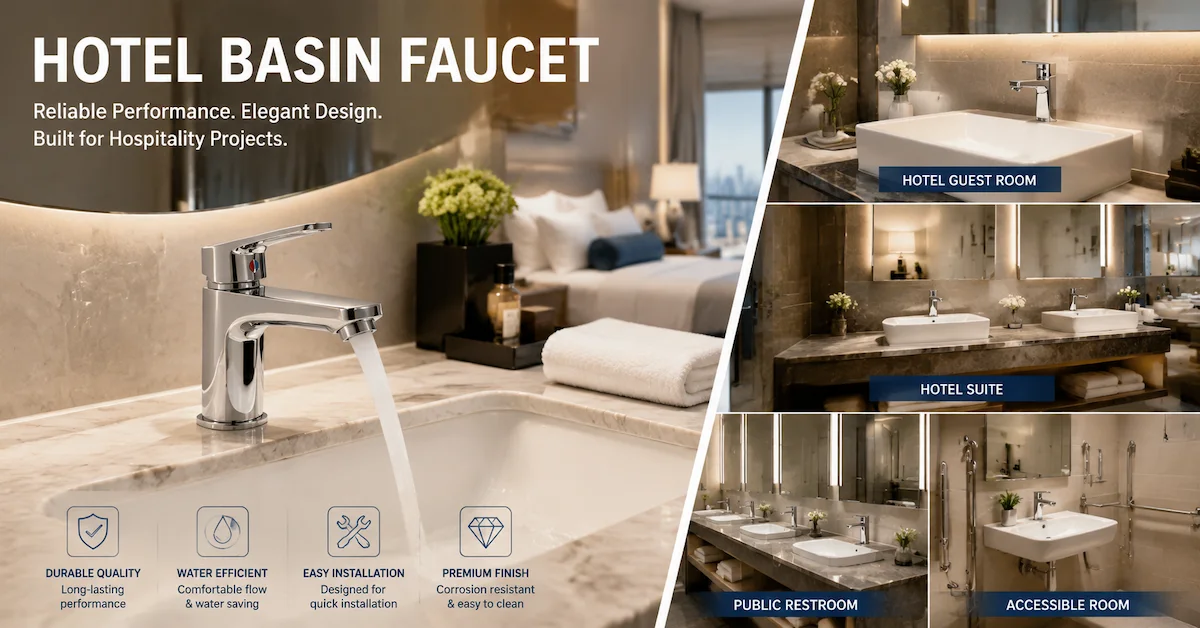


Project Grade Bathroom Faucet: Why Many Installations Fail After Handover
A project grade bathroom faucet is expected to perform not just at installation, but through years of real use.
Yet many projects encounter the same pattern: smooth samples, clean finishes, successful installation—and then, within months, complaints begin. Handles feel inconsistent. Minor leaks appear. Maintenance teams get involved sooner than planned.
The issue is rarely a single defect. It is a mismatch between product design and project reality. A faucet specified for visual approval is not automatically suitable for high-frequency, multi-user environments.
The Core Problem: Usage Intensity Meets Structural Limits
Project environments amplify stress.
- Apartments: 10–25 uses/day, moderate variability
- Hotels: 40–60 uses/day, unpredictable handling
- Commercial washrooms: 80–120 uses/day, continuous cycles
Under these conditions, three failure modes dominate:
- Base micro-movement → gradual loosening and seal fatigue
- Cartridge misalignment → uneven wear, rough control
- Seal degradation → slow leaks that escalate over time
A true project grade bathroom faucet addresses these mechanisms at the design stage, not after complaints appear.
Engineering Principles Behind Project-Grade Performance
A faucet that survives project use is engineered as a system.
Load distribution and mounting stability
Reinforced or fixed installation spreads operational force, reducing localized stress. In high-use environments, this typically delivers ~25–30% fewer loosening incidents over multi-year use.
Sealing system integrity
Multi-contact sealing and controlled compression help maintain consistent pressure under hot/cold cycles and pressure fluctuation, cutting leak-related issues by ~20–30%.
Cartridge alignment and cycle durability
Stable mounting keeps the cartridge within tolerance, extending consistent operation by ~20–25% versus standard configurations in comparable use.
Material consistency (brass bodies)
For brass bathroom faucet construction, uniform density and machining precision improve thread engagement and internal rigidity, reducing installation variance and early wear.
Project Specification vs Standard Faucets: A Data Comparison
| Factor | Standard Faucet Spec | Project Grade Bathroom Faucet | Practical Impact |
|---|---|---|---|
| Daily cycle design | 10–30 cycles | 60–120+ cycles | 2–4× higher duty capacity |
| Mounting stability | Deck-only | Reinforced / fixed-ready | ~30% fewer loosening cases |
| Seal design | Basic compression | Controlled multi-contact | 20–30% fewer leaks |
| Batch consistency | Sample-driven | Process-controlled | 15–20% fewer install issues |
| Maintenance frequency | Reactive | Reduced | 25–35% fewer service calls |
| Finish consistency | Acceptable variance | Tight tolerance | Visible mismatch reduced |
These figures represent procurement targets used by project teams to evaluate lifecycle performance, not just initial approval.
What Defines a True Project Grade Bathroom Faucet
Specification should follow application, not catalog order.
For residential developments
- Deck-mounted compatibility with common cutouts
- Stable daily operation and consistent finish
- Controlled sealing for long-term reliability
For hotel guest rooms
- Repeatable handle feel across rooms
- Resistance to frequent, varied user behavior
- Tight finish matching to maintain brand standards
For commercial facilities
- High-cycle durability for high traffic bathroom faucet conditions
- Structural reinforcement and fixed-install readiness
- Lower downtime and predictable maintenance planning
A capable bathroom faucet manufacturer aligns these requirements with design from the start.
Typical Applications Where Project-Grade Specs Matter Most
Apartment handover programs
Large-volume installs demand batch consistency. Even small variations multiply across hundreds of units. Target: 10–15% fewer post-handover replacements.
Hotel bathroom programs
Guest perception and maintenance cost intersect. A stable hotel bathroom faucet spec reduces complaints by ~20–30% and improves room uptime.
Commercial washrooms (offices, malls, airports)
Extreme usage exposes structural weaknesses quickly. A commercial bathroom faucet built to project grade can lower service calls by ~25–35%.
Renovation and retrofit projects
Compatibility is critical. Tight machining and thread accuracy reduce rework, improving install efficiency by ~10–15%.
Product Advantages That Deliver Measurable Outcomes
Reinforced structure
Limits base movement and protects internal components under repeated load.
Advanced sealing design
Maintains consistent compression, reducing leak onset across long duty cycles.
High-cycle cartridge systems
Supports tens of thousands of operations with stable control feel.
Batch-level consistency
Ensures uniform performance across large orders—critical for projects, not optional.
How to Specify the Right Project Grade Bathroom Faucet
Define usage intensity first
Match duty cycle (daily uses) to product design capacity.
Choose installation logic early
Where possible, plan for reinforced or fixed-ready mounting in high-use areas.
Set consistency criteria
Specify acceptable variance for finish, torque, and dimensions—not just appearance.
Evaluate lifecycle cost
Lower service frequency often outweighs minor unit cost differences.
Common Questions from Project Buyers
Q1. What makes a faucet “project grade”?
A: Design for higher duty cycles, reinforced mounting, controlled sealing, and batch consistency—validated beyond a single sample.
Q2. Is brass required for project use?
A: Not strictly, but brass bathroom faucet bodies typically provide better rigidity and machining stability for long-term use.
Q3. How much maintenance reduction is realistic?
A: With proper specification and installation, projects commonly see ~25–35% fewer service calls.
Specifying Project Grade Bathroom Faucets That Perform After Handover
A project grade bathroom faucet is defined by what happens after installation—when usage peaks, conditions vary, and maintenance budgets matter.
Choosing the right specification—structure, sealing, installation—turns a faucet from a potential liability into a stable, predictable component of the building.
At AQBATH, we develop project-focused faucet solutions for residential, hotel, and commercial applications, emphasizing structural stability, sealing performance, and batch consistency.
👉 Homepage: https://www.aqbath.com/
If you’re preparing specifications or evaluating suppliers for a project, aligning on usage conditions and installation requirements early can prevent downstream issues.
👉 Contact Us: https://www.aqbath.com/contact-us