
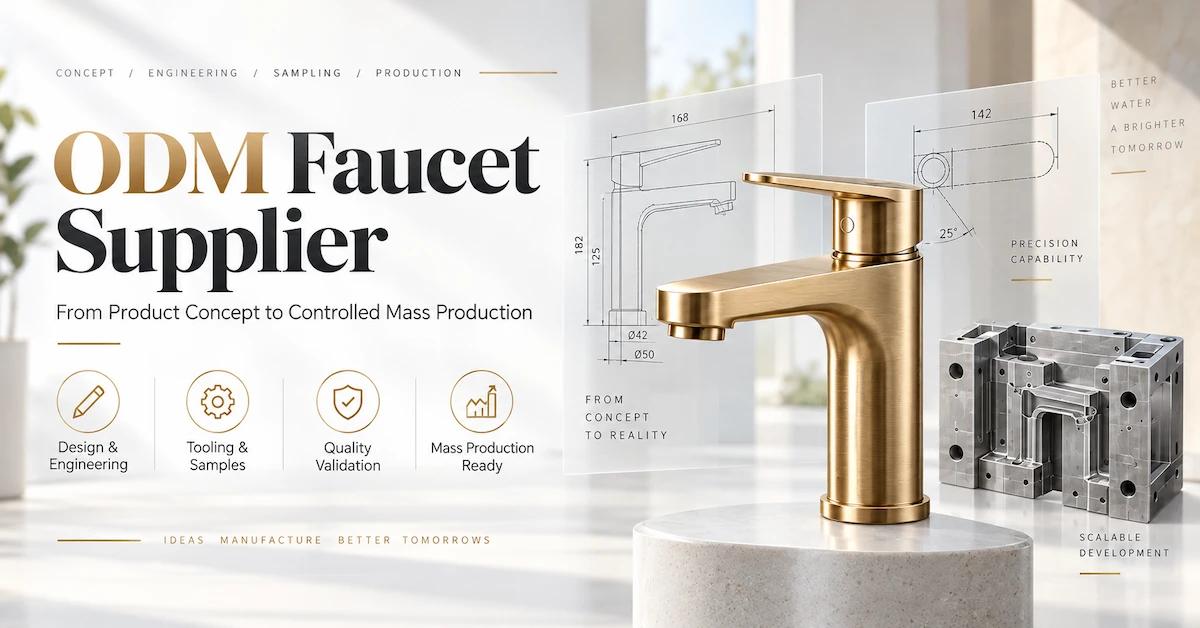
What Should an ODM Faucet Supplier Actually Do?
An ODM faucet supplier should help transform a product idea into a faucet that can be engineered, sampled, tested, manufactured, inspected, and reordered under a controlled specification.
That is different from simply choosing a catalog faucet and changing the logo or carton.
For bathroom brands, importers, distributors, hospitality suppliers, and sanitaryware companies, ODM becomes relevant when the desired product requires meaningful development work such as:
- a new appearance
- changed faucet geometry
- a new handle concept
- modified spout dimensions
- a different mounting structure
- component integration
- new tooling
- engineering validation
- coordinated product families
The commercial objective is not just to create an attractive first sample. It is to build a product platform that can survive mass production and remain consistent across future orders.
AQBATH's public manufacturing profile lists product design, mold design, mold manufacturing, casting, forging, machining, welding, pipe bending, polishing, electroplating, and several quality-testing capabilities. Buyers evaluating an ODM project can review these capabilities on the AQBATH About Us page before discussing a specific development program.
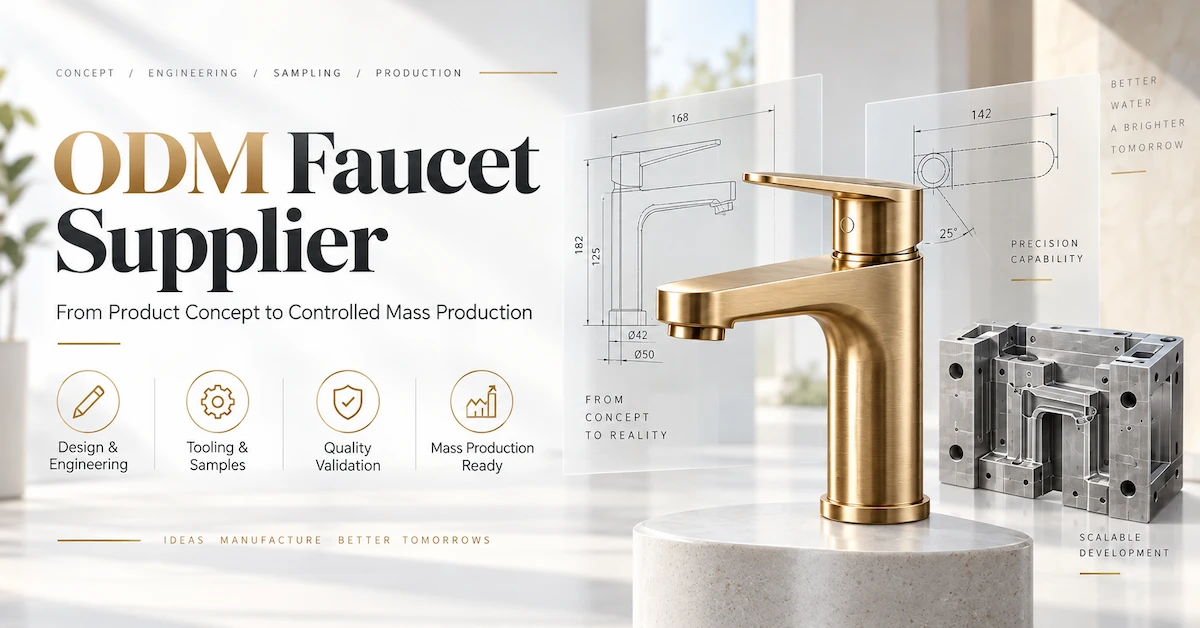
ODM vs OEM vs Private Label: Choose the Right Route First
One of the most common sourcing mistakes is using ODM, OEM, and private label as if they mean exactly the same thing.
In practice, the commercial and engineering depth can be very different.
| Development Route | Typical Scope | Development Complexity | Best For |
|---|---|---|---|
| Private label | Logo, packaging, labels, existing finish | Low | Distributors and new brands |
| OEM | Controlled configuration of an existing or defined product | Medium | Brands with clear specifications |
| ODM | Supplier-supported product development from concept or platform | Medium to high | Brands seeking differentiated products |
| New platform development | New geometry, tooling or structure | High | Established product programs |
A private-label buyer may only need a proven faucet with branded packaging.
An OEM buyer usually has a clearer product definition and wants the supplier to manufacture it consistently.
An ODM buyer often needs more development support before the final specification even exists.
If your requirement is mainly branding, finish, packaging, or component configuration, AQBATH's existing OEM faucet manufacturer guide is the more relevant sourcing path.
If your project starts with a market idea, design reference, installation problem, or new product concept that still needs engineering work, an ODM process is more appropriate.
Start ODM Development With a Product Brief, Not a Product Photo
A reference photo can communicate style, but it does not define a manufacturable faucet.
A useful ODM brief should explain what the product is expected to achieve commercially and technically.
Define the Product Position
Clarify whether the product is intended for:
- residential bathrooms
- modern vanity programs
- hotel guestrooms
- apartments
- commercial washrooms
- residential kitchens
- hospitality kitchens
- private-label retail
- distributor collections
The same visual concept may require a different structure depending on installation conditions and user environment.
Define the Target Market
The destination market can affect:
- connection requirements
- flow expectations
- material requirements
- product standards
- testing
- certification
- packaging
- instructions
Compliance therefore needs to be considered during development, not added after the design has already been frozen.
Define the Commercial Target
An ODM faucet supplier should also understand:
- target market position
- expected order volume
- annual forecast
- intended retail or project channel
- target launch schedule
- desired differentiation
- acceptable development depth
A product intended for a premium bathroom brand may justify a different tooling and finish strategy from a project faucet designed around installation efficiency and repeatability.
Choose Between Platform-Based ODM and New Product Development
ODM does not always mean starting from a blank sheet.
For many buyers, the first decision should be whether an existing faucet platform can be adapted.
AQBATH currently publishes product families covering basin faucets, kitchen faucets, commercial kitchen faucets, shower faucets, bathtub faucets, brass faucet series, and top-fixed faucet platforms.
These existing categories can be evaluated as development starting points.
Route 1: Existing Platform + Design Changes
Possible development may involve:
- finish
- handle
- spout styling
- accessories
- selected components
- branding
- packaging
Advantage: Lower development complexity.
Risk: The buyer may expect greater differentiation than the existing structure can realistically support.
Route 2: Existing Engineering Platform + New Product Appearance
The internal architecture may remain substantially proven while external geometry changes.
This can potentially reduce engineering uncertainty while allowing greater visual differentiation.
Key questions include:
- Which components can remain common?
- Which parts require new tooling?
- Does the new shape affect machining?
- Does the new spout change water delivery?
- Will the mounting structure still work?
- Does the new design affect certification scope?
Route 3: New Product Platform
This route may involve new:
- body geometry
- waterway
- mounting structure
- spout
- handle architecture
- internal components
- molds
- fixtures
It offers greater differentiation but also introduces more development cost, schedule risk, validation requirements, and change-management work.
Buyer decision: Do not pay for a fully new platform if a proven structure can achieve the product objective. But do not force major redesign onto an existing platform if the engineering compromises eliminate the intended differentiation.
Engineering Feasibility Comes Before Tooling
A rendering can look excellent and still be difficult to manufacture.
Before mold development, the ODM faucet supplier should review whether the design can be converted into a stable production part.
Typical questions include:
- Can the proposed body be cast or forged reliably?
- Can internal waterways be manufactured as designed?
- Is there enough material for machining?
- Can the spout be formed consistently?
- Are wall thicknesses practical?
- Can components be assembled without interference?
- Is the cartridge accessible?
- Can seals be installed consistently?
- Does the mounting structure fit the intended basin or sink?
- Can the surface be polished evenly?
- Are there areas that are difficult to electroplate or clean?
This stage is essentially a design-for-manufacturing review.
The objective is not to make the product easier for the factory at the expense of the design. It is to identify conflicts before tooling turns those conflicts into expensive physical parts.
Lock Faucet Geometry Around the Real Installation
ODM design should never evaluate a faucet in isolation.
For basin faucets, the project should consider:
- overall faucet height
- outlet height
- spout reach
- outlet angle
- basin dimensions
- basin depth
- drain location
- handle clearance
- mounting-hole diameter
- countertop thickness
For kitchen faucets, additional considerations may include:
- sink depth
- bowl layout
- pull-out or pull-down hose routing
- cabinet access
- backsplash clearance
- spout rotation
A faucet can pass factory functional testing and still perform poorly in the actual installation if water lands too close to the basin edge or if the handle interferes with surrounding surfaces.
When possible, ODM development should therefore use the actual basin, sink drawing, countertop drawing, or installation mock-up.
Control Materials and Components at BOM Level
“Brass faucet” is not a complete ODM specification.
The approved product definition should identify the relevant materials and components separately.
A controlled BOM may include:
- faucet body material
- spout material
- handle material
- cartridge
- aerator
- seals
- flexible hoses
- inlet connections
- mounting hardware
- decorative components
- finish specification
- accessories
AQBATH lists capabilities including brass and lead-free brass casting, zinc-alloy die casting, forging, machining, welding, pipe bending, polishing, and electroplating on its manufacturing profile.
For an ODM project, the important question is not simply whether the factory has these processes. It is which process and material apply to the exact product being developed.
That distinction prevents company-level capability from being incorrectly treated as a model-level specification.
Tooling Should Have Clear Approval Gates
Tooling is one of the points where an ODM project becomes financially harder to reverse.
Before releasing a new mold, buyers should confirm:
- final drawing revision
- key dimensions
- appearance surfaces
- internal structure
- material
- manufacturing route
- expected tool scope
- sample approval process
- responsibilities for engineering changes
The commercial agreement should also clearly define relevant tooling arrangements, including what happens if the design changes after tooling begins.
The goal is simple: tooling should begin from an approved engineering definition, not from an unfinished concept.
Do Not Treat the First Prototype as the Production Standard
The first physical sample answers an important question:
Can this concept become a real faucet?
It does not automatically answer:
Can this faucet be manufactured consistently at scale?
A strong ODM process normally separates several validation stages.
Engineering Sample
Used to verify:
- geometry
- assembly
- mechanical operation
- component fit
- waterway
- mounting
Appearance or Finish Sample
Used to verify:
- polishing quality
- color
- texture
- coating appearance
- visible surface consistency
Functional Sample
Used to confirm relevant operating performance.
Packaging Sample
Used to validate:
- product protection
- accessory organization
- labels
- instructions
- branding
- carton configuration
Each approval should have a purpose. Otherwise, a buyer can easily approve appearance while assuming engineering and packaging are also approved.
Build QC Around the New Product, Not the Old Platform
An ODM product may contain new geometry, new components, or a new production route.
That means the inspection plan may need to change.
AQBATH publicly lists quality capabilities including material spectral analysis, coating testing, 3D image measurement, hardness testing, product lifespan testing, leakage testing, and electroplating salt-spray testing.
For a specific ODM faucet, buyers should determine which checks are actually relevant and define acceptance criteria.
A useful product-control plan may include:
| Control Area | What to Verify |
|---|---|
| Incoming materials | Material/component consistency |
| Dimensions | Critical fit and installation dimensions |
| Machining | Threads, sealing surfaces, component fit |
| Surface finish | Appearance and approved finish reference |
| Assembly | Correct components and torque/fit |
| Leakage | Sealing performance |
| Function | Handle, cartridge, diverter or spray function |
| Packaging | Correct accessories and protection |
| Final inspection | Approved product configuration |
A test name alone is not enough. The ODM project should identify what is tested, when, how, and against which acceptance requirement whenever the information is commercially or technically important.
Certification Must Be Reviewed Before the Design Is Frozen
Certification is often treated as the final stage of product development.
That can create expensive problems.
If a buyer develops a product for a market with specific compliance requirements, relevant constraints should enter the ODM process early.
AQBATH's company profile lists ISO9001:2015, ISO14001:2015, cUPC, NSF, CE, WaterMark, and SNI among its certifications or certification capabilities.
However, buyers should never assume that a company-level certificate list automatically applies to every new ODM model.
For every development project, verify:
- target country
- applicable standard
- exact model
- controlled components
- certificate holder
- configuration covered
- whether design changes affect the certification scope
Important: Certification should follow the exact product configuration, not the company name alone.
Pilot Production Is the Bridge Between Sample and Mass Production
One of the biggest ODM risks is moving directly from an approved handmade or engineering sample to a large production order.
Prototype production and mass production are different environments.
A pilot run helps answer questions such as:
- Can the process reproduce the approved geometry?
- Are tolerances stable?
- Are assembly steps repeatable?
- Are surface defects appearing at production scale?
- Are fixtures sufficient?
- Is packaging efficient?
- Does inspection catch relevant defects?
- Are production documents clear?
Problems discovered during pilot production are usually easier to correct than problems discovered after a full shipment has been completed.
For a completely new structure, pilot validation may therefore be more commercially valuable than negotiating a slightly lower unit price.
Freeze a Golden Sample and Controlled Product Package
The final development output should not be a loose collection of emails.
Before mass production, create an approved product package.
Depending on the project, this can include:
- model number
- drawing revision
- BOM
- critical components
- finish reference
- approved sample
- accessories
- packaging artwork
- labels
- instructions
- inspection criteria
- certification reference
- revision history
The golden sample should represent the approved product, but the documentation behind it is equally important.
A physical sample without a controlled specification is difficult to reproduce.
A specification without an approved physical reference can also leave room for interpretation.
The strongest ODM system uses both.
ODM Faucet Cost Is More Than Unit Price
Buyers comparing ODM faucet suppliers should separate development cost from production cost.
Possible cost areas include:
| Cost Area | Why It Matters |
|---|---|
| Industrial/product design | Converts market idea into a defined concept |
| Engineering | Resolves structure and manufacturability |
| Tooling | Creates production molds or fixtures |
| Samples | Supports iterative approval |
| Finish development | Validates appearance |
| Testing | Verifies product requirements |
| Certification | Depends on market and configuration |
| Packaging development | Supports retail/project delivery |
| Pilot run | Validates production readiness |
| Unit production | Recurring manufacturing cost |
A quotation that looks cheaper may simply exclude development tasks that another supplier has already included.
For meaningful comparison, ask every ODM faucet supplier to separate:
development cost + tooling cost + sample cost + testing/certification cost + production price + packaging + commercial terms.
How to Audit an ODM Faucet Supplier Before Development
A buyer should evaluate more than the supplier's existing product catalog.
Product Development Capability
Ask whether the supplier can support:
- concept review
- drawings
- structural review
- mold development
- prototype development
- sample revisions
Manufacturing Capability
Understand which critical processes are handled directly and which depend on outside partners.
AQBATH describes an integrated process base covering product and mold development together with multiple metal-forming, machining, polishing, electroplating, and testing capabilities. Buyers can review the current company capabilities before discussing a project.
Quality Management
Ask how a new model moves from:
sample approval
→ production documentation
→ process control
→ inspection
→ shipment.
Change Control
This is especially important for ODM.
Ask:
- Who can approve component changes?
- What happens if a component is discontinued?
- Are drawing revisions recorded?
- Does the buyer receive notice before substitution?
- When is re-sampling required?
The second and fifth production orders matter just as much as the first.
What Should You Send an ODM Faucet Supplier for an Accurate RFQ?
A productive ODM inquiry should include as much of the following as possible:
- target market
- faucet application
- buyer type
- reference image or concept
- preferred existing platform, if any
- basin or sink drawing
- installation method
- desired geometry
- body/material expectations
- finish
- cartridge or valve requirements
- aerator or outlet requirements
- hose and connection requirements
- expected quantity
- annual forecast
- packaging requirements
- branding
- required standards/certifications
- target launch date
- required sample stage
- desired differentiation
Do not worry if every parameter is not finalized.
That is partly why ODM development exists.
But the supplier needs enough commercial and technical context to determine which questions should be solved first.
Buyers can begin by reviewing the AQBATH faucet product range to identify an existing platform or category that is closest to the intended product.
A Practical ODM Stage-Gate Workflow
For B2B buyers, the following structure helps prevent development decisions from becoming mixed together.
Stage 1 — Product Brief
Define market, application, buyer, positioning and development objective.
Stage 2 — Platform & Feasibility Review
Decide whether to modify an existing platform or create a new structure.
Stage 3 — Engineering Definition
Resolve geometry, materials, components, installation and manufacturing route.
Stage 4 — Tooling & Prototype
Release tooling only after the relevant engineering definition is approved.
Stage 5 — Sample Validation
Evaluate function, fit, finish, assembly and packaging separately where needed.
Stage 6 — Compliance & QC Definition
Connect the exact model to testing, certification and inspection requirements.
Stage 7 — Pilot Production
Confirm that the product can be reproduced through the intended production process.
Stage 8 — Golden Sample & Specification Freeze
Approve product, drawing, BOM, finish, packaging and inspection criteria.
Stage 9 — Mass Production
Manufacture against the controlled release.
Stage 10 — Repeat-Order Change Control
Manage component, process, finish and packaging changes through documented review.
This is where ODM creates real commercial value: the process turns a design idea into a repeatable product asset.
FAQ
1. What is an ODM faucet supplier?
An ODM faucet supplier supports product development in addition to manufacturing. Depending on the project, this can include design adaptation, engineering, structural development, mold development, prototyping, sampling, testing, packaging, and production preparation.
2. What is the difference between an OEM and ODM faucet supplier?
OEM generally starts with a more defined buyer specification or existing product configuration. ODM usually involves greater supplier participation in developing the product concept, structure, or platform. Actual service scope should always be defined project by project.
3. Does every ODM faucet require a new mold?
No. A project may use an existing faucet platform with appearance, component, or configuration changes. New tooling becomes more likely when the body geometry, spout, handle, mounting structure, or other molded/forming parts change significantly.
4. Can I start ODM development from an existing faucet?
Yes. Using an existing platform can reduce development complexity when the underlying geometry and installation already suit the intended market. AQBATH's current faucet categories can be reviewed as potential starting points.
5. What information should I provide before asking for an ODM quotation?
Provide the target market, application, reference design, expected quantity, required differentiation, installation information, material/finish expectations, compliance needs, packaging, and launch target.
6. How many sample rounds does an ODM faucet project need?
There is no universal number. The requirement depends on development depth and the issues found during engineering, appearance, functional, packaging, and pilot validation. Sample stages should be based on approval needs rather than an arbitrary number.
7. Should certification be handled after product development?
Not ideally. If the destination market has specific requirements, compliance constraints should be considered before the design is frozen because material, components, waterways, geometry, or configuration changes may affect the required evaluation.
8. What is a golden sample?
A golden sample is the approved physical reference used together with drawings, component specifications, finish references, packaging, and inspection criteria to define what mass production should reproduce.
9. Why is pilot production important for ODM faucets?
A prototype proves that a product can be made once. Pilot production helps determine whether it can be reproduced consistently using the intended manufacturing, assembly, finishing, inspection, and packaging processes.
10. How can I start an ODM faucet project with AQBATH?
Review the AQBATH product range and manufacturing capabilities, then provide your product concept, application, market, quantity, desired customization, installation requirements, and target schedule through the AQBATH project inquiry page.
Conclusion
Choosing an ODM faucet supplier is fundamentally about controlling the path from product concept to repeatable production. The strongest development process connects product positioning, engineering feasibility, materials, tooling, prototypes, QC, compliance, pilot production, golden-sample approval, and change control before a large order is released.
If you are developing a new basin, kitchen, hotel, project, or private-label faucet line, first review AQBATH's existing faucet platforms to determine whether a proven structure can shorten development. For a new concept or deeper structural customization, send your ODM faucet requirements to AQBATH for project evaluation, including your target market, reference design, quantity, installation conditions, certification needs, and launch plan.